
Ofsted and ISI reports can become significant reputation signals because they provide authoritative information about a private school’s educational provision, regulatory compliance, and standards. Reputation management strategies differ based on how inspection information is published, indexed, interpreted, and presented within search results.
Online reputation refers to the information and signals associated with a school across search engines, review platforms, news coverage, inspection publications, social media, and official websites. For private schools, inspection reports occupy a distinctive position because they represent formal external assessments rather than ordinary user-generated opinions. Their prominence in search results can therefore influence how prospective parents interpret institutional credibility. Understanding that process requires separating the substance of an inspection finding from the way search engines and users encounter it.
Why do Ofsted and ISI reports become important reputation signals?
Ofsted and ISI reports become important reputation signals because they provide structured third-party information about specific aspects of a school’s provision. Their authority differs from that of a parent review, social media comment, or promotional school webpage because inspection reports originate within formal inspection frameworks. Search engines can index these documents and associate them with the relevant school entity. Their appearance for school-name searches therefore adds an authoritative source to the SERP composition. The resulting visibility influences the information available to users evaluating the school online.
Inspection reports also contain information that users interpret according to the relevance of their search. A parent searching for a school’s academic standards encounters a different information need from someone researching safeguarding, governance, or regulatory compliance. Search engines evaluate documents against query relevance rather than assigning a universal reputation score to the school. Consequently, an inspection report becomes particularly significant when its content matches the user’s search intent. Reputation analysis therefore considers both the report’s substance and its visibility for relevant queries.
How do Ofsted and ISI reports differ from school reviews?
Ofsted and ISI reports provide formal inspection evidence, whereas school reviews represent individual experiences and opinions. Inspection documentation operates through defined assessment frameworks, while reviews vary in specificity, recency, context, and reliability. These information types therefore serve different functions within an online reputation ecosystem. A review can describe an individual experience, while an inspection report evaluates defined areas of institutional provision. Comparing them without recognising their different evidential roles creates an inaccurate assessment of reputation signals.
Their search visibility also differs according to the pages hosting the information. An inspection document hosted by an authoritative organisation can possess stronger contextual relevance for searches concerning school standards than an isolated review. Review platforms, however, can rank prominently for searches involving parent experiences or school feedback. Search engines therefore create a mixed SERP containing first-party, third-party, regulatory, and user-generated information. The overall online image emerges from this composition rather than from one source alone.
How does inspection coverage influence a school’s SERP composition?
Inspection coverage influences SERP composition by introducing authoritative documents into the set of pages available for school-related searches. A report can appear alongside the school’s official website, admissions pages, news articles, review platforms, directories, and other references. Each result contributes a distinct reputation signal according to its relevance, authority, content, and search position. Users frequently interpret prominent results before examining lower-ranking sources. This makes content visibility an important component of online perception.
Search ranking influence does not mean that an inspection report automatically outranks every other result. Ranking systems evaluate pages according to numerous signals and query-specific factors. The same report can therefore occupy different positions for different searches. A reputation audit examines these variations by mapping relevant query groups against the pages that appear for them. This provides a more precise understanding of how inspection coverage contributes to search perception.
Which has greater reputation impact: inspection findings or negative reviews?
Inspection findings and negative reviews have different forms of reputation impact, so their relative significance depends on search visibility, source authority, relevance, and context. Inspection findings carry formal evidential weight because they arise from an inspection process. Negative reviews provide user-generated perspectives that can reveal recurring themes but do not represent formal institutional assessment. A high-ranking review page can still attract substantial user attention because visibility influences exposure. Reputation evaluation therefore measures both authority and prominence rather than treating one category as universally dominant.
Sentiment distribution also affects how users interpret search results. A collection of negative reviews focusing on the same issue creates a different perception from one isolated criticism. Similarly, an inspection report containing a specific finding represents a defined assessment rather than a general statement about every aspect of school performance. Search perception emerges from the relationship between these signals. Analysing them separately before evaluating their combined effect produces a clearer reputation assessment.
Can positive school content counterbalance negative inspection coverage?

Positive and authoritative school content can provide additional context, but content enhancement does not erase or invalidate an inspection finding. Content creation operates by introducing relevant information that competes within the existing search ecosystem. A school’s curriculum pages, policies, academic information, activities, facilities, leadership information, and verified achievements can contribute additional entity context. Their effectiveness depends on relevance, authority, indexing, content quality, and search competition. This makes content enhancement a longer-term approach rather than an instant replacement mechanism.
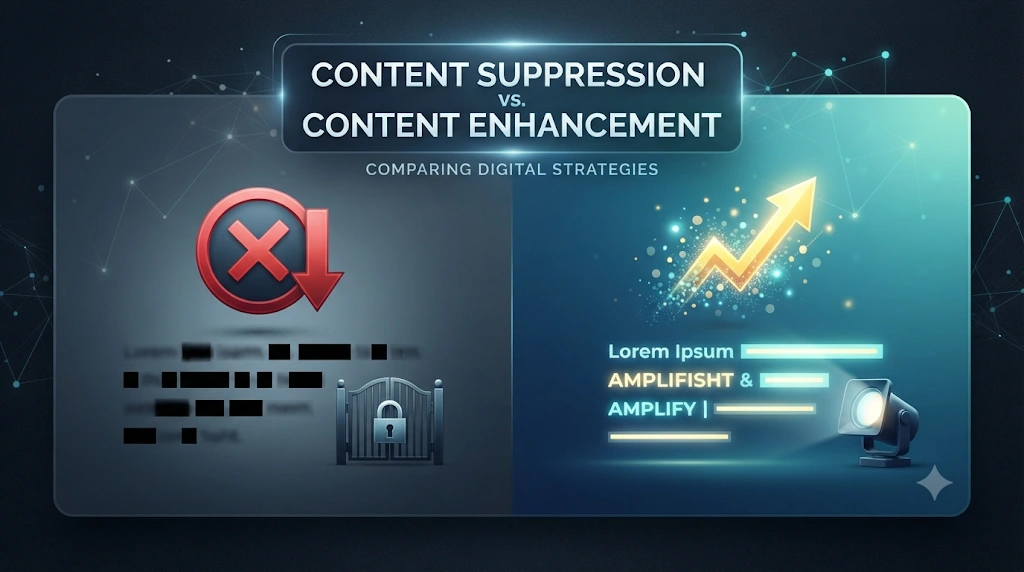
The distinction between enhancement and suppression is important. Content enhancement increases the breadth and quality of information associated with the school entity. Suppression focuses on reducing the relative prominence of particular search results through legitimate search-visibility strategies. Neither approach changes the underlying facts contained in an authoritative inspection report. The appropriate method therefore depends on whether the underlying problem concerns inaccurate information, excessive prominence, insufficient context, or legitimate public-interest reporting.
Is content removal more effective than content suppression for inspection coverage?
Content removal and content suppression address fundamentally different problems. Removal concerns the underlying source and requires an applicable basis, such as a valid correction, publisher decision, legal mechanism, or platform-specific removal process. Suppression concerns search-result prominence and does not necessarily remove the underlying page from the internet. For legitimate inspection reporting, the distinction is particularly important because public-interest information does not become removable simply because it produces an unfavourable perception. A responsible strategy therefore evaluates eligibility before considering removal.
Suppression operates through search visibility rather than deletion. Relevant authoritative pages can be strengthened so that search engines have additional information to evaluate for related queries. This process does not guarantee a particular ranking position because search results remain dynamic. The practical measure is therefore change in SERP composition, not the assumption that an individual page disappears. This distinction creates a more accurate basis for evaluating reputation-management outcomes.
How does content enhancement compare with reactive reputation management?
Content enhancement is an organic approach that develops authoritative information before or alongside reputation concerns, while reactive reputation management responds to an existing search or perception problem. Organic activity expands the school’s digital footprint by publishing useful, accurate information around relevant educational topics. Reactive activity begins with an identified reputation signal and evaluates its visibility, source, sentiment, and context. The two approaches therefore operate at different points in the reputation lifecycle.
Organic strategies generally focus on sustainability through continued information development and indexing. Reactive strategies prioritise diagnosis and response to an identifiable issue. A school with a strong existing information environment has a broader set of authoritative documents available for search engines to evaluate. A school represented predominantly by third-party or negative content has a different SERP structure requiring more extensive analysis. Comparing the approaches therefore requires examining the existing digital footprint before selecting an intervention.
Dive Deeper With Our Expert Guides:
How Does a School’s Reputation Shape Perceived Education Quality?
How Do Prep Schools Respond to Negative Reviews on Mumsnet and Google?
What role does search intent play in inspection-related reputation?
Search intent determines which inspection-related information users are attempting to find and which pages become relevant to their queries. A search for a school’s inspection rating has a different intent from a search concerning safeguarding, academic performance, or parent experiences. Search engines evaluate documents according to their relationship with the query rather than applying a fixed reputation ranking. Consequently, the same inspection report can have different visibility across different search terms.
A search-perception analysis maps these query variations to identify where inspection-related content appears. This reveals whether the report dominates school-name searches, issue-specific searches, or broader educational queries. It also identifies authoritative pages that provide relevant supplementary context. The resulting analysis demonstrates whether the reputation issue is broad or confined to a specific query cluster. Such distinction improves the accuracy of strategic evaluation.
How can schools measure the impact of inspection reports on online reputation?
Schools can measure inspection-related reputation impact through changes in search visibility, SERP composition, sentiment distribution, content indexing, and the prominence of authoritative sources. Measurement begins by establishing a baseline for relevant school-name and issue-specific searches. The baseline records which pages appear, their positions, content types, and source authority. Subsequent monitoring identifies changes following new publications, content updates, or shifts in search behaviour. This creates a measurable framework rather than relying on subjective impressions.
A structured evaluation process can:
- Map inspection-related queries to identify the searches where reports receive prominent visibility.
- Record SERP composition by categorising official, regulatory, news, review, and social results.
- Evaluate source authority by distinguishing formal inspection evidence from user-generated commentary.
- Measure sentiment distribution across prominent pages to identify recurring positive, negative, and neutral themes.
- Monitor indexing changes to determine when new or updated school information enters search results.
- Compare rankings over time to identify changes in the relative prominence of inspection coverage.
These measurements establish whether a reputation change reflects actual search-visibility movement or simply a change in user perception. They also provide evidence for determining which reputation-management approach has produced a measurable difference.
How sustainable are different approaches to inspection-related reputation?
Sustainability depends on whether the approach addresses the underlying information environment rather than focusing exclusively on one search result. Content enhancement can provide continuing value when it produces accurate, relevant, authoritative information that remains useful to users. Reactive suppression requires ongoing monitoring because search results change as new content is published and indexed. Removal, where legitimately available, addresses the source itself but does not eliminate future references to the same issue. Each mechanism therefore has a different sustainability profile.
Long-term reputation management also requires maintaining accurate institutional information. Curriculum changes, leadership updates, inspection outcomes, academic results, policies, and school activities create an evolving digital footprint. Outdated information can weaken entity clarity even when earlier content remains accurate. Regular content auditing therefore supports consistency between the school’s current provision and its online representation. Sustainability is consequently linked to information accuracy, monitoring, and continued relevance.
What is the most balanced way to evaluate inspection-related online reputation?
The most balanced evaluation combines inspection evidence with search visibility, independent sources, school information, reviews, and contextual analysis. Treating an inspection report as the complete reputation of a school ignores the broader information ecosystem. Treating it as insignificant also disregards the authority associated with formal inspection evidence. A complete evaluation recognises the report’s evidential role while examining how prominently and accurately it appears within search results.
The same principle applies to negative coverage. Negative information requires assessment based on factual accuracy, source authority, public interest, search visibility, and relevance. Where information is inaccurate and eligible for correction or removal, source-level mechanisms have a different function from search suppression. Where information is legitimate, content enhancement and contextual information represent separate mechanisms. This distinction reduces risk and creates a more transparent approach to reputation analysis.
For a deeper consideration of search visibility, how schools push down negative inspection coverage in Google search can be evaluated through the differences between content enhancement, suppression, removal, and ongoing SERP monitoring.
Ofsted and ISI reports can have a substantial role in a private school’s online image because they introduce authoritative inspection information into the search ecosystem. Their reputation impact depends not only on the findings themselves but also on indexing, search intent, source authority, ranking position, and the wider SERP composition. Reviews, school websites, news coverage, and other digital references contribute additional signals that users evaluate alongside inspection information.
The principal distinction between reputation-management approaches is mechanism. Content enhancement expands authoritative context, content suppression addresses relative search prominence, and content removal addresses the underlying source where a legitimate basis exists. Reactive strategies focus on existing reputation signals, while organic strategies build a stronger digital information environment over time.
A sustainable approach therefore depends on accurate diagnosis, evidence-based evaluation, appropriate intervention, and continuous measurement. Inspection coverage cannot be assessed solely through sentiment or ranking position. Its role becomes clearer when authority, relevance, content indexing, search visibility, and entity perception are analysed together.
How do Ofsted and ISI reports affect a private school’s online reputation?
Ofsted and ISI reports can become prominent reputation signals when parents search for a private school online. Their findings can influence perceived school quality because inspection information is authoritative, indexed and frequently associated with the school’s entity.
Do Ofsted and ISI reports appear in Google search results?
Yes, published Ofsted and ISI reports can appear in Google Search when they are relevant to a school-related query. Their visibility depends on factors such as content relevance, authority, indexing and search ranking signals.
Can a negative inspection report affect a private school’s reputation?
A negative inspection report can influence online perception when its findings become prominent within the school’s search results. The impact depends on the report’s visibility, context, recency and the surrounding reputation signals associated with the school.
How can schools manage their online reputation after an inspection report?
Schools can manage their online reputation by monitoring search results, maintaining accurate institutional information and developing authoritative content that provides relevant context. Reputation management focuses on how information is indexed, ranked and interpreted across the school’s digital footprint.
How long do Ofsted and ISI reports remain visible online?
Inspection reports can remain searchable for extended periods because published documents can continue to be indexed and referenced online. Their search prominence changes according to ranking signals, newer content, competing pages and changes within the search ecosystem.