

Parent reviews influence prep school enrolment decisions by shaping reputation signals, sentiment distribution and the perceived credibility of educational institutions within search ecosystems. Online reputation control methods are evaluated through how effectively digital information influences search visibility, entity perception and parental decision-making.
Reputation management strategies differ based on the relationship between review content, search ranking influence and institutional credibility. Parent reviews represent one component of a wider digital reputation system where search engines analyse content quality, review patterns and authority signals. Educational reputation is not created through reviews alone; it develops through the interaction between official information, external references and user-generated content. Understanding this process requires evaluating how different reputation approaches affect SERP composition, trust signals and online credibility.
How Do Parent Reviews Affect Prep School Reputation?
Parent reviews affect prep school reputation by contributing additional reputation signals that search engines evaluate alongside official educational information. Reviews provide user-generated perspectives about educational experiences, communication quality and institutional performance. Search engines interpret these signals through sentiment analysis, relevance assessment and contextual relationships with other indexed content. This creates a broader understanding of institutional identity within search ecosystems. Review content therefore influences how schools are perceived before direct engagement occurs.
Parent reviews operate differently from official school content because they represent external perceptions rather than institutional messaging. Search algorithms evaluate this distinction by comparing user-generated information with authoritative sources such as school websites, inspection reports and educational directories. Positive sentiment patterns that align with verified information strengthen entity credibility through consistent digital evidence. In contrast, inconsistent review patterns create complexity during SERP evaluation because algorithms assess conflicting signals. Reputation is therefore shaped by the relationship between multiple information sources.
Review influence depends on factors such as authenticity, relevance and consistency. A review containing detailed educational observations provides stronger contextual information than a short, unsupported statement. Search engines analyse these characteristics because useful content demonstrates clearer relationships between the reviewer, institution and topic. This evaluation process affects sentiment distribution and influences how digital reputation develops. Parent reviews therefore contribute to reputation systems through measurable information quality.
Which Reputation Signals Matter Most in Parent Reviews?
Reputation signals within parent reviews are determined by factors that demonstrate credibility, consistency and relevance. These signals include review volume, sentiment patterns, content detail and alignment with broader institutional information. Search engines evaluate these elements to understand whether online discussions accurately represent an educational entity. Strong reputation signals support clearer entity recognition because consistent information reduces uncertainty. Review analysis therefore extends beyond simple ratings and focuses on information reliability.
Search ecosystems interpret parent reviews through contextual evaluation rather than individual comments. A review mentioning specific educational factors contributes different information compared with a general opinion without supporting details. Algorithms assess these differences when determining the usefulness and relevance of indexed content. This process influences search ranking influence because reliable reputation signals provide stronger evidence of institutional credibility. Reviews therefore function as part of a wider information network.
Parent reviews also contribute to sentiment distribution, which measures the overall pattern of positive, neutral and negative opinions associated with an institution. Balanced sentiment provides search engines with broader contextual information about public perception. Extreme or inconsistent sentiment patterns require additional evaluation because algorithms compare these signals against other authoritative sources. Sentiment distribution therefore represents one measurement within a larger reputation framework.
Dive Deeper With Our Expert Guides:
How Do UK Private Schools Monitor Their Online Reputation? 7 Tools Compared
How Do Google Results Decide Which Private Schools Parents Shortlist?
How Do Search Engines Evaluate Parent Review Content?
Search engines evaluate parent review content by analysing relevance, credibility, context and relationships between information sources. Content indexing allows algorithms to identify review discussions connected to specific educational entities. Search engines then compare these discussions with official school information to establish consistency and authority. This process helps determine how strongly a school is represented within search results. Review evaluation therefore forms part of wider SERP assessment.
Algorithms analyse review content through natural language understanding, identifying topics, sentiment patterns and references to specific institutional attributes. Reviews discussing teaching quality, communication, facilities or educational outcomes create identifiable content relationships. These relationships contribute to entity perception because they provide additional context about the institution. Search engines use this information alongside other reputation signals when organising search results. Review content therefore influences digital visibility through structured evaluation.
The impact of review content differs from traditional ranking factors because reviews primarily influence perception and trust interpretation. Official pages establish institutional information, while reviews provide external validation or criticism. Search engines combine both sources to create a more complete representation of educational entities. This combination demonstrates how reputation systems operate through multiple information layers. Digital credibility develops from the interaction between controlled and independent content sources.
How Do Review Management Approaches Compare with Content Enhancement Strategies?

Review management approaches and content enhancement strategies represent two different methods for influencing educational reputation. Review management focuses on analysing, responding to and maintaining the quality of user-generated feedback. Content enhancement focuses on improving authoritative information through stronger educational content, clearer institutional documentation and improved digital consistency. Both approaches influence reputation signals, but they operate through different mechanisms within search ecosystems.
Review management operates by addressing the quality and interpretation of existing feedback. It evaluates sentiment distribution, identifies reputation risks and improves the accuracy of publicly available information. This approach provides direct insight into public perception because reviews reflect external experiences. However, its effectiveness depends on the authenticity and relevance of available review content. Review management therefore provides perception analysis but does not replace broader authority development.
Content enhancement operates by strengthening the information controlled by the institution. It improves curriculum descriptions, admissions information and educational resources that search engines use for entity evaluation. This approach creates stronger authority signals because search engines identify detailed and consistent information. However, content enhancement does not directly alter existing review sentiment. The two approaches therefore address different elements of reputation formation.
The comparison can be evaluated through:
- Analyse review management by measuring sentiment patterns, review quality and external perception indicators.
- Strengthen content enhancement by improving authoritative pages, educational information and indexed resources.
- Compare effectiveness by evaluating changes in search visibility, entity credibility and SERP composition.
Each approach contributes differently to reputation development, making evaluation dependent on the specific reputation challenge being analysed.
How Do Organic and Reactive Reputation Approaches Differ?
Organic and reactive reputation approaches differ through their timing, objectives and impact on long-term search perception. Organic reputation development focuses on continuously strengthening authority signals before significant reputation issues emerge. Reactive reputation management focuses on addressing existing reputation challenges after negative information becomes visible within search ecosystems. Both methods influence digital credibility, but their mechanisms and sustainability differ. Understanding these differences helps evaluate how reputation strategies perform within changing search environments.
Organic approaches operate by building consistent digital evidence through authoritative content, accurate institutional information and ongoing engagement with reputation signals. Search engines recognise this consistency because repeated evidence strengthens entity relationships over time. This approach supports stable search visibility by improving the overall quality of indexed information. However, organic development requires continuous management because reputation systems evolve alongside new content and changing user behaviour. Long-term effectiveness depends on maintaining authority across multiple digital sources.
Reactive approaches operate by responding to specific reputation events such as inaccurate information, harmful content or negative review patterns. These methods focus on reducing immediate reputation risks through analysis, correction or appropriate responses. Reactive strategies provide targeted solutions because they address identifiable issues affecting search perception. However, their effectiveness depends on the severity of the reputation challenge and the available response options. Reactive management therefore functions as a corrective mechanism rather than a complete reputation framework.
Which Reputation Management Method Provides Better Long-Term Search Stability?
Long-term search stability depends on the ability of a reputation approach to strengthen consistent authority signals across search ecosystems. Sustainable reputation management focuses on improving the overall digital footprint rather than targeting isolated search results. Search engines continuously evaluate content indexing, relevance and trust indicators when updating search results. A stable reputation therefore requires ongoing alignment between institutional information, external references and user-generated content.
Content enhancement strategies provide long-term stability by increasing the amount of authoritative information available for search evaluation. Detailed educational resources, accurate institutional pages and recognised references create stronger foundations for entity credibility. These assets remain valuable because they continue supporting search interpretation after initial publication. However, content enhancement alone does not address every reputation challenge because external perceptions remain an independent factor.
Review-focused strategies provide valuable insight into public perception because they identify how external audiences interpret institutional performance. They support reputation analysis by revealing sentiment patterns and areas requiring attention. However, review-focused methods depend on continuous monitoring because new feedback changes the overall reputation landscape. Long-term stability therefore requires a combination of authoritative information and accurate perception management.
How Does Negative Review Content Influence Prep School SERP Composition?
Negative review content influences prep school SERP composition by introducing additional information that search engines evaluate when determining relevance and credibility. Search results represent a combination of indexed pages, review content, institutional references and authority signals. Negative content does not operate independently because algorithms analyse its context, reliability and relationship with other information. SERP composition therefore develops through the combined evaluation of positive, neutral and negative digital evidence.
Content suppression and content enhancement represent different methods of influencing SERP composition. Content suppression focuses on reducing the visibility impact of harmful or inaccurate information through appropriate digital strategies. Content enhancement focuses on increasing the visibility of authoritative information that provides stronger contextual evidence. These approaches differ because one manages existing visibility challenges while the other strengthens competing authority signals.
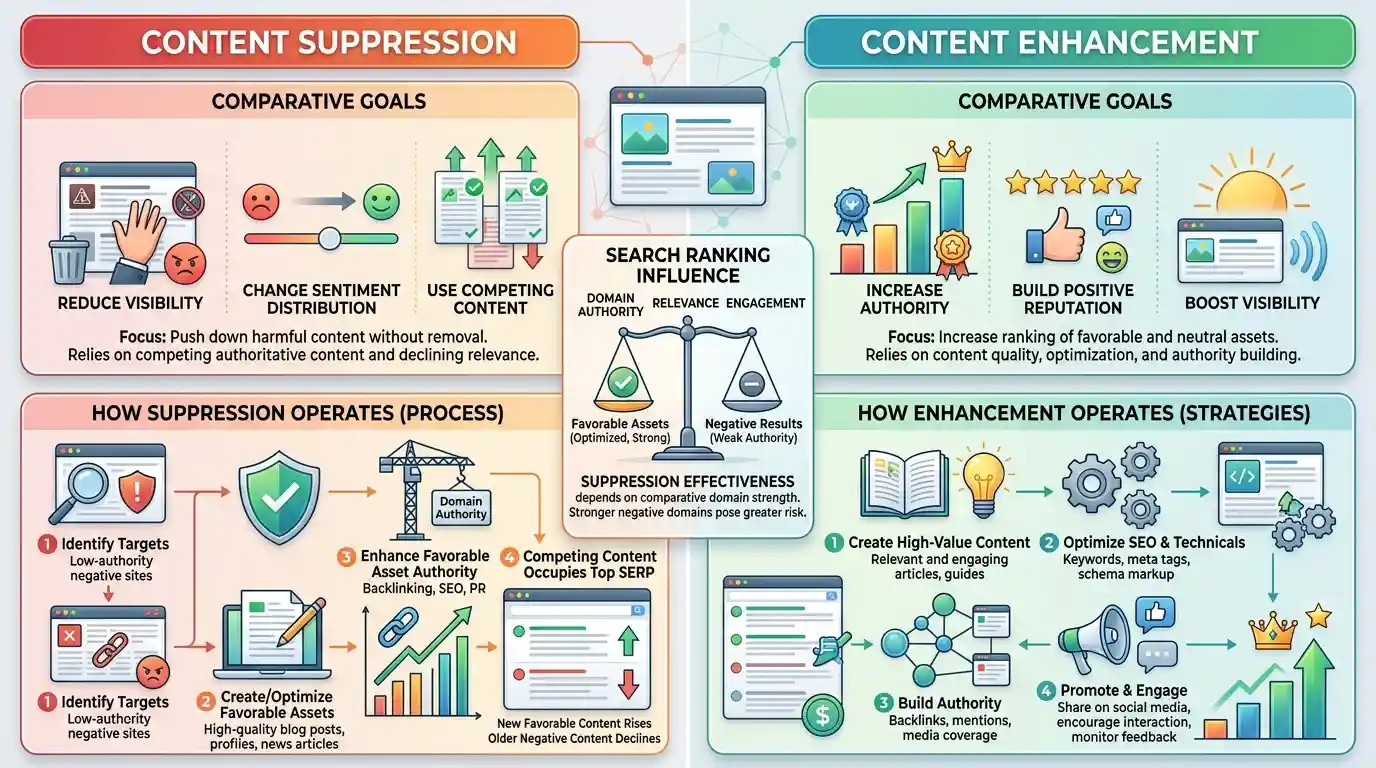
The effectiveness of either method depends on factors such as content accuracy, platform policies and search ecosystem behaviour. Search engines prioritise relevance and reliability, meaning reputation strategies require alignment with evaluation systems. Improving search perception involves understanding how algorithms interpret competing information sources. SERP control therefore develops through structured management of digital evidence rather than simple removal attempts.
What Factors Determine the Effectiveness of Parent Review Reputation Strategies?
The effectiveness of parent review reputation strategies is determined by relevance, scalability, risk exposure and sustainability. Reputation systems evaluate multiple information sources, meaning successful approaches require understanding how different signals interact. A strategy that improves one area of reputation while neglecting another creates incomplete digital representation. Effective evaluation therefore considers both immediate influence and long-term search stability.
Key evaluation factors include:
- Measure effectiveness by analysing changes in sentiment distribution, search visibility and public perception indicators.
- Evaluate scalability by examining whether reputation methods remain effective as review volume and digital presence increase.
- Assess risk exposure by identifying potential conflicts between review content, institutional information and search interpretation.
- Monitor sustainability by measuring whether improvements continue supporting entity credibility over time.
Each factor demonstrates that reputation management is a continuous evaluation process rather than a single adjustment. Search ecosystems require consistent information quality because algorithms repeatedly reassess digital evidence. Reputation strategies therefore achieve stronger outcomes when they align with long-term search behaviour.
How Can Prep Schools Evaluate Reputation Management Options?
Prep schools evaluate reputation management options by comparing how each approach influences search visibility, trust signals and institutional credibility. Different methods provide different advantages depending on whether the focus is prevention, correction or authority development. Evaluation requires analysing how strategies interact with search algorithms, review platforms and public perception. This creates a structured framework for understanding reputation performance.
A comprehensive evaluation considers the relationship between controlled content and external information. Official educational content provides foundational authority, while parent reviews provide independent perception signals. Search engines combine both sources during entity evaluation, creating a complex reputation environment. Understanding this relationship allows schools to assess whether a strategy improves digital consistency and reduces reputation uncertainty.
When evaluating reputation risks connected to reviews, understanding prep schools remove fake or defamatory Google reviews provides additional insight into how review-related challenges are assessed within search ecosystems. This evaluation focuses on content accuracy, platform processes and the difference between legitimate criticism and harmful information. Reputation approaches therefore require analysis of both visibility management and information reliability.
Parent reviews influence prep school enrolment decisions by contributing reputation signals, sentiment distribution and external perceptions within search ecosystems. Their impact depends on how search engines evaluate review content alongside authoritative educational information, digital footprints and institutional references.
Different reputation management approaches provide different benefits and limitations. Review management focuses on external perception, while content enhancement strengthens authoritative information. Organic strategies support long-term stability, while reactive approaches address immediate reputation challenges. Effective evaluation requires understanding search ranking influence, entity credibility and SERP composition.
A balanced reputation framework analyses how information is created, interpreted and ranked. By evaluating review signals, content quality and digital consistency, educational institutions gain clearer insight into how online reputation develops within modern search environments.
How do parent reviews influence prep school enrolment decisions?
Parent reviews influence prep school enrolment decisions by shaping online reputation, sentiment distribution and perceptions of educational quality. Families often evaluate review signals alongside curriculum information, inspection reports and official school content before making decisions.
Do parent reviews affect a prep school’s online reputation?
Yes, parent reviews contribute to a prep school’s online reputation by providing external reputation signals that search engines analyse with other digital information. Review patterns can influence entity credibility and how the school is perceived within search results.
How do search engines evaluate parent reviews for schools?
Search engines evaluate parent reviews by analysing relevance, sentiment, authenticity and connections with other indexed educational information. These signals help determine how a school’s reputation is represented across search engine results pages (SERPs).
Can negative parent reviews impact prep school enrolment?
Negative parent reviews can influence enrolment decisions by affecting sentiment distribution and public perception. Their impact depends on factors such as review credibility, context and how they compare with broader reputation signals.
How can prep schools improve their online reputation from parent feedback?
Prep schools improve their online reputation by analysing review patterns, maintaining accurate digital information and strengthening authoritative content. A balanced approach helps improve search visibility and supports stronger entity credibility within search ecosystems.