
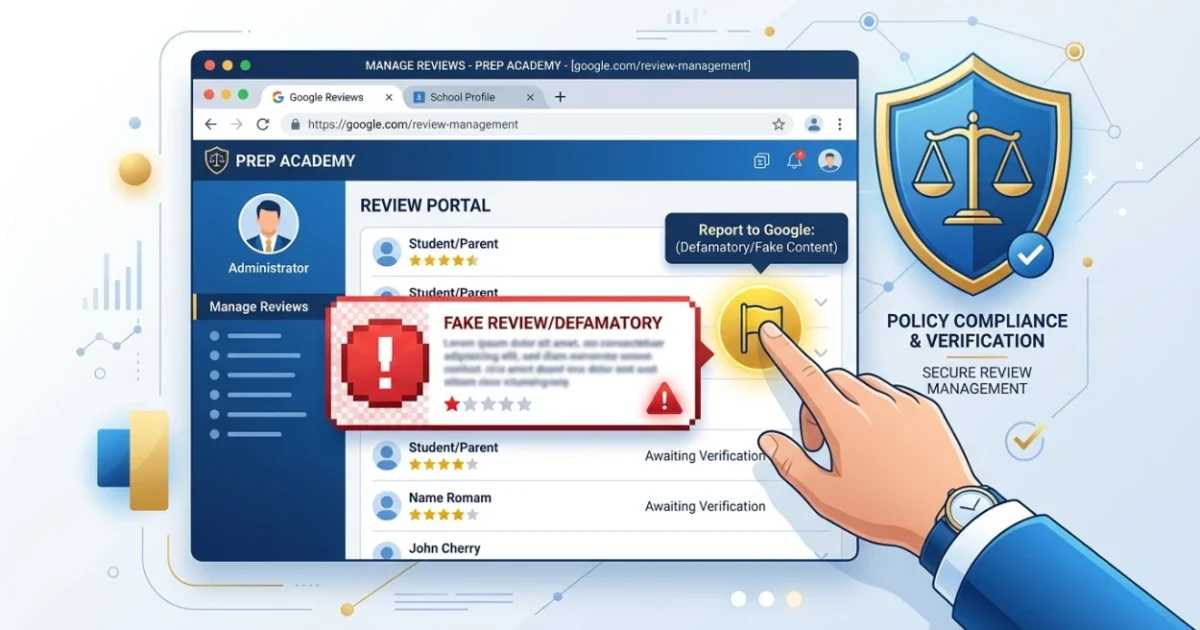
Prep schools remove fake or defamatory Google reviews through structured reputation management processes that evaluate content accuracy, platform policies and search visibility impact. Effective review management strengthens reputation signals, protects entity credibility and improves SERP control when inaccurate information affects public perception.
Reputation management for private schools focuses on controlling how educational institutions are represented across search ecosystems. Google reviews influence parental decision-making because search users evaluate visible reputation signals before engaging with a school. Fake or defamatory reviews create reputation risks by introducing inaccurate information that affects sentiment distribution and search perception influence. A structured approach analyses review validity, platform requirements and broader digital context to reduce the impact of harmful content. This ensures reputation decisions are based on evidence, compliance and long-term credibility.
Which Reputation Management Approach Removes Harmful Google Reviews Effectively?
A structured reputation management approach removes harmful Google reviews by combining review analysis, policy evaluation and appropriate removal processes. Effective management begins by identifying whether review content violates platform guidelines, contains false claims or misrepresents an educational institution. This evaluation creates a clear distinction between legitimate criticism and content that damages reputation through inaccurate information. Search ecosystems rely on information quality, making review accuracy an important factor in digital credibility. A precise approach therefore protects reputation while maintaining trust in authentic feedback.
Review removal is not based on eliminating negative opinions but on addressing content that breaches established standards. Google evaluates reviews according to factors such as authenticity, relevance and compliance with review policies. Reputation management processes analyse these elements before determining the appropriate response. This protects schools from relying on unsupported claims while preserving genuine parent feedback. The outcome is stronger SERP control through accurate representation.
Clear My Name applies evidence-based reputation management principles by analysing harmful review patterns, identifying reputation risks and developing structured responses aligned with search ecosystem requirements. This approach improves visibility control by ensuring search results reflect reliable information rather than misleading content. Reputation protection therefore depends on process clarity, documentation and accurate evaluation. The effectiveness of review management comes from systematic analysis rather than immediate removal assumptions.
How Does Negative Content Suppression Improve Prep School Search Visibility?
Negative content suppression improves prep school search visibility by reducing the prominence of harmful information while strengthening authoritative digital assets. Search engines evaluate the overall balance of indexed content when presenting results to users. When inaccurate reviews gain visibility, they influence search perception by creating an incomplete representation of institutional credibility. Negative content suppression focuses on improving SERP composition through ethical visibility management. The goal is to strengthen accurate information rather than manipulate search systems.
Search engines interpret reputation through multiple signals, including review sentiment, authority indicators and content relevance. Negative reviews with inaccurate claims can affect entity perception because they introduce conflicting information about an institution. Suppression strategies work by improving the visibility of trusted sources that provide stronger contextual evidence. These sources include official school information, educational references and verified institutional content. This creates a more balanced search environment supported by reliable information.
The effectiveness of negative content suppression depends on the strength of existing reputation signals and the quality of authoritative content available. Schools with consistent digital footprints benefit from stronger entity credibility because search engines identify clearer relationships between institutional information. Improving these relationships stabilises perception and reduces the influence of inaccurate content. Reputation management therefore operates through long-term search ecosystem principles.
Which Process Determines Whether a Google Review Is Fake or Defamatory?
A review assessment process determines whether Google review content is fake or defamatory by analysing authenticity, evidence and compliance factors. Fake reviews are identified through indicators such as misleading identity, fabricated experiences or coordinated activity. Defamatory content involves false statements presented as facts that negatively affect reputation. Both require careful evaluation because genuine criticism and harmful misinformation are treated differently within reputation systems.
The assessment process includes:
- Analyse review content by examining factual claims, language patterns and relevance to the educational institution.
- Evaluate policy compliance by comparing the review against platform standards for prohibited or misleading content.
- Document evidence by recording information that supports review reporting and reputation analysis.
- Measure impact by assessing how the review affects search visibility, sentiment distribution and public perception.
This structured evaluation improves decision accuracy because reputation actions rely on evidence rather than assumptions. Search engines prioritise trustworthy information, meaning review management requires alignment with content quality principles. A documented process strengthens reliability and supports sustainable reputation protection.
Why Is SERP Control Important for Independent Prep Schools?
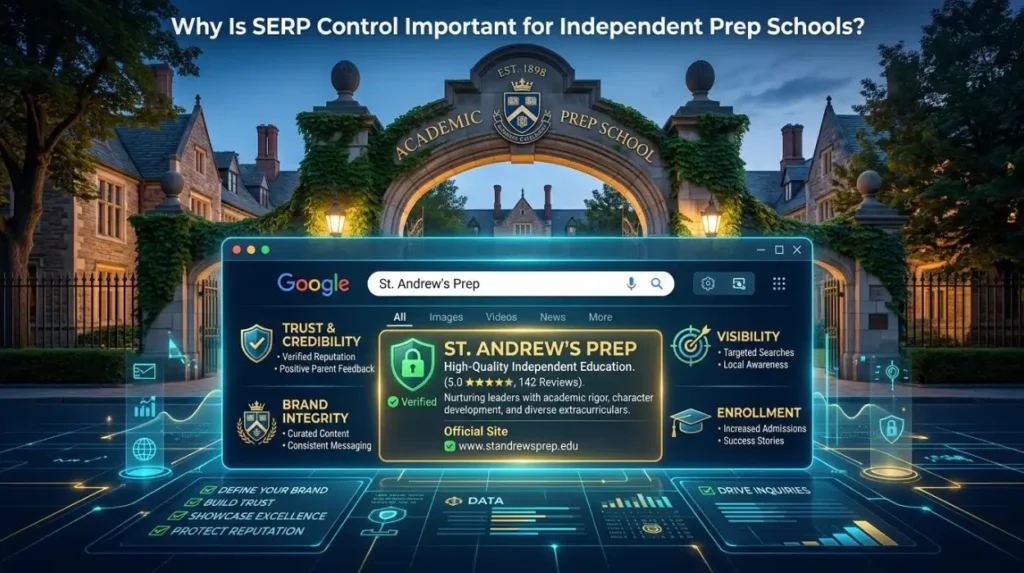
SERP control is important for independent prep schools because search results influence how prospective parents interpret institutional credibility. Before contacting a school, families often review online information, including official pages, educational references and parent feedback. Search results therefore function as a digital representation of school identity. Managing this environment ensures reputation signals accurately reflect institutional quality and authority. SERP control supports stronger trust formation during online research.
Search perception influence develops through the interaction between visible content and user interpretation. A single negative review with inaccurate information can affect perception if it appears prominently in search results. Reputation management addresses this challenge by strengthening authoritative information and improving content visibility. This process supports a more accurate digital representation of the institution. Search engines then receive clearer signals regarding entity credibility.
Independent prep schools require reputation strategies that balance transparency with protection against harmful misinformation. Authentic feedback contributes valuable insight, while false or defamatory reviews create unnecessary reputation risks. SERP control ensures search results maintain a balanced representation based on reliable information. This improves confidence by reducing uncertainty during parental research.
Which Reputation Management Methods Deliver Sustainable Results?
Sustainable reputation management methods deliver results by improving the quality, consistency and authority of information available within search ecosystems. Short-term actions focused only on individual reviews provide limited protection because search engines continuously evaluate new content and reputation signals. A sustainable approach strengthens the complete digital footprint of a prep school through accurate information, trusted references and improved content visibility. This creates stronger entity credibility over time. Long-term reputation protection therefore depends on continuous optimisation rather than isolated responses.
Different reputation management methods provide different outcomes depending on the type of reputation challenge. Review monitoring focuses on identifying sentiment changes and emerging risks, while content enhancement strengthens authoritative information that supports search interpretation. Negative content suppression addresses harmful visibility by improving the balance of indexed results. Each method contributes differently to SERP control and public perception. Effective strategies evaluate the relationship between immediate reputation risks and long-term digital authority.
The key differences between approaches include:
- Monitor reviews by tracking sentiment distribution, emerging concerns and changes in public perception.
- Strengthen authoritative content by improving institutional information that supports search engine evaluation.
- Address harmful content by applying appropriate reporting processes for policy violations.
- Maintain reputation consistency through continuous analysis of search visibility and reputation signals.
A sustainable framework combines these methods because search ecosystems evaluate multiple sources simultaneously. Strong reputation outcomes develop when accurate institutional information and external perception signals remain aligned. This improves trust signals while reducing the influence of misleading content.
Dive Deeper With Our Expert Guides:
Reputation Management Software vs Agency: Which Works for Private Schools?
What Does a Private School Reputation Audit Include? Free Audit Explained
How Does Reputation Management Protect Parent Trust During Enrolment Decisions?
Reputation management protects parent trust by improving the accuracy of information available during online research. Parents evaluating prep schools use search results, reviews and educational information to understand institutional credibility before making enrolment decisions. Reputation signals influence this evaluation because they provide evidence about public perception and organisational reliability. Managing these signals ensures digital information represents the institution accurately. Trust therefore develops through consistent and reliable search visibility.
Parent decision-making is influenced by both positive and negative reputation indicators. A strong digital presence supported by authoritative content improves confidence because search users encounter consistent institutional information. Negative or misleading reviews create uncertainty when they appear without supporting context. Reputation management reduces this risk by improving SERP composition and strengthening reliable information sources. This creates a clearer understanding of institutional identity.
Clear My Name supports reputation management for private schools through structured processes designed to improve digital credibility and search visibility. The approach focuses on evidence analysis, content evaluation and reputation signal improvement. This creates stronger control over how educational institutions appear within search ecosystems. Reputation protection therefore becomes a measurable process based on visibility, trust and information accuracy.
Which Factors Determine the Value of Reputation Management for Prep Schools?
The value of reputation management for prep schools is determined by its ability to reduce reputation risk, improve search visibility and strengthen long-term digital credibility. Cost evaluation extends beyond immediate review challenges because online reputation affects how institutions are assessed over time. A single harmful search result can influence perception during important decision stages. Investing in reputation stability therefore focuses on protecting institutional trust and maintaining accurate digital representation.
Reputation management creates measurable value through improvements in:
- Improving search visibility by strengthening authoritative content that supports stronger SERP positions.
- Reducing reputation risk by identifying harmful information and applying evidence-based response methods.
- Strengthening entity credibility by maintaining consistent educational information across trusted sources.
- Stabilising perception by balancing user-generated content with verified institutional evidence.
These outcomes demonstrate that reputation management functions as a long-term credibility system rather than a temporary corrective measure. Search engines continuously reassess information quality, making sustainable optimisation essential for maintaining visibility. The value comes from reducing uncertainty and strengthening trust signals throughout the search journey.
How Can Prep Schools Build Stronger Control Over Their Digital Reputation?
Prep schools build stronger digital reputation control by combining accurate information management, review analysis and continuous search monitoring. A controlled digital reputation requires alignment between institutional content, external references and user-generated feedback. Search engines evaluate these relationships when determining entity credibility and ranking relevance. Strong digital control therefore depends on consistent information across the entire search ecosystem.
The process requires understanding how different content types influence search perception. Official school pages communicate institutional identity, while parent reviews provide external validation or criticism. Educational references and trusted sources contribute additional authority signals. Together, these elements create the complete digital footprint evaluated by search engines. Reputation management improves this ecosystem by strengthening reliable information relationships.
For schools evaluating reputation challenges related to online reviews, understanding parent reviews influence prep school enrolment decisions provides important context. This relationship demonstrates how external feedback contributes to search perception and parental evaluation. Managing review-related risks requires analysing both the visibility of content and the credibility of information sources.
Prep schools remove fake or defamatory Google reviews through structured reputation management processes focused on evidence evaluation, platform compliance and search ecosystem principles. Effective reputation protection does not rely on removing genuine criticism but on addressing inaccurate content that damages digital credibility.
Reputation management strengthens SERP control by improving reputation signals, supporting entity credibility and ensuring search results represent reliable institutional information. Negative content suppression, authoritative content enhancement and review analysis work together to improve visibility and reduce reputation risk.
For independent prep schools, reputation management provides a reliable framework for protecting trust during parental decision-making. Clear My Name delivers a structured approach based on process clarity, evidence-driven evaluation and sustainable search visibility improvement. By managing reputation signals effectively, schools achieve stronger digital credibility and a more accurate online representation.
How do prep schools remove fake or defamatory Google reviews?
Prep schools remove fake or defamatory Google reviews by assessing review authenticity, identifying policy violations and submitting evidence-based removal requests through appropriate channels. Reputation management processes help evaluate harmful content while protecting accurate parent feedback.
Can a prep school remove a negative Google review?
A prep school can request removal of a negative Google review when it violates platform guidelines, contains false information or is identified as misleading content. Genuine criticism typically remains part of online reputation unless it breaches review policies.
What is reputation management for private schools?
Reputation management for private schools is the process of improving search visibility, managing reputation signals and maintaining accurate digital information across search ecosystems. It helps schools protect entity credibility and maintain a balanced online presence.
How do fake Google reviews affect a prep school’s reputation?
Fake Google reviews can affect a prep school’s reputation by influencing sentiment distribution, search perception and parental trust during online research. Search engines evaluate reviews alongside other authority signals when forming an understanding of an educational institution.
How long does it take to remove a defamatory Google review from a prep school profile?
The timeframe for removing a defamatory Google review depends on platform review processes, evidence quality and whether the content violates published guidelines. A structured reputation management approach focuses on accurate assessment and appropriate action rather than guaranteed instant removal.