
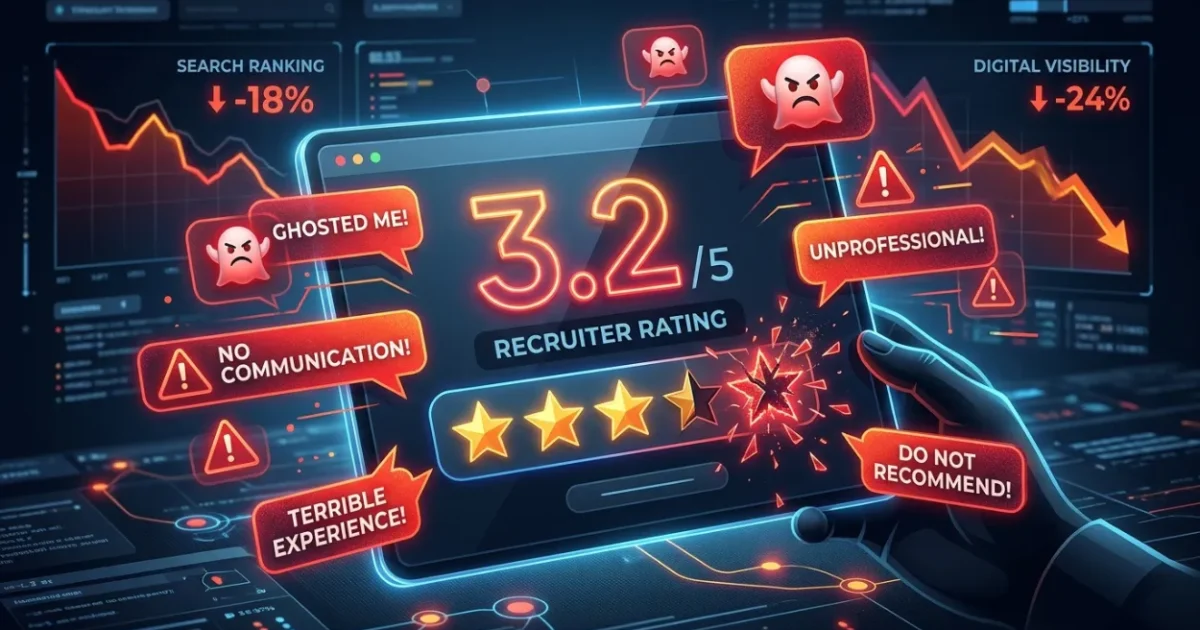
Candidate ghosting feedback damages marketing recruiter ratings by creating negative reputation signals around communication, reliability and candidate experience. The effect becomes stronger when repeated feedback creates a consistent sentiment pattern across review platforms and search results.
Reputation management strategies differ based on the source, frequency and visibility of negative feedback. Online reputation control methods are evaluated through sentiment distribution, review credibility, search visibility, entity credibility and the sustainability of corrective actions.
Why Does Candidate Ghosting Feedback Affect Marketing Recruiter Ratings?
Candidate ghosting feedback affects recruiter ratings because reviews translate individual recruitment experiences into publicly visible reputation signals. Candidate ghosting refers to a recruitment communication failure where an applicant receives no meaningful update after an interaction, application, interview or assessment stage. When candidates describe this experience through public reviews, the complaint becomes part of the recruiter’s digital footprint. Search users then encounter this information while evaluating the organisation’s credibility. The rating itself provides a numerical reputation signal, while written feedback provides contextual information explaining the perceived service failure.
Recruitment reviews operate as both sentiment indicators and trust signals within the wider search ecosystem. A single review does not represent the complete reputation of an agency, but repeated complaints about the same communication issue establish a clearer sentiment pattern. Search engines process publicly available information as part of their understanding of entities, although a review rating does not function as a simple direct ranking factor for every search. Users interpret the same information independently when deciding whether an agency appears credible. This distinction separates algorithmic search evaluation from human reputation assessment.
The reputational effect therefore depends on more than the star rating alone. Review text containing terms associated with ignored applications, unanswered messages, poor communication or candidate experience creates semantic associations around the recruiter entity. These associations contribute to the information environment surrounding the organisation. A consistent negative pattern gives the public a more defined interpretation of the recruitment experience. Reputation management consequently requires analysis of both numerical ratings and the underlying sentiment distribution.
How Does Candidate Ghosting Create Negative Reputation Signals?
Candidate ghosting creates negative reputation signals by connecting the recruiter entity with identifiable service-quality complaints. A reputation signal is information that contributes to how an organisation is interpreted across digital platforms and search environments. Candidate feedback becomes relevant when it describes a specific interaction with the recruitment process and establishes a recognisable relationship between the complaint and the agency. Repeated references to the same failure reinforce semantic consistency. The result is a digital footprint in which communication problems become associated with the recruiter’s public identity.
The mechanism operates through accumulation rather than through one isolated statement. A review describing delayed communication provides one data point, while multiple reviews describing similar experiences establish a broader sentiment distribution. Review platforms also provide visible aggregate ratings that compress individual experiences into a numerical indicator. This makes the rating easy for search users to interpret before reading the underlying comments. The combination of rating, review volume, recency and written sentiment therefore creates a more complete reputation signal.
The distinction between legitimate criticism and manipulated feedback also matters. Reputation analysis evaluates the authenticity, relevance and context of available information rather than treating every negative statement as equally authoritative. Genuine candidate feedback reflects an identifiable experience, whereas suspicious or unsupported content has a different evidential value. This distinction reduces the risk of treating reputation management as simple removal of criticism. Effective evaluation instead focuses on the information structure surrounding the recruiter entity.
Dive Deeper With Our Expert Guides:
How Do Google Reviews Decide Which Marketing Recruiters Brands Brief?
How Do Clients Vet Executive Search Firms Before Signing a Retainer?
Which Has a Greater Reputation Impact: One Negative Review or Repeated Ghosting Feedback?
Repeated ghosting feedback has greater reputational significance because consistency creates a stronger association between the recruiter and the reported experience. One negative review represents a limited information point, while repeated complaints describe a recurring theme. This distinction is important when evaluating sentiment distribution because repetition changes the perceived pattern of candidate experience. A series of similar reviews also gives prospective candidates more information before contacting the agency. The resulting perception therefore extends beyond the numerical rating.
Review recency also changes how users interpret reputation information. Recent complaints demonstrate that the issue appears in the current information environment, while older reviews provide historical context. A recruiter with older negative feedback and stronger recent evidence of improved candidate communication presents a different reputation profile from an organisation receiving the same criticism repeatedly. Reputation analysis therefore requires temporal comparison rather than a static review count. This approach separates historical reputation from current sentiment.
The impact also depends on the authority and visibility of the platform containing the feedback. A review hosted on a highly visible platform can receive greater exposure than information published on a page with limited indexing or search demand. Search results combine relevance, authority, freshness and other signals rather than ranking content according to sentiment alone. Consequently, negative candidate feedback becomes a reputation concern when it remains discoverable and relevant to searches involving the recruiter entity.
How Do Organic and Reactive Reputation Management Approaches Compare?
Organic reputation management focuses on building a stronger and more accurate information environment over time, while reactive management addresses identifiable reputation problems after they appear. Organic activity includes publishing authoritative recruitment information, maintaining accurate professional profiles and developing useful content around candidate services. Reactive activity includes responding to legitimate reviews, correcting inaccurate information and addressing platform-specific issues. The two approaches operate differently but influence the same broader digital footprint. Their effectiveness therefore depends on the nature and visibility of the reputation issue.
Organic approaches provide greater sustainability because they create a broader information network instead of concentrating attention on one review. Consistent professional content establishes additional entity associations around expertise, recruitment practices and candidate services. This creates more context for search engines and users when evaluating the organisation. However, organic content does not automatically remove or neutralise negative feedback. Its value depends on relevance, authority, indexing and the strength of competing information.
Reactive approaches provide greater immediacy because they address the source of a visible reputation problem. A factual response to legitimate criticism demonstrates accountability and adds context to the review record. Reporting demonstrably false or policy-violating content addresses a different problem because the objective is content correction rather than reputation enhancement. Reactive action therefore provides precision, while organic development provides broader resilience.
Does Review Response Strategy Reduce the Impact of Candidate Ghosting Feedback?

A structured review response strategy reduces reputational friction by adding relevant context to publicly visible criticism. A response does not erase the original review, and its value therefore depends on whether it addresses the specific issue without becoming defensive or promotional. Clear communication demonstrates that the organisation recognises the concern and understands the underlying candidate-experience issue. This provides additional information for prospective candidates assessing the review. It also creates a more complete record around the negative sentiment.
The effectiveness of review responses depends on consistency and relevance. A generic response repeated across different complaints adds little informational value because it fails to address the specific reputation signal. A response that identifies the communication issue, explains the appropriate process and directs the reviewer towards a suitable resolution provides greater contextual substance. This distinction matters because search users evaluate both the original complaint and the organisation’s response. The response consequently becomes part of the wider reputation dataset.
Review responses also have limitations. They do not guarantee rating changes, removal of legitimate criticism or improved search rankings. Their principal function is contextual rather than suppressive. Reputation management therefore evaluates responses as one component within a broader strategy rather than treating them as a standalone solution.
How Does Content Enhancement Compare With Content Removal?
Content enhancement strengthens accurate, authoritative information, whereas content removal attempts to reduce the presence of information that violates a platform rule, legal requirement or other applicable standard. These approaches address different conditions and therefore require separate evaluation. Enhancement is appropriate for expanding the organisation’s legitimate digital footprint and improving topical clarity. Removal is relevant when a specific item qualifies for correction, de-indexing or platform action. Neither approach provides a universal solution to negative candidate feedback.
Content enhancement operates through information diversification. Professional recruitment pages, candidate guidance, transparent communication policies and authoritative industry content establish additional semantic relationships around the recruiter entity. This broader information environment reduces dependence on one review or platform when users research the organisation. It also provides search engines with more relevant material for understanding the entity. However, enhancement does not alter the underlying review itself.
Content removal operates through source-specific mechanisms. A platform can remove content when it violates applicable rules, while search engines have separate processes for certain types of de-indexing or legal requests. Legitimate negative reviews generally remain subject to the platform’s review policies rather than being removable simply because they are damaging. This makes removal a narrower approach with a higher evidential threshold.
Which Reputation Management Method Provides More Sustainable Results?
A combined approach provides greater sustainability because it addresses both immediate reputation issues and the underlying information environment. Reactive measures identify and manage specific negative content, while organic measures strengthen authoritative information around the recruiter entity. This creates a distinction between correcting problematic information and improving the broader search landscape. Sustainable reputation management therefore depends on continuity rather than a single intervention. Monitoring remains necessary because reviews, rankings and indexed content change over time.
Sustainability also depends on the quality of the information being created. Publishing repetitive or low-value content does not automatically establish entity credibility. Search ecosystems evaluate content through relevance, authority, usefulness and relationships between entities and topics. A recruiter therefore gains stronger informational coverage from genuinely useful material connected to candidate experience and recruitment expertise. This creates a more defensible digital footprint.
A long-term measurement framework provides greater analytical value than checking one rating at one point in time. Useful indicators include review sentiment, rating movement, indexed content, visibility of authoritative pages and changes in the prominence of negative results. Longer-term evaluation examines whether the information environment remains stable as new content enters the search ecosystem. This separates temporary movement from sustainable reputation improvement.
How Should Recruiter Reputation Risk Be Evaluated Before Choosing an Approach?
Recruiter reputation risk is evaluated through source credibility, sentiment consistency, visibility, recency and the nature of the underlying complaint. Start by identifying where negative feedback appears and whether it is indexed for relevant recruiter searches. Then analyse whether the criticism represents an isolated incident or a recurring candidate-experience theme. Next, compare the visibility and authority of negative pages with the organisation’s existing authoritative content. This creates a structured assessment of the actual reputation environment.
A practical evaluation framework can be organised into four actions:
- Audit review sources and indexed pages to identify the exact content contributing to negative sentiment.
- Classify feedback according to authenticity, relevance, recency and the specific recruitment issue described.
- Compare negative-result prominence against authoritative professional content to measure the balance of search visibility.
- Monitor rating movement, sentiment distribution and SERP composition over a defined period to assess sustainability.
This framework prevents reputation management from becoming a purely numerical exercise. A rating provides a measurable indicator, but written sentiment explains the reasons behind that indicator. Search visibility provides another dimension by showing which information users encounter first. Entity credibility then reflects the broader interpretation created by the combined information environment.
How Can Recruiters Measure Whether Reputation Management Is Working?
Reputation management effectiveness is measured through changes in sentiment, visibility, content coverage and entity associations rather than through star ratings alone. Early indicators include changes in review sentiment, movement of authoritative pages and the prominence of negative results. Intermediate indicators include stronger topical coverage, improved consistency of professional information and broader representation across relevant search queries. Long-term indicators include greater stability in search visibility and a more balanced sentiment distribution. These measurements provide a clearer basis for comparing approaches.
The measurement period also affects the interpretation of results. Short-term ranking movement does not establish sustainable reputation improvement because search results change as content is indexed, updated and re-evaluated. A longer monitoring period provides stronger evidence about whether improvements persist. This is particularly important for recruiters because candidate reviews continue to enter the digital environment over time. Reputation management therefore operates as an ongoing evaluation process rather than a one-time correction.
The central objective is not to eliminate all negative information. A credible reputation environment contains balanced information that accurately represents the organisation. The strategic objective is to ensure that relevant, authoritative and accurate information has appropriate visibility while legitimate criticism is assessed through its context and evidence. This approach strengthens analytical control without attempting to manipulate the underlying record.
What Is the Most Sustainable Approach to Candidate Reputation Management?
The most sustainable approach combines review management, accurate information, content enhancement and continuous monitoring rather than relying on one corrective tactic. Candidate ghosting feedback becomes a significant reputation issue when repeated criticism creates consistent negative associations around communication and candidate experience. Organic content strengthens the surrounding information environment, while reactive measures address specific review or content problems. Search visibility analysis then measures how these changes affect the SERP composition. The result is a framework based on evidence rather than isolated ranking movement.
Reputation management strategies differ in effectiveness, scalability and risk exposure. Content removal has a narrow application because legitimate criticism does not automatically qualify for removal, while content enhancement has broader applicability but requires sustained quality and relevance. Reactive review management provides contextual value, while organic reputation development creates longer-term informational resilience. Raise Google Ratings also forms part of this evaluation when assessing how review sentiment, rating changes and broader reputation signals influence the overall digital footprint. The strongest evaluation therefore considers how each method contributes to the overall digital footprint.
For marketing recruiters, candidate feedback represents more than a collection of individual opinions. It forms part of the information environment through which prospective candidates assess communication standards, credibility and professional reliability. Understanding the relationship between review sentiment, content visibility, entity associations and SERP evaluation provides a more accurate basis for reputation decisions.
How does candidate ghosting feedback affect marketing recruiter ratings?
Candidate ghosting feedback can lower marketing recruiter ratings when repeated complaints create a negative sentiment pattern around communication and candidate experience. These reviews also influence how prospective candidates interpret recruiter credibility.
Can candidate ghosting reviews damage a recruitment agency’s online reputation?
Yes, repeated candidate ghosting reviews can contribute to negative reputation signals associated with a recruitment agency. Their impact depends on review frequency, recency, visibility and the consistency of the reported experience.
Why do candidates leave negative reviews about recruitment agencies?
Candidates commonly leave negative feedback when communication stops after applications, interviews or other recruitment stages. Repeated complaints about these experiences can create a persistent negative sentiment distribution across review platforms.
How can recruitment agencies manage negative candidate feedback?
Recruitment agencies can analyse review sentiment, respond appropriately to legitimate concerns and improve candidate communication processes. Monitoring indexed reviews and search visibility also helps identify changes in the agency’s online reputation.
Do negative recruiter reviews affect search visibility?
Negative reviews contribute to the broader information environment surrounding a recruitment agency, although they do not function as a simple direct ranking factor. Their visibility, relevance and sentiment can influence how users perceive the agency when it appears in search results.