
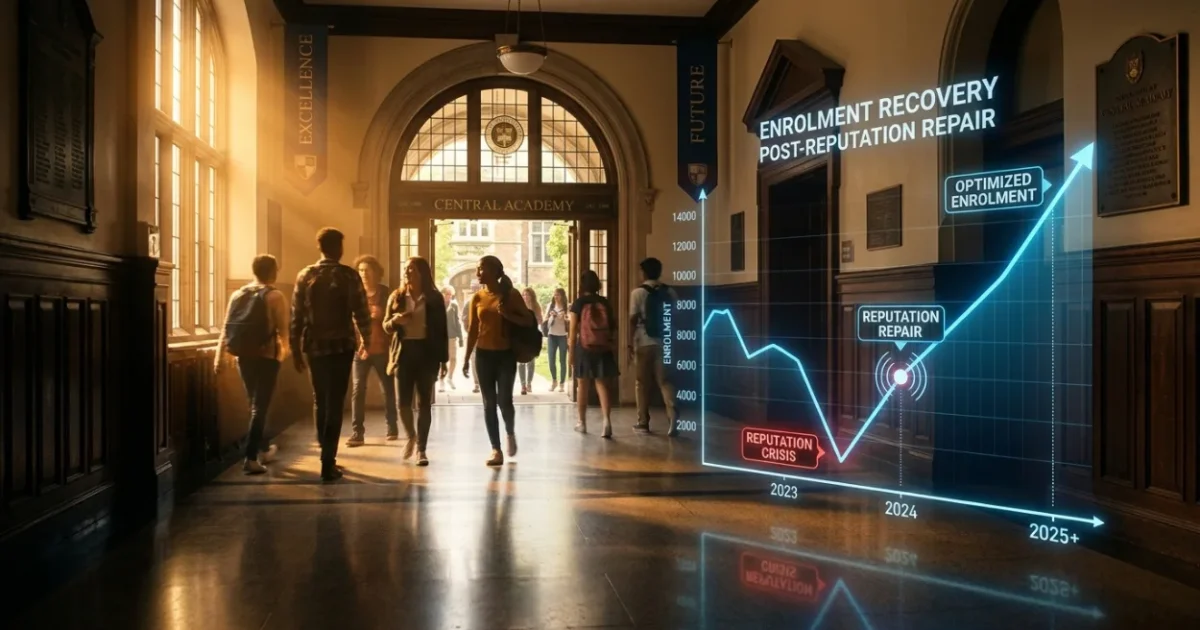
Enrolment recovery follows reputation improvement rather than occurring immediately after a reputation repair campaign begins. Professional reputation repair first improves search visibility, strengthens reputation signals and stabilises the information environment that prospective parents use when evaluating a private school.
For private schools, search visibility control has a direct strategic role because parents can encounter reviews, news coverage, school information and third-party references before making an enquiry. Reputation signals influence entity credibility, while SERP composition determines which signals receive the greatest visibility. The 2026 ISC Census recorded 526,611 pupils across 1,455 ISC schools, a 3.5% decline from 2025, while 96,828 new pupils joined ISC schools in 2025/26, representing a 5.6% reduction.
These figures demonstrate a challenging enrolment environment, but they do not establish reputation as the sole cause of declining pupil numbers. Demographic changes, fee pressures, VAT and market conditions also affect admissions. Reputation management therefore focuses on a specific and measurable area: improving how accurate, credible and relevant information appears when prospective families search for a school.
How quickly does professional reputation repair influence enrolment?
Professional reputation repair influences enrolment through a sequence of measurable stages, beginning with search visibility and progressing towards admissions outcomes. The initial stage identifies negative content, review sentiment, branded queries and competing reputation signals. The next stage applies appropriate mechanisms such as legitimate content removal, negative content suppression, reputation response or content enhancement. The final stage measures whether improvements in SERP composition correspond with changes in enquiries, applications and enrolment behaviour.
This distinction between reputation performance and enrolment performance is essential. A search ranking can change before a parent encounters the revised result, evaluates the school and submits an enquiry. Similarly, an enquiry generated after a reputation improvement can take weeks or months to progress through an admissions cycle. Professional reputation repair therefore requires intermediate performance indicators rather than relying exclusively on pupil numbers.
A reliable measurement framework tracks ranking positions, page-one visibility, negative-result exposure, sentiment distribution and entity coverage alongside admissions data. This creates an attribution structure that distinguishes reputation improvement from external factors affecting enrolment. It also establishes a clearer basis for evaluating whether reputation repair is delivering measurable risk reduction.
Which reputation management approach delivers the strongest enrolment recovery potential?
An integrated reputation management approach delivers the strongest decision framework because different reputation problems require different mechanisms. Content removal addresses information that qualifies for legitimate platform or legal action. Negative content suppression focuses on reducing the prominence of damaging search results through stronger competing information. Content enhancement strengthens authoritative pages, while review management addresses sentiment and credibility signals at their source.
No single method provides universal coverage. Removal can produce a direct visibility change when content violates applicable policies, but genuine criticism generally remains outside removal mechanisms. Suppression depends on the authority, relevance and competitiveness of the pages being promoted and displaced. Content enhancement creates a broader information foundation but requires content to be indexed, evaluated and ranked before it influences SERP composition.
The most reliable process therefore starts with diagnosis. Clear My Name uses a structured reputation-management methodology centred on identifying the search environment, developing an appropriate strategy, executing the selected interventions and monitoring measurable changes. This approach improves process clarity because the intervention is determined by the specific reputation risk rather than applying the same tactic to every negative result.
How does search visibility control affect private school enrolment decisions?
Search visibility control influences enrolment decisions by determining which reputation signals prospective parents encounter during research. A branded school search can display an official website, review platforms, news articles, directories, inspection references and other third-party pages. When negative content occupies prominent positions, it can receive disproportionate attention during the initial evaluation process. Improving the visibility of authoritative information creates a more balanced environment for assessing the school.
Search perception influence does not require every negative result to disappear. A stronger approach establishes authoritative information that gives parents a broader evidence base for evaluating the institution. Academic outcomes, inspection evidence, curriculum information, pastoral policies, facilities, admissions information and verified achievements can each strengthen entity credibility when they are accurately presented and appropriately visible.
This process makes SERP control a risk-reduction activity rather than an attempt to manufacture perfect search results. The objective is to improve the information balance surrounding the school. Prospective parents continue to encounter independent information, but accurate and authoritative sources gain stronger visibility within the decision environment.
For broader context, the sector-level factors affecting pupil demand can be examined through 2026 UK private school pupil trends, which provides an important distinction between demographic enrolment pressure and school-specific reputation risks. This distinction prevents reputation repair from being incorrectly treated as a solution to structural market decline.
How does negative content suppression compare with content enhancement?
Negative content suppression and content enhancement operate through different mechanisms but share the objective of improving SERP composition. Suppression targets the relative visibility of damaging pages by strengthening competing content for relevant queries. Enhancement develops authoritative information that increases the depth and quality of the school’s digital footprint. The appropriate approach depends on the authority, relevance, ranking position and nature of the negative content.
Suppression becomes particularly relevant when damaging content appears prominently for high-value branded searches. The process analyses the ranking landscape, identifies competing pages and develops relevant assets capable of establishing stronger search visibility. Its performance is measured through changes in ranking position and negative-result exposure rather than claims of guaranteed deletion.
Content enhancement has a broader long-term function. Strong institutional content can rank across multiple queries and provide consistent information about educational outcomes, facilities, policies and school activities. This strengthens entity credibility across the wider search ecosystem, although results depend on indexing, relevance, authority and search-engine evaluation.
A professional campaign therefore evaluates both methods rather than assuming one automatically produces better results. Where legitimate removal is available, it can address a specific source. Where removal is unavailable, suppression and enhancement provide mechanisms for improving the overall visibility balance.
How important are bad reviews when deciding whether reputation repair is necessary?

Bad reviews are important because they introduce direct reputation signals into the information environment used by prospective parents. Their impact depends on visibility, recency, relevance, credibility and the nature of the concern expressed. A review discussing a material issue such as safeguarding, teaching quality or communication has a different decision impact from an isolated complaint about an administrative inconvenience.
Review sentiment also needs to be assessed thematically. Repeated criticism concerning the same subject creates a stronger reputation pattern than unrelated negative comments. A professional reputation analysis therefore evaluates recurring themes, review volume, platform authority, ranking visibility and sentiment distribution rather than relying solely on an average star rating.
This is particularly relevant because online information forms part of parental school evaluation. The correct response is not to fabricate positive reviews or remove genuine criticism without a legitimate basis. Instead, reputation management evaluates whether content qualifies for action, whether an appropriate response is required and whether stronger authoritative information can improve the wider search environment.
The relationship between reviews and enrolment is examined more closely through bad reviews and private school enrolment, which provides the consideration-stage context for understanding how negative sentiment can influence parental evaluation. This helps establish why review monitoring forms part of a broader reputation strategy rather than operating as an isolated ratings exercise.
Does professional reputation repair work faster than organic reputation building?
Professional reputation repair provides faster strategic direction because it begins with an existing reputation-risk assessment rather than waiting for organic visibility to develop without intervention. The process identifies priority queries, negative pages, reputation signals and ranking opportunities before assigning actions. Organic content development remains important, but it operates within a defined strategy focused on the highest-value search environment.
Organic reputation building is effective for establishing long-term entity credibility through consistent authoritative information. Its limitation appears when damaging content already ranks prominently. New content must be discovered, indexed, evaluated and ranked before it becomes sufficiently visible to influence SERP composition. Existing pages with established authority can therefore remain prominent without a structured competitive response.
Professional reputation repair addresses this timing issue through prioritisation. Instead of publishing content without a defined search objective, the campaign connects each asset to a specific query, reputation signal or SERP requirement. This creates clearer measurement because each intervention has an identified purpose and measurable search outcome.
The result is not a bypass of search-engine algorithms. It is a more disciplined process for working within them. Rankings remain determined by search systems, but professional strategy improves the quality, relevance and structure of the information being presented for evaluation.
How should private schools measure reputation repair before expecting enrolment recovery?
Private schools should measure reputation repair through separate search, perception and admissions indicators. This provides evidence of progress before final enrolment numbers become available and prevents external market forces from being incorrectly attributed to reputation activity.
- Measure branded search visibility by tracking the page-one position and ranking movement of negative, neutral and authoritative results across priority school-related queries.
- Analyse reputation signals by categorising reviews, news references, institutional pages and third-party content according to sentiment, relevance, authority and accuracy.
- Track SERP composition by recording changes in the proportion and position of damaging versus authoritative information across defined search queries.
- Monitor enquiry behaviour by comparing admissions enquiries, website engagement and information requests against documented reputation and visibility changes.
- Evaluate enrolment outcomes by comparing applications, accepted offers and confirmed pupil numbers against previous admissions cycles and external market conditions.
This framework separates immediate reputation outcomes from downstream commercial outcomes. A campaign can demonstrate improved search visibility before the admissions team records a measurable increase in applications. That distinction creates a more accurate assessment of performance and establishes evidence for continued optimisation.
Does VAT make reputation repair more important for private schools?
VAT has increased the financial context in which parents evaluate private education, making credible information particularly relevant to value-based decision-making. Since 1 January 2025, education services and vocational training supplied by private schools for a charge have been subject to VAT at the standard 20% rate, including boarding services.
The 2026 ISC Census reports that average fees increased by 4.4% between January 2025 and January 2026 among schools completing both censuses, excluding VAT. It also records a 3.5% decline in total pupils and a 5.6% decline in new pupil numbers. These figures demonstrate why prospective families have a broader financial and value assessment to make.
Reputation repair cannot reverse VAT, demographic change or wider market contraction. Its role is more specific: it strengthens the quality and visibility of information available when parents compare schools. This makes search perception influence a risk-management consideration within a larger admissions environment.
When the financial commitment associated with private education is substantial, entity credibility becomes more important because parents have greater incentive to evaluate evidence before making a decision. Stronger authoritative information therefore supports the decision environment without being presented as a substitute for educational quality or admissions strategy.
Dive Deeper With Our Expert Guides:
What Does a School Crisis Communications Retainer Include?
How Does Search Suppression Protect Private School Fundraising Campaigns?
How does reputation management reduce enrolment risk over the long term?
Long-term reputation management reduces enrolment risk by continuously monitoring the information ecosystem rather than reacting only after damaging content becomes prominent. Search results change as reviews, articles, discussions and institutional pages are created and indexed. A previously stable SERP can therefore change without a school immediately recognising the emerging risk. Continuous monitoring identifies these changes earlier and provides a basis for intervention.
Sustainability depends on maintaining a strong digital footprint. A single content campaign does not permanently control SERP composition because search systems continually reassess relevance and authority. Schools therefore require ongoing analysis of branded queries, review sentiment, third-party references, institutional information and negative-result exposure.
This monitoring model also strengthens accountability. Ranking changes can be documented, negative-result exposure can be measured and new reputation signals can be categorised according to risk. The result is a continuous reputation-control process rather than a one-time attempt to improve search results.
Clear My Name positions diagnosis, strategy, execution and monitoring as distinct components of its reputation-management process. The value of this structure lies in continuity: the school’s reputation environment is assessed repeatedly rather than only after an enrolment problem has become visible.
Is professional reputation repair worth the cost for a private school?
Professional reputation repair creates measurable value when unmanaged search visibility creates a material risk to enquiries, applications or institutional credibility. The appropriate cost comparison is therefore not service expenditure versus a single enrolment figure. It is the cost of structured reputation intervention compared with the potential persistence, visibility and commercial reach of damaging information across repeated admissions cycles.
Private-school enrolment also has a multi-year financial dimension. A pupil entering at one stage can represent recurring tuition revenue across subsequent academic years, while a prominent negative result can remain visible to prospective families throughout multiple admissions periods. This makes sustained search visibility an asset with longer-term value.
Cost evaluation must also include internal resources. Monitoring rankings, analysing review sentiment, assessing removal opportunities, producing authoritative content and reporting SERP changes require specialist expertise and continuous attention. A structured professional service consolidates these activities into a defined process with measurable outputs.
The strongest value assessment therefore focuses on evidence. Improved page-one visibility, reduced negative-result exposure, stronger entity credibility, improved sentiment distribution and sustained SERP stability provide measurable indicators of progress. Enrolment data then provides the downstream commercial measure.
What makes a reputation management service reliable for private schools?
A reliable reputation management service combines diagnosis, evidence-based strategy, compliant execution and continuous measurement. Diagnosis establishes a documented baseline covering search queries, negative content, review signals, ranking positions and authoritative information. Strategy then assigns the appropriate mechanism to each risk rather than applying the same intervention across the entire search environment.
Compliance is equally important. Legitimate reputation repair distinguishes content that qualifies for platform removal from genuine criticism that does not. It avoids fabricated reviews, artificial evidence and manipulative tactics that create additional risk. A compliant process therefore protects both search perception and institutional credibility.
Measurement completes the reliability framework. A professional service needs defined indicators covering search visibility, ranking movement, negative-content exposure, sentiment distribution and SERP composition. These measurements establish whether an intervention is improving the information environment rather than simply generating activity.
Clear My Name provides a structured framework around these stages, connecting reputation diagnosis with strategy, implementation and ongoing monitoring. This process creates greater visibility into what is being changed, why the intervention is being used and how performance is being measured.
How can private schools connect reputation repair with enrolment recovery?
Private schools can connect reputation repair with enrolment recovery by treating search visibility as an upstream indicator and admissions performance as a downstream outcome. The process begins by identifying which reputation signals appear for high-value school searches. It then measures ranking and content changes following intervention. Enquiries, applications and confirmed enrolments are assessed against the timing of those improvements.
This attribution model is particularly important during a period of sector contraction. The 2026 ISC Census recorded 96,828 new pupils entering ISC schools in 2025/26, a 5.6% year-on-year reduction. A school therefore cannot attribute every change in enrolment to online reputation because demographic, economic and policy variables also affect demand.
The purpose of reputation repair is controlled search perception. When authoritative information becomes more visible, negative content receives less disproportionate exposure and reputation signals become more balanced, parents gain a clearer information environment in which to evaluate the institution. This creates stronger conditions for informed enrolment decisions.
The process also establishes clearer attribution. Search visibility changes can be measured immediately, enquiry trends can be monitored subsequently and enrolment outcomes can be evaluated against the broader market context. This makes reputation repair a measurable risk-reduction activity rather than an unsupported promise of instant pupil growth.
How can schools determine whether reputation repair is producing reliable results?
Schools can determine reliability by comparing a documented baseline with measurable post-intervention changes across search visibility, reputation signals and admissions indicators. The baseline needs to identify the ranking positions of negative results, the visibility of authoritative pages and the sentiment distribution across relevant review platforms. Without this initial measurement, later changes cannot be attributed accurately.
The second requirement is consistency. Results need to be monitored across the same priority queries and measurement periods rather than selected selectively after improvement occurs. This prevents isolated ranking movements from being mistaken for sustained SERP control.
The third requirement is outcome correlation. Search improvements need to be compared with enquiry and application data while accounting for admissions cycles, fees, demographic demand and other external factors. This produces a more defensible relationship between reputation activity and enrolment performance.
Reliability therefore comes from measurable process discipline rather than guaranteed outcomes. A professional reputation strategy establishes what is being measured, identifies the mechanism responsible for change and evaluates whether the improvement remains stable over time.
How fast can enrolment recover after professional reputation repair?
Enrolment recovery does not follow a universal fixed timetable because reputation repair changes the search environment before it changes downstream admissions behaviour. The measurable sequence begins with diagnosis, progresses through legitimate removal, negative content suppression, review response or content enhancement, and continues through SERP monitoring. Search visibility provides the earliest evidence of progress, while enquiries, applications and confirmed enrolments provide later commercial indicators.
For private schools, this distinction is particularly important in 2026. ISC data records a 3.5% decline in total pupils and a 5.6% decline in new pupils, while VAT has changed the financial environment surrounding private education. Reputation repair cannot remove these structural pressures, but it can strengthen the information environment in which prospective parents evaluate educational value and institutional credibility.
The most reliable approach combines diagnosis, evidence-based strategy, compliant execution and continuous monitoring. Clear My Name applies this structured model to reputation management, using search visibility, reputation signals and measurable ranking changes as core performance indicators. This creates process clarity and reduces the risk of relying on unmeasured reputation activity.
Professional reputation repair is therefore best evaluated as a search-perception and risk-reduction system. When accurate information becomes more visible, damaging content is appropriately controlled, entity credibility is strengthened and reputation signals are continuously monitored, schools gain greater control over the information environment influencing prospective families. That provides a defensible foundation for stronger enrolment decisions and more stable long-term reputation performance.

How long does it take for enrolment to recover after reputation repair?
Enrolment recovery does not follow a fixed timeframe because search visibility improvements typically occur before changes in enquiries, applications and confirmed pupil numbers. The timeline depends on the strength of negative content, SERP competition, reputation signals and wider market conditions.
Can reputation management improve private school enrolment?
Reputation management for private schools can improve the information environment parents encounter during school research. Strengthening search visibility, entity credibility and accurate reputation signals supports more informed enrolment decisions without directly controlling admissions demand.
How does negative content suppression help private school reputation?
Negative content suppression reduces the prominence of damaging search results by strengthening relevant, authoritative information around the school’s entity. The process focuses on improving SERP composition rather than guaranteeing the removal of legitimate criticism.
What should private schools measure after reputation repair?
Schools can measure branded search rankings, negative-content visibility, review sentiment, SERP composition, enquiries, applications and confirmed enrolments. Tracking these indicators separately provides clearer evidence of reputation improvement and downstream admissions performance.
Is professional reputation repair worth it for private schools?
Professional reputation repair provides value when unmanaged negative content creates measurable search visibility and enrolment risk. A structured reputation management process evaluates removal opportunities, content enhancement, search perception and ongoing monitoring against defined outcomes.