
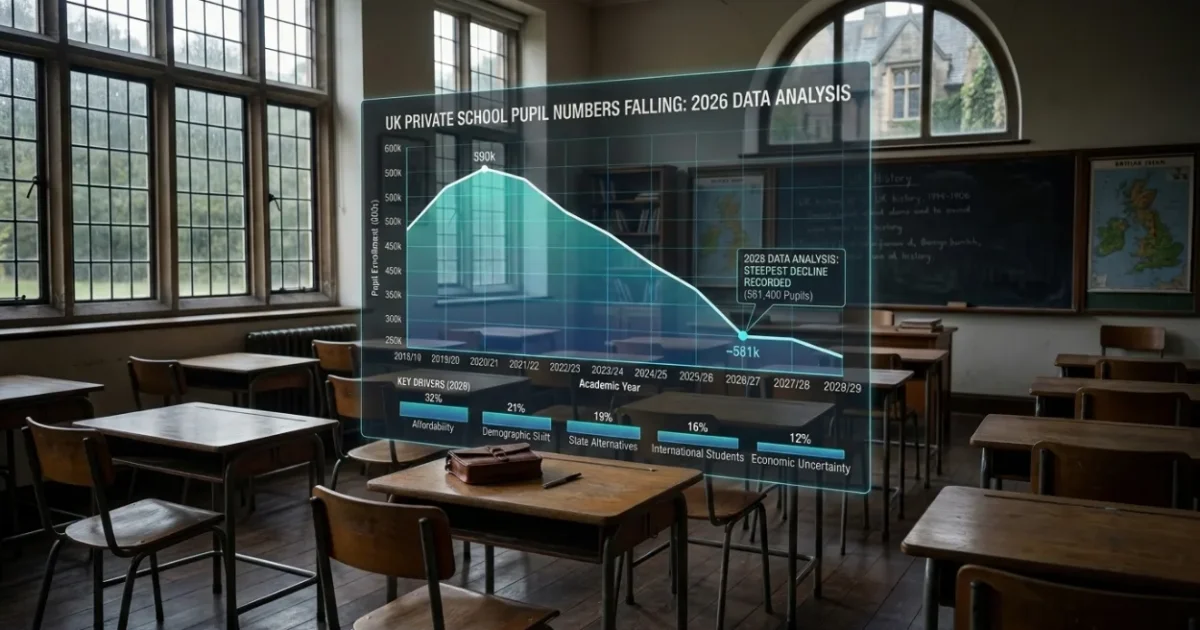
Private school pupil numbers are falling because independent schools are facing a combination of financial, demographic and policy pressures, with 2026 data showing a substantial contraction across the sector. The latest ISC Census records 526,611 pupils in 1,455 ISC schools, down 3.5% from 2025 and 3.8% on a like-for-like basis.
Reputation management is the process of understanding, monitoring and influencing how an organisation is represented across information environments. Online reputation refers to the collection of information, opinions, reviews, media references and other signals that shape how an entity is perceived through search ecosystems. For private schools, this reputation layer operates alongside measurable factors such as fees, educational outcomes, location, demographic demand and policy changes.
The 2026 data therefore needs to be interpreted carefully. Falling pupil numbers do not demonstrate that reputation is the primary cause of declining enrolment. Instead, reputation forms part of the information environment through which parents evaluate schools when financial and demographic conditions are already changing.
What do the 2026 private school pupil numbers actually show?
The 2026 figures demonstrate that the decline is broad-based rather than confined to a single type of independent school. The ISC recorded 526,611 pupils across 1,455 member schools, representing 19,029 fewer pupils than in 2025. On a like-for-like basis, the reduction reached 3.8%, indicating that the decline is not explained simply by changes in ISC membership.
The contraction also appears across different stages of education. Most year groups experienced reductions between 3% and 6%, while key intake points such as Reception, Year 7 and Year 12 experienced particularly notable declines. New pupil numbers fell to 96,828 in 2025/26, representing a 5.6% reduction from the previous year.
This distinction is important for understanding enrolment behaviour. A reduction in total pupils can result from existing families leaving, fewer new families entering, or both mechanisms operating simultaneously. The 2026 data shows evidence of both contraction in the overall pupil population and weaker intake flows, creating a direct relationship between market demand and school visibility.
How much of the decline is linked to demographic change?
Demographic change provides an important structural explanation for falling pupil numbers, particularly across England. Department for Education statistics for 2025/26 report a 3.8% decline in independent-school pupils to approximately 560,300, while the total school population also decreased. The DfE attributes declining pupil numbers across primary and secondary education primarily to demographic patterns, including the movement of smaller birth cohorts through the school system.
This means the private-school market is not operating in isolation from the wider population structure. A smaller pool of school-age children creates lower potential demand before individual schools compete for enrolment. Search visibility therefore operates within a constrained market rather than generating demand independently.
The distinction between demographic demand and reputation signals is essential. Demographics influence the size of the potential audience, whereas reputation influences how information about a school is interpreted by that audience. A school can therefore experience declining enrolment because the addressable pupil population is shrinking while still having a strong reputation within its local market.
How has VAT changed the financial context for private schools?
The introduction of VAT on private-school education has materially changed the financial environment surrounding independent education. Since 1 January 2025, education services and vocational training provided by private schools for payment have been subject to the standard 20% VAT rate. HMRC confirms that the tax applies to private-school education services and certain related payments.
The 2026 ISC Census records average fee increases of 4.4% between January 2025 and January 2026, excluding VAT, among schools completing both censuses. This means families have experienced a financial environment in which the underlying cost of private education has continued to change after VAT was introduced.
The relationship between cost and reputation is indirect but significant. When fees rise, parents evaluate whether the perceived educational value remains proportionate to the total cost. That evaluation draws on academic outcomes, pastoral provision, facilities, SEND support, reviews, media coverage and other reputation signals visible during research.
Why do new pupil numbers matter more than total enrolment?
New pupil numbers provide a direct indicator of changing demand because they measure the flow of families entering schools rather than simply the existing stock of pupils. The 2026 ISC Census records 96,828 new pupils joining ISC schools in 2025/26, down 5.6% year on year.
This decline has implications for how school reputation operates within enrolment decisions. Existing families possess direct experience of a school, while prospective families rely more heavily on externally available information. Search engines, school websites, review platforms, news articles, inspection information and social media can therefore become important information sources during the consideration process.
A reduced intake also changes the competitive environment. When fewer families enter the market, schools compete within a smaller pool of prospective pupils. In that environment, reputation signals become part of the SERP evaluation process because parents compare information about competing institutions before making an enrolment decision.
How does online reputation influence private school perception?

Online reputation refers to the information ecosystem that shapes an entity’s perceived credibility across digital channels. For a private school, this ecosystem includes official institutional information, independent reviews, news coverage, inspection references, parent discussions, educational results and other indexed content.
Search engines do not evaluate reputation as a single numerical score. Instead, search systems process individual pages, entities, links, text, reviews, structured information and behavioural signals to determine relevance and ranking. The resulting search engine results pages therefore create an information environment in which some reputation signals become more visible than others.
This process affects perception because visibility influences what prospective parents encounter during research. A highly relevant page appearing prominently for a school-related query can receive greater attention than an equally accurate page positioned deeper in the results. Search visibility therefore acts as an information-distribution mechanism rather than a direct measure of institutional quality.
How are reviews interpreted as reputation signals?
Reviews function as user-generated reputation signals because they provide publicly accessible evaluations of experiences with an organisation. For schools, reviews can contain perceptions of teaching, communication, pastoral care, facilities, admissions, fees and other aspects of the parent or pupil experience.
Search systems can index review-related content and associate language, entities and sentiment with the organisation being discussed. This does not mean that a search engine simply calculates an average sentiment score and assigns it to a school. Instead, review content becomes part of the wider corpus of information surrounding the entity.
The distinction between individual sentiment and overall entity perception is important. One negative review does not establish that an institution has poor educational quality. However, repeated negative themes distributed across highly visible platforms can create a consistent information pattern that prospective parents encounter during SERP evaluation.
Why do authority and trust signals matter for school reputation?
Authority and trust signals help search ecosystems distinguish between different sources of information. A school website, regulatory publication, established news organisation, review platform and anonymous discussion page do not necessarily possess the same contextual authority. Search systems evaluate relevance and other signals to determine how information is ranked and presented.
For private schools, authoritative information can include verified institutional facts, examination information, inspection material, governance details and clearly attributable educational outcomes. These sources contribute to the factual layer of the school’s digital footprint. Their visibility provides prospective parents with information that can be evaluated against less authoritative sources.
Trust is therefore connected to information quality, attribution and consistency. When factual information is consistent across authoritative sources, entity perception becomes easier to interpret. When conflicting claims dominate the visible search environment, parents face a more complex evaluation process.
How does content ranking affect parental perception?
Content ranking determines which information becomes most accessible when someone searches for a school. A SERP is therefore not simply a list of websites; it is a prioritised information environment in which ranking position affects exposure.
For example, queries involving a school’s name can surface its official website, admissions pages, reviews, news articles, inspection references and other third-party content. Each result contributes a different type of information to the user’s understanding of the entity.
This makes content indexing relevant to reputation analysis. Information that remains unindexed has limited direct search visibility, while indexed content competing for prominent positions becomes part of the public search landscape. Reputation analysis consequently examines not only what information exists but also how that information is distributed across search results.
Dive Deeper With Our Expert Guides:
Private School Funding Crisis: Why 2026 Is a Turning Point
How Are Private Schools Funded in the UK? Fees, Endowments, and Donations
Can falling pupil numbers be explained by reputation alone?
No. The 2026 data does not establish reputation as the primary explanation for the decline in private school enrolment. The strongest documented factors include demographic change, financial pressures, VAT, reduced new-pupil intake and changes affecting particular segments such as boarding and international pupils.
The role of reputation is better understood as a mediating information factor. Parents make decisions within an economic and demographic context, then use available information to compare the perceived value and credibility of different schools. Reputation signals influence that interpretation without independently determining market size.
This distinction prevents an incorrect causal conclusion. A decline in pupil numbers does not automatically indicate declining educational quality or damaged reputation. Equally, strong academic performance does not guarantee stable enrolment when affordability and demographic demand are changing.
What does the 2026 data reveal about the wider digital reputation ecosystem?
The data demonstrates that private school reputation exists within a broader system of measurable institutional signals. The ISC reports that 34.9% of pupils receive some form of fee assistance, covering 183,705 pupils and representing £2.1 billion in support. It also records 123,823 pupils receiving SEND support and almost 10,000 reported partnerships with state-funded schools.
These figures illustrate why entity perception cannot be reduced to reviews or search rankings. A school’s digital footprint contains information about affordability, educational provision, specialist support, academic outcomes, partnerships and institutional activity. Each category contributes different evidence to the information environment surrounding the entity.
The analytical task is therefore to connect search visibility with the underlying evidence. Reputation management in this context is not simply about improving sentiment. It involves understanding which information is indexed, how authoritative that information is, which queries surface it and how competing reputation signals influence entity perception.
What does the 2026 trend mean for understanding private school reputation?
The 2026 trend demonstrates that enrolment is influenced by interconnected economic, demographic and informational systems. ISC data shows a 3.5% overall reduction in pupils and a 3.8% like-for-like decline, while new pupil numbers fell by 5.6% and boarding numbers declined by 8.2%.
These figures establish the scale of the current contraction but do not attribute every change to one cause. Demographic pressure reduces the potential market, VAT changes the financial calculation, and declining intake numbers indicate weaker flows into the sector. Within this environment, search visibility and reputation signals influence how prospective families interpret the remaining choices.
The broader concept is therefore digital reputation as an information system. Search engines organise indexed information, parents evaluate visible evidence, reviews contribute sentiment signals, authoritative sources contribute credibility signals, and ranking determines which information receives attention. Understanding these mechanisms provides a more accurate explanation of how private school perception operates during a period of declining pupil numbers.
Private school pupil numbers are falling in the UK because the independent education sector is experiencing a combination of demographic contraction, financial pressure and policy change. The 2026 ISC Census provides the clearest current measure, recording 526,611 pupils across ISC schools, down 3.5% year on year and 3.8% on a like-for-like basis.
Reputation does not provide a standalone explanation for this decline. Instead, it operates within the decision-making environment created by affordability, educational demand and competition. Search visibility, reviews, authoritative information, content indexing and entity perception determine how prospective parents interpret each school’s position within that environment. This relationship is examined further in How Do Bad Reviews Reduce Private School Enrolment? The Data Behind the Damage, which analyses how negative review signals can influence parental evaluation and enrolment decisions.
The central insight is that enrolment trends and online reputation represent connected but distinct systems. Demographic and economic conditions determine the broader demand landscape, while search ecosystems organise the information through which families evaluate schools. Understanding both systems is necessary for interpreting what the 2026 pupil data actually demonstrates.
Why are private school pupil numbers falling in the UK?
Private school pupil numbers are falling due to demographic changes, higher education costs, VAT on private school fees and weaker new-pupil intake. The 2026 ISC Census recorded 526,611 pupils, a 3.5% year-on-year decline.
How does VAT affect private school enrolment in the UK?
VAT increases the overall cost of private education, changing the affordability calculation for families considering independent schools. Higher costs can influence enrolment decisions alongside household finances, school fees and perceived educational value.
Does online reputation affect private school enrolment?
Online reputation influences how prospective parents evaluate a private school during their research. Reviews, news coverage, school information and search rankings create reputation signals that contribute to overall entity perception.
How do bad reviews affect private school reputation?
Bad reviews can introduce negative sentiment into a school’s digital footprint and influence how prospective parents interpret its credibility. Repeated negative themes across highly visible platforms can become part of the information considered during SERP evaluation.
What is reputation management for private schools?
Reputation management for private schools involves monitoring and analysing information that shapes an institution’s online credibility and public perception. It includes evaluating reviews, search visibility, indexed content, reputation signals and third-party references across the digital ecosystem.