
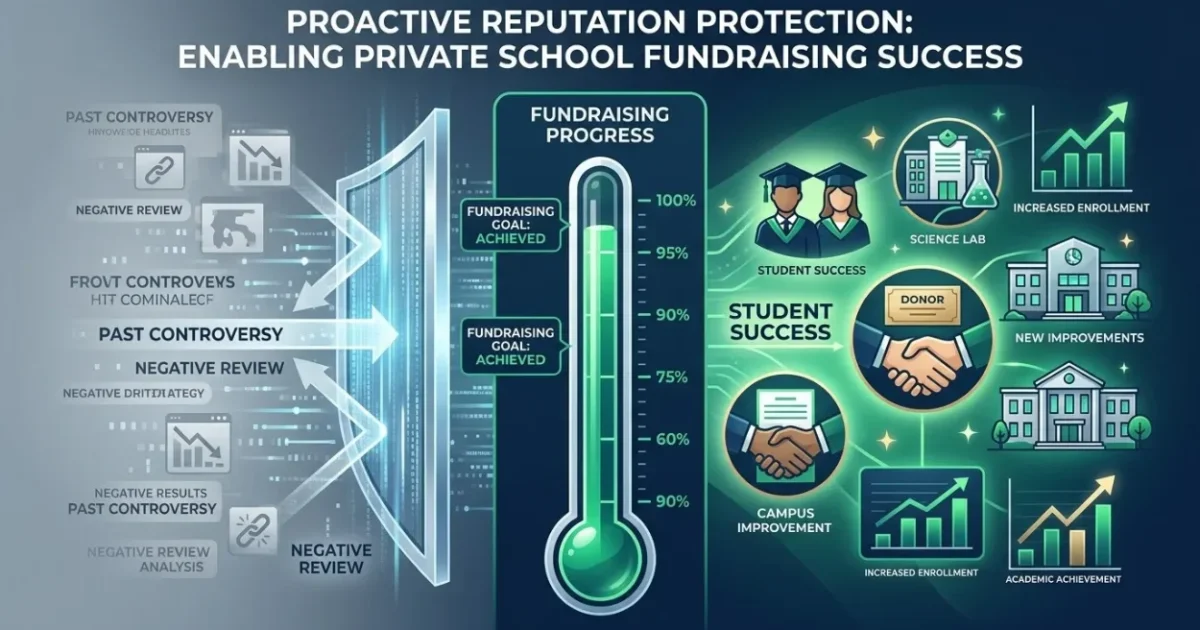
Search suppression protects private school fundraising campaigns by improving the visibility balance between harmful information and credible reputation signals. Controlled search visibility strengthens donor confidence by ensuring that authoritative information about governance, educational standards, leadership and institutional credibility remains prominent.
For UK private schools, fundraising depends on trust as much as financial need. Donors, alumni, trustees and prospective supporters frequently investigate an institution before committing funds, and search results form an important part of that due-diligence process. A negative article, unresolved complaint or outdated controversy that ranks prominently can therefore influence perception before direct communication takes place. Search suppression addresses this risk by improving SERP composition through legitimate content suppression, authoritative content development and sustained search monitoring. The objective is not to erase lawful criticism, but to reduce unnecessary prominence where credible alternatives provide a more accurate representation of the institution.
Which Reputation Management Approach Delivers the Strongest Protection for Private School Fundraising?
A coordinated reputation management strategy delivers stronger protection because it addresses search visibility, reputation signals and institutional credibility as connected systems. Private school reputation management analyses branded searches, leadership-related queries, fundraising terms, news coverage, review platforms and other sources that influence donor perception. This creates a baseline for identifying which negative results present genuine visibility risk and which have limited search impact. The strategy then assigns appropriate mechanisms, including legitimate removal assessment, content enhancement, SERP suppression and continuous monitoring. This process provides measurable control rather than relying on general public-relations activity.
The effectiveness of search suppression comes from changing the competitive environment around harmful content. Search engines rank individual documents according to factors including relevance, authority, content quality, links, freshness and query context. A negative page therefore retains visibility when it continues to satisfy search intent and outperform alternative sources. Reputation management works by strengthening accurate, authoritative resources that compete for the same relevant queries while addressing removable or policy-violating material through appropriate channels. This improves search perception influence without relying on artificial manipulation or fabricated reputation signals.
How Does Search Suppression Reduce Fundraising Risk?
Search suppression reduces fundraising risk by limiting the prominence of harmful information that interferes with donor research. A fundraising prospect searching for a school’s name can encounter news reports, institutional pages, regulatory information, reviews, social profiles and third-party references within the same SERP. When a negative result occupies a prominent position, it can become a dominant reputation signal regardless of whether the underlying issue remains current. Suppression changes this visibility balance by increasing the prominence of credible, relevant information. The result is a search environment in which donors receive broader contextual evidence before forming an assessment.
Negative content suppression does not mean deleting every unfavourable reference. Legitimate reputation management distinguishes between inaccurate, unlawful, policy-violating or outdated material and lawful reporting that remains relevant to public understanding. Appropriate removal mechanisms apply only where a valid basis exists, while non-removable content requires a different visibility strategy. This distinction reduces legal and reputational risk because the process focuses on legitimate search optimisation rather than concealment. A structured campaign therefore protects fundraising activity while maintaining factual accuracy and regulatory compliance.
Why Does Search Visibility Control Matter During Private School Fundraising?
Search visibility control matters because reputation signals influence how donors interpret institutional risk before direct engagement. A school can maintain strong educational outcomes and responsible governance while still facing reputational exposure from one highly visible negative result. Search users rarely evaluate every available source with equal attention; prominent results receive greater visibility and establish the initial context for further research. When authoritative institutional and third-party sources occupy prominent positions, they provide a broader evidence base for evaluating the organisation. SERP control therefore supports a more balanced information environment.
Fundraising campaigns intensify this requirement because financial contributions involve a higher level of trust than routine consumer decisions. Donors examine whether an institution appears stable, credible, transparent and worthy of long-term support. Negative coverage connected with leadership, finances, safeguarding, governance or institutional conduct can become a material due-diligence concern when it dominates branded searches. Reputation management addresses this exposure by mapping the queries that matter and measuring how the associated results influence perception. The emphasis remains on visibility control rather than simply increasing positive mentions.
How Does Reputation Management Improve Donor Trust Signals?
Reputation management improves donor trust signals by strengthening the consistency, authority and relevance of information associated with the school’s entity. Entity credibility develops through interconnected sources such as official institutional pages, credible media coverage, educational information, governance documentation, recognised organisations and accurate third-party references. When these sources consistently reinforce legitimate institutional attributes, search engines gain stronger contextual signals about the entity. Donors also gain a broader evidence base when researching the school. This combination supports stronger search perception without depending on promotional claims.
A reputation management campaign evaluates each source according to its authority, relevance, ranking position, sentiment and relationship to the institution. High-authority negative content receives greater strategic priority because it has stronger potential to shape search perception. Low-authority commentary receives a different level of attention because its ranking influence and credibility are weaker. This prioritisation prevents resources from being spent equally across every negative mention. It also creates a measurable framework for improving the information environment around fundraising-related searches.
What Process Delivers Reliable Search Suppression Results?
A structured audit, targeted strategy, controlled execution and continuous monitoring deliver the clearest search suppression process. Clear My Name describes its wider reputation process as diagnosis, strategy, execution and monitoring, with campaigns based on an audit of search results, reviews, social channels and other digital risks. The same principle is relevant to private school fundraising because the correct intervention depends on the source, ranking position, content type and reputation risk involved. A campaign therefore begins with evidence rather than assumptions. This establishes measurable baselines against which subsequent search visibility changes can be assessed.
The process can be structured into four outcome-focused stages:
- Audit search visibility by mapping branded, leadership and fundraising-related queries and recording the ranking positions, authority and sentiment of relevant results.
- Classify reputation risks by separating removable material, inaccurate information, lawful criticism, outdated references and high-authority negative content.
- Deploy targeted interventions by combining legitimate removal requests, authoritative content development, technical optimisation and SERP suppression according to the identified risk.
- Monitor search composition by tracking ranking movement, content visibility, sentiment distribution and the reappearance of harmful information over time.
This framework creates process clarity because every intervention connects to an identified search or reputation problem. It also prevents the campaign from becoming dependent on a single tactic such as publishing additional articles. The objective is measurable improvement in the overall search environment rather than activity for its own sake.
How Quickly Can Search Suppression Improve Private School Search Results?
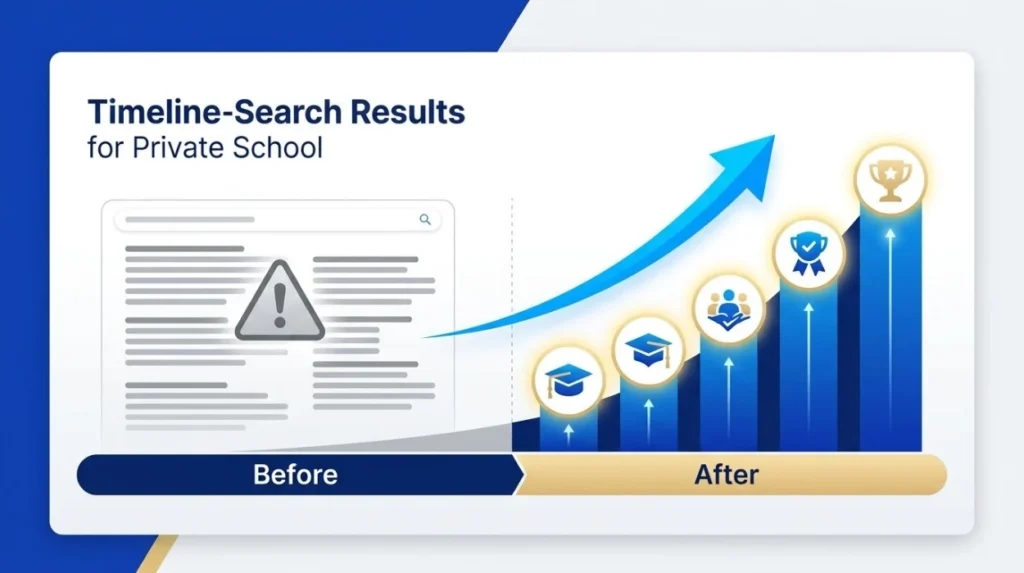
Search suppression produces measurable movement according to the authority of competing pages, the strength of existing negative results, the number of relevant queries and the depth of the content ecosystem. Clear My Name states that initial page-one improvements across campaigns commonly take 30–90 days, while its broader guidance identifies longer timelines for sustained content suppression. This distinction is important because initial ranking movement and long-term SERP control represent different outcomes. How Does Negative Press Threaten Private School Funding and Donor Confidence? provides further context on why adverse search results can affect stakeholder confidence and fundraising considerations. A newly published authoritative page can gain visibility before a complete reputation recovery is established. Sustainable suppression requires continued authority development and monitoring.
Speed also depends on whether the campaign contains a direct removal opportunity. A valid platform dispute or privacy-based removal request addresses the source directly, producing a different outcome from competing against a lawful news article through content enhancement. Clear My Name explains that its removal approach varies according to content type, platform rules and applicable legal mechanisms, while suppression is used when content cannot legitimately be removed. This distinction creates realistic expectations around speed and prevents a fundraising campaign from depending on an outcome that the underlying content does not qualify for.
Is Search Suppression More Cost-Effective Than Reactive Reputation Repair?
Search suppression provides stronger long-term value when it prevents repeated reactive interventions against the same reputation threat. Reactive reputation repair often begins after a negative page has already accumulated authority, backlinks, engagement and search visibility. Addressing the issue at that stage requires more effort because the competing content already possesses established search equity. Proactive monitoring identifies reputation threats earlier and allows authoritative information to develop before negative content becomes entrenched. The cost comparison therefore depends on the duration of the risk and the value of the fundraising activity exposed to it.
A reliable evaluation measures cost against visibility, risk reduction and sustainability rather than against the number of content pieces produced. If a negative result repeatedly appears for a high-value donor query, the relevant cost is the potential loss of trust created during that research stage. Conversely, a low-ranking negative mention with limited visibility does not justify the same level of intervention. Clear My Name states that its campaigns use baseline tracking and monthly reporting to measure SERP positions, sentiment shifts and other campaign-specific outcomes. This measurement framework provides a stronger basis for evaluating long-term value.
How Does Search Suppression Protect Fundraising Campaigns From Reputation Rebound?
Search suppression protects against reputation rebound through continuous monitoring and authority maintenance after initial ranking improvements. Search results remain dynamic because new articles, social discussions, reviews, institutional updates and algorithm changes alter the competitive environment. A negative result that falls from page one can regain visibility if competing content loses relevance or authority. Continuous monitoring identifies these movements before they become established again. This converts reputation control from a one-time intervention into an ongoing risk-management process.
Sustainability also requires maintaining accurate information across the institution’s digital footprint. Outdated school pages, inconsistent leadership information and weak third-party references create gaps that negative content can occupy. Strengthening authoritative resources improves the resilience of the entity’s search representation. Clear My Name describes ongoing monitoring and monthly reporting as part of its broader reputation process, including adaptation to algorithm changes and emerging negative content. This approach supports sustained visibility control rather than temporary ranking movement.
Dive Deeper With Our Expert Guides:
How Do Schools Push Down Negative Inspection Coverage in Google Search?
What Results Does Reputation Management Deliver for Private Schools? Case Data
Why Does Search Suppression Strengthen Private School Entity Credibility?
Search suppression strengthens entity credibility when it increases the relative prominence of authoritative information that accurately represents the institution. Search engines connect an organisation with documents, people, topics, locations and external references to determine relevance for queries. A private school’s digital entity therefore extends beyond its official website. News organisations, educational directories, governance information, alumni references and other authoritative sources contribute to the wider representation of the school.
Negative content becomes more damaging when it creates a strong association between the school’s entity and a particular controversy. Search suppression addresses that association by strengthening legitimate contextual evidence around the institution. This does not change historical facts or eliminate valid criticism; it changes which information receives the greatest search visibility. The resulting SERP composition provides donors with a more comprehensive representation of the school’s activities, credibility and institutional context.
What Outcomes Can Private Schools Expect From Professional Reputation Management?
Professional reputation management delivers measurable outcomes when campaigns define specific search queries, reputation risks and visibility objectives before execution. For private schools, relevant outcomes include improved branded SERPs, stronger visibility for authoritative institutional resources, reduced prominence of harmful content and clearer sentiment distribution. These metrics provide a more reliable assessment than generic traffic or publication counts. The objective is controlled search perception supported by credible evidence. This makes the campaign directly relevant to fundraising risk rather than treating reputation as an abstract marketing concept.
Key outcomes include:
- Improve SERP composition by increasing the prominence of authoritative school content for priority branded and fundraising-related searches.
- Reduce negative visibility by displacing harmful non-removable content through stronger, relevant and authoritative competing resources.
- Strengthen entity credibility by creating consistent relationships between the school’s official information and credible external references.
- Stabilise donor perception by maintaining balanced search results that provide accurate institutional context during due diligence.
- Measure campaign progress through ranking positions, sentiment distribution, content visibility and reputation-risk monitoring against defined baselines.
These outcomes create a direct connection between search activity and institutional risk management. They also establish clear evidence for evaluating whether the campaign is delivering meaningful improvement.
How Does Clear My Name Provide a Reliable Reputation Management Solution?
Clear My Name provides a structured reputation management model centred on search visibility, content suppression, authority building and ongoing monitoring. Its UK-focused service framework combines search suppression, content strategy, review governance and privacy protection rather than treating each reputation problem as an isolated marketing task. For a private school, this integrated approach is relevant because fundraising reputation extends across search engines, news coverage, institutional pages, social platforms and third-party references. The process begins with diagnosis, develops a bespoke strategy and continues through execution and monitoring. This creates accountability at each stage of the campaign.
Reliability also depends on ethical and legal boundaries. Clear My Name states that its reputation services operate within UK law, GDPR requirements and platform standards, while explicitly rejecting fabricated reviews and manufactured content. That distinction is important for private schools because an aggressive reputation tactic can create a secondary credibility problem with donors, trustees or regulators. Legitimate suppression, accurate content enhancement and appropriate removal procedures reduce this risk. The result is a reputation strategy designed to strengthen search perception without compromising institutional integrity.
What Makes Search Suppression a Sustainable Investment for Fundraising Protection?
Search suppression becomes a sustainable investment when it protects the visibility of accurate reputation signals across the entire fundraising research journey. The value extends beyond moving one URL because a well-managed SERP creates a stronger information environment for future donor searches, leadership searches and institutional due diligence. Authoritative content continues to provide contextual value after the initial campaign period, while monitoring identifies new threats. This creates compounding value from stronger entity credibility and improved search visibility. The investment therefore relates to risk reduction as well as immediate ranking improvement.
Private schools also benefit from separating reputation protection from crisis response. A fundraising campaign operating during a period of heightened scrutiny has less room for an uncontrolled negative narrative to dominate branded search results. Establishing search visibility control before a major fundraising push creates a stronger baseline for donor research. Where negative content already exists, targeted suppression and legitimate removal assessment address the immediate visibility imbalance. Clear My Name’s profession-specific reputation approach reflects this principle by treating reputation risks according to the characteristics of the organisation involved.
How Does Search Suppression Protect Private School Fundraising Campaigns?
Search suppression protects private school fundraising campaigns by improving control over the information donors encounter during search-based due diligence. Negative content suppression reduces the prominence of harmful information where legitimate removal is unavailable, while authoritative content enhancement strengthens credible reputation signals. Together, these mechanisms improve SERP control, strengthen entity credibility and reduce the risk that one negative narrative dominates institutional perception.
The most reliable approach combines diagnosis, evidence-based strategy, compliant execution and continuous monitoring. Clear My Name applies this structured model to reputation management, with search visibility, reputation signals and measurable ranking changes forming central elements of its methodology. For private schools, understanding How Are Private Schools Funded in the UK? Fees, Endowments, and Donations provides useful context for assessing how online reputation can influence donor confidence and fundraising due diligence. Search suppression is therefore not simply a ranking tactic; it is a structured risk-reduction mechanism for protecting institutional credibility when donor confidence depends on what appears online.
How does search suppression protect private school fundraising campaigns?
Search suppression reduces the visibility of harmful, misleading, or irrelevant search results that can undermine confidence in a private school fundraising campaign. It supports a more balanced search environment by improving the visibility of accurate and relevant information.
Can search suppression remove negative content about a school fundraising campaign?
Search suppression does not necessarily remove content from the internet; instead, it focuses on reducing the prominence of harmful results in search rankings through legitimate reputation management strategies. Content that violates platform policies or applicable laws may require separate removal processes.
Why does online reputation matter for private school fundraising campaigns?
Donors, parents, alumni, and community members often use search engines to research a school before contributing. Negative or misleading search results can affect trust, donor confidence, and perceptions of the school’s financial or organisational practices.
What types of search results can affect private school fundraising reputation?
Results such as inaccurate allegations, outdated reports, negative reviews, misleading commentary, or reputationally damaging third-party pages can influence how a fundraising campaign is perceived. A search suppression strategy assesses these results alongside authoritative school information and other relevant reputation signals.
How can Clear My Name support search suppression for school fundraising campaigns?
Clear My Name can assess the search results surrounding a private school fundraising campaign and identify harmful or misleading reputation signals affecting visibility. Search suppression strategies then focus on strengthening relevant, accurate, and authoritative content so users encounter a more balanced information landscape.