

Online reputation refers to the collective perception of an entity based on the digital footprint it leaves across the web, which search engines index, categorise, and display to users. In the modern commercial environment, a business’s public credibility is no longer dictated solely by direct interactions or traditional public relations, but rather by the specific configuration of information returned on a Search Engine Results Page (SERP).
Why does a SERP function as the primary arbiter of business credibility?
A Search Engine Results Page (SERP) functions as the definitive validator of an organization’s legitimacy because it serves as the initial, and often final, point of evaluation for a user. Search perception control relies on the fact that users view top-ranking results not merely as a list of links, but as an implicit endorsement of trust by the search engine. When a user executes a brand-name query, the immediate visual layout—incorporating organic listings, knowledge panels, and review aggregates—creates an instantaneous psychological anchor. If the dominant results contain negative sentiment, legal notices, or unresolved complaints, the search visibility architecture actively diminishes entity perception. Conversely, a clean, authoritative SERP reinforces digital trust by presenting a coherent, verified corporate identity.
The mechanism driving this phenomenon is the algorithmic curation of information based on perceived authority and relevance. Search engines use sophisticated natural language processing (NLP) to evaluate the sentiment and context of content indexing around a brand name. When a user reads a SERP, they assess the diversity of sources, the consistency of messaging, and the presence of third-party validations. If a business lacks control over its brand SERP, third-party platforms, forums, or news outlets dictate the narrative. This algorithmic layout determines whether a business possesses search resilience or remains vulnerable to sudden shifts in public perception.
How do search engine algorithms interpret trust and authority signals?
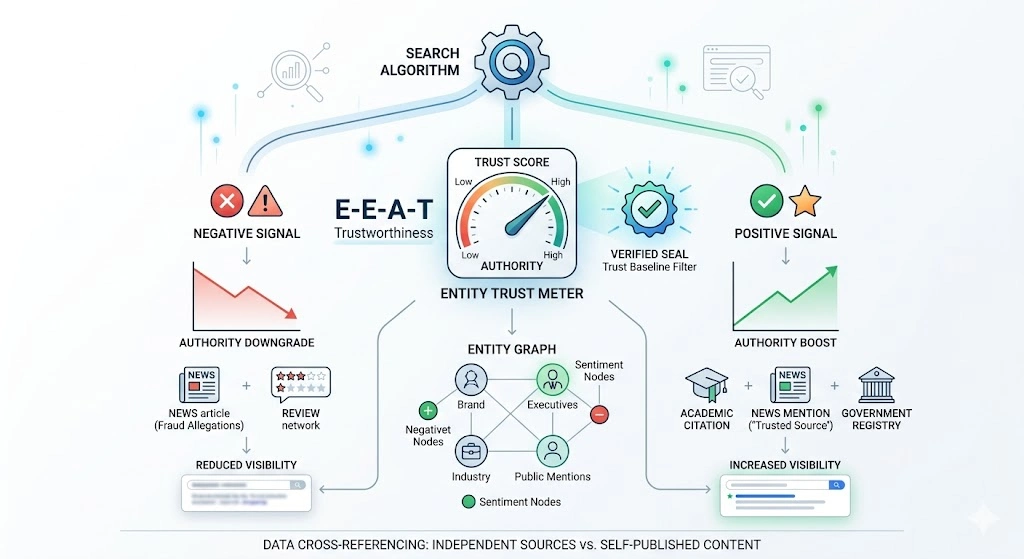
Search engine algorithms evaluate trust and authority through a multifaceted analysis of data points known as reputation signals. Within search ecosystems, entity perception is constructed by cross-referencing information across independent, high-authority domains rather than relying on an entity’s self-published material. Algorithms deploy specific frameworks to assess the Experience, Expertise, Authoritativeness, and Trustworthiness (E-E-A-T) of a brand. Trustworthiness represents the most critical component of this evaluation, acting as the baseline filter for visibility. If an entity demonstrates inconsistent data across corporate registries, news databases, and review networks, the algorithm downgrades its authority score, reducing its overall search visibility.
The mechanical processing of these signals relies on the construction of an entity graph, which maps connections between the business, its executives, its industry, and public mentions. Algorithms scan digital footprints to locate citations on authoritative platforms, academic mentions, and mainstream journalistic coverage.
When content indexing occurs, the system extracts sentiment nodes to determine if the brand is associated with fraudulent activity, consumer dissatisfaction, or regulatory non-compliance. This structural evaluation means that a single authoritative negative article can outweigh dozens of low-quality positive blog posts, as the algorithm prioritises the trustworthiness of the hosting domain over sheer content volume.
What role do review signals play in search perception control?
Review signals represent quantified trust metrics that algorithms extract from third-party platforms to calibrate the prominence and presentation of business entities. Within search ecosystems, review signals function as dynamic user-generated proof that directly influences local pack algorithms and organic rich snippets. Search engines do not merely count the number of stars a business receives; they actively parse the semantic content of the written text within those reviews. Natural language processing models analyse vocabulary choices to detect specific patterns of consumer sentiment, operational velocity, and systemic issues. A high concentration of specific keywords relating to delays or poor quality tells the algorithm that the business carries a higher risk profile.
The mechanism of review interpretation involves calculating frequency, velocity, diversity, and platform authority. A sudden spike in negative reviews alters the sentiment vector of the entity, triggering a re-evaluation of its ranking stability. Furthermore, search engines cross-reference review profiles across multiple independent platforms to verify authenticity and eliminate artificial inflation. When conducting an objective analysis, enterprises must understand how different platforms weigh these signals differently. Businesses frequently rely on comparing review platforms for business reputation monitoring to evaluate how distinct review ecosystems impact their core SERP presentation and algorithmic trust scores. This systematic assessment allows an entity to identify which platforms generate the highest algorithmic weight and require structured oversight.
How does a business digital footprint influence algorithmic sentiment analysis?
A digital footprint is the comprehensive, historical log of all online data trails associated with an entity, which algorithms ingest to form a permanent sentiment profile. Algorithmic sentiment analysis transforms unorganized text from across the web into structured data points that define whether an entity is viewed positively, neutrally, or negatively. Search engines use machine learning models to detect linguistic nuances, irony, and contextual associations surrounding a brand name. If an organization’s digital footprint contains unaddressed historical crises, negative employee reviews, or consumer advocacy complaints, these elements persist within the archival index. The algorithm maps these associations, linking the corporate entity to negative semantic concepts within its database.
This continuous content indexing creates a cumulative perception model where historical data weighs heavily on current search visibility. Algorithms assess the ratio of authoritative positive mentions against critical commentary to establish a baseline sentiment equilibrium. If the digital footprint expands with unverified or low-authority positive content, the system identifies the pattern as unnatural manipulation, which often triggers a manual or algorithmic suppression of visibility. Successful search perception control requires the steady generation of high-authority, neutral-to-positive informational assets that naturally alter the algorithmic baseline.
What are the structural components of an authoritative brand SERP?
An authoritative brand SERP consists of a highly controlled, diversified, and stable matrix of search assets that collectively project institutional credibility. Within search ecosystems, a secure brand SERP contains specific structural elements that leave minimal space for unverified third-party narratives.
- Owned web properties: Securing top organic positions with the primary corporate website, dedicated subdomains, and official international portals ensures direct control over initial consumer contact points.
- Verified knowledge panels: Utilizing structured data markup instructs the search engine to generate an official knowledge graph card containing accurate corporate metadata, executive lists, and official social profiles.
- Controlled social channels: Establishing active profiles on high-authority business platforms creates a defensive barrier of search assets that occupy valuable vertical space on the first page.
- Structured review aggregators: Integrating schema markup allows official review scores to manifest as rich snippets directly within the search listings, providing immediate visual trust signals.
The structural arrangement of these components determines the visual hierarchy and information flow presented to a user during a brand lookup. If a business fails to secure these components, the algorithm populates the vacant space with forum threads, news archives, or competitor comparison pages. This structural vulnerability exposes the organization to volatility, as external actors gain control over the primary visual real estate that defines corporate legitimacy.
How do content indexing and ranking dynamics alter public trust?
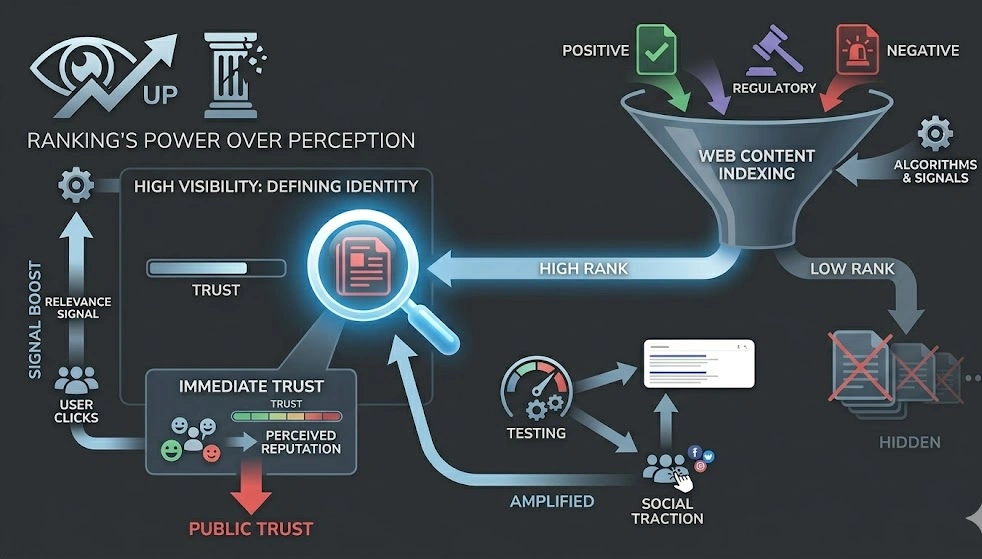
Content indexing and ranking dynamics dictate public trust by controlling the accessibility and visibility of specific narratives. The hierarchy of information on a page creates an immediate cognitive filter; users routinely assign maximum credibility to the top three organic results while completely ignoring subsequent pages. If an algorithm elevates an investigative report or a regulatory penalty notice to the absolute top of the SERP, that piece of information becomes the defining characteristic of the business identity. The ranking dynamic itself creates a feedback loop: highly ranked negative results receive more clicks, which signals relevance to the algorithm, thereby cementing the negative content at the top of the search visibility framework.
The mechanism governing this visibility shift operates through continuous algorithmic adjustments based on user behavior and document updates. When fresh content indexing occurs, search engines temporarily test the new material in higher positions to gauge user engagement signals. If a negative news story gains rapid traction across social media platforms, search algorithms quickly elevate the story within real-time search elements or news carousels. This algorithmic amplification transforms a isolated operational issue into a permanent, highly visible reputational risk that alters the public perception of corporate integrity.
Summary of Search Perception Metrics
The following structural matrix defines how specific digital elements convert into algorithmic metrics, thereby shaping overall search perception and entity authority.
| Digital Asset Element | Algorithmic Extraction Metric | Impact on Entity Perception |
| Corporate Knowledge Graph | Semantic entity node validation | Establishes baseline corporate identity and data consistency. |
| Third-Party Review Networks | Sentiment vector analysis | Adjusts real-time trust scores and local search prominence. |
| Journalistic News Coverage | Domain authority and citation weight | Drives macro visibility changes and dictates crisis duration. |
| Controlled Social Profiles | Profile synchronization and activity data | Secures SERP real estate to prevent third-party narrative capture. |
Within modern search architecture, an unmanaged entity graph leaves an enterprise completely exposed to algorithmic volatility, transforming search results into a critical corporate vulnerability or a definitive trust asset.
In summary, the digital credibility of a business relies entirely on how search engine algorithms process, categorize, and rank its surrounding data trail. Trust is no longer a abstract social variable; it is a calculated mathematical output derived from data consistency, domain authority, and semantic sentiment analysis. Enterprises that treat search results as a passive list of links remain highly vulnerable to sudden shifts in visibility and perception. Managing digital trust requires an analytical comprehension of entity graphs, content indexing mechanisms, and the structural dynamics that govern the search ecosystem.
Frequently Asked Questions
How do Google search results impact a business’s credibility?
Google search results serve as a primary digital storefront, where top-ranking content directly shapes how potential clients perceive a company’s legitimacy. A positive and authoritative Search Engine Results Page (SERP) builds immediate user trust, whereas negative links, unresolved complaints, or a lack of information can severely damage a corporate digital footprint. For businesses looking to secure their online presence, proactive business reputation management ensures that accurate, brand-controlled assets dominate search queries.
What is business reputation management in SEO?
Business reputation management within search engine optimization involves strategic content creation, technical optimization, and search perception control to influence what appears when users search for a brand. This process utilizes advanced search visibility techniques to promote authoritative, positive assets—such as corporate profiles, press releases, and verified reviews—while suppressing outdated or inaccurate information. By managing these reputation signals, a business can maintain a resilient entity graph and safeguard its search perception against algorithmic volatility.
How can a company fix negative search results on Google?
Fixing negative search results requires a systematic approach to content indexing and search perception control rather than a direct deletion of links. A dedicated service like Clear My Name focuses on suppressing negative sentiment by creating, optimizing, and amplifying high-authority web assets that outrank the damaging content. Over time, generating consistent, trustworthy digital signals shifts the algorithmic balance, pushing negative third-party links off the first page of search results.
Why do third-party review platforms affect search engine visibility?
Search engine algorithms treat third-party review platforms as unbiased, high-authority indicators of a brand’s consumer trust and operational history. Natural language processing (NLP) systems actively parse user-generated sentiment, review velocity, and overall ratings to calculate an entity’s trustworthiness score. Consequently, business reputation management relies heavily on monitoring these networks, as a sudden influx of negative reviews can trigger algorithmic suppression and lower organic search visibility.
How does algorithmic sentiment analysis determine brand trust?
Algorithmic sentiment analysis processes the entire digital footprint of a business, converting written text from news articles, blogs, and forums into structured trust metrics. Machine learning models evaluate vocabulary choices and contextual associations surrounding a brand name to classify the overall sentiment as positive, neutral, or negative. If the algorithm detects widespread negative associations, it adjusts the brand’s entity perception score, which can dramatically alter how the business is ranked and presented on the SERP.