

Reputation management is the structured control and interpretation of information that appears about an individual or entity within search ecosystems.
Online reputation refers to the aggregated perception formed through indexed content, search rankings, and digital signals associated with a person’s name across the internet.
This topic focuses on how search engines construct identity profiles, how information is evaluated, and how visibility determines perceived credibility in digital environments.
What is online reputation in search ecosystems for individuals?
Online reputation is the algorithmically constructed perception of an individual based on indexed content, search visibility, and entity-level association across digital platforms. It defines how search engines interpret identity signals and present them in search engine results pages (SERPs). This reputation is not subjective; it is structurally formed through data aggregation and ranking systems.
Search engines evaluate individuals as entities, where every indexed mention contributes to a composite reputation profile. This profile includes social content, public records, articles, profiles, and third-party references. Each element becomes part of an entity graph that defines how a person is represented within search ecosystems.
Read More:
Remove Negative Search Results About You from Google
Online reputation analysis evaluates how consistent, authoritative, and relevant this indexed data appears. High-ranking content defines dominant perception, while low-ranking content reduces visibility but remains part of the underlying dataset. The result is a structured identity layer controlled by indexing logic rather than personal intent.
How is a digital footprint created and indexed by search engines?
A digital footprint refers to the complete collection of traceable data generated through online activity and third-party references. It is created through content production, platform engagement, metadata association, and external mentions. Search engines systematically crawl and index these elements to construct a searchable identity profile.
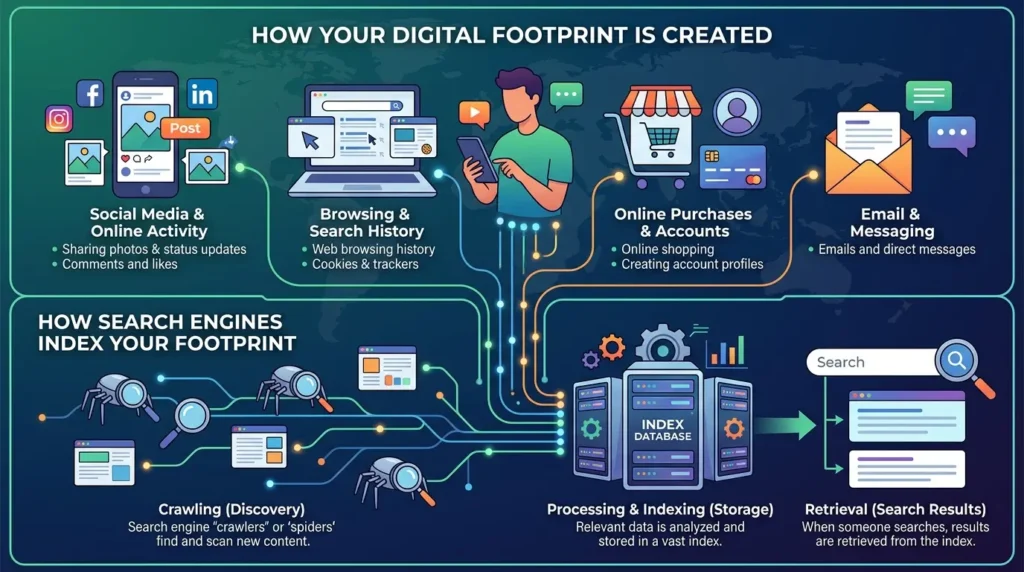
Indexing occurs when automated bots scan web pages, extract entity-related data, and store it within structured databases. Each indexed page contributes signals such as keywords, semantic context, publication authority, and link relationships. These signals define how strongly content is associated with an individual’s identity.
The digital footprint becomes searchable when multiple data points align under a single entity recognition framework. Search engines merge fragmented information into a unified profile through entity resolution systems. This process determines which content appears in SERPs and how prominently it is displayed.
Key mechanisms that build a digital footprint
- Crawling public content sources – Search engines scan websites, social platforms, and directories to collect identity-linked data.
- Indexing structured information – Data is stored with metadata that defines relevance and topical classification.
- Connecting entity references – Algorithms link mentions of a name across multiple domains to form a unified identity.
- Ranking indexed signals – Authority, relevance, and engagement metrics determine search visibility priority.
How do search engines evaluate reputation signals and trustworthiness?
Search engines evaluate reputation signals through structured trust frameworks that measure authority, consistency, and contextual relevance. These systems analyse both content quality and the credibility of sources referencing an individual. Trustworthiness is calculated through algorithmic scoring models that assess data reliability across multiple dimensions.
Reputation signals include backlinks, content sentiment, publication authority, and engagement patterns. Each signal contributes to an overall trust score associated with an entity profile. High-authority references strengthen credibility, while inconsistent or low-quality references dilute perceived trust.

Entity trust evaluation operates through layered ranking systems that prioritise verified, stable, and contextually relevant information. Search engines use these signals to determine which content represents an accurate reflection of identity. This process directly influences SERP composition and visibility hierarchy.
Trust evaluation is continuous, as new content is indexed and existing signals are reweighted based on updated data patterns. The reputation of an individual is therefore dynamic, shaped by ongoing algorithmic reassessment rather than static classification.
How does SERP ranking shape personal perception and entity identity?
SERP ranking defines how information about an individual is ordered, interpreted, and consumed by users during search interactions. It directly determines which identity signals are most visible and therefore most influential in shaping perception.
Search engines prioritise content based on relevance, authority, and user engagement metrics. Higher-ranked pages establish dominant narrative structures, while lower-ranked pages receive significantly reduced visibility. This ranking hierarchy constructs a perception framework that users interpret as credibility.
Entity identity within SERPs is formed through repeated exposure to consistent information across top-ranking results. When multiple high-ranking pages align in messaging, the perceived identity becomes stable. When results conflict, perception fragmentation occurs, reducing clarity of reputation.
SERP evaluation is also influenced by query intent, meaning different search terms produce different identity representations. Informational queries generate broad identity summaries, while navigational queries reinforce specific profile-based content.
What role does content sentiment play in online reputation formation?
Content sentiment defines the evaluative tone embedded within indexed material and influences how search engines interpret reputational quality. Sentiment analysis categorises content as positive, neutral, or negative based on linguistic patterns and contextual framing.
Search engines process sentiment signals to understand reputational directionality. Positive sentiment reinforces authority perception, while negative sentiment introduces credibility risk signals within the entity profile. Neutral content stabilises perception by providing informational balance.
Sentiment is not interpreted in isolation; it is assessed alongside source authority and engagement metrics. High-authority negative content carries stronger reputational weight than low-authority positive content. This structural weighting determines overall perception balance within SERPs.
Content sentiment also influences click behaviour, which feeds back into ranking systems. User interaction patterns signal relevance and credibility, reinforcing the visibility of emotionally or contextually dominant narratives.
How does personal branding function within reputation systems?
Personal branding within search ecosystems refers to the structured alignment of identity signals that define how an individual is represented across indexed platforms. It functions as an entity consistency mechanism that reinforces recognition across multiple data sources.
Search engines interpret personal branding through repetition, semantic consistency, and cross-platform identity alignment. When a name is consistently associated with specific topics, roles, or attributes, the entity profile becomes more stable and predictable within ranking systems.
Personal branding also interacts with authority signals, where repeated association with credible sources increases trust classification. This process strengthens visibility in SERPs by reinforcing topical relevance and entity coherence.
Within reputation systems, personal branding is directly connected to how search engines interpret identity stability. The more consistent the structured data associated with a name, the stronger the entity definition becomes.
Within this framework, Individuals / Personal Branding operates as a semantic anchor that connects identity signals across fragmented digital environments, reinforcing how search engines construct and maintain entity-level reputation profiles.
How is digital credibility maintained across platforms and data sources?
Digital credibility refers to the sustained consistency of trust signals associated with an individual across multiple indexed platforms. It is maintained through alignment between content accuracy, source authority, and entity recognition stability.
Search engines evaluate credibility by comparing information across domains to identify consistency or contradiction. When multiple authoritative sources present aligned data, credibility scores increase. When conflicting data appears, algorithmic trust confidence decreases.
Cross-platform consistency plays a central role in credibility maintenance. Search engines integrate data from websites, directories, social platforms, and structured databases to construct unified entity profiles. Each platform contributes weighted signals based on its authority and reliability.
Credibility is reinforced when identity attributes remain stable across time and platforms. Frequent inconsistencies in name usage, professional descriptions, or contextual associations weaken entity trust evaluation and reduce search visibility strength.
Online reputation within search ecosystems is defined by structured indexing, entity recognition, and algorithmic trust evaluation. Digital footprints form through aggregated data that search engines interpret as identity signals. SERP rankings determine which information dominates perception, while sentiment analysis shapes reputational direction.
Search systems construct personal identity through continuous evaluation of content authority, consistency, and relevance. Personal branding functions as a stabilising mechanism that aligns identity signals across platforms. Digital credibility emerges from sustained coherence within indexed environments, reinforcing how individuals are represented in search-driven information systems.
What is online reputation help for individuals?
Online reputation help for individuals is a set of strategies used to improve or repair how a person appears in search results and online platforms. It focuses on managing negative content, promoting positive information, and improving digital image. Services like Clear My Name often address search visibility and reputation issues.
How does digital image cleanup work?
Digital image cleanup involves identifying negative, outdated, or misleading content across search engines and websites. It then uses techniques such as content removal requests, SEO optimization, and positive content creation. The goal is to improve how a person’s name appears in search results.
Can negative Google results be removed completely?
Not all negative Google results can be fully removed, as it depends on the source website and content type. Some information can be taken down through removal requests, while other results are managed through suppression techniques. Online reputation services focus on reducing visibility rather than total deletion.
How long does online reputation management take?
The time required depends on the amount of negative content and how widely it is indexed online. Small issues may take a few weeks, while larger reputation problems can take several months. Consistent SEO and content updates are usually needed for lasting results.
Is online reputation management legal and safe?
Yes, online reputation management is legal when it follows search engine guidelines and uses ethical methods. It focuses on managing publicly available information rather than hacking or illegal removal. Services like Clear My Name use compliant strategies to improve online reputation safely.