

Reputation management is the process of analysing, influencing, and structuring how entities are interpreted across search ecosystems. Online reputation refers to the collection of indexed signals, content references, and search results that define public perception within search engine results pages (SERPs).
What Is Personal Reputation Management Within Search Ecosystems?
Personal reputation management is the structured evaluation and organisation of digital information linked to an individual entity. Within search ecosystems, reputation is formed through indexed pages, third-party references, profile consistency, media mentions, and behavioural trust signals. Search engines interpret these signals to determine entity credibility and search visibility across branded and non-branded queries. Personal reputation management focuses on understanding how these signals are discovered, processed, and ranked within SERPs.
Search engines classify individuals as entities through identifiable attributes, recurring associations, and semantic consistency. An entity profile develops when search engines repeatedly detect the same name, occupation, expertise area, and contextual references across multiple indexed sources. This process defines how an individual appears within knowledge systems and search result structures. Entity perception is influenced by source authority, contextual relevance, and information freshness. Search systems evaluate whether information aligns with existing entity associations before assigning ranking value.
Negative Google results influence reputation because search engines prioritise relevance, authority, and user interaction metrics. If a negative page receives consistent engagement, backlinks, or citation references, the page strengthens its position within SERPs. Reputation management therefore involves understanding ranking dynamics rather than suppressing isolated pages. Search engines interpret sustained visibility as a relevance indicator connected to user intent. This mechanism explains why negative information remains prominent when stronger contextual alternatives do not exist.
Digital reputation also extends beyond traditional web pages. Social profiles, forum discussions, news archives, image indexing, and public databases contribute to overall entity perception. Search engines aggregate these sources to evaluate trust, expertise, and informational consistency. Each indexed source becomes part of the broader digital footprint connected to an individual entity. Reputation management therefore refers to managing the interpretative relationship between search engines, content ecosystems, and public perception.
How Do Negative Google Results Affect Personal Reputation?
Negative Google results affect personal reputation by altering search-based perception before direct interaction occurs. Search visibility influences how users evaluate credibility, trustworthiness, expertise, and reliability during the information discovery process. SERP evaluation functions as a pre-engagement judgement mechanism within digital ecosystems. Search engines therefore act as intermediaries between content and public interpretation.
Search perception forms through ranking position, headline structure, source authority, and semantic framing. A negative article appearing within the top search positions gains disproportionate visibility because users prioritise higher-ranked content during evaluation. Search engines reinforce this visibility through behavioural metrics such as click-through rates and engagement duration. This creates a cyclical ranking effect in which user interaction strengthens existing visibility patterns. Negative content therefore acquires persistence when engagement signals remain active.

Content indexing also affects temporal relevance. Older negative pages continue appearing when search engines determine that the content retains informational value or authority. Search systems do not evaluate emotional impact; they evaluate relevance, authority, and contextual usefulness. This distinction explains why outdated information remains visible within branded search results. The persistence of indexed information contributes to long-term entity perception.
Search engines additionally evaluate sentiment relationships between entities and associated topics. Repeated co-occurrence between an individual’s name and negative terminology influences semantic associations within search ecosystems. These associations affect autocomplete suggestions, related searches, and contextual query interpretations. Reputation signals therefore extend beyond individual pages into broader search behaviour modelling. Negative visibility becomes structurally embedded when semantic connections remain consistent across indexed sources.
How Do Search Engines Interpret Reputation Signals?
Search engines interpret reputation signals through entity analysis, authority evaluation, and contextual verification systems. Reputation signals refer to measurable indicators that help algorithms determine credibility, trustworthiness, and informational reliability. These signals originate from content structure, source authority, backlink relationships, user engagement, and semantic consistency. Search systems process these factors collectively rather than independently.
Authority signals define whether a source is considered reliable within a particular topic area. Search engines analyse citation frequency, historical trustworthiness, editorial standards, and external referencing patterns to evaluate authority. A source with established topical relevance gains stronger ranking influence than isolated or inconsistent publications. This mechanism explains why authoritative domains often dominate SERP positions. Authority therefore functions as a ranking multiplier within reputation-related searches.
Trust signals emerge through consistency and verification. Search engines compare names, professional identifiers, profile descriptions, and contextual references across multiple sources to confirm entity legitimacy. Inconsistent information weakens entity confidence and reduces semantic clarity. Consistent references strengthen entity recognition and improve search interpretation accuracy. Trust therefore develops through informational alignment rather than promotional visibility.
Search algorithms additionally evaluate behavioural reputation indicators. Engagement metrics such as click-through rates, bounce patterns, and dwell time provide interpretative feedback regarding content usefulness. Search engines use these signals to refine ranking positions over time. Content that sustains engagement gains increased search visibility because algorithms interpret engagement as informational relevance. Behavioural analysis therefore contributes directly to reputation ranking stability.
What Role Does Content Indexing Play in Reputation Management?
Content indexing defines how search engines discover, categorise, and store information connected to an entity. Indexed content becomes retrievable within search results, making indexing a foundational mechanism within reputation systems. Search engines continuously crawl digital environments to identify new or updated information. Once indexed, content enters ranking evaluation processes based on relevance and authority.
Get Deep Insight:
How to Fix Your Online Reputation as an Individual or Professional
Online Reputation Management for Individuals: How to Protect Your Personal Image
Indexed pages contribute to reputation because they form the searchable archive associated with an individual entity. Search systems interpret indexed information as part of a cumulative digital identity. Positive, neutral, and negative content therefore coexist within entity evaluation frameworks. Search visibility depends on how these indexed materials compete for ranking prominence within relevant queries. Reputation management consequently involves understanding indexing behaviour and content hierarchy.
Content freshness affects indexing priority and SERP positioning. Search engines favour updated and contextually relevant information when evaluating current query intent. Fresh content gains increased crawl frequency and stronger temporal relevance signals. Older pages lose visibility when newer authoritative information provides greater contextual value. This mechanism demonstrates how indexing and ranking interact dynamically within search ecosystems.
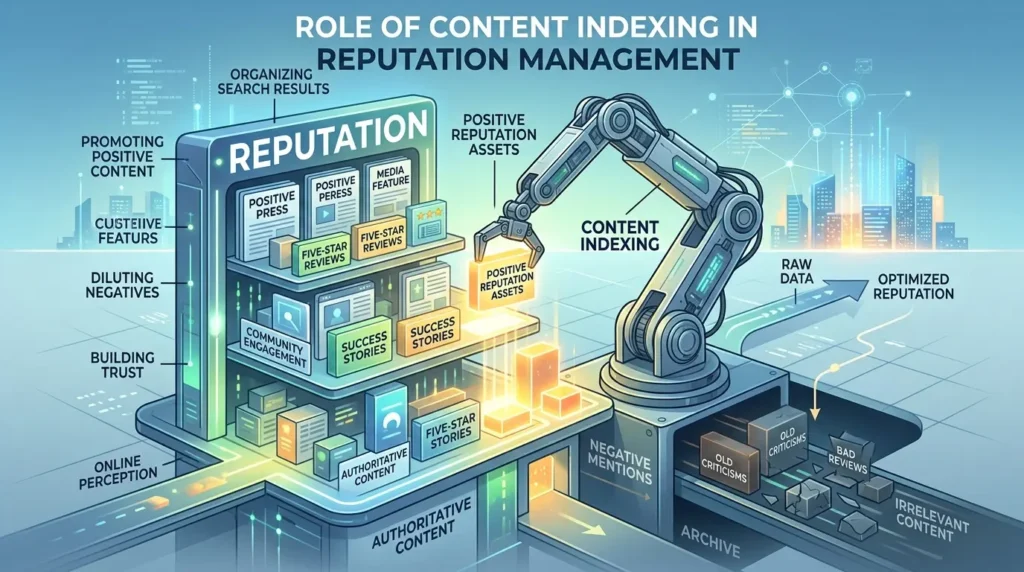
Structured content also improves interpretability during indexing. Clear headings, semantic relationships, metadata, and topical consistency help search engines categorise information accurately. Ambiguous or fragmented content weakens contextual clarity and reduces search relevance. Search systems rely on semantic organisation to connect entities with associated concepts and topics. Indexing therefore functions as both a storage process and a contextual interpretation mechanism.
How Does Search Visibility Influence Public Perception?
Search visibility influences public perception because ranked information shapes initial evaluation before direct communication occurs. Users interpret search results as credibility indicators due to algorithmic filtering and ranking structures. Higher-ranking pages gain greater attention and stronger perceived legitimacy within SERPs. Search visibility therefore acts as a perception gateway within digital environments.
SERP positioning affects authority interpretation. A source appearing repeatedly across branded queries gains perceived relevance because search engines continuously reinforce its visibility. Users often associate ranking prominence with informational accuracy, even when evaluating opinion-based or contextual material. This behaviour strengthens the relationship between visibility and reputation formation. Search engines consequently influence perception through ranking architecture.
Snippet structure also affects interpretation. Titles, descriptions, publication names, and highlighted keywords shape how users evaluate content relevance before clicking. Negative terminology appearing within snippets creates immediate reputational framing. Search engines prioritise snippet relevance based on query intent and semantic alignment. This process influences perception even when users do not open the indexed page.
Image indexing and multimedia visibility additionally contribute to public interpretation. Search engines connect images, videos, and profile references to entity searches through contextual metadata and semantic relationships. Multimedia results therefore become part of reputation ecosystems. A fragmented multimedia presence weakens entity consistency, while aligned media signals strengthen credibility perception. Search visibility extends beyond text-based results into broader informational ecosystems.
Why Do Authority and Trust Signals Matter in SERPs?
Authority and trust signals matter in SERPs because search engines prioritise reliable information sources when ranking reputation-related queries. Authority refers to recognised expertise and credibility within a topic area, while trust signals refer to indicators of informational consistency and legitimacy. Search systems evaluate both factors to reduce misinformation and improve result relevance. These evaluations directly influence ranking stability and search visibility.
Authority signals emerge through repeated topical relevance. Search engines analyse whether a source consistently publishes content connected to specific expertise categories. A source with concentrated topical focus gains stronger contextual recognition than a source with fragmented subject coverage. This mechanism strengthens semantic reliability within search indexing systems. Authority therefore develops through sustained informational consistency.
Trust signals also include technical and structural indicators. Secure websites, transparent authorship, structured metadata, and verifiable references contribute to search credibility evaluation. Search engines use these factors to assess whether information aligns with quality and reliability standards. Weak trust signals reduce ranking potential because algorithms interpret inconsistency as lower reliability. Technical clarity therefore influences reputational interpretation.
Backlink ecosystems reinforce authority and trust simultaneously. Search engines interpret external references as endorsement signals when authoritative domains cite the same entity or content source. The contextual relevance of these backlinks determines their influence on ranking systems. Irrelevant or manipulative linking patterns weaken trust evaluation. Search algorithms therefore assess both quantity and contextual quality within authority calculations.
How Do Sentiment Signals Influence Entity Perception?
Sentiment signals influence entity perception by shaping semantic associations between individuals and contextual terminology. Search engines analyse language patterns, topic relationships, and engagement behaviour to interpret sentiment orientation. Positive, neutral, and negative sentiment clusters contribute to how entities are categorised within search ecosystems. Sentiment analysis therefore functions as a contextual interpretation system rather than an emotional judgement mechanism.
Negative sentiment gains visibility when repeated associations appear across authoritative sources. Search engines identify recurring linguistic relationships between entities and specific descriptors. Consistent negative co-occurrence strengthens semantic relevance during query interpretation. This affects related searches, autocomplete predictions, and contextual ranking behaviour. Sentiment therefore influences broader search ecosystem relationships beyond individual pages.
Review signals also contribute to sentiment evaluation. Search systems analyse review language, frequency patterns, and source credibility to interpret public perception indicators. Structured reviews provide measurable reputation data that algorithms can categorise and compare. Search engines integrate these signals into local visibility, profile prominence, and trust evaluation systems. Sentiment analysis therefore extends into quantitative ranking frameworks.
Contextual balance affects how sentiment influences reputation. Search engines evaluate whether negative references dominate the indexed ecosystem surrounding an entity. A balanced content environment reduces the prominence of isolated negative references by introducing broader semantic diversity. This demonstrates how content ecosystems influence perception stability. Sentiment interpretation depends on cumulative contextual relationships rather than isolated content fragments.
What Is a Digital Footprint in Reputation Management?
A digital footprint is the cumulative collection of indexed information associated with an entity across digital environments. Within reputation management, a digital footprint includes websites, social profiles, media references, forum discussions, public records, images, and behavioural data points. Search engines aggregate these signals to construct entity understanding within search ecosystems. Digital footprints therefore function as searchable identity frameworks.
Active digital footprints develop through intentional publishing and public engagement. Profile updates, authored content, interviews, and professional references contribute to structured entity visibility. Search engines interpret these signals as indicators of relevance and expertise when semantic consistency remains strong. Active footprint development strengthens contextual clarity within indexing systems. This improves search interpretability and entity recognition.
Passive digital footprints emerge through third-party references and external indexing activity. News archives, public mentions, reviews, and forum discussions contribute to entity perception independently of direct control. Search engines evaluate these references using authority and contextual relevance metrics. Passive footprint elements often influence reputation because they originate from external sources perceived as independent. This increases their ranking significance within SERPs.
Digital footprint analysis therefore involves evaluating informational relationships rather than isolated pages. Search engines connect content through semantic associations, metadata, and entity recognition systems. The breadth, consistency, and authority of indexed references determine overall reputation structure. Digital footprints consequently represent the informational architecture surrounding entity perception within search ecosystems.
Personal reputation management refers to the analysis and organisation of how individuals are interpreted within search ecosystems. Search engines evaluate reputation through indexed content, authority signals, behavioural metrics, semantic associations, and contextual trust indicators. These mechanisms determine how entities appear across SERPs and influence public perception through ranking visibility.
Negative Google results persist when relevance, authority, and engagement signals reinforce their search prominence. Search algorithms interpret reputation through cumulative informational relationships rather than isolated pages. Content indexing, sentiment analysis, digital footprints, and entity consistency therefore shape long-term reputation structures within search environments.
Understanding reputation systems requires analysing how search engines process information, classify entities, and prioritise visibility. Reputation management consequently functions as an interpretative framework connected to search evaluation, semantic relevance, and credibility assessment across digital ecosystems.
What are personal reputation management services?
Personal reputation management services help individuals improve how they appear in Google search results and online platforms. These services typically include removing or suppressing negative content, monitoring online mentions, and building positive digital assets to strengthen online reputation.
Can negative Google search results be removed permanently?
Some negative Google results can be permanently removed if they violate platform policies, contain false information, or qualify for legal removal requests. In other cases, reputation management companies like Clear My Name use content suppression and SEO strategies to push harmful results lower in search rankings.
How does online reputation management improve Google search results?
Online reputation management improves Google results by creating and optimizing positive content that ranks higher in search engines. This process helps reduce the visibility of negative articles, reviews, or outdated information associated with a person’s name.
Is personal reputation management legal and ethical?
Personal reputation management is legal when it follows search engine guidelines and focuses on accurate, compliant content strategies. Ethical reputation management services work to remove false, harmful, or outdated information while improving the visibility of trustworthy online content.