

Old party photos resurface at difficult moments because previously published images can remain indexed, tagged, copied, or associated with a person’s digital identity long after their original context has disappeared. Search engines evaluate these assets through signals such as indexing, relevance, links, metadata, and entity associations rather than the circumstances surrounding the original upload.
Reputation management is the structured process of monitoring and influencing the information associated with a person’s identity across digital platforms. Online reputation refers to the collection of publicly accessible information that search engines, platforms, publishers, and users associate with an individual. An old photograph therefore forms part of a broader digital footprint when it remains accessible, searchable, or connected to an identifiable person.
Why do old party photos remain visible online?
Old party photos remain visible because digital content can persist independently of the platform or audience for which it was originally created. Once an image is uploaded to a social network, website, forum, blog, or image-hosting platform, the asset becomes part of an information environment that can continue to exist after the original event has ended. Deleting a post from one profile does not automatically remove copies, screenshots, cached references, or third-party publications. Search engines also retain indexed representations until their crawling and indexing systems process changes to the underlying content. This persistence explains why an image created years earlier can remain relevant to an individual’s current search results.
Content indexing is the process through which search engines discover, process, store, and evaluate online information for potential inclusion in search results. An image becomes particularly significant to reputation when its surrounding page contains a person’s name, username, profile information, location, employer reference, or other identifiable signals. These associations create relationships between the image and the individual’s digital entity. The age of the photograph does not automatically eliminate those relationships. Search visibility therefore depends on the current accessibility and relevance of the content rather than simply the date on which it was created.
How do search engines connect an old photograph with a person?
Search engines connect photographs with people through contextual and entity signals surrounding the image and its hosting page. A person’s name in a page title, caption, URL, alt text, surrounding paragraph, or social profile can establish a relationship between the visual asset and the individual. Links from other pages can reinforce that association by connecting the same identity to the source. Structured information and consistent profile details also contribute to how search systems interpret entities. The result is an information graph in which an image can become connected to a recognisable person even when the photograph itself contains little textual information.
Entity perception refers to how search systems interpret information as belonging to a particular identifiable entity. When multiple sources consistently associate a person’s name with the same social profiles, publications, images, or professional references, those relationships create stronger entity signals. An old party photograph can therefore acquire reputational significance when its page is clearly connected to the person’s identity. Search engines do not evaluate the photograph as a human observer would. They evaluate discoverable relationships, relevance, authority, and content characteristics within the search ecosystem.
Why can an old photo appear during an important professional search?
An old photograph can appear during a professional search when its page or associated profile has sufficient relevance to the searched identity. Search results are not organised exclusively by publication date, so older content remains eligible when it continues to satisfy aspects of the search query. A social profile containing an old image can also rank because the profile itself carries strong identity signals. External links, page authority, engagement signals, and textual context further influence ranking dynamics. Consequently, an image created for a personal audience can become visible during searches conducted for professional or identity-related purposes.
SERP evaluation refers to the process through which search engines determine which indexed documents provide relevant results for a particular query. A person’s name functions as an entity-oriented query when the search engine recognises the name as referring to a specific individual. If an old photograph is associated strongly with that entity, the image or its source page can enter the visible search environment. The result does not necessarily indicate that the search engine considers the image credible, positive, or negative. It indicates that the system has identified a sufficient relationship between the query, entity, and indexed content.
How do tags increase the visibility of old photographs?
Tags increase visibility by creating explicit connections between an image and the profiles or identities named within the platform. A tagged photograph can therefore appear within a person’s profile history, tagged-photo section, social graph, or other platform-specific discovery system. The tag also provides structured information that identifies the relationship between the account and the image. Even when the original uploader controls the photograph, the tagged person’s digital footprint can still contain a reference to it. This creates a distinction between ownership of content and association with content.
Social platforms use different visibility and indexing mechanisms, but the underlying reputational principle remains consistent: an association becomes more significant when it is accessible and repeatedly connected to the same identity. Public tags can also expose content to audiences beyond the original group of contacts. Search engines can index publicly accessible social content depending on the platform’s technical configuration and crawling permissions. Internal platform search can also surface material without external search indexing. Removing or restricting a tag therefore addresses an identity association even when the underlying photograph continues to exist elsewhere.
What role does context play in the interpretation of old photos?
Context influences interpretation because digital images are frequently encountered without the original circumstances surrounding their publication. A photograph uploaded years ago can appear beside a current professional profile, biography, review, article, or social account. The viewer therefore evaluates the image within the information environment available at the time of discovery. Search systems provide documents and relationships rather than a complete historical explanation for every asset. This creates a distinction between the original meaning of content and its current search context.
Digital credibility refers to the perceived reliability of information associated with an identifiable person across online sources. Credibility is influenced by consistency between professional information, social profiles, publications, reviews, and other reputation signals. An isolated photograph does not independently establish a person’s character or professional conduct. Its influence depends on how it is positioned within the wider search environment and whether surrounding information reinforces or contradicts other identity signals. Reputation analysis therefore examines relationships between content rather than treating individual search results as complete representations of a person.
How do reviews and sentiment signals interact with visual content?
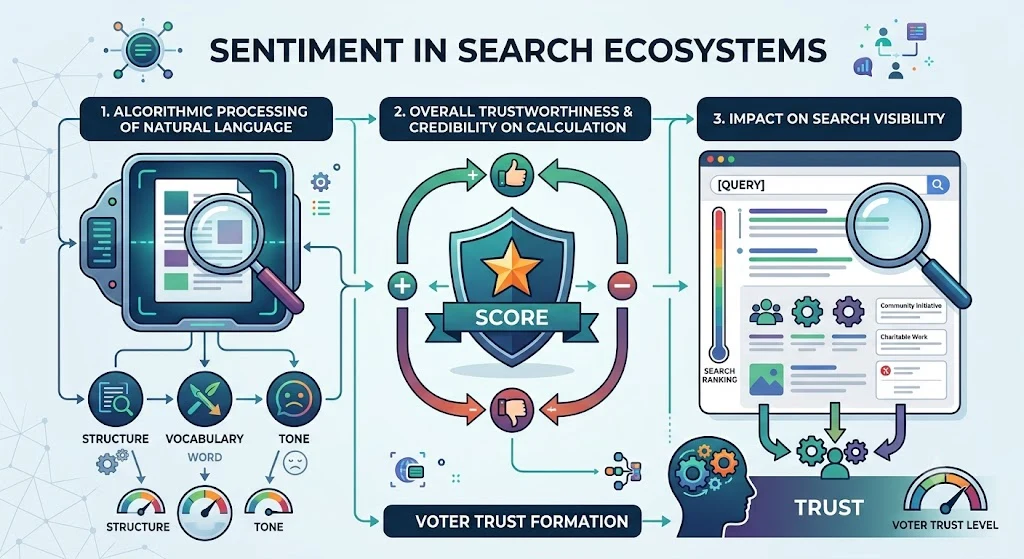
Reviews and sentiment signals influence reputation by providing textual indicators that search systems and users can associate with an individual, organisation, or entity. Positive, negative, or neutral language contributes to the broader information environment surrounding an identifiable subject. Visual content operates within the same environment when it appears on pages connected to reviews, profiles, discussions, or other indexed resources. The combination of textual and visual information can affect how a searcher interprets an entity. This does not mean that algorithms assign a single reputation score to every person.
Sentiment interpretation is the analysis of language and contextual signals that indicate favourable, unfavourable, or neutral perceptions. Search systems evaluate content relevance and quality through complex ranking processes rather than relying on sentiment alone. Reviews can nevertheless provide strong contextual information when they are closely associated with an entity and remain visible in search results. Images connected to those pages can reinforce the surrounding context by adding another information type. Reputation signals are therefore cumulative relationships within an information ecosystem rather than isolated measurements.
Why does content indexing matter when an old photo has been deleted?

Content indexing matters because removing a source does not instantly rewrite every representation of that source across the web. Search engines need to recrawl affected pages, process changes, update their indexes, and reassess whether previous results remain eligible. Other websites can also contain independent copies of the same image. Screenshots, reposts, syndicated content, and social references create additional locations that require separate evaluation. This makes digital content persistence a distributed problem rather than a single-page issue.
Index status determines whether a search engine has a stored representation of a page or asset that can participate in search results. A deleted or restricted source eventually loses search visibility when search systems recognise that the content is no longer available or eligible. However, other indexed locations remain separate information assets. This distinction explains why removing one instance of an image does not necessarily eliminate every appearance associated with it. Effective reputation analysis therefore maps content locations and identity associations across the wider digital footprint.
How can people reduce unwanted connections between old photos and their identity?
People can reduce unwanted connections by controlling public profile information, reviewing tagging permissions, and identifying where historical images remain associated with their name. Cleaning Old Photos and Tags From Your Public Profiles addresses the relationship between outdated visual content and current identity signals by focusing on accessible profile-level associations. The objective is not to alter historical information artificially but to understand which connections remain publicly discoverable. This approach places emphasis on visibility, association, and indexing rather than on the age of the photograph alone.
A structured digital-footprint review evaluates the locations, identifiers, and relationships through which old content remains discoverable. The process can include checking public profiles, reviewing tagged content, examining image-search results, and identifying duplicate references. Each source requires separate evaluation because visibility conditions differ between social platforms, websites, forums, and search engines. Changes to one profile therefore require monitoring of the wider search environment. This creates a clearer distinction between removing an association and removing the underlying content itself.
How does reputation management address persistent digital information?
Reputation management is the ongoing analysis of information that influences how an identifiable person is represented across digital search and publishing systems. It evaluates search visibility, content indexing, entity associations, authority signals, sentiment, and the consistency of information across sources. The process does not depend solely on removing unfavourable material. It also involves understanding which credible information remains visible and how search engines connect different sources to the same entity.
Search perception develops from the interaction between indexed documents, platform profiles, links, reviews, media references, images, and other digital assets. When these sources provide consistent information, the search environment presents a clearer representation of the entity. When historical content remains highly visible while relevant current information is difficult to discover, the search environment becomes less representative of the person’s present identity. Analysing that imbalance requires attention to ranking dynamics rather than focusing on individual results in isolation.
What determines whether an old party photo continues to affect online reputation?
An old photograph continues to have reputational relevance when it remains accessible, strongly associated with the person’s identity, and visible within searches or platform discovery systems. Its influence depends on factors such as source authority, indexing status, query relevance, profile associations, external references, and competing content. The photograph’s age is only one attribute within this wider system. A decade-old image can remain searchable if its source retains authority and the identity connection remains intact.
The most useful evaluation therefore considers the photograph as part of a larger digital footprint. Search visibility establishes whether the material can be discovered, while entity perception determines how strongly it is connected to the person. Authority and trust signals influence the relative prominence of surrounding information, while content indexing determines whether individual sources remain eligible for retrieval. These mechanisms collectively explain why historical photographs can resurface during periods when a person’s online identity receives greater scrutiny.
Dive Deeper With Our Expert Guides:
Why People-Search Sites Publish Your Address and Phone Number
How a Viral Embarrassing Moment Becomes Your First Search Result
Why do old photos resurface when reputation matters most?
Old party photos resurface because digital information persists through indexing, tagging, copying, profile associations, and search ranking systems. Their visibility is determined less by their historical age than by their current accessibility, relevance, authority, and connection to an identifiable entity. Search engines evaluate these relationships through ranking and indexing processes rather than through an understanding of the original social circumstances.
Online reputation is therefore a continuously changing information system rather than a permanent reflection of a person’s past activity. A person’s digital footprint contains historical and current signals that interact across search engines, social platforms, reviews, publications, and other sources. Understanding content indexing, entity perception, reputation signals, and SERP evaluation provides a clearer framework for analysing why old material remains discoverable. This systems-based view explains how information created in one context can acquire renewed visibility when the surrounding search environment changes.
Why do old party photos still appear in Google search results?
Old party photos can remain visible when the original page, social profile, or copied version is still indexed. Search engines can continue associating the image with a person’s name through tags, captions, links, and other reputation signals.
How can old party photos affect someone’s online reputation?
Old party photos can influence online reputation when they appear prominently alongside current professional or personal information. Their impact depends on search visibility, context, entity associations, and how users interpret the available information.
Can removing a tag hide an old party photo from search results?
Removing a tag can weaken the connection between a person’s profile and an old photograph, but it does not necessarily remove the image from its original source. Search visibility also depends on whether the image or page remains publicly accessible and indexed.
How do search engines connect old photos to a person’s identity?
Search engines use signals such as names, usernames, captions, profile information, links, and page context to associate images with an identifiable person. These entity signals help determine which content appears for searches involving that person’s name.
How can Clear My Name help with old photos and tags online?
Clear My Name provides reputation management for individuals, including analysis of publicly visible content connected to a person’s digital identity. Addressing old photos and tags involves reviewing profile associations, content visibility, indexing, and other reputation signals without relying solely on the age of the content.