

A personal reputation recovery and protection strategy is a structured system for managing search visibility, trust signals, and digital identity across online platforms. Effective reputation management for individuals depends on balancing recovery mechanisms with long-term reputation protection measures.
Reputation management strategies differ based on the source of reputational risk, the authority of existing search results, and the durability of digital content. Online reputation control methods are evaluated through search ranking influence, sentiment distribution, entity credibility, and SERP composition.
What defines an effective personal reputation recovery strategy?
An effective reputation recovery strategy is a framework that restores trust signals while reducing the visibility of harmful or outdated information. The effectiveness of a strategy depends on how search engines interpret entity relationships and content authority.
Personal reputation recovery is the process of changing how an individual is represented across search ecosystems. Search engines evaluate reputation signals through content relevance, authority, freshness, and user engagement metrics. Negative content influences entity credibility when authoritative sources dominate search results. Recovery mechanisms therefore focus on altering search result composition rather than simply deleting information. Search ranking influence increases when positive and neutral assets establish stronger topical authority. Reputation management for individuals operates within these search-based constraints.
Recovery strategies differ according to risk type. Defamation, outdated information, poor reviews, and negative media each require different interventions. A legal removal approach addresses policy violations and unlawful content. A content enhancement approach builds stronger digital assets that compete in search visibility. Search engines prioritise relevance and authority rather than intent, making strategic alignment essential. Effective systems measure sentiment distribution across multiple platforms. Sustainable reputation recovery depends on maintaining long-term entity credibility.
How do content suppression and content enhancement compare?
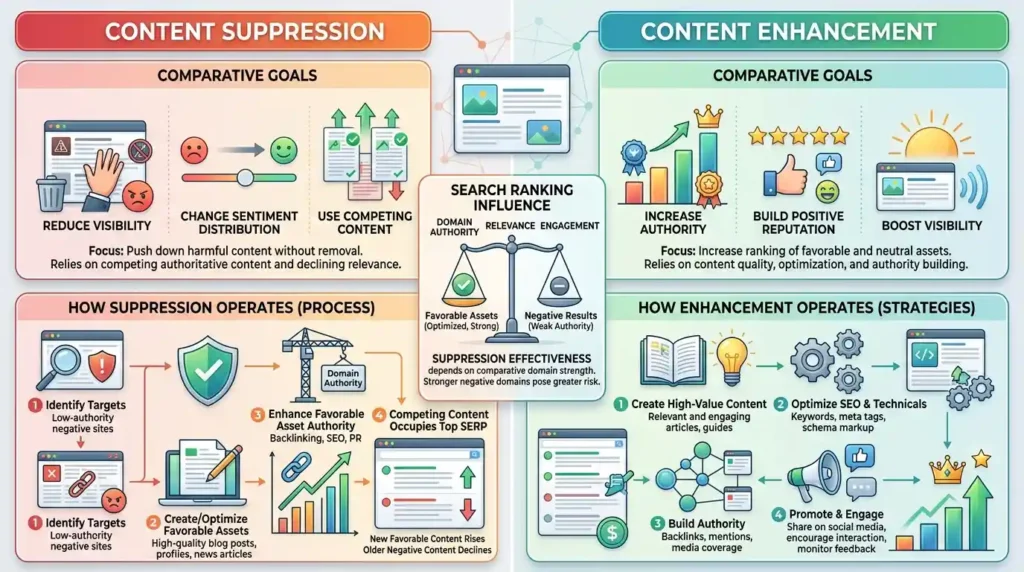
Content suppression and content enhancement differ in their mechanisms for influencing SERP composition. One reduces the visibility of harmful content, while the other increases the authority of positive or neutral assets.
How does content suppression operate?
Content suppression is the process of reducing the prominence of negative search results through competing authoritative content. It operates by increasing the ranking potential of favourable assets that occupy valuable SERP positions.
Search engines rank pages according to authority, relevance, and engagement. Suppression strategies create or optimise high-quality content that competes against unwanted results. This mechanism changes sentiment distribution without removing the original content. The strategy performs effectively when negative pages possess weak authority or declining relevance. Risk exposure increases when harmful content originates from high-authority domains. Search ranking influence therefore depends on comparative domain strength.
How does content enhancement operate?
Content enhancement is the process of strengthening positive reputation signals through strategic publishing and optimisation. It operates by increasing the semantic authority of an individual’s digital footprint.
Enhanced content includes professional biographies, thought leadership, interviews, and verified profiles. Search engines use these assets to establish entity relationships and credibility. Strong content ecosystems improve knowledge graph associations and reinforce trust signals. This approach produces sustainable outcomes because authority accumulates over time. Its limitation lies in slower results when immediate reputation damage exists. Long-term reputation stability, however, benefits from content enhancement strategies.
Which approach performs better: content removal or reputation building?
Content removal and reputation building address different stages of reputation management. One eliminates harmful material when legally or technically possible, while the other strengthens positive representation.
Content removal is a process that eliminates information from search results or source websites. It operates through legal frameworks, privacy rights, platform policies, or publisher cooperation. Removal directly affects search visibility by eliminating indexed content. This method performs effectively when information violates regulations or platform standards. Its limitation emerges when content remains legally permissible. Scalability remains low because each case requires separate evaluation.
Reputation building is the systematic creation of trustworthy digital assets. It influences search ecosystems by increasing entity credibility and diversifying reputation signals. Search engines reward consistent authority across platforms and content formats. Reputation building offers greater sustainability because positive assets continue generating trust signals over time. Risk exposure decreases when digital ownership increases. Compared with removal strategies, reputation building delivers broader long-term resilience.
How do proactive and reactive reputation management methods differ?
Proactive and reactive reputation management differ in timing, resource allocation, and risk mitigation. One prevents reputation deterioration, while the other responds after damage occurs.
Proactive reputation management is the continuous monitoring and optimisation of digital identity. It operates by strengthening online authority before reputational threats emerge. Search engines interpret established entities as more credible due to historical consistency. This approach improves search ranking influence and stabilises sentiment distribution. Risk exposure decreases because strong digital assets resist negative visibility. Sustainability remains high due to continuous optimisation.
Reactive reputation management addresses existing reputational damage. It focuses on suppression, removal, and corrective communication mechanisms. Search ecosystems often preserve negative content due to authority and engagement signals. Reactive measures therefore require greater resources and longer recovery periods. Effectiveness depends on the severity of existing search results. Long-term resilience remains lower without proactive measures.
How do search engines interpret reputation signals?
Search engines interpret reputation signals through authority, relevance, trustworthiness, and user engagement indicators. These signals influence how entities appear across search results.
Reputation signals include mentions, backlinks, reviews, profile consistency, and content quality. Search algorithms evaluate these elements to determine entity credibility. Positive signals strengthen semantic relationships between individuals and topics. Negative associations alter sentiment distribution and influence user perception. Search ranking influence emerges when authoritative content repeatedly confirms expertise or identity. Consistency across platforms increases trust signals.
Entity-based search systems rely on structured data and contextual relationships. Search engines compare information from multiple sources to establish identity confidence. Contradictory information weakens credibility and reduces trust. Strong entity validation improves SERP stability and reduces volatility. Reputation management for individuals therefore extends beyond isolated content pieces. It functions as an interconnected digital ecosystem.
What role does digital footprint optimisation play in reputation protection?
Digital footprint optimisation is the structured management of online assets that define an individual’s public identity. It operates by strengthening visibility across controlled and authoritative platforms.
A digital footprint includes websites, social profiles, publications, directories, and media references. Search engines use these assets to construct entity profiles and determine relevance. Optimisation ensures consistency in names, credentials, and professional associations. Improved consistency strengthens entity credibility and reduces ambiguity. Search ranking influence increases when authoritative assets dominate branded queries. Protection mechanisms become stronger as asset diversity expands.
Digital footprint optimisation provides long-term advantages compared with isolated interventions. Controlled assets remain adaptable to algorithmic changes and evolving search behaviours. Risk exposure decreases because stronger digital ownership reduces dependency on third-party platforms. Sentiment distribution becomes more balanced when positive assets occupy greater SERP real estate. The limitation lies in the time required to establish authority. Sustainability remains significantly higher than short-term corrective methods.
Which metrics measure reputation management effectiveness?
Reputation management effectiveness is measured through search visibility, sentiment distribution, authority indicators, and engagement metrics. These measurements evaluate how search ecosystems perceive an individual.
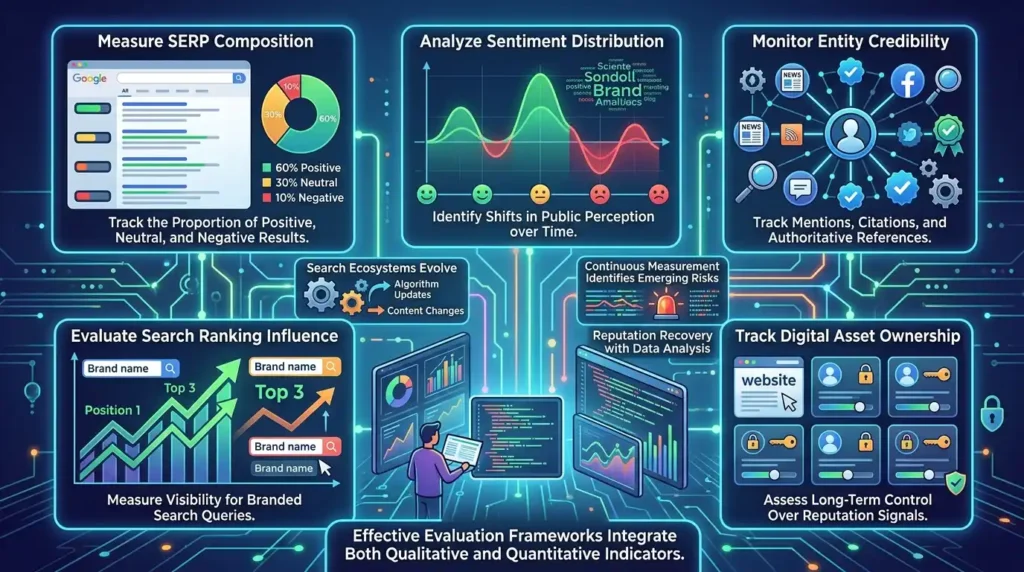
Key evaluation metrics include:
- Measure SERP composition by tracking the proportion of positive, neutral, and negative results.
- Analyse sentiment distribution to identify shifts in public perception over time.
- Monitor entity credibility through mentions, citations, and authoritative references.
- Evaluate search ranking influence by measuring visibility for branded search queries.
- Track digital asset ownership to assess long-term control over reputation signals.
Metrics provide objective evidence of strategy performance. Search ecosystems constantly evolve due to algorithm updates and content changes. Continuous measurement identifies emerging risks before visibility deteriorates. Reputation recovery without data analysis lacks measurable outcomes. Effective evaluation frameworks therefore integrate both qualitative and quantitative indicators.
How do short-term and long-term reputation strategies compare?
Short-term and long-term strategies differ in durability, scalability, and sustainability. Immediate interventions address urgent visibility concerns, while long-term systems strengthen lasting credibility.
Short-term strategies focus on rapid visibility changes through suppression campaigns, removals, and corrective content. These methods alter SERP composition within limited timeframes. Effectiveness depends on the authority of competing content and the nature of reputational risks. Search ranking influence often fluctuates because temporary interventions require ongoing maintenance. Risk exposure remains higher when structural credibility remains unchanged. Immediate outcomes therefore do not guarantee stability.
Dive Deeper With Our Expert Guides:
Comparing DIY and Professional Reputation Monitoring Approaches
How Negative Search Results Influence Professional Opportunities
Long-term strategies strengthen entity credibility through consistent content creation, profile optimisation, and digital footprint expansion. Search engines reward persistent authority signals and semantic consistency. Reputation signals accumulate and reinforce trust over time. Scalability improves because established assets continue generating visibility. Sustainable reputation protection emerges when positive authority exceeds negative influence. Long-term approaches therefore create greater resilience against future reputational challenges.
The evaluation of reputation strategies demonstrates that no single approach addresses every reputational risk. Content suppression, content enhancement, removal methods, and digital footprint optimisation operate through different search mechanisms and influence entity credibility in distinct ways. Search engines interpret reputation signals through authority, relevance, and consistency, making reputation management an ecosystem rather than an isolated activity. Strategic effectiveness depends on sustainability, risk exposure, scalability, and the ability to influence SERP composition over time. A balanced framework integrates recovery mechanisms with protection systems to maintain stable sentiment distribution and durable search visibility.
Within professional contexts, discussions surrounding:
Online Reputation Services for Professionals often focus on how specialised environments influence reputation signals and search visibility.
Answers to Key Questions
How long does it take to improve an individual’s online reputation?
The timeframe depends on the authority of existing search results and the complexity of reputation issues. Reputation management for individuals often involves ongoing content optimisation, search visibility improvements, and digital trust building.
Can negative search results be removed from Google?
Some content can be removed if it violates legal requirements or platform policies. When removal is not possible, online reputation management strategies focus on content enhancement and search result optimisation.
Why is maintaining a positive digital footprint important?
A strong digital footprint strengthens entity credibility and improves trust signals across search engines. Consistent online information helps individuals maintain better search visibility and reputation stability.
How does Clear My Name approach reputation management for individuals?
Clear My Name focuses on analysing online reputation signals, search visibility, and digital identity factors related to reputation management for individuals. Effective reputation strategies evaluate sentiment distribution and long-term reputation protection.