
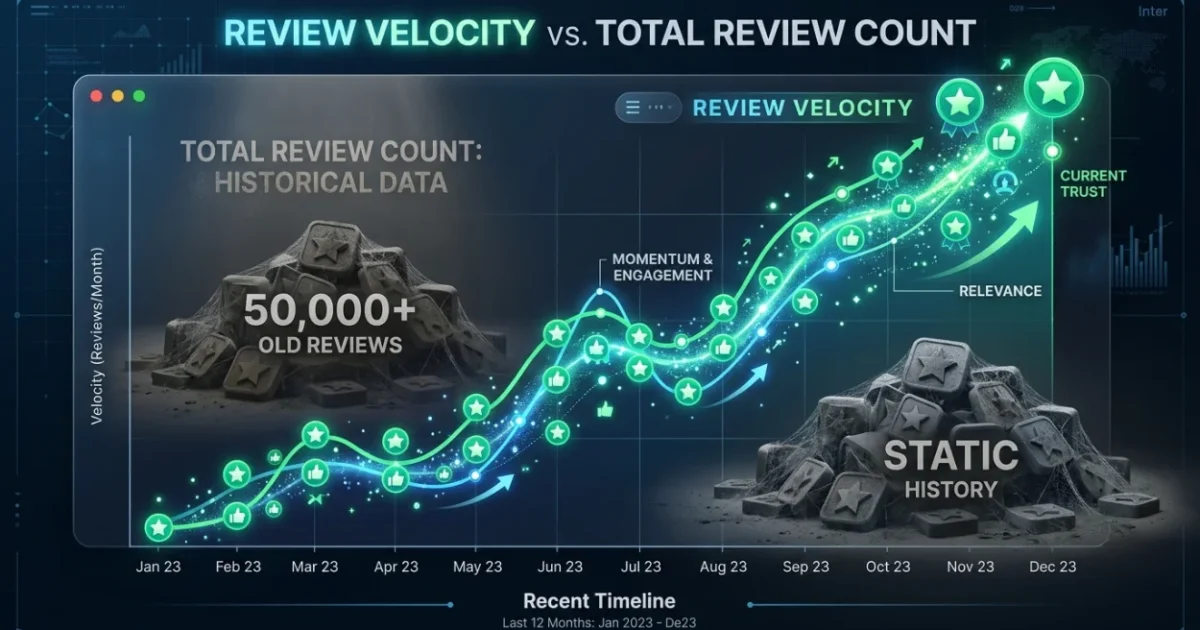
Review velocity matters because the rate at which new reviews appear provides a stronger indication of current customer engagement than total review volume alone. A business with a consistent flow of recent reviews presents a different reputation signal from one with a large historical review count but little recent activity.
Reputation management is the process of monitoring, analysing and influencing how an individual, organisation or entity is represented across digital environments. Online reputation refers to the collection of information, opinions, signals and content that shape an entity’s perceived credibility within search ecosystems. Review velocity forms part of this broader reputation system because review timing adds a temporal dimension to sentiment, relevance and trust evaluation.
What is review velocity in online reputation?
Review velocity is the rate at which an entity receives new reviews over a defined period. It measures review activity through time rather than simply counting the total number of reviews associated with a profile.
A review profile therefore contains two distinct measurements: review volume and review velocity. Review volume represents the accumulated number of reviews, while review velocity represents the frequency and consistency of newly published reviews. A profile containing 2,000 reviews accumulated over ten years has a different temporal pattern from a profile containing 800 reviews generated consistently during the past two years.
This distinction matters because online reputation is not a static dataset. Search ecosystems continuously process newly indexed information, including reviews, ratings, comments and other reputation signals. Recent information contributes to the current representation of an entity, while older information forms part of its historical reputation.
Review velocity also provides contextual information about ongoing customer interaction. A steady pattern indicates continuing review activity, whereas a long period without new reviews indicates reduced recent review signals. The interpretation therefore depends on both the quantity and distribution of review data.
Why does review velocity matter more than total review count?
Review velocity matters because recent review activity provides stronger temporal context than an accumulated historical total. Total review count establishes the scale of an entity’s review history, but it does not explain how current that reputation signal is.
Search systems evaluate information according to relevance, freshness, authority and contextual relationships. Reviews form part of the information environment surrounding an entity, and their publication dates establish when specific reputation signals entered that environment. A high historical count therefore does not automatically represent current customer sentiment.
For example, a profile with 5,000 reviews and only two reviews during the previous year contains substantial historical evidence but limited recent review activity. A profile with 1,000 reviews receiving new reviews consistently contains a stronger stream of current reputation information. The difference concerns temporal distribution rather than absolute volume.
Review velocity also influences how an entity’s reputation appears to users examining search results or review platforms. Users frequently assess recent reviews to understand whether historical perceptions remain representative. Consequently, review recency and review consistency operate alongside aggregate ratings and total review count.
How does review velocity influence search reputation?
Review velocity influences search reputation by contributing fresh reputation signals to the information ecosystem surrounding an entity. Search reputation is shaped by the consistency, relevance and credibility of information associated with an entity across indexed sources.
Reviews can contribute structured and unstructured information. Star ratings provide quantitative signals, while written reviews contain language relating to service quality, products, customer experience and other attributes. Their publication dates add temporal information that distinguishes current sentiment from historical sentiment.
Search engines also analyse relationships between entities, topics and sources. Review content containing consistent references to an organisation’s products, services or attributes strengthens the contextual information surrounding that entity. Regularly published reviews therefore create an ongoing stream of entity-associated content.
This does not mean that review velocity functions as a standalone ranking factor. Search visibility results from multiple systems and signals, including relevance, authority, content quality, technical accessibility and user intent. Review velocity is better understood as one component of the broader reputation environment that search engines and users evaluate.
How do search engines interpret recent review activity?
Search engines interpret recent review activity as time-sensitive information within an entity’s broader digital footprint. The date and context of newly published content help establish whether information represents current or historical conditions.
Content indexing determines when publicly available information enters a search engine’s searchable database. Once indexed, review-related information becomes part of the wider digital environment surrounding an entity. Newer reviews add additional evidence to that environment rather than replacing older information automatically.
Search systems also evaluate semantic relationships within content. Repeated references to relevant products, services, locations or attributes create contextual associations between review content and the entity being discussed. Sentiment interpretation then provides additional information about whether those references are positive, negative or neutral.
Temporal consistency adds another layer. A continuous sequence of reviews provides a different information pattern from a concentrated burst followed by a prolonged period of inactivity. The underlying review count remains important, but the distribution of reviews provides additional context for understanding the current reputation state.
Does a high review count guarantee a stronger online reputation?
A high review count does not guarantee a stronger online reputation because volume does not establish the current quality, consistency or sentiment of the underlying information. Total reviews measure accumulated activity rather than the present condition of an entity’s reputation.
A profile can contain thousands of reviews while still presenting mixed or outdated reputation signals. Historical reviews remain relevant to the overall record, but their age affects how users interpret their relevance to current conditions. Recent reviews provide more immediate evidence about contemporary experiences.
Aggregate ratings also require contextual evaluation. An average rating represents a mathematical summary of ratings but does not reveal the distribution, timing or language of individual reviews. Two entities with identical ratings and review counts can therefore have materially different review profiles.
Review velocity adds the missing temporal dimension. It demonstrates whether review activity continues consistently and whether new sentiment is entering the reputation ecosystem. A complete reputation assessment therefore evaluates volume, velocity, recency, sentiment and contextual relevance together.
How does review velocity affect sentiment interpretation?

Review velocity affects sentiment interpretation because recent reviews provide evidence about the direction and continuity of current sentiment. Sentiment analysis examines language within reviews to identify positive, negative or neutral associations with an entity.
A historical review dataset can contain a large amount of sentiment information, but the balance of that information can change over time. Recent reviews introduce new sentiment signals and establish whether current feedback aligns with or differs from historical patterns.
Consistency is particularly important when analysing sentiment. A continuous sequence of positive reviews creates a different sentiment pattern from a sudden concentration of positive reviews followed by inactivity. Similarly, recurring negative themes in recent reviews provide different reputation information from isolated negative comments that occurred years earlier.
The semantic content of reviews also matters. Search systems and users evaluate references to specific attributes rather than relying exclusively on numerical ratings. Terms associated with reliability, quality, customer support, delivery or professionalism can create identifiable topical relationships within the entity’s reputation profile.
Why is consistent review activity important for entity perception?
Consistent review activity is important because entity perception develops from an accumulation of signals across time. Entity perception refers to how search systems and users understand an organisation, person or brand based on its associated information.
A digital footprint contains information from multiple sources, including websites, social platforms, directories, news publications and review platforms. Reviews form one part of this network and contribute customer-generated evidence to the overall representation of the entity.
Consistent review activity keeps this evidence temporally connected to the entity’s current digital presence. When recent reviews continue to appear, the review profile remains an active source of current information. When activity stops for an extended period, the profile becomes increasingly dependent on historical evidence.
This relationship does not establish that consistent reviews automatically improve rankings. Instead, it explains why review velocity has analytical value when evaluating reputation. It provides evidence about the continuity of customer interaction and the freshness of publicly available sentiment.
How should review velocity be evaluated alongside review volume?
Review velocity should be evaluated as a temporal metric alongside total review count, rating distribution, sentiment and review recency. No single measurement provides a complete representation of an entity’s reputation.
A useful evaluation begins by establishing the review volume and then examining how that volume is distributed across time. The analysis then identifies whether review activity is continuous, concentrated within specific periods or characterised by long gaps.
The next stage evaluates sentiment within recent reviews. This separates current reputation signals from historical sentiment and identifies whether recent feedback reinforces or changes the established reputation pattern.
Finally, the review profile can be considered within the wider search environment. Review signals interact with other forms of indexed information, including authoritative content, third-party references and entity-associated pages. This creates a broader SERP evaluation framework in which review velocity represents one temporal reputation signal rather than an isolated metric.
Dive Deeper With Our Expert Guides:
How Meta’s Review Policies Decide What Content Stays
Why Facebook Reviews Carry More Weight for Local Services
What role does review velocity play in digital credibility?
Review velocity contributes to digital credibility by demonstrating that an entity continues to generate publicly observable feedback over time. Digital credibility refers to the perceived reliability and trustworthiness of an entity based on the quality and consistency of its online information.
Credibility is constructed through multiple independent signals. Authoritative references establish external recognition, high-quality content demonstrates topical relevance, and customer reviews provide experience-based information. The interaction between these signals creates a more comprehensive representation than any single source.
Review velocity strengthens the temporal component of that representation. Recent and consistently distributed reviews provide evidence that the entity continues to receive attention and feedback. This evidence becomes part of the wider reputation dataset available to both users and search systems.
The key distinction is between activity and accumulation. Accumulation explains how much historical evidence exists, while activity explains how frequently new evidence enters the system. Effective reputation analysis therefore treats both measurements as separate but connected dimensions.
How can review velocity be understood within reputation management?
Review velocity can be understood within reputation management as a measurement of how quickly current reputation information enters an entity’s digital footprint. It provides a framework for analysing the timing and continuity of customer-generated content.
Reputation management is not limited to monitoring negative information or tracking star ratings. It involves understanding how information is created, indexed, connected and interpreted across digital systems. Review velocity fits this framework because it explains how reputation information changes through time.
A complete analysis considers review volume, velocity, recency, sentiment, source credibility and semantic relevance. These measurements reveal different properties of the same reputation environment. Volume measures scale, velocity measures activity, recency measures freshness, and sentiment measures the direction of expressed opinion.
This analytical approach prevents total review count from becoming the sole measure of reputation strength. A large historical dataset provides valuable evidence, but current review activity determines how much new reputation information continues to enter the ecosystem.
Review velocity matters because reputation is a time-dependent information system rather than a static numerical score. Total review count measures accumulated evidence, while review velocity measures the frequency and continuity of new reputation signals.
Search visibility and entity perception are influenced by multiple information sources, making review velocity one component of a broader SERP evaluation process. Recent reviews contribute current sentiment, contextual information and temporal evidence to an entity’s digital footprint.
Understanding review velocity therefore provides a more complete view of online credibility than relying exclusively on total review count. The most meaningful analysis evaluates volume, timing, sentiment, consistency and authority together to understand how an entity’s reputation is represented within search ecosystems.
Why is review velocity important for online reputation?
Review velocity measures how frequently an entity receives new reviews over a specific period. It provides temporal context about current customer feedback, making it a useful reputation signal alongside total review count and average rating.
What is a good review velocity for a business?
A good review velocity is consistent with the business’s normal customer activity and review history. Consistent review generation provides a clearer indication of ongoing customer engagement than an isolated increase in review volume.
Does review count affect search visibility?
Review count contributes to the overall information associated with an entity, but it does not independently determine search rankings. Search engines evaluate review information alongside relevance, content quality, authority, sentiment and other reputation signals.
Are recent reviews more important than older reviews?
Recent reviews provide stronger temporal context because they reflect more current customer experiences. Older reviews remain part of the historical reputation record, while newer reviews help indicate whether established sentiment continues over time.
How does review velocity affect reputation management?
Review velocity helps reputation management analysis measure the frequency and consistency of new customer feedback. Evaluating it alongside sentiment, review recency, rating distribution and total review volume provides a more complete view of an entity’s online reputation.