

Political reputation monitoring has shifted from tracking isolated media mentions to evaluating interconnected digital signals across search engines, social platforms, news ecosystems, and public discussion spaces. Reputation management strategies differ based on platform structure, content velocity, search ranking influence, and the way entity credibility is interpreted across digital ecosystems. Online reputation control methods are evaluated through sentiment distribution, SERP composition, reputation signals, engagement quality, and content authority rather than isolated metrics.
How has political reputation monitoring evolved across digital platforms?
Political reputation monitoring is the continuous evaluation of digital signals that influence public perception across multiple online environments. It operates by analysing search visibility, content authority, audience interaction, media coverage, and sentiment distribution to understand how an individual or political entity is represented online. Earlier monitoring approaches focused primarily on newspaper coverage, television broadcasts, and isolated web mentions. Modern monitoring evaluates interconnected digital ecosystems where search engines, social platforms, video content, forums, and news publishers continuously reinforce or reshape reputation signals.
Search engines now aggregate information from numerous authoritative sources while social platforms generate rapid engagement signals that influence public attention. This interconnected environment creates a broader digital footprint where entity credibility depends on consistency across multiple channels rather than isolated publications. Reputation monitoring therefore compares information accuracy, publication authority, engagement quality, and search ranking influence simultaneously. The evaluation process extends beyond counting mentions and instead measures how different digital assets contribute to overall search perception.
Which digital platforms provide the strongest reputation signals?
Different digital platforms contribute distinct reputation signals because each operates under separate ranking systems, audience behaviours, and content evaluation models. Search engines prioritise authority, relevance, structured information, and content relationships, while social networks prioritise engagement velocity, interaction patterns, and audience participation. News websites contribute editorial credibility, whereas video platforms strengthen visual authority and long-form explanations.
Search engines versus social platforms
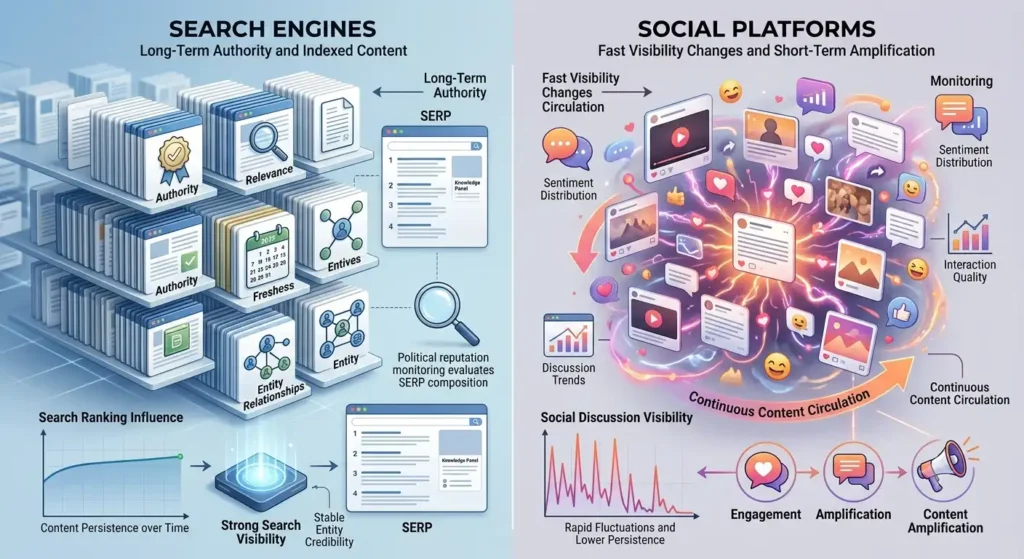
Search engines organise information according to relevance, authority, freshness, and entity relationships. Political reputation monitoring evaluates SERP composition by analysing which pages dominate branded searches, related entities, knowledge panels, and news results. Search ranking influence reflects long-term authority because indexed content remains discoverable long after publication. Strong search visibility supports stable entity credibility when authoritative sources consistently reinforce accurate information.
Social platforms operate through continuous content circulation driven by engagement and algorithmic distribution. Monitoring evaluates sentiment distribution, interaction quality, discussion trends, and content amplification. Social content spreads rapidly but also changes rapidly, creating frequent fluctuations in reputation signals. Compared with search results, social discussions produce faster visibility changes while offering lower long-term content persistence.
News platforms versus community discussions
Editorial news platforms contribute structured credibility because published content undergoes editorial review before distribution. Reputation monitoring measures publication authority, article prominence, topic consistency, and citation frequency across reputable sources. News content frequently influences search visibility because authoritative publishers receive strong ranking signals within search ecosystems.
Community discussion platforms generate different forms of reputation signals through public conversations, comments, and user-generated evaluations. These discussions reveal sentiment distribution rather than institutional authority. Monitoring analyses recurring themes, discussion frequency, and narrative consistency instead of editorial credibility. Together, editorial publications and community discussions provide complementary perspectives on digital reputation.
How do proactive and reactive reputation monitoring approaches compare?
Proactive reputation monitoring establishes continuous observation before reputation challenges emerge. Reactive monitoring begins after negative attention becomes visible across search engines or digital platforms. Both approaches analyse reputation signals, yet they differ significantly in timing, operational efficiency, and risk exposure.
Proactive monitoring operates by tracking search visibility, sentiment changes, content publication, and entity associations on an ongoing basis. Continuous evaluation identifies emerging reputation trends before they dominate search ecosystems. Early identification improves content enhancement opportunities because authoritative content enters search indexes before negative narratives expand. Long-term monitoring also produces historical datasets that support accurate trend analysis and performance measurement.
Reactive monitoring focuses on identifying existing reputation issues after visibility changes become measurable. Analysis centres on content suppression versus content enhancement, negative search results, misinformation, and declining sentiment distribution. Although reactive monitoring addresses immediate visibility concerns, corrective measures compete against already established search ranking influence. This creates greater operational complexity because negative content already occupies authoritative positions within search results.
From a sustainability perspective, proactive monitoring produces stronger long-term entity credibility while reducing overall reputation volatility. Reactive monitoring provides essential issue identification but requires greater resources to restore balanced search perception once negative narratives gain visibility.
How do content enhancement and content suppression strategies differ?
Content enhancement and content suppression represent two distinct reputation management methods that influence search ecosystems through different mechanisms. Each approach affects SERP composition, entity credibility, and search ranking influence differently.
Content enhancement is the creation and optimisation of authoritative digital assets that strengthen positive reputation signals. It operates by publishing high-quality articles, structured profiles, interviews, policy explanations, verified media coverage, and educational resources that satisfy search intent. Search engines reward authoritative, relevant, and well-connected content, allowing enhanced assets to strengthen overall SERP composition naturally. This method builds sustainable digital authority because it continuously expands trusted information.
Content suppression focuses on reducing the visibility of undesirable search results through stronger competing content. Rather than removing existing information, suppression changes ranking dynamics by increasing the authority of alternative pages. The mechanism relies on search competition rather than deletion. Effectiveness depends on content quality, domain authority, internal linking, and topical relevance.
Content enhancement provides greater long-term sustainability because it expands authoritative information that reinforces entity credibility. Content suppression delivers measurable improvements when competing content achieves stronger search ranking influence, yet its effectiveness depends entirely on the relative authority of competing digital assets. Combining both mechanisms produces broader SERP improvements without relying exclusively on visibility reduction.
How do search engines evaluate political reputation signals?
Search engines evaluate political reputation through interconnected signals that describe authority, relevance, consistency, and entity relationships across the web. Reputation signals are interpreted collectively rather than individually, creating a comprehensive representation of digital trust.
Entity credibility is the measurable consistency of information associated with a recognised public figure. It operates by connecting names, organisations, publications, social profiles, structured data, and authoritative references into a unified digital identity. Search engines compare these signals across multiple sources to determine information reliability and relationship accuracy.
Sentiment distribution complements entity credibility by measuring the balance of positive, neutral, and negative content appearing across search ecosystems. Balanced sentiment supported by authoritative publications strengthens stable search perception because search engines recognise consistent topical coverage. Uneven sentiment concentrated within high-authority publications alters SERP composition by increasing visibility for dominant narratives.
Search ranking influence reflects the authority and relevance of digital assets rather than popularity alone. Pages receiving consistent authority signals, topical depth, quality backlinks, and strong user engagement achieve stronger visibility. Reputation monitoring therefore evaluates how these ranking factors interact instead of measuring isolated metrics.
Which monitoring metrics provide the most meaningful evaluation?
Effective political reputation monitoring relies on measurable indicators that describe search performance, public perception, and content authority simultaneously. Single metrics rarely represent complete reputation performance because digital ecosystems combine multiple ranking signals.
The most informative evaluation framework includes:
- Measure SERP composition by analysing the proportion of positive, neutral, and negative search results appearing on the first search results page.
- Evaluate sentiment distribution across search engines, news platforms, social networks, and discussion communities to identify dominant perception patterns.
- Track entity credibility through consistent citations, authoritative references, structured information, and verified digital profiles.
- Compare search ranking influence by monitoring visibility changes for authoritative content against competing narratives.
- Analyse publication authority by examining source credibility, editorial standards, topical relevance, and citation relationships.
These indicators produce a balanced evaluation because they combine technical search performance with public perception analysis. Continuous measurement also identifies gradual reputation shifts that isolated monitoring frequently overlooks.
How do short-term and long-term monitoring strategies compare?

Short-term monitoring evaluates immediate changes following news coverage, political announcements, debates, or public discussions. It operates through frequent observation of search rankings, social engagement, and sentiment distribution over limited periods. This approach identifies rapid visibility changes and emerging narratives before they expand into broader search ecosystems. Short-term evaluation supports immediate analysis of reputation signals but offers limited insight into long-term authority development.
Long-term monitoring analyses reputation patterns across extended periods to measure sustainable entity credibility. Historical trend analysis identifies recurring sentiment cycles, consistent publication authority, and gradual changes in SERP composition. Search engines reward sustained authority more consistently than isolated bursts of activity, making long-term evaluation essential for understanding search ranking influence. Stable digital footprints also improve consistency across multiple search queries and related entity associations.
Comparing both approaches demonstrates that immediate monitoring provides operational awareness, whereas long-term monitoring evaluates strategic sustainability. Together they create a comprehensive understanding of digital reputation because temporary visibility fluctuations are interpreted alongside enduring authority signals.
Dive Deeper With Our Expert Guides:
Which Political Reputation Signals Should Campaign Teams Monitor Closely?
Evaluating the ROI of Digital Communications in Political Reputation Building
What limitations affect political reputation monitoring across digital platforms?
Political reputation monitoring remains dependent on platform-specific algorithms, indexing behaviour, and content availability. These technical differences influence data interpretation and create analytical limitations that require structured evaluation.
Search engines continuously update ranking systems, altering the visibility of indexed content without changing the content itself. Social platforms modify recommendation algorithms according to engagement objectives, affecting audience exposure independently of information quality. News publishers determine editorial priorities that influence publication frequency and topical emphasis. Community platforms generate discussion patterns based on user participation rather than editorial judgement.
These structural differences require cross-platform comparison because isolated datasets provide incomplete representations of reputation. Monitoring systems therefore evaluate relationships between search visibility, content authority, engagement quality, and sentiment distribution rather than relying on a single platform. Integrated analysis produces more accurate assessments of entity credibility and search perception than platform-specific reporting alone.
Political reputation monitoring has evolved into a multidisciplinary evaluation process that measures interconnected reputation signals across search engines, news publications, social platforms, and community discussions. Proactive monitoring differs from reactive monitoring through timing and sustainability, while content enhancement and content suppression influence SERP composition through separate mechanisms. Search engines interpret entity credibility, sentiment distribution, publication authority, and search ranking influence collectively, making integrated evaluation essential for accurate reputation analysis.
Long-term monitoring strengthens consistent digital assessment, whereas short-term analysis identifies immediate reputation shifts following new information. Effective evaluation depends on comparing multiple digital environments rather than interpreting isolated metrics. Understanding these differences enables more accurate assessment of online political visibility and provides a structured framework for analysing:
Multi-Platform Reputation Management Services for Political Campaigns within the broader context of reputation management for politicians.
Answers to Key Questions
What is reputation management for politicians?
Reputation management for politicians is the process of monitoring, analysing, and improving how political figures are perceived across search engines, news websites, social media, and other digital platforms. It focuses on reputation signals, online visibility, and public trust through accurate and authoritative content.
Why is online reputation important for politicians?
Online reputation influences how voters, journalists, and stakeholders perceive a political figure when searching online. Strong digital credibility and balanced search results help present accurate information across multiple platforms.
How does political reputation monitoring work?
Political reputation monitoring tracks mentions, search engine results, news coverage, social media discussions, and sentiment distribution to identify changes in public perception. This analysis helps evaluate digital reputation trends and search visibility over time.
Can negative search results about politicians be managed?
Negative search results are typically managed through content enhancement, search visibility optimisation, and continuous reputation monitoring rather than immediate removal. These approaches strengthen authoritative information and improve overall SERP composition where appropriate.