

Political campaign teams monitor reputation signals that directly influence public trust, search visibility, and digital credibility across search engines, news platforms, social media, and authoritative websites. The strongest indicators combine search perception, sentiment distribution, content authority, and engagement quality to provide an accurate picture of public reputation.
Reputation management strategies differ based on the type of reputation signals being monitored, the speed at which information spreads, and the platforms shaping public perception. Online reputation control methods are evaluated through search ranking influence, entity credibility, sentiment distribution, content authority, and the balance between content suppression vs content enhancement. Within reputation management for politicians, monitoring measurable reputation indicators enables campaign teams to evaluate perception changes before they influence voter confidence, media narratives, and search engine results pages (SERPs). Search engines continuously analyse relationships between entities, authoritative sources, user engagement, and topical relevance, making reputation signals an integral component of digital visibility rather than a standalone communications activity.
Which Political Reputation Signals Have the Greatest Influence on Search Visibility?
Search engines assign greater value to reputation signals that demonstrate authority, consistency, relevance, and public trust across multiple digital sources. Strong reputation signals reinforce entity credibility while weak or conflicting signals reduce search confidence and create fragmented SERP composition.
Entity credibility is the foundation of political reputation analysis. Entity credibility is the degree of confidence search engines establish when identifying a political figure through verified information, authoritative publications, structured data, and consistent digital references. It operates by connecting mentions across trusted websites, official publications, news coverage, interviews, and publicly accessible records. Consistent information strengthens search ranking influence because search engines identify fewer contradictions across indexed content. Inconsistent entity information weakens confidence and increases ambiguity within search ecosystems.
Sentiment distribution provides another measurable reputation signal. Sentiment distribution is the balance between positive, neutral, and negative content appearing within indexed search results. It operates by reflecting how frequently each sentiment category appears across news articles, opinion pieces, discussion platforms, videos, and social media references. A balanced sentiment profile often indicates broader topical coverage, whereas a concentration of negative content reshapes search perception and alters user behaviour before engagement with official sources.
Search ranking influence measures the visibility of reputation-related content across prominent search positions. Content occupying the first page gains substantially higher user interaction than lower-ranked pages, making ranking position an important indicator of reputation exposure. High-authority informational content generally stabilises reputation signals because it provides consistent context for search engines. Lower-quality or duplicated material introduces conflicting signals that reduce topical clarity.
How Does Search Engine Interpretation Compare with Public Sentiment Analysis?
Search engine interpretation evaluates authority, relevance, and entity relationships, whereas public sentiment analysis measures emotional and opinion-based responses across digital platforms. Both systems assess reputation differently, making their combined evaluation more accurate than relying on a single metric.
How Search Engines Interpret Reputation Signals

Search engines interpret reputation using structured relationships rather than emotional reactions. Algorithms analyse topical authority, backlink quality, semantic relevance, entity consistency, freshness, and source reliability. This mechanism prioritises information that demonstrates expertise and contextual accuracy instead of popularity alone. Search ecosystems also compare information across multiple domains to validate factual consistency. As a result, search visibility reflects information quality as much as public attention.
How Sentiment Analysis Measures Public Perception
Sentiment analysis evaluates the emotional direction of public discussions by classifying content into positive, neutral, or negative categories. It operates by processing language patterns, contextual meaning, engagement trends, and discussion frequency across digital channels. Unlike search algorithms, sentiment systems measure public reactions rather than source authority. Rapid changes in sentiment distribution often appear before significant changes occur within search rankings. This makes sentiment monitoring valuable for identifying emerging reputation trends.
Comparative Evaluation
Search interpretation provides long-term indicators of digital credibility, while sentiment analysis captures immediate perception shifts. Search systems favour authoritative evidence and topical consistency. Sentiment analysis responds rapidly to public discussion but fluctuates more frequently because conversation volumes change quickly. Combining both approaches improves reputation evaluation by balancing stable authority indicators with dynamic perception metrics.
Which Digital Sources Produce the Strongest Political Reputation Signals?
Authoritative news publications, government records, official websites, academic references, and verified social platforms generate stronger reputation signals than low-authority user-generated content because search engines assign greater trust to reliable information sources.
News publications influence reputation by introducing high-authority content into search ecosystems. News articles often receive rapid indexing, making them significant contributors to SERP composition during political campaigns. Their authority increases search ranking influence when multiple trusted publishers reference similar factual information. Repeated coverage also strengthens entity associations through semantic relationships established by search algorithms.
Official websites contribute structured information that reinforces entity credibility. They operate by providing consistent factual references, biographies, policy documents, speeches, and verified announcements. Search engines compare these resources against external references to measure consistency. Reliable official content therefore strengthens topical authority without relying solely on engagement metrics.
Social media contributes behavioural reputation signals rather than primary authority signals. Verified profiles improve entity recognition, while engagement quality provides additional context regarding audience interaction. Search engines evaluate these platforms alongside authoritative sources rather than treating engagement alone as evidence of credibility. Consequently, strong social engagement complements authoritative content instead of replacing it.
How Does Content Enhancement Compare with Content Suppression?
Content enhancement improves reputation by increasing the visibility of authoritative information, whereas content suppression reduces the prominence of unfavourable search results through stronger competing content. Both approaches alter SERP composition using different mechanisms.
Content enhancement is the systematic publication of authoritative, relevant, and semantically connected material. It operates by expanding topical coverage through articles, interviews, policy pages, multimedia resources, and structured information. Search engines reward comprehensive topical depth because it strengthens entity credibility and contextual relevance. This approach produces sustainable search ranking influence through continuous information growth.
Content suppression operates by introducing stronger authoritative content that naturally outranks less relevant pages. It does not remove information from search indexes. Instead, it changes SERP composition by increasing the ranking strength of higher-quality pages. This mechanism reduces visibility for lower-authority results without altering their existence. The effectiveness of suppression depends entirely on the authority and relevance of competing content.
Content enhancement offers greater long-term sustainability because it continually strengthens topical authority. Content suppression addresses visibility distribution more directly but requires ongoing optimisation to maintain ranking advantages. Comparing both methods demonstrates that sustainable reputation management relies more heavily on expanding authoritative content than relying exclusively on visibility displacement.
How Do Organic Reputation Strategies Compare with Reactive Reputation Responses?
Organic reputation strategies build consistent authority over time, whereas reactive responses focus on correcting sudden reputation disruption after negative information appears. Their effectiveness differs according to timing, scalability, and long-term stability.
Organic reputation management is continuous digital reputation development through authoritative publishing, entity optimisation, and consistent messaging. It operates by strengthening search confidence before reputation challenges emerge. Search engines interpret ongoing publication activity as evidence of topical authority, producing gradual improvements in search ranking influence and entity credibility.
Reactive reputation responses address existing reputation issues through corrective communication, factual clarification, content optimisation, and search result management. They operate after reputation signals have already shifted. This approach restores information balance but requires greater effort because search ecosystems already contain established negative associations.
Organic strategies demonstrate stronger sustainability because search authority develops progressively across multiple trusted sources. Reactive strategies resolve immediate reputation imbalance but often require extended optimisation before search ecosystems fully recognise updated authority signals. Comparing these approaches highlights the importance of continuous monitoring alongside responsive reputation evaluation.
Which Metrics Best Measure Political Reputation Performance?
Reputation performance is measured through indicators that reflect visibility, credibility, consistency, and public perception across search ecosystems. Effective measurement combines technical search data with perception analysis rather than relying on a single performance metric.
Campaign teams evaluate reputation by measuring:
- Track sentiment distribution across news results, search results, and public discussion platforms to identify changes in overall perception.
- Measure search ranking influence for branded and issue-based search queries to assess SERP composition over time.
- Evaluate entity credibility using authoritative citations, knowledge consistency, structured information, and trusted references.
- Analyse content authority by comparing topical relevance, publication quality, backlink strength, and semantic coverage.
- Monitor engagement quality to distinguish meaningful audience interaction from temporary visibility spikes.
Each metric represents a different component of digital reputation. Search ranking influence measures discoverability, sentiment distribution measures perception, entity credibility measures trust, and content authority measures information quality. Combined evaluation provides a broader understanding of political reputation than isolated analytics.
How Do Short-Term Reputation Signals Compare with Long-Term Reputation Indicators?
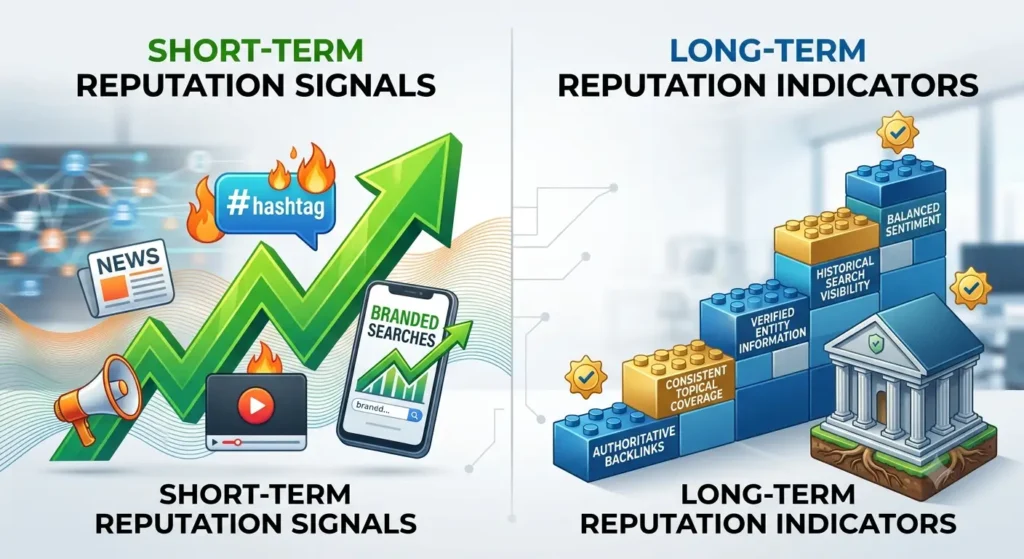
Short-term reputation signals reflect immediate public attention, while long-term indicators demonstrate sustained digital authority and consistent trust. Comparing both categories reveals important differences in stability, predictability, and strategic value.
Short-term signals include trending news coverage, social discussion volume, viral content, and sudden increases in branded searches. These indicators change rapidly because they respond directly to current events and media attention. Search ecosystems recognise these changes quickly, although ranking stability depends on the continued authority of supporting content. Temporary visibility gains rarely establish lasting entity credibility without consistent reinforcement.
Long-term indicators include authoritative backlinks, consistent topical coverage, verified entity information, historical search visibility, and balanced sentiment distribution across extended periods. These factors operate by strengthening semantic relationships that search engines continuously evaluate. Stable authority accumulates gradually and remains more resistant to temporary fluctuations in public discussion. As a result, long-term indicators provide a stronger foundation for sustained search ranking influence and digital trust.
Comparing both categories demonstrates that immediate visibility and enduring credibility perform different functions within reputation management. Short-term indicators identify emerging perception shifts, whereas long-term indicators measure the resilience of established reputation signals across changing search environments.
Dive Deeper With Our Expert Guides:
Evaluating the ROI of Digital Communications in Political Reputation Building
Political Search Visibility Audits: Measuring Narrative Control Online
What Strategic Considerations Improve Political Reputation Monitoring?
Effective political reputation monitoring depends on integrating search analysis, entity evaluation, sentiment measurement, and content assessment into a unified monitoring framework rather than treating each signal independently.
Search engines interpret relationships between entities instead of isolated documents. This makes semantic consistency an essential element of reputation analysis because repeated authoritative references reinforce digital identity across multiple sources. Monitoring therefore extends beyond keyword rankings to include entity associations, topical completeness, and source reliability. Evaluating these interconnected factors produces a clearer understanding of how digital reputation evolves within search ecosystems.
Reputation monitoring also requires balancing proactive measurement with reactive assessment. Continuous evaluation identifies gradual shifts in sentiment distribution before they reshape search ranking influence. At the same time, analysing sudden reputation changes provides insight into how search engines redistribute visibility after major information updates. Integrating both perspectives strengthens long-term reputation assessment without relying exclusively on short-term fluctuations.
For organisations evaluating structured approaches to ongoing monitoring, broader analysis of:
Comprehensive Political Reputation Monitoring and Protection Services provides additional context on monitoring frameworks and reputation protection models.
Political reputation signals extend beyond media coverage and social engagement to include entity credibility, search ranking influence, sentiment distribution, content authority, and SERP composition. Each signal contributes differently to digital trust because search engines evaluate authority, consistency, and relevance through interconnected semantic relationships.
Comparing reputation management approaches demonstrates that content enhancement delivers stronger long-term authority, while content suppression primarily reshapes visibility within search results. Organic reputation strategies establish sustainable digital credibility through continuous authority building, whereas reactive approaches address existing perception challenges after reputation signals shift. Effective political reputation monitoring combines search interpretation, sentiment evaluation, and entity analysis to measure reputation accurately across evolving digital ecosystems without relying on isolated metrics.
Answers to Key Questions
What is reputation management for politicians?
Reputation management for politicians is the process of monitoring, analysing, and improving a politician’s digital reputation across search engines, news websites, and social media. It focuses on reputation signals, sentiment distribution, and search visibility to maintain accurate public perception.
Why is online reputation important for political campaigns?
Online reputation influences how voters, journalists, and stakeholders perceive political candidates through search results and digital content. Strong reputation management helps maintain entity credibility and supports balanced search visibility.
How do search engines evaluate a politician’s online reputation?
Search engines evaluate reputation using factors such as authoritative content, entity credibility, backlink quality, sentiment distribution, and topical relevance. These reputation signals influence search rankings and the composition of search engine results pages (SERPs).
What reputation signals should political campaign teams monitor?
Campaign teams should monitor sentiment distribution, search ranking positions, media coverage, branded search results, social media mentions, and entity consistency. Tracking these signals helps identify reputation changes before they affect public perception.