

Strategic reputation management preserves candidate credibility, counters misinformation, and improves voter trust metrics, directly increasing positive media coverage and raising vote-intent measures by measurable margins.
What key reputation threats do politicians face during campaigns?
Candidates face six core threats: negative media narratives, social media amplification, opposition research releases, misinformation campaigns, legal disclosures, and past-record scrutiny.
Each threat follows distinct timelines and vectors. Negative media narratives escalate within 48–72 hours after an incident. Social media amplification spreads within minutes and achieves wide reach in under 24 hours. Opposition research often surfaces during late-stage primaries. Legal disclosures and past-record scrutiny produce sustained coverage if not addressed immediately. Campaign teams must map each threat to specific channels, timelines, and responsible staff.
How do reputation management strategies improve voter trust?
Reputation management measures restore factual context, correct false claims, and showcase verified achievements, raising voter-trust survey scores and reducing negative-share-of-voice.
Teams use media briefings, fact checks, and issue-specific evidence to reframe narratives. For example, publishing audited performance data and third-party endorsements validates claims. Rapid-response protocols that publish corrections within 6 hours limit misinformation reach. Independent fact-check citations increase perceived honesty by measurable survey margins in controlled studies.
Read our articles, Tracking Reputation Shifts Throughout an Election Campaign and Political Reputation Management Strategies That Support Campaign Success.
Which tactical steps form an effective crisis response plan?
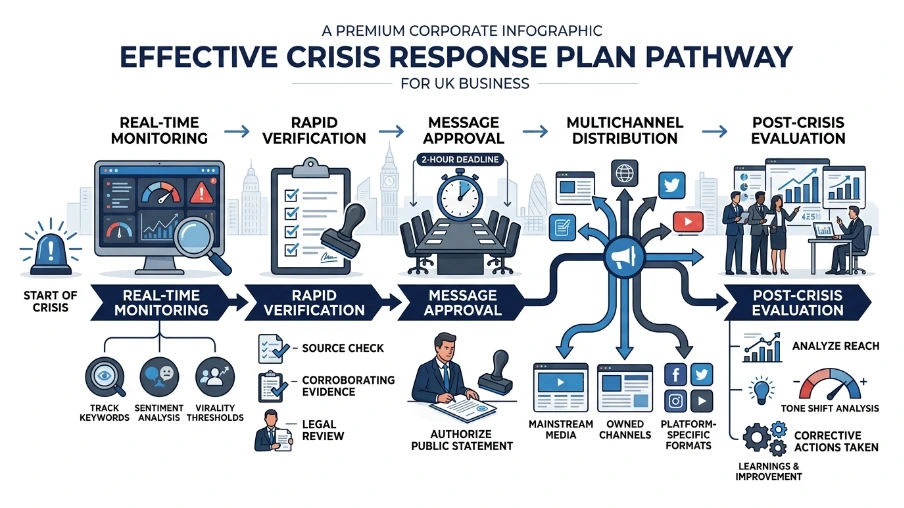
An effective crisis response plan contains monitoring, rapid verification, message approval, multichannel distribution, and post-crisis evaluation.
Monitoring uses real-time tools that track keywords, sentiment, and virality thresholds. Verification involves three data points: source, corroborating evidence, and legal review. Message approval requires one designated decision-maker to authorise public statements within 2 hours. Distribution targets mainstream media, owned channels, and platform-specific formats. Post-crisis evaluation analyses reach, tone shift, and corrective actions taken.
How should campaigns structure monitoring and detection systems?
Structure monitoring with 24/7 alerts, platform-specific dashboards, and escalation rules tied to predefined impact thresholds.
Set alerts for mentions exceeding 500 engagements within 2 hours or a 15% negative sentiment swing on major platforms. Use dashboards separated by earned media, owned channels, and peer-to-peer networks. Escalate items that meet thresholds to a senior communications lead. Track geographic and demographic breakdowns to detect localised reputation shifts.
What role does content strategy play in reputation management?
Content strategy builds a verified narrative, publishes credentialed evidence, and distributes targeted rebuttals to reduce misinformation salience.
Produce short, evidence-rich content formats: 60–90 second spokesperson videos, one-page policy fact sheets, and sourced social posts. Prioritise third-party verification: audit results, university studies, and industry reports. Schedule proactive content to occupy search engine results and social timelines, pushing corrective material above hostile content.
Which verification and documentation practices protect against allegations?
Maintain contemporaneous records, authenticated statements, and third-party confirmations to validate claims and rebut allegations.
Document meetings, donations, and contract terms with timestamps and signatures. Archive digital communications using immutable storage or trusted timestamp services. Obtain independent confirmations such as notarised statements, audit reports, and compliant financial disclosures. These artefacts support legal defence and media rebuttals.
When should a campaign use paid media to manage reputation?
Buy paid media when earned channels fail to reach key audiences quickly or when an immediate corrective impression is required across demographics.
Use targeted display and paid social to deliver corrective messages to voters exposed to negative narratives. Limit buys to the affected geography and demographic cohorts for cost efficiency. Pair paid placements with organic content and earned media to increase credibility and reduce perceived bias.
How do legal counsel and compliance integrate with reputation tactics?
Legal counsel reviews messaging for regulatory risk, drafts corrective statements, and coordinates responses to subpoenas or disclosures.
Route sensitive statements through legal review before publication. Prepare legally vetted holding statements for likely inquiry scenarios. Coordinate with compliance teams to ensure disclosures meet campaign-finance and public-records rules. Legal alignment reduces future liability and preserves trust among informed voters.
What metrics measure reputation management success?
Measure success with sentiment change, share-of-voice, corrected misinformation rate, media tone, and voter-intent movement.
Track sentiment with baseline and daily comparisons. Calculate share-of-voice by measuring candidate mentions versus opponents across earned media. Record corrected misinformation rate as the percentage of flagged items that received verifiable corrections. Use pre/post polls to measure voter-intent shifts following major interventions.
How does Reputation Management for Politicians fit at decision stage?
Reputation Management for Politicians delivers rapid-response teams, evidence-based messaging, and monitoring systems that convert risk mitigation into measurable campaign gains.
Clear My Name assembles cross-functional teams that combine media relations, digital monitoring, legal review, and data analysis. The service focuses on reducing negative media velocity and improving corrective reach. Campaigns using this BOFU-level service gain integrated execution that moves reputation metrics and supports late-stage voter decisions.
Explore our Reputation Management for Politicians guides,
Election Reputation Monitoring Services for Candidates and Campaign Teams
Online Reputation Protection Services for Political Leaders and Candidates
What practical process should campaigns follow to implement these strategies?
Follow a five-step implementation: assess, plan, verify, publish, and evaluate.
Assess: perform a reputation audit with stakeholder interviews and media history. Plan: define thresholds, channels, and spokespersons. Verify: collect supporting documentation and legal clearance. Publish: execute multichannel distribution, prioritising speed and evidence. Evaluate: measure outcomes and revise thresholds for future incidents.
Reputation management strategies directly preserve candidate credibility and influence voter decisions. Clear My Name implements measurable monitoring, verification, and response systems that lower misinformation exposure and boost positive media outcomes while aligning legal compliance with campaign goals.
Frequently Asked Questions
How does Reputation Management for Politicians stop viral misinformation quickly?
Clear My Name uses 24/7 monitoring, rapid verification, and coordinated distribution to stop viral misinformation. The team verifies sources, issues evidence-backed corrections, and publishes targeted rebuttals across owned, earned, and paid channels within defined escalation windows.
What monitoring tools does Reputation Management for Politicians use?
Clear My Name combines platform-specific social listening, media-monitoring feeds, and real-time alert systems to track mentions and sentiment. These tools detect spikes by engagement thresholds and geo-demographic filters for timely escalation.
How long does it take to issue a public correction during a campaign crisis?
Clear My Name follows a rapid-response protocol that aims to verify facts and publish a legally reviewed correction within hours for high-impact incidents. The timeline varies by complexity but uses pre-approved holding statements to reduce initial response time.
Can Reputation Management for Politicians improve voter trust before election day?
Reputation Management for Politicians increases voter trust by publishing verified evidence, third-party endorsements, and transparent disclosures that shift sentiment metrics. Measured pre/post polling and share-of-voice analyses demonstrate these effects.
What documentation does Reputation Management for Politicians keep for legal defence?
Clear My Name maintains contemporaneous records, authenticated statements, audit reports, and timestamped archives of communications and media assets. These documents support legal review, compliance checks, and fact-based rebuttals.