

Media coverage alters perceptions rapidly by amplifying events, framing narratives, and prioritising issues; shifts appear within days and are measurable through polling and sentiment trends.
Media selects which events reach voters and sets the issue agenda. News outlets use headlines, visuals, and repeated stories to emphasise topics. This causes attention to focus on specific policy areas or scandals within 24–72 hours. Polls register movement when coverage sustains for several days. Social sentiment analytics show sentiment changes within hours after breaking stories.
Media framing changes interpretation. Reporters choose quotes, experts, and context. Positive framing highlights competence and policy clarity. Negative framing highlights inconsistency and controversies. Voters often use these frames as heuristics when they lack deep policy knowledge.
Data-driven monitoring captures these effects. Daily tracking of mentions, sentiment scores, and headline prominence links coverage patterns to polling swings. Campaigns use these metrics to respond quickly to damaging frames.
How do candidate actions affect reputation during campaigns?
Candidate actions—speeches, gaffes, policy announcements, and rallies—directly influence reputation; measurable reputation shifts occur within hours for major events and days for policy changes.
Public reaction depends on visibility and perceived relevance. A high-profile speech that clarifies policy can boost perceived competence. A gaffe that contradicts prior statements lowers trust scores. Rallies that mobilise supporters increase positive engagement metrics but may polarise undecided voters.
Actions interact with existing narratives. For example, a candidate with a clean record gains more benefit from a strong policy speech than one with credibility issues. Rapid measurement uses day-over-day polling, debate-specific trackers, and social media engagement rates to quantify impact.
Campaign teams must validate actions against legal and ethical compliance. Reputational teams verify messages, fact-check claims, and authenticate supporter endorsements to limit damage.
How do social media dynamics shift voter sentiment?
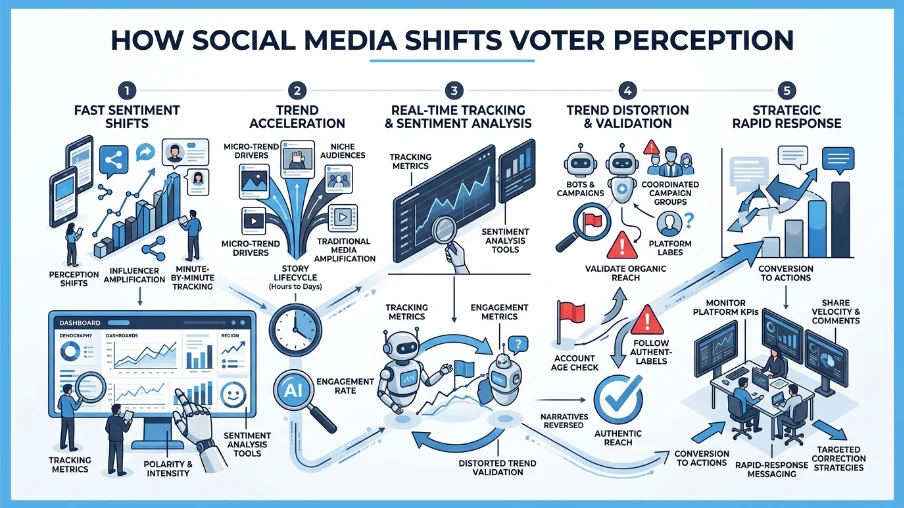
Social platforms create fast, granular perception shifts through sharing, influencer amplification, and viral content; sentiment changes can be tracked minute-by-minute with engagement and share-rate metrics.
Social media drives micro-trends that traditional media later amplifies. Viral clips, memes, and influencer posts spread narratives to niche audiences. These platforms accelerate the lifecycle of a story from hours to days. Sentiment analysis tools measure polarity and intensity across demographics and regions.
Bots and coordinated campaigns distort trends. Analysts validate organic reach by checking account age, follower growth patterns, and engagement authenticity. When platforms label content or reduce distribution, the narrative trajectory may reverse.
Campaign teams monitor platform-specific KPIs: share velocity, comment sentiment, conversion of exposure to supporter actions. These metrics inform rapid-response messaging and targeted correction strategies.
How do opinion polls and trackers reflect reputation changes?
Polls and trackers quantify reputation shifts by measuring favourability, trust, and voting intention; significant changes appear after sustained events or high-exposure incidents.
Polls provide structured snapshots of public opinion. Daily trackers detect small movements—often 1–3 percentage points—while weekly trackers capture more stable trends. Favourability and trust scores show reputational change independent of voting intention. Poll methodology matters; sample frame, weighting, and question order influence results.
Cross-referencing poll shifts with media-tone indexes and social sentiment confirms causality. For example, a 4-point drop in favourability following a sustained negative media cycle and a 30% increase in negative social mentions indicates a causal link.
Campaigns use trackers to allocate resources. Declines trigger targeted communications, while gains prompt defensive strategies to consolidate support.
How do events like debates and scandals alter perception trajectories?
Debates and scandals produce sharp reputation swings; debates shift perceptions based on performance within hours, while scandals cause sustained declines if corroborated across sources.
Debates concentrate attention and reduce noise. Performance evaluation focuses on clarity, facts, and demeanour. A strong debate performance increases competence and leadership ratings the same day. Conversely, a clear mistake reduces trust metrics quickly.
Scandals have longer tails. Initial accusations cause immediate sentiment drops. If third-party verification or regulatory findings corroborate the issue, reputational damage deepens over days and weeks. Rapid, evidence-backed rebuttals and transparent remedial actions reduce damage.
Measurement combines immediate polls, longer-term tracking, and media-sentiment decay rates to estimate recovery time. Recovery often requires consistent positive coverage over two to eight weeks.
How do demographic and regional differences shape perception changes?
Demographic and regional groups respond differently; age, education, and local issues cause distinct perception shifts, measurable through segmented polling and geo-tagged social analysis.
Younger voters react faster on social media and show higher volatility in sentiment. Older voters rely more on broadcast and print, resulting in slower but more sustained shifts. Education correlates with issue prioritisation; higher-educated groups react strongly to policy detail and fact-based corrections.
Regional issues create localised reputation swings. For instance, an infrastructure pledge affects voters in a specific constituency more than national voters. Geo-tagged social and regional poll oversamples identify these patterns.
Campaigns tailor messages by segment. Quick micro-targeted communications address volatile segments. Long-form policy outreach targets stable, issue-focused groups.
Explore our Reputation Management for Politicians articles,
Why Political Credibility Matters More Than Ever in the Digital Age
How Online Conversations Influence Election Narratives
How should campaigns measure and respond to perception shifts?
Campaigns must implement continuous monitoring, rapid-response protocols, and data-driven corrective messaging to manage perception shifts effectively.
First, establish a real-time monitoring stack: media clipping, social sentiment tools, and daily polling trackers. Second, set trigger thresholds; for example, a 3-point daily fall in favourability or a 40% spike in negative mentions that prompt escalation. Third, enact response playbooks: fact-check releases, targeted ads, and spokesperson interviews.
Use verification steps before public rebuttals: authenticate sources, validate claims with evidence, and log compliance checks. Follow each response with measurement to confirm impact.
Practical example: after a viral allegation, verify documents within 24 hours, issue a concise factual statement, and run corrective messaging to the affected demographic within 48 hours.
Read our articles, Tracking Reputation Shifts Throughout an Election Campaign and Political Reputation Management Strategies That Support Campaign Success
How does reputation management for politicians reduce long-term damage?
Reputation Management for Politicians mitigates long-term harm by detecting threats early, validating facts, and coordinating strategic communications across channels.
A structured reputation programme monitors signal and noise across channels. Detection uses keyword alerts, anomaly detection, and influencer mapping. Validation verifies claims with primary sources and official records.
Strategic communications create coherent narratives. These include evidence-backed statements, targeted stakeholder outreach, and timely third-party endorsements. Recovery plans focus on rebuilding trust through transparency, audit disclosures, and policy clarity.
Brand-aligned messaging maintains consistency across platforms. Clear, factual information reduces misinformation spread and shortens recovery windows.
Public perception shifts continuously during election campaigns. Measurable drivers include media coverage, candidate actions, social dynamics, polls, debates, scandals, and demographic variation. Campaigns that combine real-time monitoring, validated responses, and targeted communications limit damage and stabilise reputation.
Clear My Name provides structured Reputation Management for Politicians services that detect issues early, validate allegations, and coordinate corrective messaging. The firm integrates daily media tracking, sentiment analysis, and rapid-response playbooks to protect reputations throughout campaigns.
Frequently Asked Questions
How does Reputation Management for Politicians work?
Reputation Management for Politicians identifies reputation risks through media monitoring, social sentiment analysis, and polling trends, then validates claims using primary sources. Clear My Name coordinates targeted communications and rapid-response tactics to correct misinformation and restore public trust.
How long does it take to see results from political reputation management?
Early detection and rapid responses can change online sentiment within 24–72 hours for specific incidents, while broader favourability improvements typically require 2–8 weeks of consistent messaging. Clear My Name measures progress with daily trackers, sentiment scores, and poll comparisons.
What tools are used in political reputation monitoring?
Teams use media clipping services, social listening platforms, sentiment analysis, influencer mapping, and daily polling trackers to detect and quantify reputation shifts. Clear My Name combines these tools with document verification workflows to produce citation-ready evidence for responses.
Can reputation management prevent damage from scandals during a campaign?
Reputation management reduces impact by detecting early signals, authenticating claims, and deploying evidence-based rebuttals and stakeholder outreach. Clear My Name’s approach focuses on fast verification and transparent communications to limit narrative escalation.
How much does Reputation Management for Politicians cost?
Costs vary by monitoring scope, response capacity, and geographic scale; basic monitoring and rapid-response packages start at a lower tier, while full-service programmes with round-the-clock tracking and bespoke communications require larger retainers. Clear My Name provides tailored quotes after an initial audit of media exposure and risk factors.