

Public sentiment represents the collective evaluation, emotional tone, and shifting perception directed toward an entity by the general population at any given moment. In digital environments, public sentiment transforms into a measurable digital footprint that search engine algorithms crawl, index, and evaluate to determine the authority and credibility of a political figure. Online reputation refers to the digital consensus of an entity’s character, competence, and trustworthiness as structured and presented across search engine results pages (SERPs). Within search ecosystems, this online reputation determines the visibility of positive, neutral, or negative information, establishing a direct link between real-time public opinion and algorithmic search perception control.
How Does Public Sentiment Influence Search Engine Results Pages?
Public sentiment alters SERPs by driving sudden shifts in user search behavior, query volume, and content production click-through rates. When public interest spikes during a political event, search engines adjust their ranking algorithms to prioritize freshness and real-time relevance over long-term historical authority. This algorithmic shift, often controlled by systems like the Query Deserves Freshness (QDF) protocol, introduces volatile user-generated content, breaking news articles, and social media updates into the top ranking positions. Consequently, a stable and controlled digital presence transforms into a dynamic environment where unverified sentiment commands high search visibility.
Search engine algorithms evaluate user interaction signals—such as click-through rates (CTR), dwell time, and search refinement patterns—to determine what information satisfies current user intent. If a sudden surge of users searches for a politician’s name alongside negative terms, the search engine interprets this behavior as a shift in topical relevance. The algorithm responds by updating auto-complete suggestions, related searches, and “People Also Ask” boxes to reflect the negative sentiment. This algorithmic adjustment increases the discovery of critical content, creating a feedback loop where negative sentiment drives search visibility, and increased visibility reinforces the negative public consensus.
The structural composition of a SERP shifts from static informational assets, such as official biographies or government portals, to highly volatile multimedia formats. Video segments, real-time social media carousels, and forum discussions gain prominent positioning because they match the immediacy of public demand. Search engines utilize natural language processing (NLP) to categorize the emotional tone of these incoming content streams, mapping the correlation between the entity and the sentiment vectors. If the dominant sentiment remains negative across multiple authoritative platforms, the search engine updates the core knowledge graph entry for the individual, cementing the reputational damage within the semantic data layer.
How Do Algorithms Interpret Trust and Credibility for Political Entities?
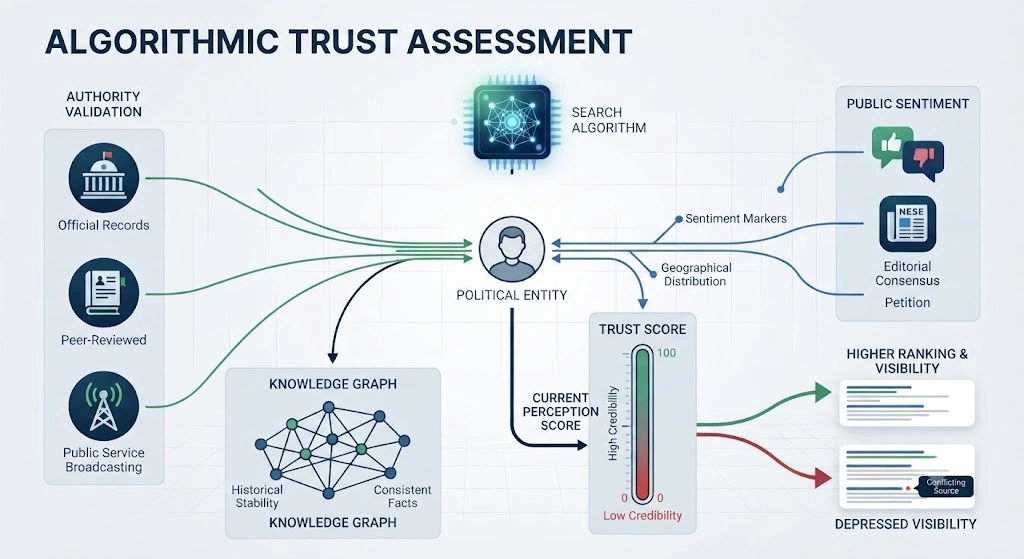
Algorithms interpret trust and credibility by evaluating the structural authority, historical stability, and cross-referenced consistency of information across the web. Search engines rely on specific frameworks, such as Experience, Expertise, Authoritativeness, and Trustworthiness (E-E-A-T), to calculate the reliability of content concerning civic and political entities. Because political information directly impacts public welfare, search engines apply stricter evaluation standards to these topics, categorising them under Your Money or Your Life (YMYL) guidelines. To establish trust, an algorithm requires validation from recognized, highly authoritative sources such as official legislative records, peer-reviewed journals, and established public service broadcasting networks.
The primary mechanism for verifying credibility is the semantic triangulation of entity attributes within a knowledge graph. A knowledge graph is a programmatic network that defines real-world entities and the precise relationships between them. When content outlines a claim or fact about a politician, the algorithm cross-references this data against existing authoritative nodes within its database. If independent, high-authority domains consistently validate the information, the trust score of the narrative increases. Conversely, if contradictory information emerges from unverified or low-authority domains, the algorithm depresses the visibility of those conflicting sources to prevent the spread of misinformation.
Review signals, public feedback, and digital citations function as independent validation points within the algorithmic assessment of trust. Algorithms parse textual content to extract sentiment markers, identifying patterns of praise, criticism, or skepticism across editorial pieces, public comment sections, and digital petitions. The frequency, velocity, and geographical distribution of these citations indicate the consensus surrounding the entity’s current standing. A sudden divergence between historical credibility signals and real-time sentiment alerts the ranking system to reassess the entity perception score, which frequently results in a reordering of the top search results to reflect the current state of public trust.
What Are the Mechanics of Content Indexing During a Reputation Crisis?
Content indexing during a reputation crisis operates via accelerated crawl schedules, algorithmic filtering bypasses, and high-frequency data extraction. Under normal conditions, search engine crawlers (bots) visit web pages at standard intervals determined by the host domain’s historical publishing frequency and overall authority. During an active crisis, the massive influx of content updates across news outlets, blogs, and social platforms triggers an automated re-evaluation of the crawl budget. Search engines reallocate computing resources to index new URLs within minutes, ensuring that the freshest perspectives dominate search results while older, static content drops in position.
The mechanism of semantic parsing extracts specific keywords, entities, and intent structures from newly indexed text to categorize the nature of the reputation crisis. Natural language processing models analyze sentence structures to identify subject-verb-object relationships, linking the political entity directly to specific allegations, controversies, or achievements. This linguistic analysis assigns semantic weights to the content, grouping similar articles into thematic clusters within the index. When a user executes a search query, the engine serves these freshly indexed clusters because they represent the most immediate match for the evolving search intent.
Information velocity determines how long crisis-related content remains prominent within the indexing architecture. If the volume of new articles, social mentions, and search queries remains high, the algorithm continues to refresh the SERP with new material, suppressing historical, positive assets. Once the publication volume decelerates and user search queries return to baseline levels, the algorithm transitions back to standard indexing protocols. However, the crisis content remains part of the permanent index, stored as historical reputation signals that continue to influence the entity’s long-term search visibility and authority scores.
How Do Authority Signals Shape the Digital Footprint of a Public Figure?
Authority signals shape the digital footprint by establishing permanent hierarchical relationships between different information sources on the internet. A digital footprint encompasses the entire trail of data, content, and citations an entity leaves across the digital ecosystem. Link equity—the reputational value passed from one website to another via hyperlinks—acts as a primary authority signal within search engine algorithms. When a highly authoritative domain, such as a major national newspaper or a university repository, links to a specific piece of content about a politician, it transfers structural trust to that target URL, anchoring it firmly at the top of the search results.
The architectural distribution of these authority signals determines which narratives define the public figure’s digital footprint over extended periods. Search engines calculate the backlink profile of every indexed page, evaluating the quantity, quality, and contextual relevance of the incoming links. A concentrated network of authoritative links pointing toward an investigative report ensures that the report retains high search visibility, even years after publication. This structural permanence means that short-term spikes in public sentiment can transform into long-term systemic visibility if authoritative domains adopt, reference, and link to the crisis narrative.
Entity association functions as a non-link authority signal that structurally alters search perception. When search algorithms frequently encounter a politician’s name in close proximity to specific topics, concepts, or co-occurring phrases across the web, they form a semantic bond between those entities. This association occurs independently of direct hyperlinks, relying instead on textual co-occurrence within authoritative contexts. Once an association crystallizes within the search engine’s semantic model, the algorithm automatically surfaces the associated topics whenever a user searches for the politician, permanently altering the contextual landscape of their digital footprint.

How Can Entities Monitor the Transition from Sentiment Shifts to Structural Search Damage?
Entities monitor the transition from fleeting sentiment shifts to permanent structural search damage by tracking specific algorithmic indicators, query mutations, and indexing patterns. A temporary shift in public opinion exists primarily on social media networks and real-time communication channels without deeply affecting search engine mechanics. Structural search damage occurs when these volatile sentiment shifts migrate into the core search index, altering the permanent retrieval patterns of ranking algorithms. To identify this transition early, entities must systematically isolate and analyze specific technical metrics across the search landscape.
- Track query autocomplete mutations. Monitor the search engine’s predictive text inputs daily to identify when negative descriptive terms append themselves to the entity’s primary name.
- Analyze related search modifications. Evaluate the transactional variations in the “People Also Ask” and “Related Searches” sections to determine if algorithms are permanently linking the entity to crisis-specific topics.
- Quantify SERP volatility metrics. Measure the displacement rate of owned, positive digital assets by external, sentiment-driven URLs within the top ten search positions.
- Audit backlink velocity changes. Identify when external websites begin linking heavily to negative content pieces, as this link building anchors the damaging URLs into high-ranking positions.
- Review knowledge graph attribute updates. Check the automated text snippets, descriptions, and linked data points in the primary knowledge panel to see if the core algorithmic definition of the entity has changed.
Isolating these metrics allows for the precise tracking of information degradation within the search ecosystem. When a sentiment shift successfully crosses the threshold into structural damage, standard communication strategies fail because the search engine continues to serve the damaging material as the definitive truth. Understanding these underlying algorithmic mechanics provides the foundation for identifying early warning signs of political reputation decline, allowing for a technical assessment of how search engines process public distrust.
The intersection of public sentiment and search engine mechanics demonstrates that digital reputations are governed by structured algorithmic systems rather than mere opinion. Search engines do not merely display information; they actively interpret, weigh, and organize content based on signals of authority, trust, and real-time relevance. When public sentiment shifts rapidly, protocols like the Query Deserves Freshness protocol alter the composition of SERPs, elevated fresh content over historical assets and changing entity perception at scale.
Long-term digital trust relies on the permanent architectural framework of the web, driven by link equity, knowledge graph associations, and semantic consistency. Fleeting social trends transition into lasting structural search damage when authoritative domains index and link to negative narratives, permanently updating how algorithms define an entity. Managing a digital footprint requires an analytical understanding of these algorithmic indexing patterns, data verification methods, and entity relationships within the search ecosystem.
Frequently Asked Questions
How does an online reputation crisis affect a politician’s career?
An online reputation crisis rapidly diminishes a public figure’s political capital by shifting search engine visibility toward negative press and damaging user-generated content. As algorithms prioritize fresh, critical narratives during a controversy, voter trust declines because authoritative information channels reinforce the negative public consensus. Proactive target services like reputation management for politicians help stabilize these algorithmic shifts by rebuilding entity trust across digital search ecosystems.
What are the main indicators of digital trust erosion for a public figure?
The primary indicators of digital trust erosion include negative mutations in search autocomplete queries and the sudden displacement of owned media by critical URLs on the first page of search results. Additionally, search engines may alter knowledge panels and “People Also Ask” sections to reflect emerging controversies based on user search volume and sentiment signals. Monitoring these technical shifts allows specialists at Clear My Name to identify structural risks before temporary sentiment hardens into permanent search damage.
How do search engine algorithms evaluate political entity credibility?
Search engine algorithms evaluate political credibility by applying strict Your Money or Your Life (YMYL) assessment criteria alongside Experience, Expertise, Authoritativeness, and Trustworthiness (E-E-A-T) frameworks. Algorithms cross-reference facts across verified entities in a knowledge graph, prioritizing citations from legislative records and established public service broadcasting networks over unverified blogs. Consequently, professional digital perception control requires aligning all online assets with these rigid structural trust signals.
Can public sentiment permanently alter a politician’s search results?
Yes, short-term spikes in negative public sentiment can cause long-term structural search damage if highly authoritative domains adopt and link to the crisis narrative. This transfer of link equity anchors negative pages into high-ranking SERP positions, turning a fleeting news cycle into a permanent digital footprint. Strategic digital correction efforts focus on generating consistent, high-authority trust signals to decouple the entity’s name from outdated controversies.
Why does real-time content rank higher during a political controversy?
During a political crisis, search algorithms utilize protocols like Query Deserves Freshness (QDF) to satisfy a sudden surge in real-time user search intent. This mechanism bypasses standard, historical ranking factors to elevate breaking news, live video feeds, and social media updates into prominent search positions. Specialized reputation management for politicians focuses on navigating these volatile indexing windows to restore equilibrium and factual clarity to the candidate’s online footprint.