

Political reputation decline is monitored through the systematic tracking of sentiment distribution and entity credibility signals across search engine results pages (SERPs). Reputation management strategies differ based on whether a political entity relies on reactive content suppression or proactive asset diversification to manage digital perception risks.
What Constitutes an Early Warning Sign in Search Perception Analysis?
An early warning sign in search perception analysis is a measurable shift in entity attribution, query volume spikes, or algorithmic sentiment variance before a public crisis matures. Search engines interpret reputation signals by processing user behavior, semantic connectivity, and text mining across authoritative data sources. When a political figure experiences a negative shift in public perception, the algorithmic footprint alters across specific vectors.
The primary mechanism involves query suggestion engines and automated completions. Search algorithms track velocity spikes in keyword combinations, pairing an entity name with terms related to scandal, investigation, or underperformance. This algorithmic association alters the knowledge graph connections surrounding the politician, lowering overall entity credibility scores.
Another critical warning sign is the sudden diversification of the domain mix within the top positions of the SERP. In steady-state conditions, controlled digital assets dominate the first page of search results. When a reputation begins to decline, independent news media, user-generated platforms, and legal databases displace these controlled assets due to freshness algorithms prioritizing breaking updates.
Evaluating these signals requires a systematic review of structural volatility. The following framework outlines how search systems register these initial shifts in data state:
- Track algorithmic search query spikes to isolate velocity anomalies in branded search terms.
- Monitor algorithmic sentiment variance across indexing clusters to detect changes in entity associations.
- Analyse real-time changes in knowledge graph attributes to identify new, high-risk thematic nodes.
- Measure ranking volatility for core branded terms to gauge the stability of controlled digital assets.
How Do Reactive and Proactive Reputation Management Strategies Compare?
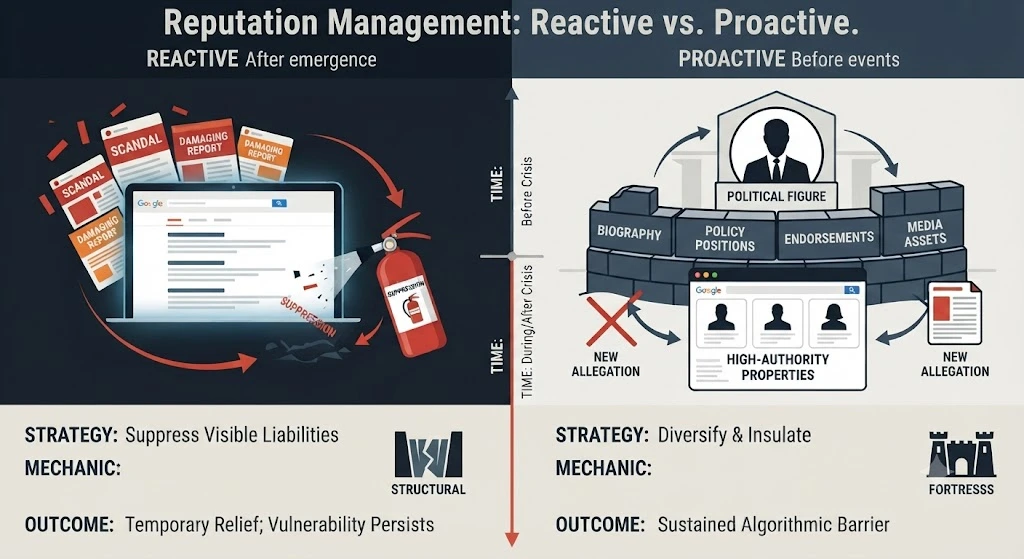
Reactive strategies operate by addressing visible search liabilities after they emerge, whereas proactive strategies focus on long-term digital footprint insulation. The choice between these two architectural approaches dictates the vulnerability of a political entity to sudden narrative shifts. Both methods influence search visibility through entirely different operational mechanics.
Reactive reputation management relies heavily on legal removals, search engine de-indexing requests, and aggressive content suppression. This approach works by identifying specific URLs containing defamatory or damaging material and executing protocols to lower their visibility. The mechanism is binary, focusing entirely on reducing the search ranking influence of negative content assets. While reactive methods provide immediate relief for specific keywords, they fail to alter the underlying thematic vulnerabilities within the broader search ecosystem.
Proactive digital footprint optimisation establishes a diversified network of high-authority web properties before a negative event occurs. This method operates by occupying the top search positions with robust, independent entities controlled by or aligned with the political figure. By saturating the SERP with high-credibility biographical, policy, and media assets, the proactive approach creates an algorithmic barrier that resists displacement by new, unverified sentiment sources.
Evaluating these methodologies demonstrates that reactive tactics address symptoms rather than structural vulnerabilities. Proactive strategies demand greater initial technical execution but deliver sustained structural resilience against algorithmic volatility.
Which Mechanisms Best Address Content Suppression Versus Content Enhancement?
Content suppression and content enhancement represent the two primary technical levers used to modify sentiment distribution within search results. Understanding the underlying mechanics of each process is vital for calculating the long-term sustainability of a digital risk mitigation campaign. Each mechanism interacts with search evaluation systems in distinct ways.
Content suppression requires the systematic devaluation of specific negative assets so they fall below the first page of search results. This process uses inverse SEO techniques, which involve building stronger relevance signals for competing neutral or positive assets. The goal is to force the negative URL down the rankings until it passes the threshold of typical user interaction. The main limitation of suppression is its dependence on external web properties, meaning a sudden increase in external links to the negative asset can reverse the suppression effects.
Content enhancement modifies the entity profile by creating and optimizing high-authority informational assets. This method uses structured data schemas, deep topical coverage, and semantic entities to feed search engine algorithms clear data about the politician’s record. Content enhancement works by reinforcing positive entity credibility, making it difficult for low-authority negative pages to gain traction.
- Execute deep semantic optimization to ensure alternative neutral narratives possess superior topical authority.
- Deploy structured data microformating to clarify entity relationships directly within the knowledge graph.
- Build a balanced backlink distribution profile to sustain the search ranking influence of positive assets.
- Audit anchor text distributions regularly to prevent negative keyword associations from anchoring to the main brand.
How Do Organic Asset Building and Paid Suppression Methods Differ in Sustainability?
Sustainability in reputation control is measured by the durability of the SERP state when active optimization resources are reduced. Organic asset building creates permanent changes in the search architecture, while paid suppression methods offer temporary containment. The choice between them influences long-term risk exposure and operational costs.
Organic asset building relies on constructing a network of earned media, authoritative self-owned platforms, and verified institutional profiles. This strategy aligns with search engine quality guidelines, which reward authentic user engagement, technical performance, and deep topical expertise. The long-term impact is highly stable because the established assets earn natural authority over time, reducing the need for constant technical intervention.
Paid suppression methods often involve short-term algorithmic manipulation or heavy reliance on legal notices that may not stand up to judicial scrutiny. While paid options can clear search space quickly during an election cycle, they create a fragile digital ecosystem. Once the active campaign ends or the temporary ranking boosts fade, the original negative content often returns to its previous position.
Furthermore, relying exclusively on paid suppression increases overall risk exposure. If search algorithms update their webmaster guidelines to penalize artificial visibility manipulation, the entire reputation infrastructure can collapse simultaneously. Organic asset building avoids this risk by focusing on real entity credibility signals that naturally fit within standard algorithmic updates.
What Are the Scalability Barriers in Managing Political Entity Credibility?
Managing entity credibility for political figures presents unique scalability challenges due to the high volume of real-time data and the speed of modern media cycles. As a political narrative expands across regional and national digital networks, maintaining a stable sentiment distribution requires increasingly complex technical systems. The primary barriers involve data processing limitations and algorithmic adjustments to breaking news.
The first barrier is the velocity of user-generated content on social platforms and forum networks. Search engines index real-time data feeds during active news events, meaning unverified claims can appear in core search results within minutes. Standard content enhancement methods cannot scale fast enough to match this volume manually, necessitating automated monitoring and algorithmic asset deployment systems.
The second barrier involves the geographic variation of search results. Political reputation signals are not uniform; search results alter based on user location, localized search history, and regional media authority. A strategy that secures the first page of results in a capital city may fail in a critical regional constituency, demanding localized technical execution across multiple search areas.
- Implement automated natural language processing tools to monitor sentiment distribution shifts across regional search zones.
- Construct dynamic content architectures that update automatically based on localized query trend variations.
- Utilise multi-layered domain networks to manage entity credibility across separate legislative, personal, and party-political searches.
- Calibrate technical responses to match the specific indexing cycles of national versus regional news domains.
Strategic Considerations for Long-Term Digital Trust Systems
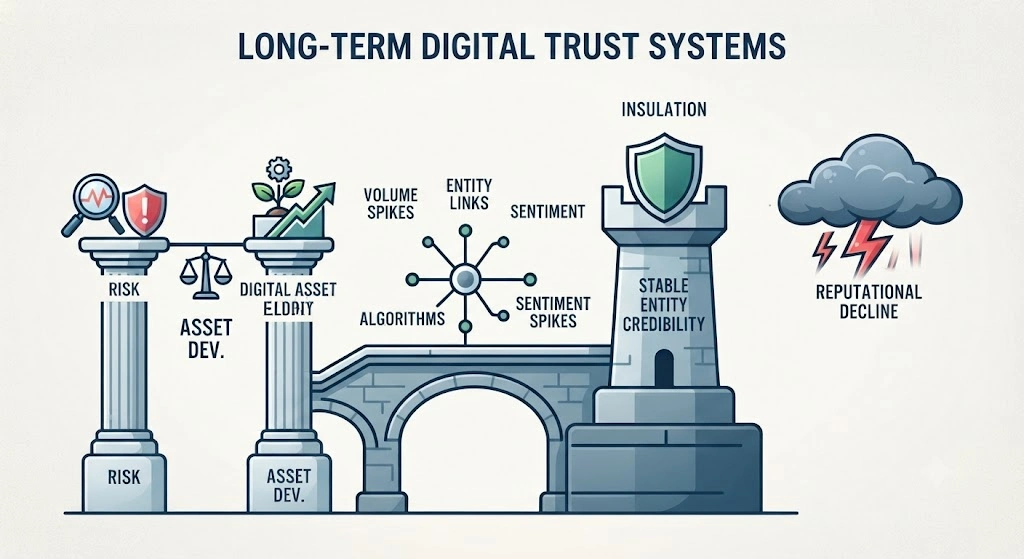
Maintaining stable entity credibility requires a continuous balance between risk identification and digital asset development. A successful strategy avoids short-term manipulation in favor of building a resilient digital footprint that aligns with search engine quality guidelines. Political organizations must evaluate their digital vulnerabilities before public narrative shifts occur, treating search results as a core part of institutional risk management.
The difference between successful stability and sudden reputational decline depends on how early an organization identifies warning signs. By understanding how search algorithms process query volume spikes, sentiment distribution, and entity connections, teams can deploy technical assets before a crisis breaks. Investing in organic asset building and proactive content enhancement provides the foundation needed to survive intense scrutiny.
In the context of long-term risk mitigation, political organizations often look for comprehensive frameworks to audit, secure, and insulate their digital profiles against structural volatility. Implementing a systematic approach to reputation management for politicians ensures that entity credibility remains resilient against sudden narrative shifts and algorithmic changes.
Frequently Asked Questions
How do politicians know if their online reputation is declining?
Politicians can identify early signs of digital reputation decline by monitoring shifts in Google’s autocomplete suggestions and the appearance of negative search queries. Algorithmic changes, such as unexpected drops in official website rankings or a sudden increase in negative media coverage on the first page, indicate a drop in entity credibility. Tracked changes in sentiment distribution across search engines serve as a clear warning sign before a major communication crisis occurs.
What is the difference between content suppression and content enhancement?
Content suppression uses strategic search optimization to push negative links down to lower pages where they get fewer views from users. Content enhancement focuses on creating and optimizing positive, high-authority digital assets that naturally build a strong online profile. Clear My Name implements these content enhancement frameworks to ensure authentic biographical and policy information maintains the highest search ranking influence.
Can a politician remove negative search results from Google?
Removing negative search results completely is usually limited to content that violates legal standards, copyright laws, or search engine terms of service. For most public information, reputation management for politicians involves using search optimization strategies to outrank negative links with authoritative, neutral content. This systematic method changes the visible balance of content without relying on direct content deletion.
How do search engines evaluate a politician’s entity credibility?
Search engines analyze entity credibility by looking at data from knowledge graphs, structured schemas, and connections across reputable websites. Algorithms evaluate the consistency of information, user search patterns, and backlink authority to determine how trustworthy a political figure is. When negative news gains quick momentum, search engines temporarily adjust visibility to prioritize fresh updates over older assets.
How long does it take to repair a damaged political digital footprint?
Rebuilding a political digital footprint typically takes between three to six months of continuous optimization, depending on how deeply the negative search results are indexed. Establishing long-term search stability requires building new, high-authority web properties and improving structured data profiles. Clear My Name focuses on creating sustainable organic assets to help public figures maintain balanced search results throughout intense election cycles.