

Real estate attorneys can turn online research into consultations by aligning informative content, reputation signals and search visibility with the stages of client research. Reputation management strategies differ based on whether the objective is to remove harmful information, enhance useful content or strengthen the overall search representation of a professional entity.
Which online reputation strategies best support client research?
Content enhancement generally provides broader long-term value than isolated reputation repair because it expands the information available around a professional entity. Content enhancement operates by publishing or improving relevant material that addresses search queries, demonstrates subject expertise and strengthens topical associations. Removal strategies operate differently by attempting to reduce the visibility or availability of specific information through appropriate source-level processes. The distinction is important because enhancement adds positive informational context, while removal addresses an existing information problem.
For real estate attorneys, the effectiveness of each approach depends on the type of information appearing in search results. A factual but incomplete professional profile requires a different response from inaccurate or inappropriate third-party information. Content creation can increase the depth of relevant information without directly changing an existing source. Removal addresses the source itself when a legitimate removal pathway exists. Reputation analysis therefore evaluates the underlying information problem before selecting between content enhancement and removal.
How does content creation compare with content removal?
Content creation and content removal influence search ecosystems through different mechanisms. Content creation operates by introducing relevant, authoritative information that search engines can crawl, index and associate with an entity. Content removal operates by reducing the availability of a specific information source where a valid removal mechanism applies. Creation therefore changes the information environment through addition, while removal changes it through subtraction. Neither method represents a universal solution because their effectiveness depends on indexing status, source authority, query relevance and the nature of the information involved.
The distinction between content suppression and content enhancement is also important. Content suppression refers to reducing the prominence or accessibility of information, while content enhancement refers to strengthening the relevance and visibility of useful information. Suppression can address a defined search-result problem without creating replacement information. Enhancement creates additional context but does not necessarily eliminate an existing result. A balanced evaluation therefore examines whether the underlying issue concerns accuracy, visibility, relevance or the absence of sufficient authoritative information.
Which is more sustainable: organic or reactive reputation management?
Organic reputation management is generally more sustainable because it builds an information environment through continuous relevance and authority rather than responding only to individual incidents. Organic approaches operate through the consistent creation, optimisation and maintenance of useful content connected to an entity’s expertise. Reactive approaches operate in response to specific reviews, search-result changes, inaccurate information or reputation events. Reactive intervention provides targeted control over a defined issue, while organic activity develops a broader search footprint. Their different operating models make them complementary rather than interchangeable.
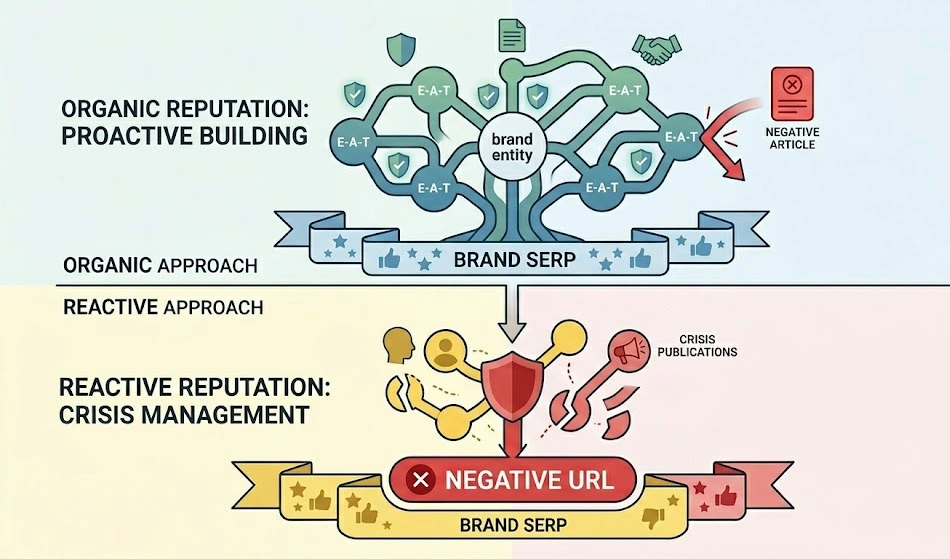
Sustainability depends on how effectively an approach continues to generate relevant reputation signals over time. Organic content can remain indexed and continue contributing to topical relevance after publication, although rankings and search visibility remain subject to algorithmic changes. Reactive intervention generally has a narrower scope because it responds to an identified information event. A removal request, correction or review response addresses a specific source rather than the complete entity environment. Long-term reputation analysis therefore measures the durability of the overall search representation rather than the outcome of one intervention.
How does search visibility influence consultation decisions?
Search visibility influences consultation decisions by determining which professional information users encounter during online research. Search engines rank indexed documents according to relevance, quality, authority and other signals, creating a hierarchy of information for each query. Users then interpret this hierarchy as part of their research process, although ranking position itself does not constitute a direct measure of professional competence. A professional entity with clearly organised information provides users with more context for evaluating expertise and relevance. Search visibility therefore functions as an information-distribution mechanism within the consultation journey.
The relationship between visibility and consultation intent becomes stronger when content corresponds closely to the user’s research question. Informational queries require explanatory material, while decision-stage queries involve evaluating professional suitability, expertise and credibility. Content that addresses the correct stage of intent provides a more relevant informational bridge between discovery and consultation. This does not guarantee conversion because user behaviour also depends on factors outside search visibility. The strategic value lies in matching information architecture with the sequence of research intent.
How do reputation signals affect the transition from research to consultation?

Reputation signals affect the transition from research to consultation by providing evidence that users use to evaluate professional credibility. These signals include reviews, professional references, published expertise, consistent identity information and relevant third-party coverage. Each signal contributes a different form of evidence, so their combined distribution provides a broader representation than a single rating or webpage. Search systems also interpret these sources through indexing, classification and relevance processes. The resulting SERP composition determines which signals receive initial visibility.
Sentiment distribution is particularly relevant when reviews form part of the research environment. Sentiment distribution refers to the pattern of positive, neutral and negative evaluative language across review content. A numerical rating provides compressed information, while written reviews provide contextual evidence about specific experiences. Users interpret these signals alongside professional credentials and other sources rather than in isolation. Reputation analysis therefore evaluates both the quantity and contextual quality of available information.
Is content enhancement more effective than reactive reputation control?
Content enhancement is more effective for expanding topical authority, while reactive control is more effective for addressing defined information problems. Enhancement operates through the creation of relevant pages, articles and professional resources that strengthen the entity’s topical context. Reactive control addresses specific content through correction, response, source-level action or other appropriate mechanisms. The first approach expands the available information environment, whereas the second concentrates on an identified risk. Effectiveness therefore depends on the problem being evaluated rather than on a universal preference for one method.
The difference becomes clear when examining search ranking influence. New content can contribute to search visibility when it satisfies relevance and quality requirements, but publication alone does not determine ranking. Reactive control can change the presence or prominence of a particular result, but it does not automatically establish stronger alternative content. A search environment with limited authoritative information therefore requires a different strategy from one containing a specific inaccurate result. Comparing the approaches requires measuring their effect on SERP composition, entity credibility and information completeness.
How do short-term and long-term reputation strategies differ?
Short-term reputation strategies focus on immediate changes to a defined search or information problem. These strategies operate through targeted actions such as addressing inaccurate information, responding to relevant reviews or correcting inconsistent professional details. Their advantage is measurable focus because the intervention relates to an identifiable source or signal. Their limitation is restricted scope because resolving one result does not necessarily alter the complete digital footprint. Short-term effectiveness is therefore assessed through changes in the specific information environment being targeted.
Long-term strategies focus on developing a coherent and durable information ecosystem around the professional entity. They operate through sustained content relevance, consistent entity information, authoritative references and ongoing reputation monitoring. Their impact accumulates across multiple search queries and information sources rather than appearing through one isolated change. This approach has greater sustainability when the objective involves establishing comprehensive topical context. However, its results depend on continued content quality, indexing and search-system evaluation.
How should risk exposure be evaluated across reputation strategies?
Risk exposure is evaluated by examining the likelihood that an intervention creates unintended changes to the information environment. Content creation has relatively broad exposure because new material becomes another indexed representation associated with the entity. Poorly structured or irrelevant content can weaken topical clarity rather than improve it. Reactive interventions have narrower scope but can create dependence on individual platforms, publishers or source-level decisions. Risk analysis therefore examines both the intended outcome and the potential secondary effects.
Scalability provides another important comparison. A structured content framework can scale across multiple relevant queries because one semantic topic can support interconnected informational resources. Source-level removal or correction is less scalable when every issue requires separate assessment and action. This difference becomes significant when an entity has a large digital footprint distributed across multiple sources. Sustainable reputation management therefore evaluates the ratio between intervention effort, information coverage and measurable search impact.
Dive Deeper With Our Expert Guides:
Credibility-Building Strategies for Tax and Financial Law Practices
How Patent and IP Attorneys Can Rank in Local and National Search
How can real estate attorneys align reputation strategy with search intent?
Real estate attorneys can align reputation strategy with search intent by mapping each information asset to a defined stage of user research. Informational content addresses questions about property law, transactions and legal processes. Comparative content helps users evaluate expertise, experience and professional relevance. Decision-stage content provides information that supports the transition from research towards direct consultation. This structure creates a semantic pathway between search queries and professional information without treating every page as a conversion asset.
The alignment also improves the interpretation of reputation signals because each content type serves a distinct informational function. Educational resources establish topical relevance, professional profiles establish identity and expertise, while reviews provide experiential evidence. Third-party references add external context that users can evaluate alongside first-party information. When these elements remain semantically connected, the digital footprint presents a more coherent entity structure. Search visibility then reflects a broader information network rather than a single page competing for attention.
Which reputation approach provides the strongest SERP control?
No single approach provides universal SERP control because search visibility results from multiple ranking, indexing and retrieval systems. Content enhancement influences the available information environment by adding relevant documents and strengthening topical coverage. Reactive control influences individual information sources when correction, removal or response mechanisms are available. Monitoring provides the measurement layer by identifying changes in rankings, sentiment distribution and source representation. Effective evaluation therefore treats SERP control as an ongoing information-management process rather than a one-time intervention.
SERP composition provides the clearest framework for comparing these approaches. Analyse which sources occupy prominent positions, evaluate the relevance and authority of those sources, and identify the reputation signals presented to search users. Then distinguish between information that requires suppression and information that requires stronger contextual alternatives. This method separates source-level problems from content-coverage problems. It also provides a measurable basis for assessing search ranking influence without assuming that any intervention guarantees a particular result.
What should real estate attorneys consider before choosing a reputation strategy?
Real estate attorneys should first identify whether the primary issue involves inaccurate information, insufficient authoritative content, inconsistent entity data, negative sentiment or limited search visibility. Each problem corresponds to a different mechanism within the reputation ecosystem. Content enhancement addresses information gaps, while removal and correction strategies address defined source-level problems. Review analysis evaluates sentiment distribution, and entity consistency analysis examines whether search systems can accurately connect information across sources. Diagnosis therefore precedes strategic selection.
The second consideration is the desired time horizon. Short-term interventions provide targeted responses to immediate information problems, while organic strategies develop broader search visibility over time. Risk exposure, scalability and sustainability also determine whether an approach remains suitable as the digital footprint expands. The most useful evaluation framework therefore compares mechanisms rather than judging strategies by promotional claims. This approach keeps reputation management connected to measurable changes in search visibility, trust signals and entity perception.
How can online research be converted into a structured consultation pathway?
Online research becomes a structured consultation pathway when search content corresponds to the user’s evolving information requirements. The process begins with informational discovery and progresses towards evaluation of professional relevance, credibility and expertise. Content that answers early-stage questions establishes topical context, while decision-stage resources address factors relevant to professional selection. Reputation signals support this pathway by providing independent and first-party evidence across the research environment. The resulting structure connects search intent with increasingly specific information needs.
The strategic distinction is between attracting visibility and supporting informed evaluation. Search visibility places professional information within the user’s research environment, but relevance and credibility determine whether that information contributes meaningfully to further evaluation. A coherent digital footprint supports this progression by connecting professional identity, expertise, reviews and topical resources. The objective is therefore not simply to increase rankings but to create an information structure that remains useful throughout the research journey. This approach provides a clearer basis for understanding how online research can progress towards consultation intent.
What is the most balanced approach to reputation management for real estate attorneys?
The most balanced approach combines targeted reputation control with sustained content development and measurement. Reactive methods address defined information risks, while organic methods strengthen the broader information environment. Monitoring connects both approaches by measuring SERP composition, reputation signals, sentiment distribution and entity consistency. This combination distinguishes immediate source-level problems from long-term information-architecture requirements. It also reduces the risk of evaluating reputation through a single metric.
The central consideration is therefore strategic fit rather than selecting one universally superior method. Content creation provides scalable topical coverage, removal and correction methods address specific information problems, and monitoring evaluates the resulting search environment. Short-term interventions provide focused responses, while long-term strategies establish greater informational continuity. Together, these distinctions explain how reputation management methods influence search visibility and professional perception. Convert Online Research Into Clients for Real Estate Attorneys represents the decision-stage endpoint of this research pathway, where informational relevance connects with consultation intent.
How can real estate attorneys turn online research into consultations?
Real estate attorneys can align informative content with search intent, reputation signals and professional expertise to support users moving from research to consultation. A structured digital footprint provides relevant information at each stage of the client journey.
What reputation signals influence real estate attorney consultations?
Key reputation signals include professional credentials, reviews, relevant published content, third-party references and consistent identity information. These signals contribute to entity credibility and influence how users evaluate professional relevance during online research.
Is content creation or content removal better for online reputation?
Content creation strengthens the available information around a professional entity, while content removal addresses a specific source where a legitimate removal mechanism exists. The appropriate approach depends on whether the issue involves insufficient information, inaccurate content or search-result visibility.
How does search visibility affect client research for real estate attorneys?
Search visibility determines which professional information users encounter when researching real estate legal services. Relevant and authoritative content can provide stronger context for evaluating expertise, credibility and professional suitability.
How can reputation management improve the online research journey?
Reputation management analyses the digital footprint, reviews, search results and other reputation signals associated with a professional entity. Combining content enhancement, reputation monitoring and appropriate source-level responses creates a more coherent search environment for client research.