

Reputation management pricing for law firms is determined by the scope, complexity, and volume of reputation-related activities required to improve search visibility and strengthen digital trust. Reputation management is the structured process of analysing, influencing, and maintaining how a law firm is interpreted across search ecosystems through indexed content, reputation signals, and entity associations.
What Is Reputation Management Pricing for Law Firms?
Reputation management pricing for law firms refers to the financial structure used to evaluate the resources required to manage, analyse, and strengthen a firm’s online reputation. Within search ecosystems, pricing reflects the amount of work necessary to influence reputation signals, improve search visibility, and maintain consistent entity perception across digital platforms. The cost is determined by measurable operational factors rather than arbitrary pricing models. These factors include the size of the firm’s digital footprint, the volume of indexed content, the competitiveness of legal search results, and the frequency of reputation monitoring. Each variable increases or reduces the level of analysis, optimisation, and content evaluation required to maintain a stable search presence.
Reputation management differs from advertising because it focuses on information quality rather than promotional exposure. Search engines evaluate entities through structured and unstructured information collected from websites, reviews, news coverage, legal directories, and other publicly available sources. Pricing reflects the effort required to analyse these information sources and improve their consistency. The broader and more fragmented the information environment becomes, the greater the analytical workload involved in reputation management.
Why Does Online Reputation Affect Pricing?
Online reputation refers to the collection of indexed information that shapes public perception and search engine interpretation of an entity. For law firms, this information includes website content, legal directory listings, review platforms, media references, and professional profiles. Search engines continuously evaluate these sources to determine credibility, authority, and topical relevance. Pricing increases as the number of reputation signals requiring evaluation expands.
A law firm with an extensive digital footprint presents a larger information network for analysis. Duplicate profiles, inconsistent business information, outdated legal content, and negative search results increase the complexity of reputation evaluation. Each additional source requires verification, monitoring, and content assessment. As a result, pricing reflects the amount of structured work necessary to establish consistency across indexed assets and maintain accurate entity perception.
How Does Search Visibility Influence Reputation Management Costs?
Search visibility defines how frequently and prominently a law firm appears within search engine results pages (SERPs). Higher visibility increases exposure to both positive and negative reputation signals. Reputation management pricing therefore reflects the scale of search evaluation required to maintain favourable visibility across relevant legal queries.
Search engines rank content according to relevance, authority, quality, and user satisfaction signals. Reputation management analyses how existing content performs within these ranking systems and identifies factors influencing visibility. Competitive legal keywords generate dense search environments where authoritative legal publications, directories, review platforms, and informational resources compete for rankings. Greater competition requires broader content evaluation and more comprehensive indexing analysis, increasing the overall scope of reputation management work.
How does content indexing affect search visibility?
Content indexing refers to the process through which search engines discover, categorise, and store information for retrieval within search results. Indexed pages contribute directly to entity perception because search engines evaluate the relationships between documents, topics, and organisations. Reputation management analyses indexed content to determine whether outdated, duplicated, or conflicting information affects search interpretation.
Incomplete indexing reduces content discoverability, while conflicting indexed information weakens entity consistency. Pricing reflects the amount of auditing required to identify indexing issues and evaluate their influence on search visibility. Larger websites and broader content archives require more detailed analysis because each indexed page contributes to overall reputation signals.
What Determines the Complexity of Reputation Management?
The complexity of reputation management is defined by the quantity, diversity, and interaction of reputation signals associated with a law firm. Complexity increases as more digital assets contribute to search engine evaluation. Reputation pricing reflects the time and analytical resources required to understand these relationships and maintain information consistency.
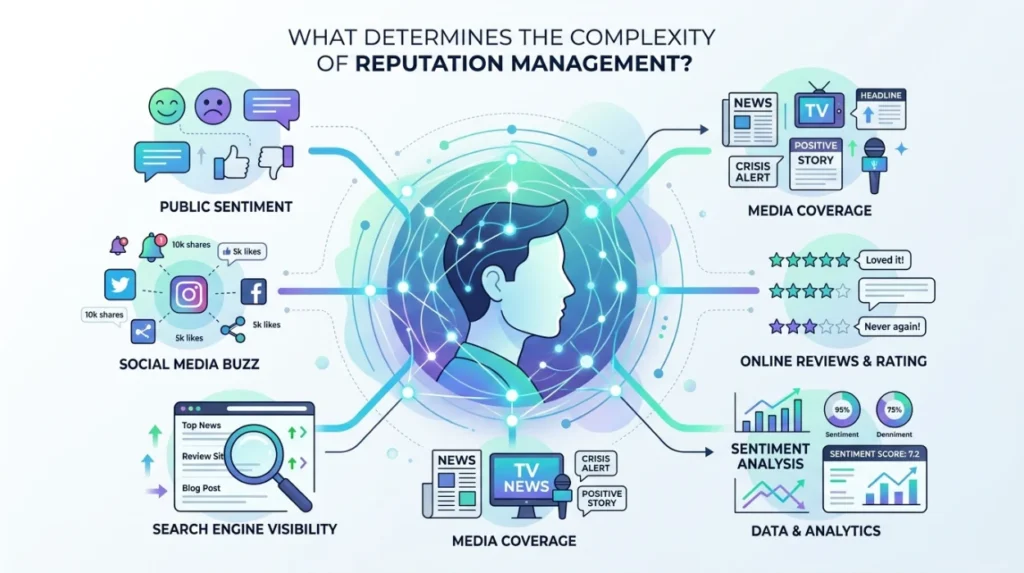
Search ecosystems interpret information collectively rather than individually. A firm’s website, legal directory profiles, review platforms, media citations, and knowledge panels contribute interconnected reputation signals. Conflicting information weakens confidence in entity accuracy and reduces trust signals. Reputation management therefore involves evaluating relationships across multiple indexed sources rather than analysing isolated content pieces.
Complexity also increases when historical content remains visible within search results. Archived news articles, outdated legal information, expired webpages, and inactive profiles continue influencing entity perception until search engines reassess their relevance. Pricing reflects the ongoing analysis required to monitor these legacy signals and understand their impact on search evaluation.
How Do Review Signals Influence Reputation Management Pricing?
Review signals refer to structured user-generated feedback that search engines interpret when evaluating credibility and trust. Reviews contribute directly to online reputation because they provide measurable evidence of public sentiment and engagement. Reputation management pricing reflects the volume, distribution, and consistency of review signals requiring analysis.
Search engines evaluate reviews using multiple indicators, including review frequency, recency, language consistency, rating distribution, and platform authority. These factors contribute to broader trust evaluation rather than functioning as isolated ranking signals. Reputation management analyses review ecosystems to identify patterns affecting credibility across search results.
Sentiment interpretation extends beyond numerical ratings. Search algorithms analyse written language to understand recurring themes, topical relevance, and consistency between user experiences and business information. Larger review datasets require more detailed sentiment evaluation, increasing analytical workload and influencing pricing structures accordingly.
Why Does Digital Footprint Size Affect Costs?
A digital footprint refers to the complete collection of online information associated with an entity across indexed and discoverable platforms. Every webpage, profile, citation, directory listing, publication, review, and media reference contributes to this footprint. Reputation management pricing increases as the digital footprint expands because additional information requires structured evaluation.
Search engines construct entity understanding through relationships between these digital assets. Consistent information strengthens entity confidence, while conflicting details reduce credibility. Larger law firms frequently maintain offices across multiple locations, each generating separate citations, local listings, and review profiles. Reputation management therefore requires broader information verification and more extensive content analysis.
Digital footprint expansion also increases monitoring requirements. Newly indexed content, updated reviews, and changing search rankings continuously modify entity perception. Pricing reflects the resources required to evaluate ongoing changes within evolving search ecosystems.
Dive Deeper With Our Expert Guides:
Why Attorney Profiles Matter for Client Acquisition
How Local Search Influences Law Firm Growth
How Do Authority and Trust Signals Shape Pricing?
Authority signals represent evidence demonstrating subject expertise, reliability, and topical relevance within search ecosystems. Trust signals refer to indicators supporting factual consistency, transparency, and information accuracy. Reputation management pricing reflects the effort required to evaluate these signals across all publicly accessible digital assets.
Search engines interpret authority through multiple interconnected factors, including content quality, citation relationships, professional references, backlink profiles, structured data, and topical consistency. Trust emerges when information remains accurate across websites, directories, and authoritative publications. Reputation management analyses these elements collectively because isolated improvements provide limited influence on entity perception.
Authority evaluation becomes increasingly detailed within legal sectors because expertise and accuracy directly influence search quality assessment. Broader authority analysis therefore requires more extensive content evaluation, increasing the operational scope reflected in pricing structures.
How Does Content Quality Affect Reputation Management Costs?
Content quality defines how effectively information satisfies search intent while maintaining factual accuracy, topical depth, and semantic relevance. Search engines evaluate content quality using relevance, expertise, structure, originality, and user experience signals. Reputation management pricing reflects the analysis required to evaluate existing content against these quality indicators.
Low-quality content weakens entity perception by creating inconsistencies across indexed information. Thin pages, duplicated material, outdated legal guidance, and conflicting terminology reduce search confidence in the entity. Reputation management identifies these weaknesses through structured content evaluation and semantic analysis.
Content quality also influences long-term search visibility. High-quality legal information reinforces topical authority, while inconsistent content reduces credibility over time. Pricing therefore reflects the amount of content requiring assessment, categorisation, and ongoing evaluation to maintain consistent reputation signals.
How Are Reputation Management Costs Structured?
Reputation management costs are structured according to measurable operational requirements rather than fixed outputs. Pricing reflects the scale of information analysis, monitoring frequency, content evaluation, search performance assessment, and reputation signal management. Larger information ecosystems require proportionally greater analytical effort.
The primary operational factors include:
- Evaluate digital footprint size by analysing the number of indexed assets, including legal directories, review platforms, websites, and archived content.
- Assess search visibility through keyword rankings, SERP evaluation, and the prominence of positive and negative indexed content.
- Analyse reputation signals by measuring review sentiment, citation consistency, authority indicators, and trust-related information.
- Monitor content indexing through ongoing assessment of newly indexed pages, removed content, and changes in search engine interpretation.
- Review entity consistency by comparing business information, legal credentials, and structured data across publicly indexed platforms.
Each operational activity contributes directly to the total analytical workload. Pricing therefore represents the cumulative effort required to evaluate and maintain reputation quality within complex search ecosystems.
What Determines the Cost of Law Firm Reputation Management?
The cost of law firm reputation management is determined by the interaction between search visibility, digital footprint size, authority signals, review ecosystems, content quality, and entity consistency. These variables define the analytical resources required to evaluate reputation across search environments rather than functioning as independent pricing factors.
Search ecosystems continuously update indexed information, reassess authority relationships, and interpret new reputation signals. Reputation management therefore remains an ongoing analytical process focused on maintaining information accuracy and consistent entity perception. Cost reflects the scale of this continuous evaluation rather than a single technical activity. As search environments expand, operational complexity increases because additional indexed content creates more relationships requiring analysis.
Reputation management pricing for law firms reflects the complexity of analysing information rather than the purchase of a standardised service. Search visibility, digital footprint size, review signals, authority indicators, content indexing, and entity consistency collectively define the analytical workload required to evaluate online reputation. Search engines interpret these interconnected signals to construct digital trust and determine entity perception across SERPs. Understanding these mechanisms provides a clearer explanation of why reputation management costs differ between law firms and why pricing aligns with the structure of search ecosystems rather than fixed service categories.
What factors affect reputation management pricing for law firms?
Reputation management pricing for law firms depends on factors such as the size of the firm’s digital footprint, the volume of negative or outdated content, search visibility, review profiles, and the complexity of online reputation issues. These elements determine the level of analysis, monitoring, and content optimisation required.
How long does law firm reputation management take to show results?
Reputation management is an ongoing process because search engines continuously update rankings and evaluate new content. The timeframe depends on the condition of the existing online reputation, the amount of indexed content, and how frequently search engines recrawl and reassess webpages.
Why do larger law firms pay more for reputation management?
Larger law firms usually have a broader digital footprint, including multiple office locations, lawyer profiles, reviews, directory listings, and media mentions. Managing a greater number of reputation signals requires more extensive analysis and ongoing monitoring, which increases overall costs.
Does reputation management improve search engine visibility?
Reputation management supports search visibility by improving content quality, strengthening reputation signals, and maintaining consistent entity information across search ecosystems. Better-organised and trustworthy information helps search engines evaluate a law firm’s credibility more effectively.
How does Clear My Name approach reputation management for law firms?
Clear My Name focuses on analysing reputation signals, search visibility, content indexing, and digital trust factors that influence how law firms appear in search results. The process centres on improving information quality and maintaining consistent online reputation across relevant digital platforms.