

Reputation management is the study and practice of how an entity’s public standing is formed, measured and modified within digital systems. Online reputation refers to the collection of indexed content, review signals and entity-linked metadata that together create an observable perception across search ecosystems.
What is the relationship between search results and first impressions?
Search results directly define initial perceptions by presenting a curated set of reputation signals that evaluate an entity’s trustworthiness and authority.
First impressions from search are the immediate cognitive assessment users make when viewing a search engine results page (SERP). This impression is a composite of titles, snippets, knowledge panels, review stars and ranked links that together create a rapid judgement about an entity’s credibility.
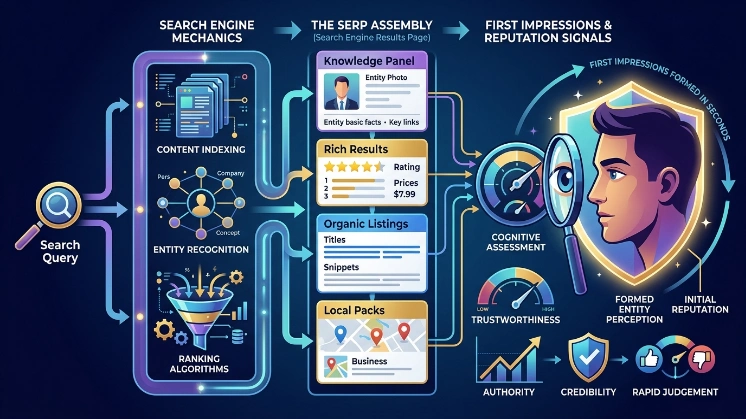
Search engines generate first-impression content through content indexing, entity recognition and snippet selection. Crawlers index pages and map them to entity identifiers; ranking algorithms evaluate relevance, authority and user engagement to select which assets appear prominently. The SERP assembly process uses templates (organic listings, rich results, local packs) to prioritise different reputation signals according to query intent.
The elements surfaced on a SERP become primary reputation signals because users rarely go beyond the first page. High-ranking pages with authoritative content increase perceived credibility; negative or low-quality indexed content reduces entity perception. The presence of authoritative structured data (reviews, ratings, knowledge panels) shifts quick assessments by surfacing trust indicators before users click any link.
How does content indexing create reputation signals?
Content indexing creates reputation signals by converting published material into searchable, entity-linked records that ranking systems evaluate for authority and relevance.
Indexing begins with crawling and proceeds through parsing (extracting text, metadata, structured data), entity linking (associating content with named entities), and storing document vectors that ranking models use. Indexing also records signals like publication date, canonical tags and schema markup that influence how content contributes to an entity’s reputation.
Indexed content defines the visible evidence for an entity’s reputation. Fresh, well-structured content indexed promptly yields stronger positive signals; outdated or poorly indexed content dilutes authority. Search visibility increases when indexed pages use clear entity references and schema markup to ensure the algorithm attributes content to the correct entity.
How do algorithms interpret trust and credibility?
Algorithms interpret trust and credibility by weighting multi-dimensional signals authority signals, behavioural engagement and provenance metadata into composite reputation scores.
Trust and credibility evaluation refers to algorithmic processes that score content and entities based on indicators that correlate with reliability and expertise within a search ecosystem.
Algorithms aggregate signals such as inbound links (source authority), on-page expertise markers (authorship, citations), user behaviour metrics (click-through rates, dwell time), and provenance metadata (domain age, HTTPS, publisher reputation). Machine-learning models train on labelled examples of trustworthy versus untrustworthy content, enabling pattern recognition that classifies new content. Additionally, entity graphs and knowledge panels provide context that influences credibility by linking entities to verified attributes.
Pages and entities that present consistent authority signals receive elevated ranking and prominent SERP features, which amplify perceived credibility. Conversely, inconsistent provenance or signals associated with low-quality sites reduce ranking and visibility, thereby degrading first impressions formed on the SERP.
What role do review signals and sentiment interpretation play?
Review signals and sentiment interpretation shape reputation by providing explicit, user-generated evidence that algorithms use to adjust entity perception and ranking prominence.
Aggregators capture review data from review platforms, business listings and product pages; these data points feed ranking models as discrete features (average rating, review recency, volume) and unstructured text for sentiment analysis. Sentiment models extract sentiment polarity, identify recurring issues and detect emphasis patterns that contribute to a signal profile. Review schema markup enables direct ingestion of rating data, while entity linking associates reviews with the correct business or individual.
High average ratings plus positive sentiment increase the likelihood of rich snippets and local pack prominence, improving immediate perception on SERPs. Negative sentiment or clusters of low ratings act as negative reputation signals that depress visibility and alter first impressions. Search ecosystems prioritise aggregated, recent and corroborated review data when assigning weight to review signals.
How does authority function as a reputation signal?
Authority is a measure of the perceived expertise and reliability of an entity within a topical domain as inferred from external endorsements, domain-level metrics and content quality.
Authority arises from inbound links (referrals from other authoritative domains), citations, mentions in recognised knowledge sources and consistent topical publication. Ranking models treat endorsements from high-authority nodes as stronger signals through link-weighting algorithms and entity-graph propagation. On-page indicators detailed content, references, credentials and structured data augment perceived authority.
Entities with stronger authority signals gain broader SERP coverage, including featured snippets and knowledge panels, which shape first impressions toward competence and legitimacy. Weak authority correlates with lower ranking and less favourable first impressions.
How does entity perception form from a digital footprint?
Entity perception forms from a digital footprint by aggregating all indexed traces’ content, social signals and structured data into an evaluative summary that search systems present to users.
A digital footprint refers to the aggregate of an entity’s online presence, including web pages, social profiles, mentions, images and structured records that search engines index and attribute to that entity.
Search ecosystems build entity profiles within knowledge graphs by linking identifiers across web properties. Signals such as co-occurrence of names, shared identifiers (emails, business numbers), schema markup and consistent authoring styles strengthen entity linkage. Graph-based models then derive attributes and relationships that inform entity perception. Discrepancies or fragmentation in the footprint reduce confidence scores, while consistent, corroborated data increases clarity.
Take control of your online identity with professional Reputation Management for Individuals designed to strengthen digital footprints, improve entity recognition, and enhance search visibility. Strategic reputation management helps individuals build consistent trust signals, reinforce credibility, and maintain a positive online presence across search ecosystems.
How does content influence perception through semantic relevance?
Content influences perception through semantic relevance by aligning topical coverage, entity signals and user intent so that search systems interpret materials as authoritative and contextually appropriate.
Modern ranking systems use semantic indexing and contextual embeddings to map content to topical clusters and entity concepts. Content that uses coherent terminology, structured headings and entity-centric metadata integrates more strongly into those clusters. Semantic relationships such as co-occurrence of domain-specific terms and citation patterns signal topical authority; structured data reinforces entity ties.
Semantically relevant content ranks higher for aligned queries and surfaces as clear, context-rich snippets, strengthening first impressions of expertise. Poorly aligned content ranks lower and may produce misleading snippets that weaken user trust.
Dive Deeper With Our Expert Guides:
13 Online Reputation Statistics Every Professional Should Know
How does SERP evaluation alter user decision-making?
SERP evaluation alters user decision-making by prioritising specific reputation cues that users consume before clicking, thus shaping intent and trust.
Users assess titles, snippets, URLs, review stars and rich results in a rapid scan. Algorithms present a curated combination of signals (authority, recency, reviews) that become heuristics for user judgement. Eye-tracking and click modelling indicate that users rely on visible trust markers more than deeper content when forming initial impressions.
When search engines surface strong reputation signals on the SERP, users infer higher credibility and select those links first, reinforcing engagement metrics and further boosting ranking. If the SERP shows neutral or negative signals, users form adverse impressions that reduce click-through and engagement, depressing visibility.
What are the measurable indicators of reputation within search systems?
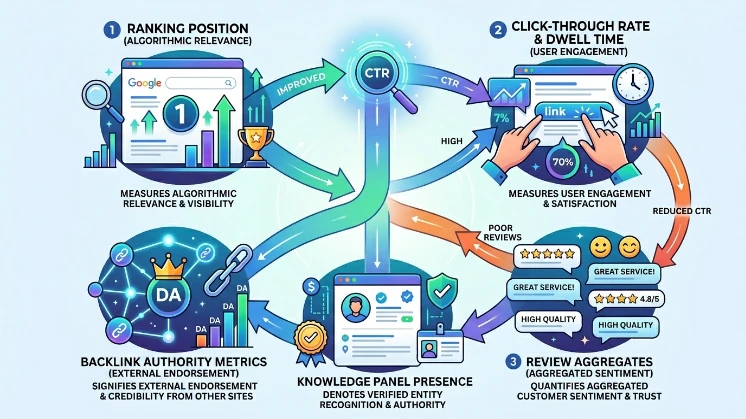
Measurable indicators of reputation include ranking position, click-through rate, review aggregates, knowledge panel presence and backlink authority metrics. Reputation indicators are quantifiable signals that search systems and analysts use to evaluate the standing of an entity.
Ranking position reflects algorithmic relevance; click-through rate and dwell time measure user engagement; review aggregates quantify aggregated sentiment; knowledge panel presence denotes verified entity recognition; and backlink authority metrics signify external endorsement. These indicators interact: improved ranking increases CTR, which feeds back into models, while poor reviews reduce CTR and can lower ranking.
These indicators provide a measurable proxy for reputation; positive indicator profiles produce favourable SERPs and stronger first impressions, while negative profiles reduce visibility and create adverse perception cycles.
Get the Full Insights Here:
Is Your Online Reputation Helping or Hurting Your Career?
Search results form the primary mechanism through which first impressions arise in modern information environments. Reputation management is the systemic study of how indexed content, review signals, authority markers and entity-linked metadata combine into observable reputation signals. Understanding indexing, semantic relevance, review interpretation and authority propagation explains why SERP composition exerts outsized influence on perception and decision-making. Clear, consistent entity data and semantically aligned content increase search visibility and positive entity perception; fragmented or negative signals reduce prominence and degrade first impressions.
Related FAQs
How does Clear My Name define reputation management for individuals?
Reputation management for individuals refers to monitoring, evaluating and improving an individual’s online presence across search results, social profiles and review sites. Clear My Name explains that this includes addressing negative content, enhancing positive content visibility and aligning entity data for accurate SERP evaluation.
How long does it take to see changes in search visibility after reputation actions?
Changes in search visibility typically appear within weeks for content indexing and several months for authority signals like backlinks to register. Clear My Name notes that timing depends on content indexing frequency, search engine crawl rates and the strength of existing reputation signals.
What are the main reputation signals that affect individual search perception?
Main reputation signals include indexed content quality, review aggregates and sentiment, backlink authority and knowledge panel presence; each signal influences entity perception and SERP ranking. Clear My Name recommends auditing these signals to evaluate trust metrics and search visibility.
How do review sites and social profiles impact an individual’s online reputation?
Review sites and social profiles provide direct user-generated signals—ratings, comments and mentions that feed sentiment analysis and review aggregates in search ecosystems. Clear My Name explains that consistent, verified profiles and positive reviews increase credibility and improve SERP features like rich snippets.