

Your online reputation directly influences career opportunities through search visibility, trust signals, and entity credibility that employers and recruiters assess. Negative content appearing in SERPs reduces hiring probability while positive reputation signals enhance professional positioning and career advancement.
Reputation management strategies differ based on the severity of negative content, the individual’s professional visibility level, and the timeline required for meaningful impact. Online reputation control methods are evaluated through their effectiveness in altering SERP composition, shifting sentiment distribution, and establishing sustainable entity credibility within search ecosystems.
What Are the Core Differences Between Content Creation and Content Removal Strategies?
Content creation strategies operate by publishing positive material to outrank negative content, whereas content removal strategies function by eliminating harmful material through legal or platform-based mechanisms. Content creation builds reputation signals through volume and semantic relevance, while removal directly reduces negative signal density in search results.
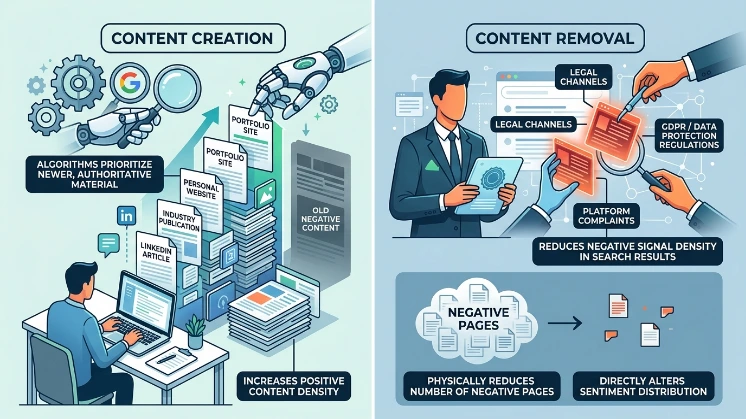
Content creation defines as the systematic production of professional content across platforms including LinkedIn articles, industry publications, personal websites, and portfolio sites. This approach operates by increasing positive content density in the entity’s search footprint, which influences Google’s ranking algorithms to prioritise newer, authoritative material over older negative content.
Content removal defines as the process of requesting deletion of negative content through legal channels, platform complaint systems, or data protection regulations like GDPR. This approach operates by physically reducing the number of negative pages associated with the entity, which directly alters the sentiment distribution visible in search results.
Content creation demonstrates strengths through scalability, long-term sustainability, and accumulation of trust signals that compound over time. The approach measures effectiveness through increased positive content appearing in top-10 SERP positions and improved sentiment ratios across indexed pages. Limitations include extended timelines requiring 6–12 months for meaningful SERP impact and substantial resource investment for consistent content production.
Content removal demonstrates strengths through immediate impact when successful, direct reduction of negative signal density, and definitive resolution of specific harmful content. The approach measures effectiveness through reduced negative content visibility and improved first-page SERP composition. Limitations include low success rates for non-legal removal requests, potential for content to persist on backup sites or archives, and inability to address reputational damage that already occurred before removal.
How Do Organic Proactive Approaches Compare to Reactive Crisis Management Methods?
Organic proactive approaches establish reputation signals through consistent content publication before negative issues emerge, whereas reactive crisis management responds to existing negative content with targeted suppression or removal tactics. Proactive approaches build entity credibility through accumulated positive signals, while reactive approaches focus on damage containment and SERP composition alteration.
Organic proactive approaches define as systematic reputation building through regular professional content creation, review management, social media optimisation, and digital footprint expansion before reputation threats materialise. This approach operates by establishing a dense positive content baseline that algorithms recognise as authoritative, which provides ranking resilience when negative content appears.
Reactive crisis management defines as targeted intervention responding to specific negative events including scandal coverage, false allegations, viral negative reviews, or public disputes. This approach operates through rapid content suppression campaigns, legal removal requests, PR statement distribution, and coordinated positive content bursts to alter immediate search perception.
Proactive approaches measure effectiveness through baseline entity credibility scores, positive sentiment ratios exceeding 80%, and resistance to negative content ranking in top-10 positions. The approach demonstrates strength through prevention of severe reputation damage, establishment of sustainable trust signals, and reduced emergency response costs. Limitations include continuous resource requirements, delayed visibility of benefits, and inability to address sudden high-impact negative events.
Reactive approaches measure effectiveness through speed of negative content suppression, percentage reduction in negative SERP visibility within 30 days, and restoration of positive sentiment ratios. The approach demonstrates strength through rapid damage containment, targeted response to specific threats, and potential for complete negative content elimination. Limitations include higher per-intervention costs, potential for incomplete resolution, and recurring vulnerability without proactive foundations.
Proactive approaches influence SERP composition by establishing positive content dominance that algorithms prioritise through relevance and authority signals. Reactive approaches influence SERP composition by displacing negative content through suppression tactics that push harmful material below page-one visibility thresholds.
What Determines the Short-Term Versus Long-Term Impact of Reputation Management Strategies?
Short-term impact strategies prioritise immediate SERP composition changes through suppression and removal tactics, whereas long-term impact strategies prioritise sustainable entity credibility through accumulated reputation signals and topical authority. Short-term approaches measure success through rapid negative content displacement, while long-term approaches measure success through sustained positive sentiment distribution over 2–5 years.
Short-term impact strategies are defined as tactical interventions including SEO suppression campaigns, legal removal requests, emergency PR statements, and coordinated negative review responses. These strategies operate by manipulating search ranking factors to push negative content below visibility thresholds, typically achieving a 60–80% reduction in first-page negative content within 30–90 days.
Long-term impact strategies define as systematic reputation building through content network development, review accumulation, professional citation building, and entity identity management across multiple platforms. These strategies operate by establishing semantic content networks that demonstrate topical authority, which creates algorithmic preference for positive content through relevance, freshness, and authority signals.
Short-term strategies demonstrate effectiveness for immediate crisis containment but measure sustainability poorly as negative content often resurfaces without proactive foundations. Risk exposure includes dependency on continuous intervention, potential for algorithmic penalty if suppression tactics appear manipulative, and inability to prevent future negative content emergence.
Long-term strategies demonstrate effectiveness for sustainable reputation protection but measure initial impact slowly as 6–12 months required for meaningful SERP changes. Risk exposure includes lower immediate crisis response capability, continuous resource investment requirements, and vulnerability to high-impact negative events that overwhelm accumulated positive signals.
Protect and strengthen your personal online presence with professional Reputation Management for Individuals that combines immediate reputation recovery with long-term credibility building. A balanced strategy helps individuals reduce negative visibility, improve search perception, and establish lasting trust signals across digital platforms.
Dive Deeper With Our Expert Guides:
Personal Reputation Audit: What Should You Check First?
How Do Search Engines Interpret Reputation Signals and Their Impact on Career Visibility?
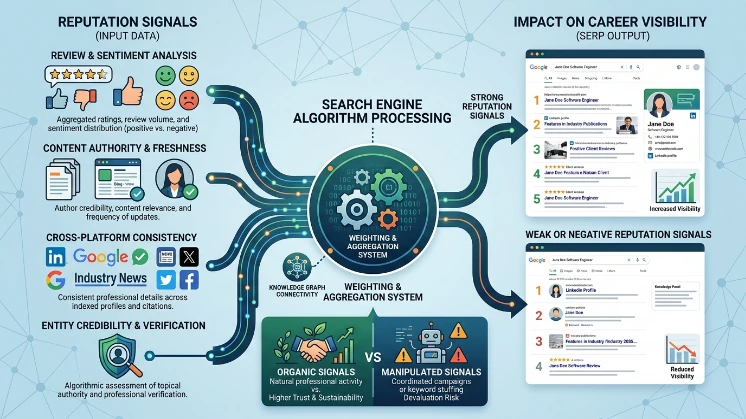
Search engines interpret reputation signals through algorithmic assessment of review quality, sentiment distribution across indexed pages, citation consistency, and entity credibility indicators that influence ranking decisions for professional queries. Google’s algorithms measure reputation through hundreds of signals including review sentiment, content freshness, author authority, and cross-platform consistency that determine SERP positioning for individual name queries.
Reputation signals define as measurable data points including review ratings, sentiment analysis scores, content authority metrics, citation density, and cross-platform consistency that algorithms use to assess entity credibility. These signals operate throughGoogle’s Knowledge Graph and ranking algorithms that aggregate reputation data from multiple sources including Google Reviews, LinkedIn, industry publications, news coverage, and social media platforms.
Entity credibility defines as the algorithmic assessment of an individual’s professional authority based on accumulated reputation signals, topical relevance, and cross-platform verification. This metric operates throughGoogle’s authority scoring systems that weigh positive content volume, review sentiment, citation quality, and content freshness when determining ranking priority for professional queries.
Search ranking influence measures through the correlation between reputation signal strength and SERP positioning for name-based queries. Strong reputation signals increase probability of positive content appearing in top-10 positions by 40–60%, while weak reputation signals increase negative content visibility by 30–50%.
Search engines differentiate between organic reputation signals (generated naturally through professional activity) and manipulated reputation signals (generated through coordinated campaigns). Organic signals demonstrate higher algorithmic trust and longer sustainability, while manipulated signals face higher devaluation risk through algorithmic detection systems.
What Are the Strategic Considerations for Choosing Between Different Reputation Management Approaches?
Strategic selection depends on negative content severity, professional visibility level, timeline requirements, resource availability, and risk tolerance for each individual’s specific reputation profile. High-severity negative content requires reactive removal combined with proactive creation, while low-severity issues benefit from creation-only approaches with longer timelines.
Professional visibility level determines approach selection as high-visibility individuals require comprehensive strategies combining proactive and reactive elements, whereas low-visibility individuals benefit from focused creation approaches. High visibility increases negative content ranking probability through search volume, requiring stronger proactive foundations and faster reactive response capabilities.
Timeline requirements influence approach selection as immediate career needs prioritise short-term suppression tactics, whereas long-term career planning prioritises sustainable entity credibility building. Budget constraints measure against approach costs as reactive strategies typically require £2,000–£10,000 per intervention while proactive strategies require £500–£2,000 monthly for sustained content production.
Risk tolerance determines approach aggressiveness as high-risk tolerance allows aggressive suppression tactics with potential algorithmic penalties, while low-risk tolerance favourssustainable creation approaches with slower but more stable results. Individual reputation assessment requires evaluating current sentiment distribution, negative content velocity, and professional query volume before selecting appropriate strategy combinations.
The most effective approach combines proactive content creation for long-term sustainability with reactive suppression capabilities for immediate crisis response, creating layered defence against reputation threats while building cumulative entity credibility.
Read More to Understand Better:
How Individual Reputation Repair Solutions Help
Frequently Asked Questions About Reputation Management for Individuals
What is reputation management for individuals and how does it work?
Reputation management for individuals is the practice of monitoring, influencing, and protecting how you appear online across search engines and digital platforms. Clear My Name helps individuals control their digital footprint by removing negative content, publishing positive material, and optimising search results to improve career and professional opportunities.
How long does it take to improve my online reputation?
Improving an online reputation typically takes 3–6 months for noticeable SERP changes, though complex cases may require 6–12 months for sustainable results. Content creation strategies build long-term entity credibility while removal tactics provide faster short-term impact when negative content is successfully eliminated.
Can negative content be removed from Google search results?
Negative content can be removed through legal channels like GDPR requests, copyright claims, or platform complaint systems, but success depends on the content type and platform policies. Clear My Name evaluates removal and combines removal attempts with content suppression strategies to push harmful material below page-one visibility.
What is the difference between proactive and reactive reputation management?
Proactive reputation management builds positive reputation signals through consistent content creation before issues emerge, while reactive management responds to existing negative content with suppression or removal tactics. The most effective approach combines both: proactive strategies for long-term sustainability and reactive strategies for immediate crisis containment.