

A positive personal reputation online is built through consistent, accurate, and trustworthy information that search engines can index, evaluate, and associate with an individual entity.
Reputation management is the process of influencing how information about an entity is discovered, interpreted, and ranked within digital environments. Online reputation refers to the collective perception created by indexed content, reputation signals, and search visibility across search ecosystems.
What Is a Positive Personal Reputation Online?
A positive personal reputation online is a favourable entity perception created through credible, relevant, and consistently validated information. Within search ecosystems, reputation is not a single asset. It is a collection of signals that define how an individual is represented across search engine results pages (SERPs), websites, social platforms, publications, and public records.
Search engines evaluate reputation through content indexing and entity association. When an individual’s name appears across authoritative and contextually relevant sources, algorithms establish stronger confidence in the accuracy of that entity profile. This process contributes to search visibility and credibility assessment.
Reputation signals include published content, profile consistency, mentions, reviews, citations, and engagement indicators. Each signal contributes data that helps search engines understand identity, expertise, and trustworthiness. Consistent signals reinforce entity clarity, while conflicting signals reduce certainty.
Online perception develops from the information users encounter during SERP evaluation. Search results often form the first layer of reputation analysis. The visibility, quality, and context of indexed content influence how audiences interpret credibility before engaging with any additional information.
How Is Personal Reputation Formed in Search Engines?

Personal reputation is formed when search engines collect, organise, and interpret information associated with an individual entity. Search engines use crawling and indexing systems to gather content from publicly accessible sources and connect those sources through entity recognition processes.
Content indexing allows algorithms to evaluate relationships between names, topics, organisations, publications, and digital profiles. These relationships create an entity map that defines how a person is understood within search ecosystems. The stronger the contextual alignment, the clearer the entity perception becomes.
Algorithms evaluate information quality through relevance, authority, consistency, and freshness. Accurate information appearing repeatedly across trusted sources strengthens confidence signals. Inconsistent information introduces ambiguity and weakens entity understanding.
SERP evaluation reflects these assessments through rankings and content presentation. Search engines prioritise information that demonstrates credibility and contextual relevance. As a result, reputation formation becomes closely connected to content quality and entity validation.
Why Does a Digital Footprint Influence Online Reputation?
A digital footprint is the total collection of information associated with an individual across digital environments. It includes published content, profiles, comments, media, citations, and references that remain accessible through search and indexing systems.
Search engines use digital footprints to construct entity understanding. Every indexed asset contributes information that helps algorithms define expertise, interests, affiliations, and trust signals. The breadth and consistency of these assets affect overall reputation assessment.
A fragmented digital footprint creates entity ambiguity. When information differs across platforms, search engines encounter conflicting data points that complicate interpretation. Consistent information strengthens entity confidence and improves search visibility.
Digital footprints also influence user perception. During SERP evaluation, users assess available information to determine credibility and relevance. The quality of indexed assets directly affects how an individual is interpreted within search environments.
How Does Content Shape Personal Reputation Online?
Content shapes personal reputation by providing searchable evidence that defines expertise, authority, and credibility. Search engines rely on content to understand entities because content contains the contextual signals necessary for interpretation.
Published articles, professional profiles, interviews, presentations, and educational resources create information pathways that connect an individual with specific topics. These connections strengthen topical relevance and improve entity recognition. Search engines use these relationships to evaluate expertise.
Content ranking dynamics influence which information receives visibility. Higher-ranking content attracts greater attention during SERP evaluation, making ranking position a significant reputation factor. Information appearing prominently often becomes the dominant source of perception.
Content quality influences trust assessment. Accurate, well-structured, and contextually relevant content demonstrates credibility. Search engines evaluate these characteristics through relevance signals, user interaction metrics, and authority indicators, which contribute to stronger reputation signals.
The phrase “personal reputation management strategies” represents a contextual link between reputation development and content governance. Search engines analyse anchor text to understand topical relationships, helping reinforce entity perception within reputation-focused content networks.
What Role Do Search Engine Results Pages Play in Reputation?
Search engine results pages serve as the primary interface through which users evaluate digital reputation. SERPs organise indexed information and present the most relevant results according to ranking algorithms.
The order of search results influences perception. Higher-ranking content receives greater visibility and engagement, making ranking position an important reputation signal. Information appearing on the first page often carries greater perceived credibility because of its prominence.
SERPs display multiple content formats, including webpages, profiles, images, videos, news references, and knowledge panels. These elements collectively shape entity perception by presenting different forms of information about an individual.
Search engines continuously reassess rankings through algorithmic evaluation. Changes in content quality, authority signals, and entity relevance affect visibility. Consequently, reputation within SERPs remains linked to ongoing content indexing and quality assessment processes.
How Do Trust and Authority Signals Affect Reputation?
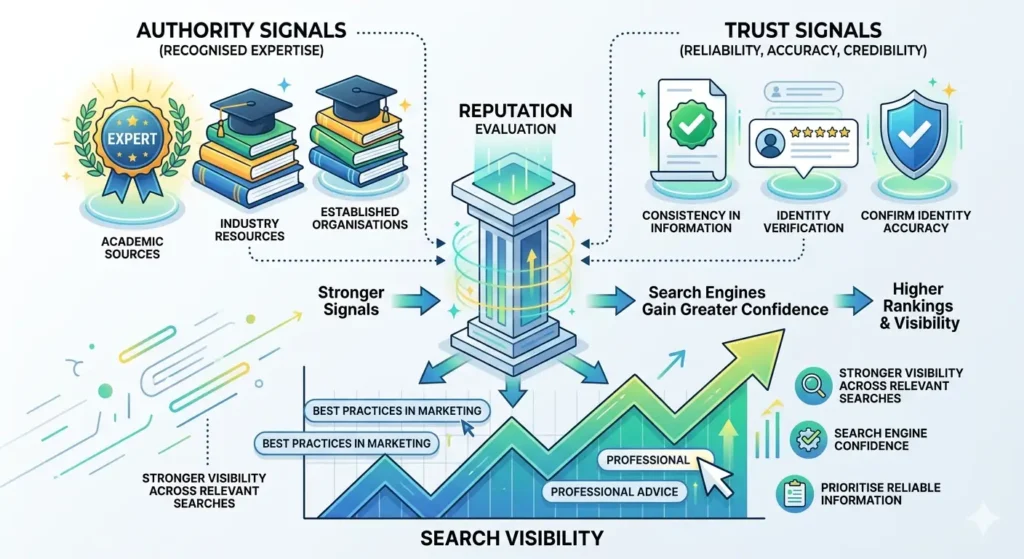
Trust signals are indicators that demonstrate reliability, accuracy, and credibility. Authority signals are indicators that demonstrate recognised expertise or influence within a specific topic area. Together, these signals form a critical component of reputation evaluation.
Search engines analyse authority through contextual associations. References from recognised publications, academic sources, industry resources, and established organisations strengthen entity validation. These associations provide evidence supporting expertise and credibility.
Trust signals emerge through consistency and verification. Matching information across profiles, publications, and digital assets helps algorithms confirm identity accuracy. Consistency reduces ambiguity and strengthens confidence in entity interpretation.
Authority and trust influence search visibility because ranking systems prioritise reliable information. When strong reputation signals exist, search engines gain greater confidence in the quality and relevance of associated content. This confidence contributes to stronger visibility across relevant searches.
How Are Reviews and Sentiment Interpreted by Search Systems?
Reviews are structured forms of feedback that provide evaluative information about an entity. Sentiment refers to the positive, neutral, or negative language patterns present within content. Search systems analyse both elements to understand public perception.
Sentiment interpretation relies on natural language processing. Algorithms examine language structures, contextual meanings, and evaluative expressions to identify overall sentiment patterns. These assessments contribute to broader reputation analysis.
Search engines evaluate review credibility through authenticity indicators, source quality, and contextual relevance. Verified and trustworthy review environments provide stronger signals than low-quality or unreliable sources. Quality assessment affects how review information contributes to reputation evaluation.
Sentiment signals influence perception because users often interpret aggregated feedback during SERP evaluation. Positive sentiment supports favourable entity perception, while negative sentiment introduces reputational friction. Search systems analyse these patterns as part of broader entity understanding.
What Causes Reputation Signals to Strengthen Over Time?
Reputation signals strengthen when information remains accurate, consistent, and contextually relevant across digital environments. Search engines reward stability because stable information improves entity understanding and reduces ambiguity.
Consistency supports stronger entity recognition. Repeated alignment of names, professional information, expertise areas, and published content creates clear associations. These associations help algorithms build reliable knowledge structures around an individual.
Authority accumulation contributes to reputation development. As trusted sources reference an entity within relevant contexts, search engines receive additional validation signals. Repeated validation strengthens confidence in credibility assessments.
Content longevity also influences reputation strength. Information that remains relevant and accurate over time continues contributing value to entity perception. Long-term consistency allows search engines to develop more complete and reliable entity profiles.
How Can Online Credibility Be Evaluated?
Online credibility is evaluated through evidence-based signals that demonstrate reliability, expertise, and accuracy. Search engines and users rely on observable indicators rather than subjective claims when assessing credibility.
Content quality represents a foundational credibility signal. Accurate information, clear structure, and topical relevance demonstrate expertise. Search systems evaluate these characteristics during content indexing and ranking analysis.
Entity consistency contributes to credibility evaluation. Uniform information across websites, profiles, publications, and references strengthens identity verification. Consistency reduces uncertainty and supports trust assessment.
Authority associations provide additional credibility evidence. References from respected sources reinforce expertise and improve entity perception. Search engines analyse these associations to determine the reliability and contextual relevance of information connected to an individual.
Why Is Entity Perception Important for Long-Term Reputation?
Entity perception is the collective understanding that search engines and users develop about an individual based on available information. It represents the culmination of content indexing, reputation signals, authority indicators, and trust assessments.
Search engines organise information around entities rather than isolated keywords. This approach allows algorithms to understand relationships, expertise, and contextual relevance more accurately. Strong entity perception improves interpretation and ranking consistency.
Long-term reputation depends on entity clarity. Clear entity definitions help search systems connect information accurately, reducing ambiguity and improving search visibility. Consistent signals strengthen this clarity over time.
Entity perception also influences future content evaluation. When search engines possess strong confidence in an entity profile, they interpret new information within an established context. This process creates a cumulative reputation framework that supports ongoing credibility assessment.
Dive Deeper With Our Expert Guides:
Remove Negative Search Results About You from Google
How to Fix Your Online Reputation and Protect Your Name Online
Building a positive personal reputation online depends on the creation, consistency, and interpretation of trustworthy information across search ecosystems. Reputation develops through content indexing, entity recognition, authority signals, trust indicators, sentiment analysis, and SERP evaluation.
Digital footprints, content quality, search visibility, and entity perception work together to define how individuals are represented online. Search engines continuously analyse these interconnected signals to understand credibility, relevance, and expertise. A positive online reputation therefore reflects the successful alignment of accurate information, strong reputation signals, and clear entity understanding within modern search environments.
Answers to Key Questions
How does online reputation form in search engines?
Online reputation forms through content indexing, where search engines collect and organise information linked to a person’s name. Algorithms evaluate reputation signals such as authority, consistency, and relevance across multiple sources. These signals shape how the individual is perceived in search results.
Why is personal digital footprint important for reputation?
A digital footprint represents all indexed data connected to an individual across websites, profiles, and platforms. Search engines use this data to build entity understanding and assess credibility. A consistent footprint strengthens trust signals and improves search visibility.
What affects a person’s search engine reputation?
A person’s search engine reputation is influenced by content quality, backlinks, sentiment signals, and authority references. Search engines analyse how information is distributed and whether it remains consistent across sources. These factors determine ranking and overall reputation strength.
How do SERPs impact personal reputation online?
SERPs (Search Engine Results Pages) directly shape first impressions by displaying ranked information about an individual. Users evaluate credibility based on visible content, snippets, and source authority. High-ranking accurate content strengthens positive entity perception.