

Reputation management is the structured analysis of how information about a person or entity is created, indexed, and ranked within search ecosystems.
Online reputation refers to the collective interpretation of search-visible content that forms an entity’s perceived credibility in SERPs.
Removing negative search results about you from Google describes the process of influencing, limiting, or de-ranking specific content so it no longer dominates search visibility for a personal or branded query.
What does removing negative search results from Google mean in search ecosystems?
Removing negative search results from Google refers to the reduction of visibility of specific indexed pages that contain unfavourable information within SERP evaluation systems. It does not define a single technical action but describes multiple search visibility interventions applied across indexing, ranking, and content suppression layers.
Within search ecosystems, removal operates through three structural mechanisms: de-indexing, demotion, and content displacement. De-indexing removes a page from Google’s searchable database. Demotion reduces ranking signals associated with the page. Content displacement introduces competing authoritative content that shifts ranking positions downward.
Search engines interpret “removal” as a visibility outcome rather than a permanent deletion event. Even when content remains live on a source website, it can lose SERP presence through reduced authority signals or algorithmic re-evaluation.
This concept directly connects to entity perception, where Google evaluates how a person is represented across multiple sources. Negative search results influence this perception by reinforcing low-trust associations within the entity profile. Removal strategies therefore focus on altering how the system interprets relevance, not only eliminating content at the source level.
How do negative search results appear in Google’s ranking system?
Negative search results appear in Google’s ranking system when indexed content aligns with query relevance signals, authority metrics, and user interaction patterns. Ranking systems evaluate pages based on keyword alignment, backlink profiles, and engagement behaviour.
Search engines crawl publicly available content and assign indexing status based on discoverability and technical accessibility. Once indexed, content enters ranking evaluation where relevance scoring determines placement within SERPs. Negative content ranks when it satisfies query intent better than competing pages or receives stronger authority signals.
How ranking signals reinforce negative visibility
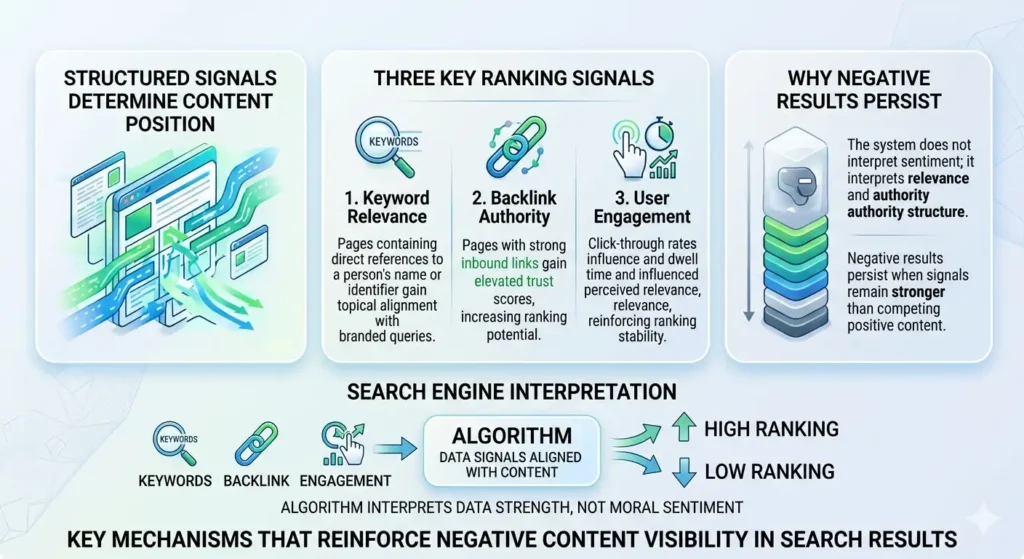
Search engines apply structured signals that determine content position:
- Evaluate keyword relevance across page content and metadata
Pages containing direct references to a person’s name or identifier gain topical alignment with branded queries. - Analyse backlink authority distribution across referring domains
Pages with strong inbound links gain elevated trust scores, increasing ranking potential even for negative content. - Measure engagement behaviour across user interactions
Click-through rates and dwell time influence perceived relevance, reinforcing ranking stability.
Negative results persist when these signals remain stronger than competing positive or neutral content. The system does not interpret sentiment; it interprets relevance and authority structure.
What determines whether negative content ranks on the first page of Google?
Negative content ranks on the first page of Google when it achieves high relevance alignment combined with strong domain authority and low competitive suppression. First-page visibility is determined by aggregated ranking signals rather than content sentiment.
Search engines prioritise pages that demonstrate topical authority for a given query. If a negative article includes a direct match to a personal or brand query and originates from a high-authority domain, it gains ranking advantage. This is reinforced by historical indexing stability and backlink accumulation.
Key ranking determinants influencing negative visibility
Search visibility is structured through layered evaluation systems:
- Assess domain authority strength across indexed sources
High-authority websites transmit ranking power to hosted content, increasing SERP dominance. - Match query intent with content relevance signals
Direct name mentions or entity references increase ranking alignment for branded searches. - Stabilise ranking positions through historical engagement data
Older pages with consistent traffic patterns maintain algorithmic trust continuity. - Reinforce content relevance through semantic proximity to entity terms
Repeated association with a named entity strengthens SERP anchoring effects.
These factors collectively determine whether negative results maintain first-page visibility or become displaced through competing content ecosystems.
How does Google interpret reputation signals and entity credibility?
Google interprets reputation signals through entity-based indexing systems that map relationships between content, sources, and named subjects. Entity credibility refers to the algorithmic trust assigned to a person or organisation based on structured data associations across the web.
Search systems evaluate reputation using a combination of content consistency, source authority, and contextual alignment. Entity recognition systems link mentions across multiple domains, forming a structured identity graph that influences SERP evaluation.
Entity-based reputation evaluation
Reputation signals are interpreted through structured mechanisms:
- Aggregate entity mentions across indexed documents
Repeated references reinforce identity recognition within search databases. - Evaluate contextual sentiment distribution across sources
Although sentiment is not directly scored, context influences association strength. - Map authoritative relationships between linking domains and entity pages
High-trust domains increase credibility weighting for associated content. - Stabilise entity profiles through structured data consistency
Consistent naming and metadata reinforce identity clarity within search systems.
Entity credibility directly affects how quickly negative content can be displaced or neutralised within SERPs, as stronger entity profiles support more competitive ranking environments for positive content.
Can search results about a person be removed from Google indexing systems?
Search results about a person can be removed from Google indexing systems through de-indexing processes, legal removal requests, or technical exclusion mechanisms applied at the page or domain level. Removal refers specifically to elimination from Google’s searchable index rather than deletion from the source website.
Indexing systems operate by storing crawled content in structured databases. When a page is de-indexed, it becomes inaccessible through search queries, although it may still exist on its original server. Removal depends on compliance with indexing policies, content eligibility criteria, and legal frameworks governing personal data visibility.
Index control mechanisms affecting removal
Search visibility can be altered through structured processes:
- Request de-indexing through search console or legal frameworks
Pages meeting policy criteria can be excluded from search databases. - Apply technical exclusions using robots directives
Noindex tags instruct crawlers to exclude content from indexing systems. - Remove or alter source content at publication origin
Content deletion reduces crawlable material available for indexing. - Re-evaluate duplicate or outdated content structures
Canonicalisation processes consolidate or remove redundant indexing paths.
These mechanisms define how search engines adjust index coverage but do not guarantee permanent suppression unless supported by sustained indexing control signals.
How does content suppression influence search visibility for negative results?
Content suppression influences search visibility by shifting ranking distribution away from negative results and replacing them with higher-authority, contextually relevant content. Suppression operates at the ranking layer rather than the indexing layer, meaning content remains indexed but loses visibility position.
Search engines continuously re-evaluate ranking signals based on new content publication, link acquisition, and engagement changes. When competing content demonstrates stronger authority signals, it displaces lower-performing pages from high-ranking positions.
Structural suppression mechanisms in SERPs
Suppression operates through layered ranking adjustments:
- Deploy competing high-authority content targeting the same entity query
Stronger pages override weaker ones in ranking hierarchies. - Increase semantic coverage across authoritative domains
Broader content representation reduces dominance of single negative sources. - Strengthen backlink ecosystems pointing to positive content clusters
Authority redistribution shifts ranking power across indexed pages.
Anchor text used for Service: negative search result suppression plays a structural role in linking semantic clusters that influence visibility redistribution across SERPs.
Suppression does not erase content; it reorganises ranking priorities within search engine evaluation frameworks.
What role does digital footprint play in long-term search reputation?
Digital footprint plays a defining role in long-term search reputation by forming the cumulative dataset that search engines use to construct entity profiles. Digital footprint refers to all indexed, crawlable, and referenced content associated with a person or entity across the internet.
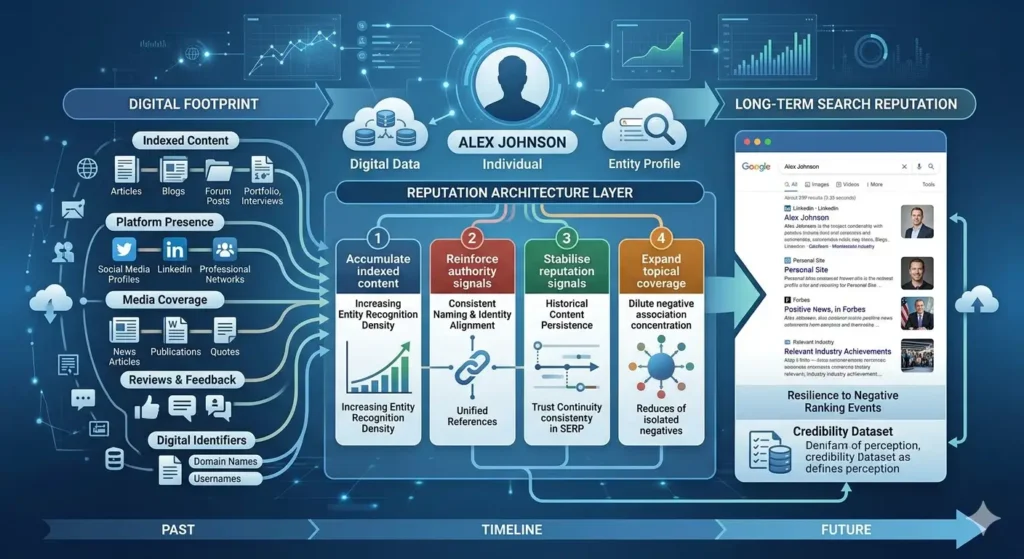
Search engines interpret digital footprint as a long-term credibility dataset. Each piece of content contributes to the overall perception graph, influencing how future queries rank associated results.
Digital footprint as a reputation architecture layer
Digital footprint operates through structured mechanisms:
- Accumulate indexed content across multiple domains and platforms
Distributed content increases entity recognition density. - Reinforce authority signals through consistent naming and identity alignment
Uniform entity references strengthen algorithmic association. - Stabilise reputation signals through historical content persistence
Long-standing content increases trust continuity in SERP evaluation. - Expand topical coverage to dilute negative association concentration
Broader content ecosystems reduce the impact of isolated negative pages.
Digital footprint determines how resilient an entity is to negative ranking events. Stronger footprints distribute authority across multiple sources, reducing dependency on any single result.
Dive Deeper With Our Expert Guides:
How to Fix Your Online Reputation and Protect Your Name Online
Protect Your Name Online: Reputation Management for Individuals Explained
Search reputation systems operate through structured mechanisms that define how content is indexed, ranked, and interpreted within SERPs. Removing negative search results about a person from Google is not a singular action but a system-level adjustment involving indexing control, ranking dynamics, and entity perception.
Reputation is formed through aggregated signals including authority, relevance, and digital footprint distribution. Google evaluates these signals through entity-based frameworks that map relationships across indexed content. Negative visibility persists when ranking signals reinforce its authority, while suppression occurs when competing content rebalances search visibility structures.
Understanding these mechanisms clarifies how search ecosystems construct and maintain reputational narratives over time without relying on sentiment interpretation, but through structured evaluation of content and authority networks.
Answers to Key Questions
How do negative Google search results appear for individuals?
Negative Google search results appear when indexed web pages contain relevant name-based or entity-based signals linked to an individual. Search engines rank these pages using authority, keyword relevance, and engagement metrics, which determine SERP visibility.
Can Clear My Name remove negative search results from Google completely?
Clear My Name works within reputation management for individuals by influencing search visibility rather than directly deleting indexed content. In most cases, removal depends on de-indexing eligibility, legal removal routes, or suppression through stronger ranking content.
What is reputation management for individuals in search engines?
Reputation management for individuals refers to the process of shaping how personal information is indexed, ranked, and displayed in search results. It involves managing digital footprint signals, entity perception, and SERP evaluation patterns.
Why do some negative results rank higher than positive ones on Google?
Negative results rank higher when they have stronger authority signals, backlinks, or better relevance alignment with the search query. Google ranking systems prioritise relevance and trust signals, not sentiment or content positivity.