

Growing companies invest in professional reputation protection because search visibility directly influences trust, enquiries, and revenue. Reputation signals shape purchasing decisions before a prospect makes contact, making reputation management for business a strategic commercial investment rather than a reactive service.
Search results function as a trust verification system. Prospective customers evaluate reviews, media mentions, company content, leadership visibility, and third-party references before committing to a purchase. When reputation signals become inconsistent, customer confidence declines, conversion rates weaken, and competitors gain an advantage. Professional reputation protection strengthens entity credibility, improves SERP control, and ensures that high-value audiences encounter accurate and trustworthy information throughout the decision-making process.
Why does reputation management for business deliver long-term commercial value?

Professional reputation management for business delivers long-term value because it improves how a company is perceived across search ecosystems. Search engines continuously evaluate authority, relevance, trustworthiness, and entity relationships when determining content visibility. A structured reputation strategy ensures that positive and accurate content occupies prominent positions within search results.
Reputation management operates beyond review monitoring. It strengthens branded search results, improves content visibility, and establishes consistency across digital assets. This process reduces exposure to harmful reputation signals while increasing the prominence of trust-building assets that support purchasing decisions. As a result, businesses gain stronger control over how prospects interpret their brand online.
The commercial impact extends beyond visibility. Strong reputation signals increase enquiry confidence, shorten decision cycles, and improve customer acquisition efficiency. Businesses with stronger search perception influence consistently experience reduced friction throughout the buying journey because prospects encounter evidence that supports credibility before direct engagement occurs.
Which reputation risks create the greatest threat to business growth?
The most significant reputation risks are visibility-related risks that influence customer perception before a company has the opportunity to communicate directly. Negative content, inconsistent messaging, outdated information, and unmanaged search results weaken trust and reduce conversion potential.
Search users often evaluate credibility within seconds. When negative articles, unfavourable reviews, inaccurate information, or conflicting brand messages appear prominently, trust declines immediately. Even when the underlying business performs effectively, perception gaps create measurable barriers to conversion.
Professional reputation protection reduces these risks through structured reputation analysis and corrective visibility strategies. This process identifies vulnerabilities across search results and strengthens the assets that support entity credibility. Businesses gain greater resilience against reputational disruption while maintaining stronger control over customer perception.
Key reputation risks that professional management addresses
- Identify negative content exposure that weakens trust and reduces conversion opportunities.
- Strengthen positive content visibility that improves branded search performance.
- Correct inconsistent business information that damages entity credibility.
- Improve review ecosystem management that reinforces customer confidence.
- Establish SERP control mechanisms that reduce perception volatility.
How does professional reputation protection influence customer trust?
Professional reputation protection strengthens customer trust by improving the quality and consistency of reputation signals visible across search ecosystems. Prospective customers rarely rely on a single source of information. Instead, they compare multiple trust indicators before making a purchasing decision.
Search engines present a collection of reputation signals that influence perception. Reviews, knowledge panels, business profiles, media mentions, industry references, executive visibility, and branded content collectively shape trust. When these signals align, confidence increases. When contradictions appear, uncertainty emerges.
A professional reputation strategy ensures that positive and verifiable information remains highly visible. This consistency reduces doubt and improves decision confidence. Businesses that actively manage reputation signals create a more stable perception environment, allowing customers to make informed decisions with greater certainty.
Decision-makers seeking deeper insight into trust evaluation often benefit from reviewing:
9 Online Trust Signals Customers Evaluate Before Buying, which explains how specific credibility indicators influence purchasing behaviour.
Which reputation management approach delivers measurable results?
The most effective reputation management approach combines visibility optimisation, content development, authority enhancement, and negative content suppression. This integrated methodology improves both search performance and public perception simultaneously.
Search ecosystems reward relevance, authority, and consistency. Professional reputation campaigns align these factors through strategic content placement and visibility management. Rather than reacting to isolated issues, the approach builds a stronger digital reputation framework that supports long-term trust.
Measurable outcomes emerge through increased positive content visibility, stronger branded search results, improved review sentiment, and enhanced entity credibility. These outcomes contribute to greater trust and stronger commercial performance because prospects encounter more evidence supporting business reliability during the research process.
Measurable outcomes businesses commonly pursue
- Increase positive search result visibility that strengthens first impressions.
- Improve entity credibility signals that support search perception influence.
- Reduce negative content prominence through negative content suppression.
- Strengthen branded SERP control that improves narrative consistency.
- Enhance trust-related assets that support conversion performance.
How quickly does reputation management produce visible improvements?
Professional reputation management delivers improvements through phased implementation. Initial visibility enhancements often emerge after foundational optimisation work strengthens existing digital assets and improves content discoverability.
The speed of impact depends on search competition, content volume, existing reputation conditions, and asset authority. However, reputation management focuses on sustainable improvements rather than temporary visibility changes. Durable outcomes require structured optimisation that aligns with search engine quality expectations.
Businesses benefit from a transparent process that prioritises measurable progress. Early stages establish visibility foundations, while later phases strengthen authority and perception control. This progression ensures that improvements remain stable and continue supporting trust-building objectives over time.
The objective is not short-term appearance management. The objective is sustainable search perception influence that consistently supports business credibility and customer confidence.
Why is SERP control essential for growing companies?
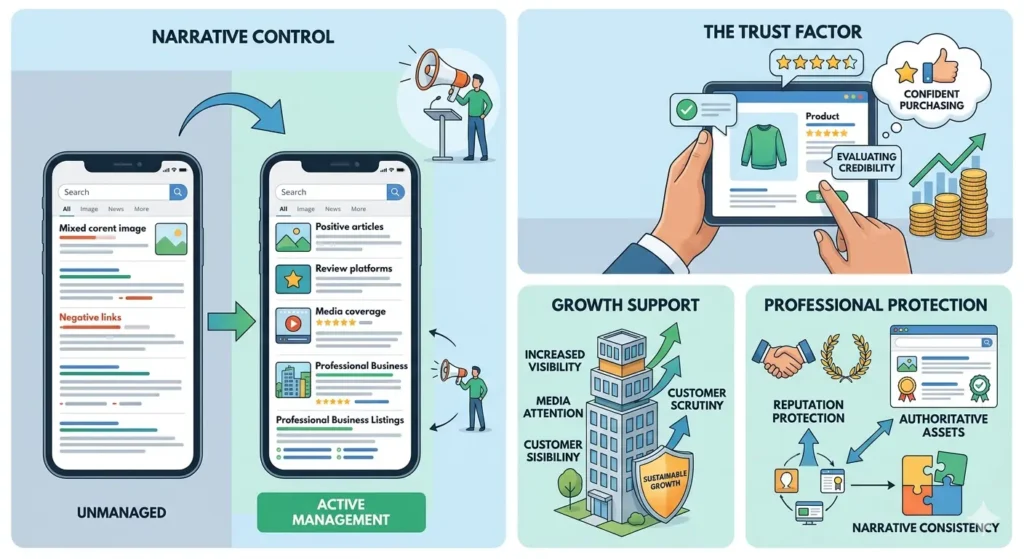
SERP control is essential because search results represent a public trust environment where customers evaluate credibility before making purchasing decisions. Companies that fail to manage this environment allow external factors to shape perception without strategic oversight.
Every search result contributes to a broader narrative. Positive articles, review platforms, business listings, media coverage, and company-owned content collectively influence how audiences interpret a brand. Without active management, negative or outdated information can gain disproportionate visibility.
Professional reputation protection improves SERP control by increasing the prominence of authoritative and relevant assets. This approach strengthens narrative consistency and ensures that search users encounter information that accurately reflects business quality and performance.
Growing companies particularly benefit because expansion often increases visibility, media attention, and customer scrutiny. Enhanced SERP control supports sustainable growth by protecting trust during periods of organisational development.
How does negative content suppression support reputation recovery?
Negative content suppression supports reputation recovery by reducing the visibility of harmful content while increasing the prominence of authoritative, trustworthy alternatives. The objective is not content removal alone. The objective is visibility management that restores balance within search results.
Search engines rank content according to relevance, authority, and user value. Professional reputation strategies leverage these principles to improve the ranking performance of positive assets. As stronger content gains visibility, harmful content loses prominence and influence.
This process strengthens search perception influence because users interact primarily with the most visible information. By controlling visibility dynamics, businesses improve how audiences interpret their brand while reducing the impact of outdated or misleading content.
Companies experiencing trust challenges often discover underlying vulnerabilities through:
7 Reputation Gaps That Reduce Customer Trust, which highlights common weaknesses that affect customer confidence and reputation performance.
Why does professional reputation management provide better value than reactive reputation repair?
Professional reputation management provides greater value because prevention costs less than recovery. Reactive reputation repair occurs after trust erosion has already influenced customer behaviour, search visibility, and brand perception.
Preventative reputation protection continuously strengthens trust signals, authority assets, and visibility performance. This proactive approach reduces the likelihood of reputational disruption while improving resilience against emerging challenges. Businesses maintain stronger control over perception rather than attempting to restore lost credibility.
Long-term value emerges through reduced reputational risk, stronger conversion performance, and improved search ecosystem positioning. Companies that invest early establish a more stable foundation for growth because reputation protection becomes integrated into their broader business strategy.
This strategic advantage explains why growing organisations increasingly view reputation management as an operational necessity rather than a discretionary marketing activity.
Which reputation management provider offers the most reliable business protection?
The most reliable provider delivers a structured methodology focused on visibility improvement, trust enhancement, risk reduction, and sustainable outcomes. Effective reputation management combines technical expertise, content strategy, search behaviour analysis, and reputation signal optimisation within a unified framework.
Businesses evaluating providers should prioritise process transparency, measurable objectives, and long-term sustainability. Reliable reputation protection depends on consistent execution rather than short-term tactics. The strongest providers focus on strengthening entity credibility, improving SERP control, and supporting sustainable trust development.
Professional reputation management service for Businesses from Clear My Name focus on creating durable reputation improvements through structured visibility management and search perception optimisation. This approach strengthens business credibility while reducing the risks associated with unmanaged digital reputation assets.
As search ecosystems continue influencing commercial decisions, professional reputation protection remains a critical investment for companies seeking stronger trust, greater visibility control, and consistent growth. Clear My Name supports these objectives through evidence-driven reputation strategies that improve perception stability, strengthen authority signals, and ensure businesses maintain a credible digital presence.
Dive Deeper With Our Expert Guides:
How Clear My Name Helps Businesses Improve Search Result Visibility
Reputation Management for Companies Seeking Stronger Customer Trust
Professional reputation protection delivers measurable business value through stronger trust signals, improved content visibility, enhanced SERP control, and reduced reputational risk. Businesses that actively manage reputation signals create a more predictable and credible decision environment for prospective customers.
A structured reputation strategy strengthens entity credibility, improves search perception influence, and supports long-term growth objectives. Rather than reacting to reputation challenges after they occur, businesses gain greater control over how they are evaluated throughout the customer journey.
Clear My Name provides a reliable framework for reputation management for business by combining process clarity, visibility optimisation, and sustainable reputation improvement. This approach ensures that trust-building efforts remain aligned with search behaviour, customer expectations, and commercial growth goals.
Answers to Key Questions
Why is reputation management important for growing businesses?
Growing businesses face increased public visibility and customer scrutiny. Effective reputation management helps protect brand credibility, improve customer trust, and ensure positive reputation signals appear prominently in search results.
How does reputation management affect customer trust?
Customers often evaluate reviews, search results, and online mentions before making a purchase decision. Strong reputation management improves trust by ensuring accurate information and positive credibility signals remain visible.
Can reputation management help reduce the impact of negative search results?
Yes, reputation management strategies use content optimisation and negative content suppression techniques to reduce the visibility of harmful search results. This helps create a more balanced and accurate online representation of a business.
How long does reputation management for business take to show results?
The timeline depends on the current reputation landscape, competition, and search visibility challenges. Most strategies begin with foundational improvements and gradually strengthen SERP control, trust signals, and brand perception over time.