

Affordable reputation management services maintain quality by focusing on sustainable reputation signals, transparent methodologies, and measurable search visibility improvements rather than low-cost, short-term tactics.
Reputation management strategies differ based on search objectives, risk exposure, entity credibility, and the complexity of an organisation’s digital footprint. Online reputation control methods are evaluated through search ranking influence, sentiment distribution, SERP composition, content quality, and long-term sustainability.
Which factors determine whether affordable reputation management services maintain quality?
Affordable reputation management is the structured process of improving and maintaining online reputation through cost-efficient methods without reducing strategic quality or technical effectiveness. Cost alone does not determine service quality because reputation management depends on the selection of appropriate mechanisms rather than the size of the investment. Search engines interpret reputation through connected signals including authoritative content, user-generated reviews, structured business information, news mentions, and website authority. A lower-cost approach remains effective when it prioritises activities that strengthen these signals consistently. An expensive strategy that focuses on low-value activities produces weaker outcomes despite a larger budget. Evaluation therefore centres on operational quality, measurable reputation signals, and search ecosystem performance rather than price.
Quality also depends on how resources are allocated across proactive reputation building and reactive issue management. Organisations with stable sentiment distribution benefit from continuous content enhancement and review monitoring instead of intensive suppression strategies. Businesses experiencing significant negative search visibility require greater investment in corrective actions because search ecosystems contain stronger competing signals. Entity credibility increases when information remains consistent across trusted platforms and authoritative content expands topical relevance. Reputation management for business therefore operates most efficiently when affordability aligns with strategic priorities instead of reducing essential activities.
How do proactive and reactive reputation management approaches compare?
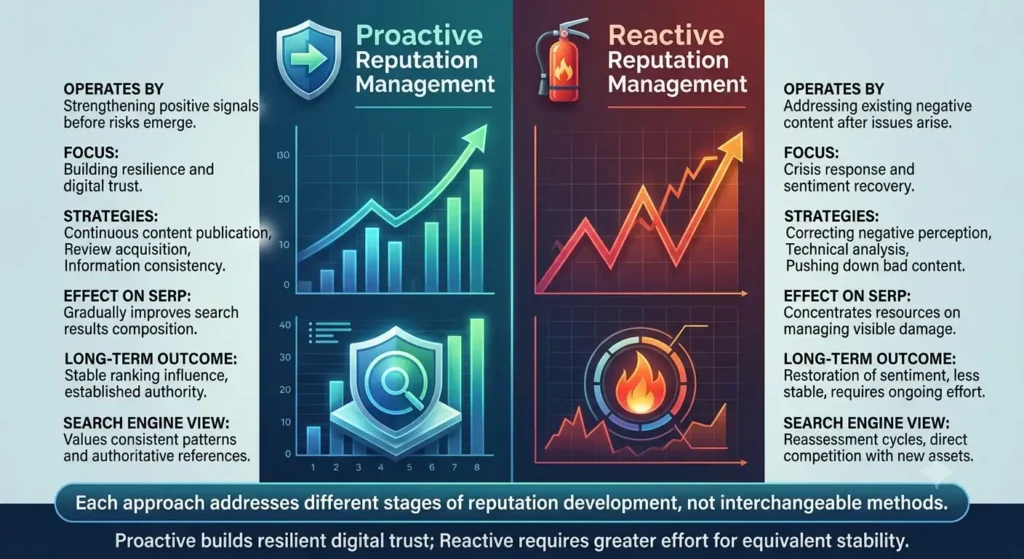
Proactive reputation management operates by strengthening positive reputation signals before reputation risks affect search visibility. Reactive reputation management operates by addressing existing negative content, declining sentiment distribution, or damaged entity credibility after issues become visible in search results. The distinction influences both implementation methods and long-term search performance. Proactive strategies gradually improve SERP composition through continuous publication of relevant content, review acquisition, and information consistency. Reactive strategies concentrate resources on correcting search perception after negative signals become dominant. Each approach addresses different stages of reputation development rather than competing as interchangeable methods.
Proactive approaches create stable search ranking influence because search engines evaluate consistent publication patterns, authoritative references, and positive engagement over time. Reactive approaches often require more intensive technical analysis because existing negative search results compete directly with new reputation assets. Reputation recovery therefore depends on the authority of replacement content, the persistence of negative signals, and search engine reassessment cycles. Long-term sustainability remains stronger when proactive reputation management establishes resilient digital trust before issues emerge. Reactive programmes remain valuable for restoring sentiment distribution but require greater effort to achieve equivalent stability.
How does budget allocation differ between proactive and reactive strategies?
Budget efficiency improves when proactive activities receive continuous investment instead of concentrating resources during reputation crises. Routine monitoring identifies reputation changes before negative content dominates search visibility. Content enhancement gradually expands positive search assets while review management strengthens authentic customer sentiment. Reactive spending often increases because urgent suppression efforts require accelerated production of authoritative content and extensive monitoring. Cost efficiency therefore reflects timing as much as financial investment.
How does content enhancement compare with content suppression strategies?
Content enhancement is the process of creating and optimising authoritative digital assets that strengthen positive search ranking influence. Content suppression operates by reducing the visibility of negative search results through stronger competing content rather than deleting existing material. Both approaches influence SERP composition through different mechanisms. Search engines reward relevance, authority, freshness, and user engagement instead of intentional suppression activities. As a result, content enhancement aligns more directly with organic ranking systems while suppression depends on outperforming competing pages.
Content enhancement strengthens entity credibility because authoritative articles, expert resources, business profiles, and relevant media expand trusted information across search ecosystems. Suppression strategies remain dependent on the quality and authority of replacement assets because weak content cannot displace stronger negative pages. Sustainable reputation management therefore combines enhancement with strategic optimisation rather than relying exclusively on suppression objectives. Search perception improves through balanced sentiment distribution instead of artificial removal attempts. This distinction explains why content quality remains the primary ranking influence within reputation management programmes.
Which review management methods provide stronger reputation signals?
Online review management is the structured process of monitoring, responding to, and encouraging authentic customer feedback across recognised review platforms. Reputation signals derived from reviews influence consumer trust as well as search engine understanding of business credibility. Search ecosystems evaluate review volume, recency, response consistency, and sentiment distribution together instead of treating star ratings as isolated ranking factors. Affordable reputation management therefore focuses on systematic review governance rather than rapid reputation inflation. Quality review management strengthens entity credibility through authentic engagement and transparent communication.
Comparing review management methods highlights significant operational differences.
- Monitor review platforms continuously to identify sentiment changes before negative patterns affect search perception.
- Respond consistently with factual, solution-focused communication that demonstrates active reputation governance.
- Encourage verified customer feedback through legitimate post-service processes that increase authentic review diversity.
- Analyse recurring themes to identify operational issues that influence long-term reputation signals.
Artificial review generation creates distorted sentiment distribution and weakens entity credibility because search platforms detect behavioural anomalies. Authentic review ecosystems provide stronger search ranking influence because engagement reflects genuine customer experience. Sustainable review management therefore produces higher long-term value than volume-focused review acquisition alone.
How do local SEO and broader reputation management complement each other?
Local SEO is the optimisation of location-specific search signals that improve visibility within geographic search results. Reputation management for business evaluates broader digital trust across search engines, review platforms, news coverage, and content ecosystems. Local optimisation strengthens proximity-based relevance while reputation management expands entity credibility beyond local discovery. The relationship between these disciplines becomes important when organisations compare affordable service options. Local visibility supports customer acquisition, whereas reputation management shapes overall search perception.
Businesses operating within defined geographic markets benefit from accurate business information, consistent citations, verified reviews, and location-relevant content. Broader reputation strategies extend beyond these assets by improving authoritative content, knowledge graph consistency, media references, and branded search results. Search engines evaluate both local trust signals and broader entity relationships when determining overall credibility. Organisations therefore achieve stronger SERP composition when both systems reinforce each other instead of operating independently. Affordability improves because overlapping activities strengthen multiple ranking influences simultaneously.
Which reputation monitoring methods provide better long-term value?
Reputation monitoring is the continuous measurement of reputation signals across search engines, review platforms, news publications, and social discussions. Monitoring operates by identifying changes in visibility, sentiment distribution, and entity credibility before significant reputation decline occurs. Manual monitoring provides direct oversight but consumes operational resources and reduces reporting consistency. Automated monitoring increases efficiency through continuous data collection and structured alerts. Both methods contribute valuable information when integrated into a comprehensive evaluation framework.
Long-term value depends on measurement quality rather than monitoring frequency alone. Effective monitoring analyses branded search results, review trends, backlink quality, media coverage, and structured business information together. Isolated metrics fail to explain reputation changes because search ecosystems interpret interconnected signals instead of individual indicators. Affordable reputation management therefore prioritises meaningful measurement frameworks that connect search visibility with trust development. Consistent analysis improves strategic decision-making while reducing unnecessary corrective expenditure.
Which metrics provide the clearest evaluation framework?
Effective reputation assessment focuses on measurable indicators instead of subjective impressions.
- Measure branded search visibility to evaluate positive and negative SERP composition.
- Track sentiment distribution across review platforms and public discussions.
- Evaluate entity credibility through authoritative citations and trusted content references.
- Compare review response consistency against changing customer feedback patterns.
- Assess content performance using ranking influence and search visibility metrics.
These indicators explain reputation performance more accurately than isolated traffic statistics because they reflect search ecosystem interpretation directly.
How do short-term tactics compare with long-term reputation strategies?
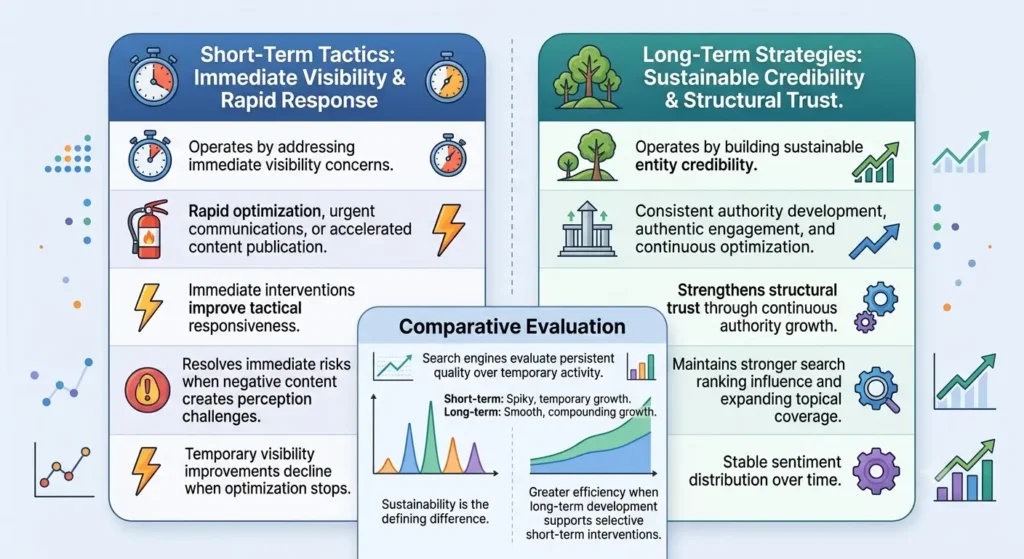
Short-term reputation tactics operate by addressing immediate visibility concerns through rapid optimisation, urgent communications, or accelerated content publication. Long-term strategies operate by building sustainable entity credibility through consistent authority development, authentic engagement, and continuous optimisation. Both approaches influence reputation signals differently because search engines evaluate persistent quality over temporary activity. Immediate interventions improve tactical responsiveness while long-term programmes strengthen structural trust. Their effectiveness therefore depends on strategic objectives rather than implementation speed.
Short-term activities resolve immediate reputation risks when negative content creates significant search perception challenges. However, temporary visibility improvements decline when ongoing optimisation stops because competing search assets continue evolving. Long-term strategies maintain stronger search ranking influence through continuous authority growth, expanding topical coverage, and stable sentiment distribution. Sustainability therefore becomes the defining difference between both approaches. Affordable reputation management achieves greater efficiency when long-term credibility development supports selective short-term interventions instead of replacing them.
Dive Deeper With Our Expert Guides:
12 Proven Online Reputation Management Strategies That Actually Work
How to Build a Reputation Improvement Strategy
What evaluation criteria help compare affordable reputation management options?
Evaluation frameworks compare reputation management approaches through measurable operational characteristics instead of marketing claims. Reputation management programmes differ according to methodology, reporting transparency, technical implementation, scalability, and alignment with search ecosystem principles. Comparing these characteristics identifies quality differences without focusing exclusively on financial cost. Structured evaluation therefore improves procurement decisions for businesses assessing available options. Objective comparison also reduces exposure to ineffective reputation practices.
A practical evaluation framework includes the following criteria:
- Compare methodology based on content enhancement, review governance, monitoring, and technical optimisation.
- Evaluate reporting using measurable reputation signals instead of general performance summaries.
- Assess scalability by examining how strategies expand alongside business growth.
- Measure sustainability through long-term entity credibility rather than temporary ranking movement.
- Analyse transparency by reviewing clearly defined processes and realistic implementation timelines.
This framework explains whether affordability reflects operational efficiency or reduced strategic capability. Quality remains linked to measurable search ecosystem performance instead of pricing alone.
Affordable reputation management services differ according to methodology, sustainability, and their influence on reputation signals rather than their price alone. Proactive and reactive approaches address different stages of reputation development, while content enhancement, review management, monitoring, and local optimisation each contribute distinct mechanisms for improving entity credibility and search visibility. Long-term strategies strengthen sentiment distribution through consistent authority building, whereas short-term tactics resolve immediate visibility challenges without providing lasting structural improvements. Comparing services through measurable evaluation criteria, transparent methodologies, and search ranking influence provides a more reliable assessment than comparing costs in isolation. Effective reputation management for business therefore depends on selecting approaches that balance affordability with sustainable improvements in digital trust and SERP composition.
For deeper insight, explore:
Affordable Reputation Management Services for Small Businesses: Compare Your Options
Answers to Key Questions
What is reputation management for business?
Reputation management for business is the process of monitoring, improving, and maintaining how a company appears across search engines, review platforms, news sites, and social media. It focuses on strengthening positive reputation signals, managing online feedback, and improving digital trust over time.
How do affordable reputation management services maintain quality?
Affordable reputation management services maintain quality by prioritising content enhancement, review management, reputation monitoring, and search visibility improvements. Clear My Name explains that quality depends on strategy, transparency, and measurable outcomes rather than price alone.
How long does reputation management for business take to show results?
Reputation management is an ongoing process because search engines continuously evaluate new content and reputation signals. Initial improvements can appear within a few months, while stronger search visibility and entity credibility develop through consistent long-term optimisation.
What factors should businesses compare when choosing reputation management services?
Businesses should compare methodology, reporting, monitoring processes, content strategy, review management, and long-term sustainability. Evaluating these factors provides a clearer picture of service quality than comparing prices alone.