

Online reputation management strategies work by influencing reputation signals, search visibility, and public perception across search engines, review platforms, news sources, and social media. The most effective strategy depends on the source of reputational risk, the existing search landscape, and the strength of an organisation’s digital footprint.
Reputation management strategies differ based on the origin of negative content, the authority of existing digital assets, and the balance between proactive reputation building and reactive reputation repair. Online reputation control methods are evaluated through search ranking influence, entity credibility, sentiment distribution, content authority, and long-term sustainability rather than short-term visibility changes.
Which online reputation management strategies produce the most sustainable results?
Long-term reputation management strategies produce sustainable results by strengthening entity credibility and improving positive reputation signals across multiple digital channels. Sustainable methods focus on building authoritative content rather than attempting to remove unfavourable information without addressing its underlying causes.
Content enhancement is a reputation management approach that operates by publishing authoritative, relevant, and trustworthy digital assets. Search engines evaluate these assets through relevance, quality, topical authority, and user engagement. Strong content gradually improves SERP composition because higher-value resources receive greater visibility over time. This approach creates a broader digital footprint that represents an organisation through accurate and consistent information.
Reactive reputation repair focuses on responding after negative search results, reviews, or media coverage appear. It addresses immediate visibility concerns but often depends on existing search authority and the competitiveness of search results. Reactive methods influence sentiment distribution more quickly than proactive content development, yet their long-term effectiveness depends on continuous monitoring and strategic updates. Sustainable reputation improvement combines consistent authority building with structured responses to emerging reputation risks.
How does content creation compare with content removal strategies?
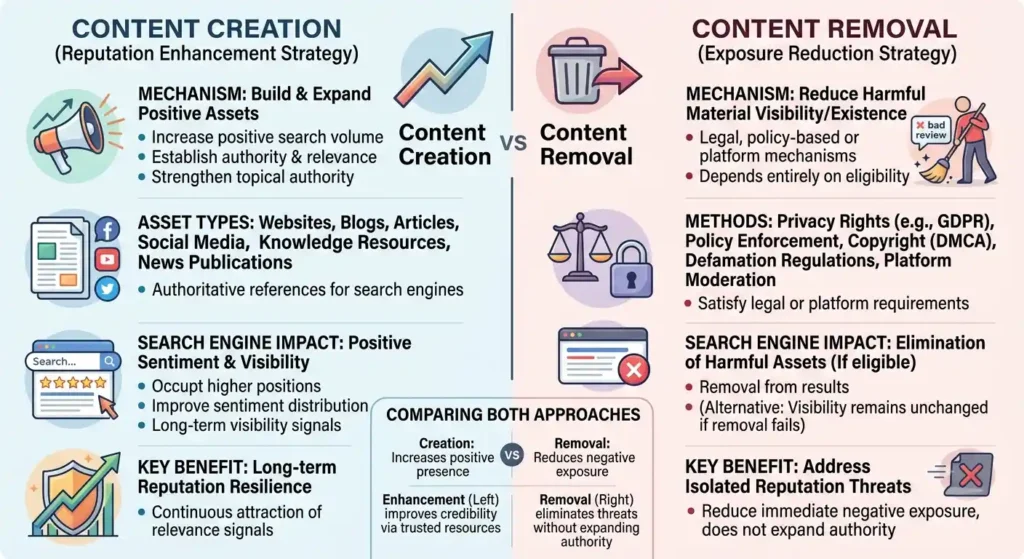
Content creation improves reputation by increasing the volume and authority of positive search assets, while content removal focuses on reducing the visibility or existence of harmful material through legal, policy-based, or platform-specific mechanisms.
Content creation is a reputation enhancement strategy that operates by expanding positive digital assets across websites, knowledge resources, news publications, and social platforms. Search engines interpret these assets as additional entity references, strengthening topical authority and improving search ranking influence. As authoritative content grows, positive resources occupy a greater proportion of branded search results, improving overall sentiment distribution. This process supports long-term visibility because new authoritative assets continue attracting relevance signals.
Content removal strategies operate through privacy rights, policy enforcement, copyright procedures, defamation regulations, or platform moderation systems. Their effectiveness depends entirely on eligibility rather than optimisation techniques. Removal eliminates harmful assets only when legal or platform requirements are satisfied. Where removal is unavailable, search visibility remains unchanged, making suppression or enhancement strategies more appropriate for reputation management.
Comparing both approaches highlights different mechanisms. Content creation increases positive search presence, whereas removal reduces negative exposure. Content enhancement improves entity credibility through additional trusted resources, while removal addresses isolated reputation threats without expanding digital authority. Long-term reputation resilience generally depends on expanding trusted information rather than relying solely on deletion requests.
How do proactive reputation strategies compare with reactive reputation management?
Proactive reputation management prevents reputation decline through continuous optimisation, whereas reactive reputation management addresses existing reputation issues after negative content becomes visible.
Proactive reputation management is an ongoing process that operates by maintaining accurate business profiles, publishing expert content, encouraging authentic customer feedback, and monitoring search results. Search engines interpret consistent information across authoritative platforms as stronger reputation signals, reinforcing entity credibility. This approach improves stability because positive assets already exist before negative content emerges.
Reactive reputation management begins after search visibility changes, negative reviews increase, or adverse media coverage affects perception. The process analyses search intent, identifies influential negative assets, evaluates ranking factors, and develops corrective actions. Reactive approaches restore balance within SERPs but require greater resources because negative content already influences perception and click behaviour.
The comparison demonstrates different operational priorities. Proactive management strengthens trust signals before problems develop, reducing future risk exposure. Reactive management restores visibility after measurable reputation damage. Both approaches remain essential within comprehensive reputation management frameworks because search ecosystems continuously evolve as new content enters indexed search results.
Which review management techniques improve digital trust most effectively?
Review management improves digital trust by increasing review authenticity, response quality, and consistent customer engagement rather than simply increasing review volume.
Review management is a reputation management strategy that operates by influencing review quality, review recency, response consistency, and overall sentiment distribution. Search engines and review platforms evaluate review authenticity through behavioural patterns, user activity, and content quality. Genuine reviews strengthen entity credibility because they represent verified user experiences rather than manipulated feedback.
Responding professionally to negative reviews improves perception without altering review history. Public responses demonstrate accountability, transparency, and engagement. Search users evaluate both the original criticism and the quality of the organisation’s response, making response strategy an important trust signal alongside review ratings.
Artificial review generation differs significantly from authentic review acquisition. Fake reviews distort sentiment distribution temporarily but introduce substantial risk because detection systems identify suspicious review patterns through behavioural analysis. Platform penalties, review removals, and credibility loss reduce long-term effectiveness. Authentic review collection creates sustainable trust because reputation signals remain consistent with genuine customer experiences.
How do search result optimisation and social media management differ?
Search result optimisation controls branded search visibility, whereas social media management influences audience interaction, engagement signals, and public communication across digital platforms.
Search result optimisation is a reputation management method that operates by strengthening high-authority content capable of ranking for branded search queries. The objective is improving SERP composition through authoritative websites, positive news coverage, structured business information, and trusted organisational assets. Search engines evaluate authority, relevance, freshness, and user interaction when determining ranking positions.
Social media management operates through continuous publication, audience engagement, and platform consistency. Although most social posts produce limited direct search ranking influence, verified profiles, active engagement, and consistent branding strengthen entity credibility across digital ecosystems. Social activity also generates additional references that reinforce organisational identity.
Comparing both approaches demonstrates different functions. Search optimisation directly affects search visibility where users actively research organisations. Social media shapes ongoing public perception through communication and interaction. Effective reputation management evaluates both because search behaviour and social engagement contribute complementary reputation signals.
How do monitoring systems compare with active reputation intervention?
Monitoring systems identify reputation changes, while intervention strategies actively modify reputation signals through structured corrective actions.
Reputation monitoring is a measurement framework that operates by tracking search rankings, review activity, media mentions, sentiment distribution, backlink changes, and social discussions. Continuous monitoring detects shifts before visibility changes become widespread. Search ecosystems generate new content daily, making regular analysis essential for maintaining accurate reputation assessments.
Active intervention begins after monitoring identifies measurable reputation risks. Intervention includes publishing authoritative resources, correcting inaccurate information, improving structured business profiles, responding to reviews, or strengthening trusted digital assets. These activities directly influence the composition of indexed search results over time.
Monitoring alone does not improve reputation because measurement produces information rather than visibility changes. Intervention without monitoring lacks strategic direction because corrective actions fail to prioritise the most influential reputation risks. Effective reputation management integrates continuous measurement with evidence-based optimisation.
Which reputation management strategies provide the strongest long-term search performance?
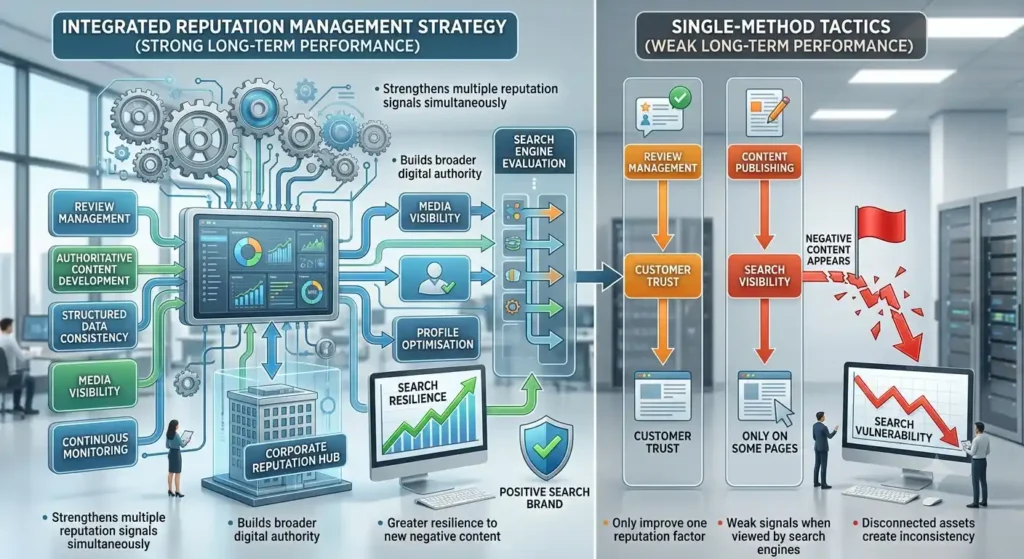
Integrated reputation management strategies provide stronger long-term search performance because they strengthen multiple reputation signals simultaneously rather than relying on isolated tactics.
A comprehensive reputation strategy operates by combining authoritative content development, review management, structured data consistency, media visibility, profile optimisation, and continuous monitoring. Search engines evaluate entities through multiple interconnected signals rather than individual webpages. Organisations with broader digital authority maintain greater resilience when new negative content appears because positive assets already dominate branded search results.
Single-method strategies often improve only one reputation factor. For example, review management strengthens customer trust but does not expand authoritative search content. Content publishing improves search visibility but does not address inaccurate business listings or review quality. Search ecosystems reward consistency across interconnected digital assets rather than isolated optimisation efforts.
Long-term sustainability depends on maintaining accurate information, consistent entity references, trusted external citations, and balanced sentiment distribution. Reputation management becomes more resilient when every digital asset contributes positive reputation signals within the wider search ecosystem.
Dive Deeper With Our Expert Guides:
How to Build a Reputation Improvement Strategy
Business Reputation Benchmarking Against Competitors
What evaluation framework identifies the most appropriate reputation management strategy?
A structured evaluation framework identifies the most appropriate strategy by measuring search visibility, reputation signals, authority strength, and sentiment balance before selecting corrective actions.
An evidence-based framework compares measurable indicators rather than assumptions. Reputation management becomes more accurate when each strategy addresses the primary cause of reduced trust instead of treating every issue as identical.
The following evaluation process compares reputation management options:
- Identify the dominant reputation issue by analysing branded search results, review platforms, news visibility, and social mentions.
- Measure sentiment distribution across indexed assets to determine whether negative visibility results from isolated content or widespread perception.
- Evaluate entity credibility using authoritative references, consistent business information, and digital authority signals.
- Compare content suppression versus content enhancement based on search competitiveness and the authority of existing assets.
- Monitor search ranking influence regularly to measure changes in SERP composition and reputation signals over time.
This framework improves strategic decision-making because every reputation challenge originates from different search dynamics. Organisations with strong digital authority require different interventions from organisations with limited online visibility, making evidence-based evaluation essential before implementing any reputation management strategy.
Online reputation management strategies differ in their mechanisms, scalability, and long-term impact on search ecosystems. Content enhancement strengthens entity credibility through authoritative digital assets, while content removal addresses eligible harmful material through legal or platform-based processes. Proactive reputation management builds resilience before visibility declines, whereas reactive strategies restore balance after measurable reputation challenges emerge. Review management, search optimisation, monitoring, and digital footprint development each influence different reputation signals and contribute distinct forms of search ranking influence.
Selecting an appropriate reputation management strategy depends on evaluating SERP composition, sentiment distribution, authority strength, and the origin of reputation risks. Sustainable reputation management relies on consistent optimisation across interconnected digital assets rather than isolated actions, creating stronger long-term visibility and more stable digital trust.
Get deeper insight, explore:
Professional Business Reputation Management Services That Protect Your Brand
Answers to Key Questions
What is reputation management for business?
Reputation management for business is the process of monitoring, improving, and protecting how a company appears across search engines, review platforms, news websites, and social media. It focuses on strengthening positive reputation signals and addressing content that affects public trust.
Why is online reputation important for a business?
A strong online reputation influences customer trust, purchasing decisions, and search visibility. Positive reviews, accurate business information, and authoritative content help improve credibility and support long-term brand perception.
How long does reputation management for business take to show results?
The timeframe depends on the existing search results, the level of negative content, and the strength of current digital assets. Reputation management is an ongoing process that improves search visibility and trust through consistent optimisation.
Can negative search results be removed from Google?
Some content can be removed if it violates legal requirements or platform policies, but not all negative search results qualify for removal. When removal is unavailable, reputation management focuses on improving search result composition through authoritative content and positive reputation signals.