
A reputation improvement strategy is a structured framework for identifying, measuring, and influencing reputation signals across search results, digital platforms, and owned media assets. Effective reputation improvement depends on analysing visibility gaps, sentiment distribution, entity credibility, and search ranking influence within the digital ecosystem.
Reputation management strategies differ based on the source of reputation issues, the structure of search engine results pages (SERPs), and the availability of positive reputation assets. Online reputation control methods are evaluated through their impact on search visibility, trust signals, content prominence, and long-term sustainability.
Which Components Form the Foundation of a Reputation Improvement Strategy?
A reputation improvement strategy is a systematic process for strengthening favourable reputation signals while reducing the prominence of negative or outdated information. The strategy operates by analysing how search engines interpret content relevance, authority, and user engagement signals across digital properties.
The first component is reputation auditing. Reputation auditing is the measurement of existing search visibility, sentiment distribution, review patterns, media coverage, and branded search results. Search engines evaluate entities based on content consistency, authority indicators, and topical relevance. A reputation audit identifies strengths, weaknesses, and exposure points that influence entity credibility.
The second component is reputation asset mapping. Reputation assets include owned websites, social profiles, knowledge sources, media mentions, and third-party references. Asset mapping measures the authority and visibility of each asset within the search ecosystem. Strong asset coverage increases content control and improves SERP composition.
The third component is strategic prioritisation. Strategic prioritisation evaluates which reputation issues create the greatest visibility risk. High-ranking negative content, review concentration problems, and authority gaps require different intervention mechanisms. Prioritisation improves resource allocation and accelerates measurable outcomes.
How Does Content Enhancement Compare with Content Suppression?
Content enhancement focuses on increasing the visibility of positive and authoritative content. Content suppression focuses on reducing the prominence of unfavourable content through competitive ranking strategies. Both approaches influence SERP composition but operate through different mechanisms.
How Does Content Enhancement Operate?

Content enhancement is the creation and optimisation of authoritative digital assets that strengthen entity credibility. The method operates by publishing relevant content across websites, media platforms, industry resources, and social channels.
Search engines interpret consistent, authoritative content as a signal of expertise and relevance. Enhanced content increases branded search coverage and expands the volume of favourable search results. The approach improves trust signals because users encounter stronger informational assets during reputation evaluation.
Content enhancement demonstrates strong scalability and sustainability. New content assets continue generating visibility over time. However, content enhancement requires substantial authority development before search ranking influence becomes measurable.
How Does Content Suppression Operate?
Content suppression is a visibility management strategy that aims to reduce the ranking prominence of undesirable search results. The method operates by strengthening competing assets that satisfy search intent more effectively than negative content.
Search ranking influence depends on relevance, authority, and engagement signals. Suppression campaigns improve favourable asset visibility while pushing undesirable results lower within SERPs. Since users rarely explore deeper result pages, visibility reduction alters perception exposure.
Content suppression produces measurable SERP changes when sufficient authority assets exist. However, suppression effectiveness depends on the strength of competing content. High-authority negative publications create greater ranking resistance and require extensive optimisation efforts.
Which Reputation Management Approach Produces More Sustainable Results?
Long-term reputation improvement produces stronger sustainability than short-term reactive interventions. Sustainability is measured through lasting search visibility, stable sentiment distribution, and consistent entity credibility signals.
Reactive reputation management operates after reputation issues become visible. The approach focuses on immediate response actions such as crisis communication, review responses, or urgent content publication. Reactive methods address visibility threats quickly but provide limited structural improvement.
Organic reputation management operates through continuous reputation asset development. The method strengthens content ecosystems, authority signals, and search visibility over extended periods. Search engines reward consistency, relevance, and topical authority, making organic approaches more durable.
From a sustainability perspective, organic strategies outperform reactive interventions because they build cumulative authority. Reactive methods remain important for managing immediate risks, but long-term reputation resilience depends on ongoing optimisation rather than isolated responses.
How Does Review Management Compare with Content-Based Reputation Strategies?
Review management focuses on user-generated feedback signals, while content-based strategies focus on search visibility and authority development. Both influence reputation perception through distinct mechanisms.
Review management is the monitoring, analysis, and response process for customer reviews across digital platforms. Reviews operate as trust signals because users evaluate sentiment trends before making decisions. Search engines also interpret review quality, review frequency, and engagement patterns as credibility indicators.
Content-based reputation strategies operate by controlling informational visibility rather than direct user feedback. Authoritative content strengthens branded search results, expands positive information coverage, and improves topical relevance. Content assets influence what users discover during search evaluation.
Review management delivers direct trust signal improvements because users frequently rely on peer feedback. Content-based strategies provide broader SERP control and entity positioning benefits. Combined implementation creates stronger reputation protection because both search visibility and public sentiment improve simultaneously.
What Role Does Search Engine Interpretation Play in Reputation Improvement?
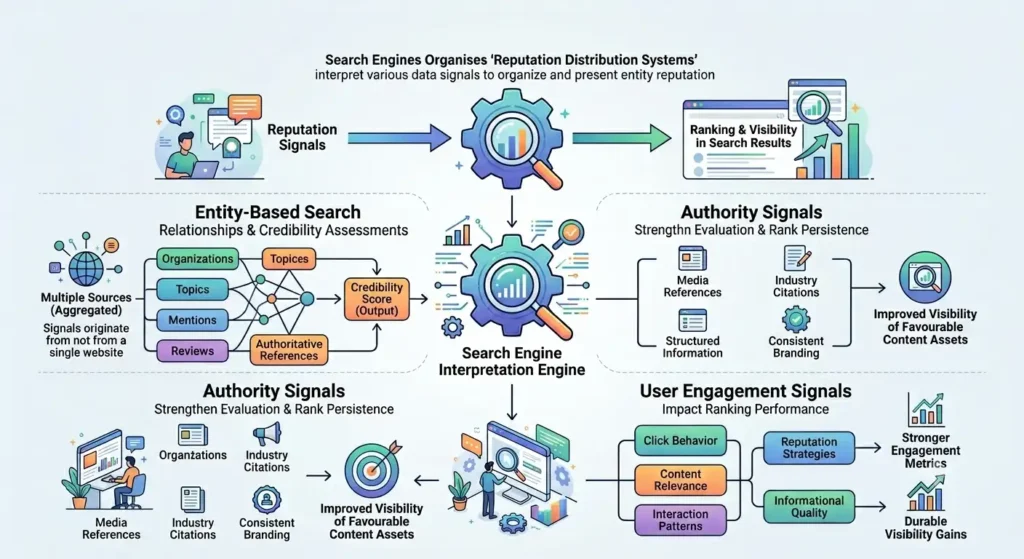
Search engines act as reputation distribution systems that organise, rank, and present reputation signals. Reputation improvement strategies succeed when they align with the mechanisms search engines use to evaluate entities.
Entity-based search systems analyse relationships between organisations, topics, mentions, reviews, and authoritative references. Reputation signals originate from multiple sources rather than a single website. Search engines aggregate these signals to establish credibility assessments.
Authority signals influence how content ranks and persists within search results. Media references, industry citations, structured information, and consistent branding strengthen authority evaluation. Strong authority improves the visibility of favourable content assets.
User engagement signals also contribute to reputation visibility. Click behaviour, content relevance, and interaction patterns influence ranking performance. Reputation strategies that improve informational quality generate stronger engagement metrics and more durable visibility gains.
Which Metrics Best Measure Reputation Improvement Effectiveness?
Reputation improvement effectiveness is measured through visibility indicators, sentiment indicators, and authority indicators. Comprehensive evaluation requires tracking all three categories simultaneously.
The most important visibility metrics include:
- Measure branded search result composition to evaluate SERP control.
- Analyse ranking positions to assess search ranking influence.
- Track asset visibility growth to identify authority expansion.
- Monitor negative result displacement to evaluate suppression performance.
Sentiment metrics measure public perception trends. Sentiment distribution compares positive, neutral, and negative references across reviews, media coverage, and social mentions. Positive sentiment growth indicates improved perception quality.
Authority metrics evaluate entity credibility. Authority measurements include citation growth, media references, backlink quality, and knowledge graph visibility. Strong authority metrics support long-term reputation sustainability and ranking stability.
No single metric provides a complete evaluation. Effective measurement frameworks combine visibility, sentiment, and authority indicators to assess overall reputation progress.
How Do Risk Exposure Levels Influence Strategy Selection?
Risk exposure determines which reputation improvement methods receive priority. Different reputation threats require different response mechanisms based on visibility impact and authority levels.
Low-risk environments typically involve minor visibility gaps, limited review issues, or incomplete reputation assets. Content enhancement and authority building represent effective solutions because structural weaknesses are the primary concern.
Medium-risk environments involve visible negative content, sentiment imbalance, or review concentration problems. A combination of content enhancement, review management, and suppression tactics improves reputation resilience. Multiple intervention points become necessary to improve SERP composition.
High-risk environments involve significant negative search visibility, widespread negative sentiment, or authoritative negative publications. High-risk scenarios require comprehensive reputation frameworks that address visibility, sentiment distribution, and authority deficits simultaneously.
Risk evaluation improves strategic efficiency because resources target the most influential reputation factors first. Search visibility analysis and sentiment analysis provide the foundation for accurate risk classification.
How Should Organisations Evaluate Reputation Improvement Methods Before Implementation?
Method evaluation depends on effectiveness, scalability, sustainability, and risk exposure reduction. These four criteria provide a structured framework for comparing reputation management approaches.
Effectiveness measures the ability of a strategy to influence reputation signals and SERP composition. Content enhancement demonstrates strong effectiveness for authority development, while review management demonstrates strong effectiveness for trust signal improvement.
Scalability measures how efficiently a strategy expands across multiple channels and assets. Content ecosystems scale more effectively than isolated reactive interventions because authority compounds over time.
Sustainability evaluates whether results persist without continuous corrective action. Organic visibility improvements generate stronger sustainability than short-term reputation repair measures. Search engines favour established authority, creating long-term ranking stability.
Risk reduction measures the ability of a strategy to protect entity credibility from future reputation threats. Diverse reputation assets, strong authority signals, and balanced sentiment distribution create greater resilience against future visibility challenges.
Dive Deeper With Our Expert Guides:
Business Reputation Benchmarking Against Competitors
How to Identify Business Reputation Risks Before They Escalate
Building a reputation improvement strategy involves analysing reputation signals, evaluating visibility risks, and selecting methods that influence search perception through measurable mechanisms. Content enhancement, content suppression, review management, and authority development each operate through distinct pathways within search ecosystems.
The key differences between approaches relate to sustainability, scalability, search ranking influence, and risk exposure reduction. Content enhancement strengthens entity credibility through authority growth, while content suppression modifies SERP composition through ranking competition. Review management improves trust signals, whereas broader content strategies influence informational visibility.
Strategic evaluation depends on understanding how search engines interpret reputation signals, how sentiment distribution affects perception, and how authority influences long-term visibility. Effective reputation improvement frameworks combine measurement, optimisation, and continuous asset development to maintain stable digital credibility over time.
For deeper insight, explore:
What Makes Clear My Name Different From Other Reputation Agencies
Answers to Key Questions
How does reputation management improve search results for a business?
Reputation management improves search results by increasing the visibility of positive and authoritative content while reducing the prominence of negative or outdated information. This helps create a more balanced SERP composition and strengthens entity credibility.
What are the most effective reputation management strategies for businesses?
Effective reputation management strategies include content enhancement, review management, digital footprint optimisation, and search visibility improvement. The best approach depends on existing reputation signals, sentiment distribution, and business goals.
How long does it take to see results from reputation management for business?
The timeline depends on the competitiveness of search results, the authority of existing content, and the severity of reputation issues. Improvements in search visibility and reputation signals often require sustained optimisation over several months.
Why is online reputation important for businesses?
Online reputation influences customer trust, search perception, and decision-making. Strong reputation signals across reviews, search results, and digital content help improve credibility and support long-term business visibility.