

Trustpilot and Feefo verified status is established through platform-specific verification requirements, accurate business information and compliance with the relevant review-platform rules. Protecting verified status requires ongoing attention to verification conditions, review activity, business information and reputation signals rather than treating verification as a permanent trust indicator.
Reputation management strategies differ based on whether the objective is establishing verified status, maintaining platform compliance or managing the wider reputation environment surrounding a business. Online reputation control methods are evaluated through their effect on trust signals, review authenticity, entity credibility and search perception. Verification provides a defined platform signal, while reputation management addresses the broader information ecosystem in which that signal appears. Comparing these approaches requires analysing how verification operates, how businesses maintain it and how review-platform information affects buyer perception. The distinction is particularly relevant when a verified profile becomes part of a company’s wider digital footprint.
How do Trustpilot and Feefo verification processes differ?
Trustpilot and Feefo use their own platform requirements and verification systems, so the process for obtaining or maintaining verified status depends on the specific platform. Verification generally establishes that a business has satisfied defined conditions relating to identity, account information, review processes or platform participation. The resulting status provides contextual information to users viewing the business profile. It does not represent a universal certification of business quality. Verification therefore needs to be evaluated according to the platform’s stated criteria rather than treated as an identical signal across review ecosystems.
The distinction between the platforms also affects how businesses approach reputation management. A process designed for one platform does not automatically satisfy another platform’s requirements. Business information, review collection practices and account conditions need to remain aligned with the relevant platform environment. This creates separate compliance considerations even when the underlying objective is the same: establishing a credible and verifiable review presence. Platform-specific requirements therefore form the foundation for maintaining verified status.
What is the most effective way to earn verified status?
The most effective approach is to establish accurate business information and follow the relevant platform’s verification and review requirements from the beginning. Verification operates by confirming defined information or activity rather than by measuring the overall reputation of a business. Accurate organisational details provide a consistent foundation for the platform to associate the account with the correct entity. Review activity then needs to remain within the applicable platform rules. This creates a more reliable verification environment than attempting to correct inconsistencies after they have accumulated.
Business information also contributes to entity credibility beyond the review platform itself. Company names, websites, contact details and descriptions can appear across search engines, directories and third-party sources. Consistency between these sources helps users and search systems associate information with the same business entity. A verification status therefore becomes more meaningful when it sits within a coherent digital footprint. Maintaining that consistency is part of broader reputation management rather than a separate technical task.
How does review authenticity affect verified status?
Review authenticity affects verified status because review platforms distinguish legitimate customer feedback from activity that violates their review policies. Authentic review collection provides a stronger foundation for reputation signals because the information represents identifiable customer interactions rather than manufactured sentiment. Platform rules exist to protect the integrity of the review environment. Attempts to manipulate review volume, content or sentiment introduce compliance risk. Reputation management therefore needs to prioritise legitimate review practices rather than short-term rating outcomes.
Sentiment distribution also influences how a profile is interpreted by users. A credible review profile contains feedback that reflects genuine customer experiences rather than an artificially uniform pattern. Buyers evaluate ratings alongside written comments, review dates and recurring themes. Search systems can also encounter this review information when platform pages become indexed. Authenticity therefore has both platform-compliance implications and wider effects on digital credibility.
Is review management more important than verification status?
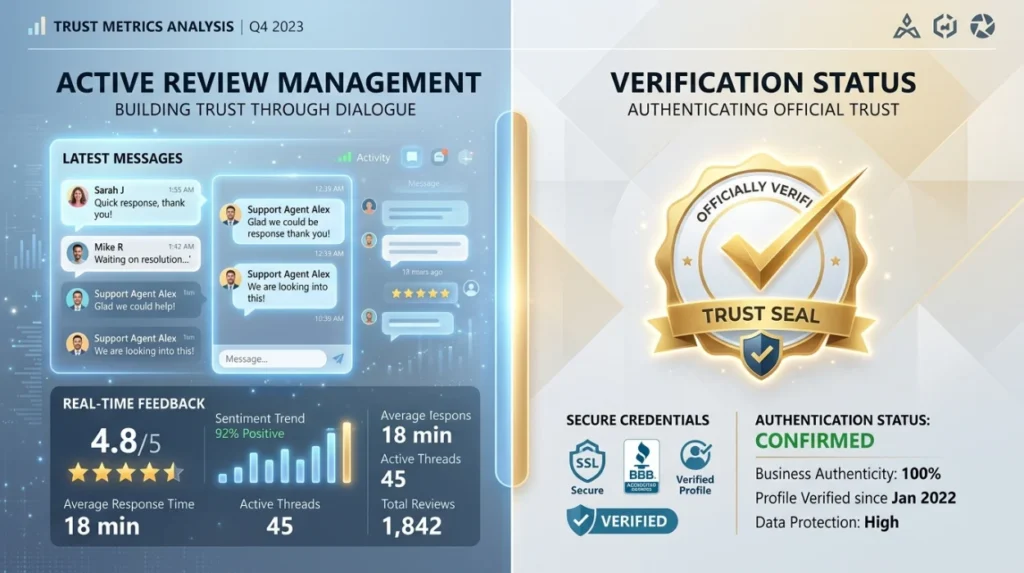
Review management and verification status serve different functions, so neither signal replaces the other. Verification communicates that defined platform requirements have been satisfied, while review management concerns the quality, authenticity and ongoing interpretation of customer feedback. A verified profile with poor or inconsistent review sentiment still presents a complex reputation environment. Similarly, strong customer feedback without a relevant verification indicator communicates a different set of trust signals. Effective reputation analysis evaluates both signals according to their individual mechanisms.
Review management operates through continuous attention to incoming feedback, sentiment patterns and platform compliance. It also involves identifying reviews that violate platform rules and understanding the appropriate reporting or dispute mechanisms. Verification management focuses more directly on maintaining the conditions associated with platform status. Combining the two creates a broader reputation framework, but the activities remain analytically distinct. This distinction prevents businesses from treating verified status as a substitute for ongoing reputation quality.
How does organic reputation management compare with reactive verification protection?
Organic reputation management builds a stable information environment through consistent business information, legitimate review activity and ongoing reputation monitoring. Reactive verification protection begins after a business encounters a verification problem, review-policy issue or change in platform status. Organic management therefore focuses on maintaining the conditions that support credibility, while reactive management concentrates on correcting an existing problem. The two approaches differ primarily in timing and risk exposure. Preventative activity reduces information gaps, whereas reactive activity responds to information gaps after they become visible.
Organic activity also supports stronger long-term consistency across the digital footprint. Accurate information can remain aligned across review platforms, websites and external references. Reactive activity requires additional analysis because the cause of a verification or reputation problem needs to be identified before corrective action is selected. This increases the importance of diagnosis. A sustainable strategy therefore combines preventative information management with clearly defined procedures for responding to verification or reputation issues.
Dive Deeper With Our Expert Guides:
Turning Employee Advocacy Into a Reputation Asset for Your Company
Managing Brand Perception During and After a Product Recall
How does content creation compare with content removal for reputation protection?
Content creation and content removal influence reputation through different mechanisms. Content creation introduces relevant information into the indexed ecosystem, while content removal attempts to eliminate or reduce the visibility of an existing document where a legitimate removal mechanism exists. Creation therefore expands the information environment, whereas removal reduces a specific source of information. Neither method directly controls the entire SERP. Their effectiveness depends on source authority, relevance, indexing status and the relationship between the content and the business entity.
Content enhancement becomes particularly relevant when negative information cannot legitimately be removed. Publishing accurate, authoritative and relevant information creates additional context for search engines and users. Content suppression focuses on reducing the prominence of problematic information through appropriate mechanisms. The distinction between content suppression vs content enhancement is therefore based on the direction of influence: one addresses existing visibility, while the other strengthens alternative information. Reputation management evaluates both approaches according to the specific characteristics of the search environment.
How does verification influence search visibility and SERP composition?
Verification can influence search perception when a verified review profile becomes visible within relevant search results, but the badge itself is not a universal search-ranking mechanism. Search engines evaluate indexed pages according to broader relevance, authority, content and user-intent systems. A verified review profile can nevertheless contribute to the information users encounter during branded searches. The resulting SERP composition can contain ratings, review sentiment, business information and verification indicators. These signals collectively influence how users interpret the entity.
Search ranking influence therefore needs to be separated from perception influence. A verification badge does not guarantee that a review profile will rank above competing pages. However, when the profile is visible, its verification status becomes part of the credibility information presented to the user. Reputation management consequently evaluates both where information appears and how users interpret it. This distinction prevents verification from being incorrectly presented as a direct SEO ranking tactic.
What is the difference between short-term and long-term verification protection?
Short-term verification protection focuses on resolving an immediate platform issue, such as inconsistent business information, a verification concern or a review-policy problem. Its objective is to restore alignment with the platform’s requirements within a defined situation. Long-term protection operates through continuous monitoring of account information, review activity, platform requirements and wider reputation signals. The short-term approach addresses a current condition, while the long-term approach manages the factors that can generate future conditions. This creates a fundamental difference in sustainability.
Long-term monitoring also provides historical information that helps identify recurring patterns. Changes in review activity, business details or platform policies can then be evaluated against previous conditions. This allows reputation managers to distinguish isolated events from persistent compliance risks. A short-term response lacks this historical perspective because it focuses on the immediate problem. Long-term protection therefore provides greater analytical depth for businesses with active review-platform profiles.
How can businesses evaluate the effectiveness of verification protection?
Businesses can evaluate verification protection through measurable indicators covering status continuity, review authenticity, information accuracy and search visibility. A useful assessment begins by defining the conditions that support verified status on the relevant platform. Monitoring then checks whether those conditions remain satisfied over time. Additional analysis examines the review environment and the wider digital footprint associated with the business. This creates a broader measurement framework than simply checking whether a badge remains visible.
A practical evaluation framework includes four stages:
- Verify business information — Check names, websites, contact details and organisational information for consistency across the relevant review platform and external sources.
- Monitor review activity — Analyse incoming reviews for authenticity, policy compliance, sentiment distribution and recurring reputation themes.
- Measure profile visibility — Evaluate whether the review profile appears for relevant branded searches and how it contributes to SERP composition.
- Review compliance changes — Track platform requirements and identify changes that affect verification conditions or review-management practices.
This framework connects verification with broader reputation signals without treating the badge as an independent measure of business quality. It also provides measurable checkpoints for identifying changes before they develop into larger reputation or compliance issues.
How does verification status affect entity credibility?
Verification status affects entity credibility by providing additional information about the relationship between a business and a recognised review platform. Entity credibility refers to how consistently and reliably a business is represented across connected digital information sources. A verification indicator supports this interpretation by adding a platform-specific trust signal. It does not independently establish expertise, customer satisfaction or operational performance. Its value therefore depends on the consistency and quality of the wider entity profile.
A coherent entity profile contains consistent business names, descriptions, websites and other identifying information across relevant sources. Search engines use relationships between these sources to interpret entities and their associated topics. Users also compare information across multiple platforms during research. Verification contributes one additional point of evidence within this comparison. Maintaining consistency therefore strengthens the context in which verified status is interpreted.
What are the main risks of losing verified status?
The primary risk of losing verified status is the removal or reduction of a recognisable trust signal within a review environment. A change in status can alter how users interpret the profile, particularly when verification has become part of the business’s established digital presentation. The wider effect depends on the visibility of the profile and the importance of the platform within the business’s reputation ecosystem. Loss of status does not automatically damage search rankings. Its primary effect concerns trust interpretation and the credibility context surrounding the review profile.
Additional risk arises when verification loss results from an underlying compliance or information problem. Inconsistent business information, prohibited review practices or unresolved platform issues can indicate broader weaknesses in reputation management. Addressing only the visible status without understanding the underlying cause leaves the risk unresolved. A structured analysis therefore identifies the source of the problem before selecting a corrective approach. This reduces the likelihood of repeated issues.
Is continuous reputation management more sustainable than one-time verification work?
Continuous reputation management provides greater sustainability because review-platform environments change through new reviews, updated business information, evolving policies and changing search visibility. One-time verification work addresses the conditions visible at a particular point in time. Continuous management repeatedly evaluates whether those conditions remain satisfied. This creates an ongoing feedback loop between monitoring, analysis and corrective action. Sustainability therefore depends on maintaining oversight after the initial verification stage.
The distinction also applies to the wider digital footprint. New pages, mentions, reviews and external references continually add information associated with the business entity. These sources can affect search perception even when verification status remains unchanged. Continuous reputation analysis therefore protects the context surrounding the verification signal as well as the status itself. The result is a more comprehensive approach to digital trust management.
How should businesses compare verification protection strategies?
Businesses can compare verification protection strategies by evaluating effectiveness, scalability, risk exposure and sustainability. A reactive strategy provides focused attention when a defined problem occurs, while a proactive strategy establishes monitoring before a problem becomes visible. Content removal addresses specific information sources, while content enhancement strengthens the wider information environment. Short-term work targets immediate conditions, while long-term management evaluates changes over time. Each approach therefore solves a different part of the reputation-management problem.
The comparison becomes clearer when each strategy is measured against the same criteria:
| Evaluation factor | Reactive approach | Ongoing approach |
|---|---|---|
| Effectiveness | Addresses a defined verification or reputation issue | Monitors and manages changing reputation conditions |
| Scalability | Focuses on individual problems | Applies recurring monitoring across reputation signals |
| Risk exposure | Responds after a problem becomes visible | Identifies emerging risks through continuous analysis |
| Sustainability | Ends after the defined intervention | Continues as the digital footprint develops |
| Search perception | Targets specific visible information | Evaluates wider SERP composition and entity credibility |
This comparison demonstrates why no single reputation method applies to every situation. The appropriate strategy depends on the stability of the business’s review environment, the frequency of reputation changes and the importance of verified status within its digital footprint.
What is the best framework for protecting Trustpilot and Feefo verified status?
The strongest framework combines platform compliance, authentic review practices, accurate entity information and continuous reputation monitoring. Platform compliance establishes the conditions for maintaining verification. Authentic reviews protect the integrity of the reputation signals associated with the profile. Accurate entity information supports consistent interpretation across digital sources. Continuous monitoring then identifies changes that affect status, sentiment or search perception.
For businesses evaluating long-term verification protection, verified status protection strategies provide a useful framework for connecting platform requirements with broader reputation management. The emphasis remains on understanding how verification, review authenticity, search visibility and entity credibility interact. This approach avoids treating a badge as an isolated reputation asset. Instead, verified status becomes one component of a wider digital trust system.
How should verified status be protected over time?
Trustpilot and Feefo verified status is best understood as a platform-specific trust signal within a wider reputation ecosystem. Earning and protecting that status requires accurate business information, authentic review practices, platform compliance and continuous monitoring. Content creation, content removal, organic management and reactive intervention each influence different parts of the reputation environment. Their effectiveness depends on the source, visibility and persistence of the information being managed.
The key strategic distinction is between protecting a status at one point in time and managing the conditions that support it continuously. Short-term interventions address defined problems, while long-term reputation management evaluates changing reviews, platform requirements, entity information and search visibility. Effectiveness, scalability, risk exposure and sustainability therefore provide the strongest criteria for comparing approaches. Verified status remains most meaningful when it forms part of a consistent, credible and actively monitored digital reputation.
How do you get Trustpilot verified status?
Trustpilot verified status is obtained by meeting the platform’s applicable verification and business-account requirements. Accurate business information, compliant review practices and adherence to platform policies support the verification process.
How do you protect Trustpilot and Feefo verified status?
Protecting verified status requires maintaining accurate business information, following review-platform policies and collecting authentic customer feedback. Ongoing reputation monitoring helps identify compliance or reputation signals that require attention.
Does verified status improve online reputation?
Verified status provides an additional trust signal that can support perceptions of business credibility. Buyers still evaluate verification alongside review ratings, sentiment, written feedback and other online reputation signals.
Can a business lose its Trustpilot or Feefo verified status?
Verified status can be affected when a business no longer meets applicable platform requirements or violates relevant review policies. Monitoring account information and review activity helps identify conditions that can affect verification.
What is the difference between verification and reputation management?
Verification confirms that a business satisfies defined platform conditions, while reputation management evaluates the wider digital footprint, including reviews, search results, content and sentiment. Reputation management therefore addresses a broader set of trust and credibility signals.