

Online reputation improves when search ecosystems consistently index trustworthy, relevant, and credible information about an entity across digital sources. Building trust fast depends on strengthening reputation signals that search engines use for SERP evaluation and entity understanding.
Reputation management is the process of monitoring, interpreting, and structuring reputation-related information across digital environments. Online reputation refers to the collective perception created by indexed content, reviews, mentions, and engagement signals within search ecosystems.
What is online reputation and why does it matter in search ecosystems?
Online reputation is the digital perception of an entity formed through searchable information across websites, reviews, social platforms, and search engines. It defines how users and algorithms evaluate credibility, trust, and authority during information retrieval.
Search engines process online reputation through entity-based indexing and content relationships. Every indexed page contributes to entity perception by creating associations between topics, sentiment, expertise, and relevance. Search systems analyse textual signals, contextual relationships, and user interactions to determine credibility. This process transforms isolated content pieces into structured knowledge about an entity. Reputation therefore functions as an information layer rather than a single metric.
Online reputation directly influences search visibility because algorithms prioritise trustworthy information sources. Positive reputation signals strengthen content ranking dynamics, while inconsistent or negative signals reduce perceived reliability. SERP evaluation relies on evidence gathered from multiple sources rather than isolated webpages. Search engines compare consistency across content ecosystems to validate authority. As a result, online reputation becomes a critical component of information quality assessment.
How is online reputation formed in search engines?
Online reputation is formed through the aggregation and interpretation of digital signals across indexed environments. Search engines continuously analyse information to build an evolving representation of entities.
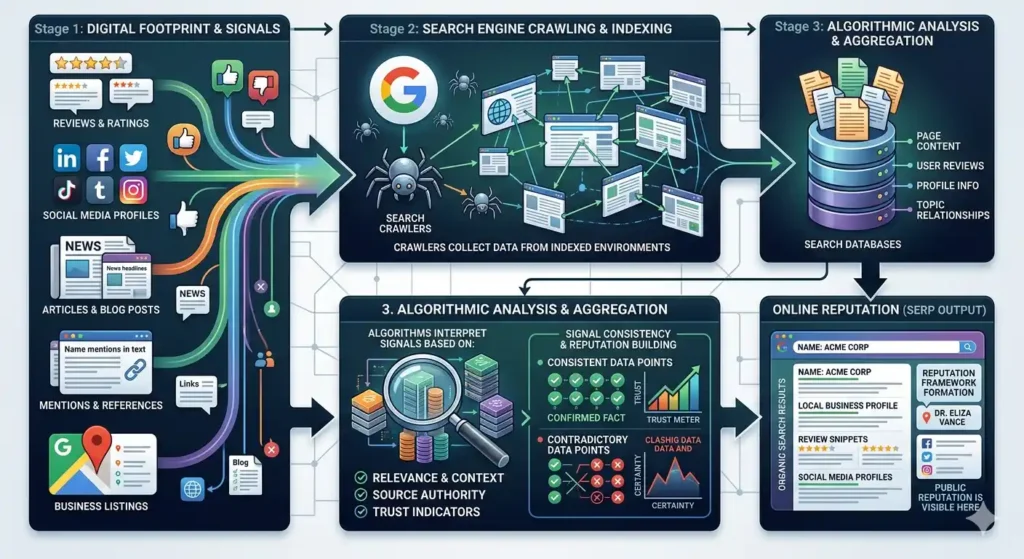
Content indexing acts as the foundation of reputation formation. Search crawlers collect webpages, reviews, profiles, and references before storing them within search databases. Algorithms classify these documents according to relevance, topic relationships, and authority indicators. Every indexed source contributes additional context to entity understanding. This process creates a searchable reputation framework that evolves over time.
Reputation formation also depends on signal consistency. When identical facts appear across multiple authoritative sources, algorithms assign greater confidence to that information. Contradictory information weakens entity certainty and reduces trust assessment. Search systems evaluate semantic relationships between data points to resolve ambiguity. This mechanism explains why consistent digital identities strengthen online credibility.
What are reputation signals in digital environments?
Reputation signals are measurable indicators that help search systems evaluate trust, expertise, and credibility. They represent the evidence algorithms use during entity assessment.
Reputation signals include review sentiment, content quality, backlink authority, citation consistency, and engagement metrics. Search engines analyse these signals collectively rather than individually. A single positive signal carries limited value without supporting evidence from related sources. Algorithms evaluate patterns across ecosystems to determine reliability. This integrated approach increases accuracy in search evaluation.
Reputation signals influence both user perception and search visibility. Strong signals improve confidence in indexed information and enhance discoverability. Weak signals create uncertainty during SERP evaluation and reduce perceived authority. Search systems prioritise entities demonstrating consistency across multiple trust indicators. Reputation therefore emerges from cumulative evidence rather than isolated achievements.
How does content influence online reputation?
Content defines how entities are described, interpreted, and ranked within search ecosystems. It acts as the primary source of information used during entity analysis.
Search engines evaluate content according to relevance, expertise, originality, and topical depth. High-quality content demonstrates subject understanding and reinforces semantic relationships. When content consistently addresses related concepts, algorithms develop stronger entity associations. This process improves topical authority and strengthens credibility signals. Content therefore functions as both information and reputation infrastructure.
Content also shapes public perception through visibility patterns. Frequently indexed pages occupy prominent positions within SERPs and influence user interpretation. Positive and informative content strengthens trust by providing clear and verifiable information. Poor-quality or inconsistent content creates ambiguity in entity perception. Search ecosystems reward clarity because accurate information improves retrieval efficiency.
What role does content freshness play?
Content freshness refers to the recency and relevance of indexed information. Search systems evaluate whether information reflects current realities within a topic.
Fresh content updates entity understanding and improves information accuracy. Search engines prioritise timely updates when recency affects user intent. Outdated information weakens credibility because algorithms favour reliable and current sources. Regular updates therefore contribute to stronger reputation maintenance. Freshness supports trust when content remains relevant and accurate.
What is a digital footprint and how does it affect credibility?
A digital footprint is the collection of data, content, and interactions associated with an entity across online environments. It represents the long-term record of digital activity.
Digital footprints include published articles, reviews, social content, citations, and archived webpages. Search engines use these data points to build entity profiles and establish contextual relationships. Every indexed asset contributes to overall reputation assessment. The accumulation of information creates historical evidence about credibility and behaviour. This process explains why digital footprints persist over time.
Online credibility depends heavily on footprint consistency. Search systems evaluate whether information aligns across different platforms and sources. Inconsistent details reduce confidence during entity verification. Consistent digital identities strengthen trust and improve search visibility. Credibility therefore emerges from informational coherence rather than volume alone.
How do reviews influence reputation and trust signals?
Reviews function as structured feedback signals that help algorithms interpret public sentiment and quality perceptions. They provide searchable evidence about trust and reliability.

Search engines analyse review content using sentiment interpretation models. Positive sentiment strengthens reputation signals when supported by authenticity and consistency. Negative sentiment influences entity perception by introducing conflicting evidence. Algorithms evaluate patterns rather than isolated opinions to reduce manipulation risks. This approach improves the reliability of reputation assessment.
Review signals contribute directly to SERP evaluation because they reflect user-generated information. Search systems consider review frequency, recency, and thematic consistency when determining credibility. Structured review data improves machine understanding and enhances information retrieval. Reputation therefore depends not only on content creation but also on external feedback ecosystems.
How is sentiment interpreted by algorithms?
Sentiment interpretation refers to the computational analysis of emotional and evaluative language within content. Search systems use natural language processing to classify sentiment patterns.
Algorithms identify positive, neutral, and negative language indicators across reviews and mentions. They examine contextual relationships to improve interpretation accuracy. Repeated patterns influence entity perception more strongly than isolated statements. Sentiment analysis therefore transforms qualitative opinions into measurable reputation signals. This mechanism helps search systems evaluate trust at scale.
What is entity perception in modern search systems?
Entity perception is the algorithmic understanding of a person, organisation, or concept based on structured information. It reflects how search engines interpret identity and authority.
Search ecosystems increasingly rely on entity-based search rather than keyword matching alone. Algorithms connect entities with attributes, relationships, and topics to improve retrieval accuracy. This model enables search systems to understand meaning beyond exact phrases. Entity perception therefore determines how information is categorised and ranked. Accurate entity understanding improves search relevance.
Strong entity perception enhances online credibility because search engines recognise expertise and contextual authority. Weak entity signals create ambiguity that reduces confidence during SERP evaluation. Structured information, semantic relevance, and consistent references strengthen entity understanding. Search systems reward clarity because it improves user outcomes. Entity perception therefore functions as a core element of digital trust.
How do authority and trust signals improve search visibility?
Authority and trust signals are indicators that demonstrate reliability, expertise, and informational quality within search ecosystems. They help algorithms identify dependable sources.
Authority emerges when content consistently demonstrates topical depth and semantic relevance. Search engines evaluate expertise through information quality, citations, and contextual relationships. Trust signals include factual consistency, source reliability, and user engagement patterns. Together, these elements influence ranking systems and visibility outcomes. Search algorithms prioritise trusted information because it improves search accuracy.
Search visibility increases when authority aligns with relevance. Highly authoritative information outside a topic receives lower ranking potential than relevant expertise. Algorithms therefore balance credibility with contextual alignment. This evaluation process strengthens information quality across search environments. Authority functions as a relational signal rather than an isolated metric.
How can online reputation be evaluated through SERPs?
SERP evaluation refers to analysing how search engine results present information about an entity. It provides insight into visibility, perception, and credibility.
Search results reveal which content sources dominate entity representation. Users often form opinions based on visible titles, descriptions, and rankings. Search engines therefore influence perception by determining information prominence. Indexed content appearing on the first page receives greater exposure and stronger interpretative influence. SERPs act as reputation interfaces between algorithms and users.
Evaluating reputation through search results requires analysing information consistency and sentiment distribution. Positive informational signals strengthen credibility, while conflicting information creates uncertainty. Search ecosystems reward entities with clear and reliable representations. This relationship demonstrates how search visibility shapes trust. SERP evaluation therefore serves as an important measure of digital reputation health.
What strategies strengthen online credibility in search ecosystems?
Online credibility strengthens when information remains accurate, consistent, and contextually relevant across digital environments. Search systems reward reliability because it improves information retrieval quality.
- Maintain consistency – Ensure identical entity details appear across indexed platforms because search engines validate information through cross-source comparison.
- Publish expertise – Create topic-focused content that demonstrates knowledge and reinforces semantic relationships within search ecosystems.
- Monitor sentiment – Analyse review patterns and mentions to identify shifts in reputation signals and public perception.
- Improve indexing – Structure information clearly so algorithms interpret entities accurately during content indexing.
- Strengthen authority – Build contextual relevance through credible references and interconnected content networks.
These mechanisms improve entity perception and support stronger search visibility. Search algorithms prioritise information that demonstrates reliability through evidence-based signals. Credibility therefore functions as an outcome of structured information quality. Digital trust emerges from consistent representation across search ecosystems.
Dive Deeper With Our Expert Guides:
Complete Guide to Online Reputation Management for Personal and Business Brands
Professional Reputation Management Services for Individuals and Businesses
Online reputation is an information system shaped by content indexing, reputation signals, and search interpretation mechanisms. Search engines evaluate credibility through entity perception, review sentiment, and authority indicators to determine visibility and trust.
Understanding how search ecosystems process information explains why digital footprints, content quality, and consistency influence reputation outcomes. SERP evaluation reflects the interaction between algorithms and public perception. Reputation management represents the ongoing organisation and interpretation of information within digital environments rather than a single measurable asset.
Answers to Key Questions
How does online reputation affect search engine results?
Search engines evaluate reputation signals such as reviews, content quality, and authority when ranking information. A strong online reputation can improve SERP visibility and influence how users perceive an entity.
What factors influence online reputation?
Online reputation is influenced by reviews, search results, media mentions, social profiles, and published content. Consistent and accurate information strengthens trust signals and supports positive entity perception.
How long does it take to improve an online reputation?
The timeline depends on content indexing, search engine updates, and the strength of existing reputation signals. Search ecosystems continuously reassess information, making reputation management an ongoing process.
Can negative search results impact digital trust?
Negative search results can influence user perception and reduce online credibility if they dominate search visibility. Search engines evaluate content relevance and authority, which affects how information is presented in SERPs.