

Negative search results lose visibility when search ecosystems receive stronger relevance, trust, and authority signals from more accurate and better-indexed content. Online reputation changes through content creation, content indexing, authority evaluation, and user interaction signals across search environments.
Reputation management is the process of monitoring, analysing, and influencing how information about an entity is interpreted within digital ecosystems. Online reputation refers to the collection of indexed information, sentiment signals, and search results that shape public perception across search engines and digital platforms.
What Is Online Reputation and How Is It Formed?
Online reputation is the cumulative perception created by indexed digital information associated with an entity. Search engines evaluate this information to determine credibility, relevance, and trustworthiness across search environments.
Online reputation forms through content publication, user-generated material, reviews, social mentions, media references, and website authority signals. Search engines continuously crawl and index these assets to create an entity profile. This profile defines how search systems interpret relationships between topics, people, organisations, and websites. Entity perception emerges from structured and unstructured data distributed across digital channels. The resulting search visibility determines which information users encounter first.
A digital reputation evolves through continuous content updates and behavioural signals. Search algorithms analyse relevance, freshness, engagement, and authority to evaluate content quality. Positive signals strengthen trusted content, while negative signals increase the visibility of unfavourable information when supported by strong authority metrics. Search ecosystems therefore function as dynamic evaluation systems rather than static information repositories.
Why Do Negative Search Results Appear in SERPs?
Negative search results appear in SERPs because search algorithms prioritise relevance, authority, and user intent satisfaction. Visibility depends on ranking signals rather than sentiment alone.

Search engine results pages organise information according to algorithmic evaluation. A negative article, review, or discussion gains prominence when it demonstrates high authority, relevance, and engagement. Search systems do not classify content as positive or negative during ranking. Instead, they evaluate signals such as backlinks, topical relevance, publication authority, and content quality. SERP evaluation therefore focuses on information utility rather than emotional interpretation.
Content indexing directly influences negative result visibility. Indexed pages with strong link profiles and historical trust retain ranking stability over time. Search engines interpret persistent references as indicators of significance within an entity’s information landscape. This mechanism explains why negative information remains visible even when newer content exists elsewhere. Search visibility therefore reflects algorithmic confidence rather than preference.
How Do Search Engines Interpret Reputation Signals?
Search engines interpret reputation signals by analysing authority, trust, relevance, and consistency across multiple sources. These signals help algorithms evaluate entity credibility.
Reputation signals include backlinks, review patterns, citation consistency, structured data, user engagement metrics, and content quality indicators. Algorithms compare information across multiple sources to identify reliability and authenticity. Consistent information strengthens entity recognition, while conflicting data weakens algorithmic confidence. This process enables search systems to construct a coherent representation of digital identities.
Entity perception depends on relationships between topics, sources, and contextual references. Search engines use semantic analysis to understand how information connects across the web. Positive authority signals strengthen credibility assessments, whereas persistent negative associations influence trust evaluations. Reputation systems therefore operate through interconnected networks of information rather than isolated webpages.
What Is a Digital Footprint Within Search Ecosystems?
A digital footprint is the total collection of online information linked to an entity across searchable environments. It represents the searchable history of digital interactions and publications.
Digital footprints include websites, social profiles, reviews, news references, forum discussions, and multimedia content. Search engines index these assets to establish entity relationships and determine topical authority. Every indexed asset contributes additional context that shapes entity perception and search visibility. As the volume of indexed content grows, search systems refine their understanding of an entity’s identity.
The permanence of indexed information affects long-term reputation formation. Historical content retains value when search algorithms identify continued relevance. Search ecosystems preserve and retrieve information according to ranking signals rather than publication dates alone. This mechanism explains why older content remains visible in search results despite the emergence of newer information. Digital footprints therefore function as persistent reputation archives.
How Does Content Influence Search Reputation?
Content influences search reputation because search engines rely on indexed information to evaluate authority, relevance, and expertise. Content defines how entities are interpreted within search ecosystems.
High-quality content establishes topical relevance and strengthens authority signals. Search systems analyse semantic relationships, keyword coverage, and contextual depth to determine content value. Comprehensive information improves entity recognition by providing clear evidence of expertise and subject alignment. Consistent publication patterns further reinforce credibility signals across search environments.
Content ranking dynamics determine which information receives visibility. Pages with stronger authority, engagement, and relevance metrics gain priority in SERPs. Weak or outdated content loses prominence when superior resources satisfy user intent more effectively. This process demonstrates how search ecosystems continuously recalculate reputation based on available information. Effective reputation management therefore relies on understanding how search systems interpret content quality rather than merely increasing content volume.
What Role Do Reviews Play in Online Credibility?
Reviews influence online credibility because they function as direct reputation signals within search ecosystems. Search engines evaluate review quantity, consistency, recency, and sentiment patterns.
Review signals contribute to entity trust assessments across local and broader search environments. Algorithms analyse language patterns, rating distributions, and authenticity indicators to identify credible feedback. Consistent positive sentiment strengthens trust signals, while recurring negative themes alter entity perception. Review ecosystems therefore serve as large-scale credibility datasets.
Sentiment interpretation extends beyond star ratings alone. Search systems evaluate textual context, semantic relationships, and behavioural indicators to determine meaning. Repeated references to similar issues increase algorithmic confidence in sentiment trends. This evaluation influences search visibility and user trust simultaneously. Online credibility therefore emerges from measurable signals rather than isolated opinions.
How Do Authority and Trust Signals Affect Search Visibility?
Authority and trust signals affect search visibility because search engines prioritise reliable information sources. Strong signals increase algorithmic confidence in content quality and entity legitimacy.
Authority signals include backlinks from trusted sources, expertise indicators, and citation frequency. Search algorithms use these factors to evaluate the likelihood that information accurately satisfies user intent. High-authority content receives stronger ranking potential because it demonstrates reliability within a topic area. Search visibility therefore reflects perceived informational value.
Trust signals operate through consistency and verification mechanisms. Structured data, secure websites, author transparency, and factual alignment strengthen credibility assessments. Search ecosystems compare information across multiple sources to validate accuracy. Contradictory or unreliable information weakens trust evaluations and reduces ranking performance. Authority and trust consequently function as core components of SERP evaluation.
How Can Negative Search Results Lose Visibility Over Time?
Negative search results lose visibility when stronger relevance and authority signals emerge within search ecosystems. Search engines recalculate rankings as new information enters indexed environments.
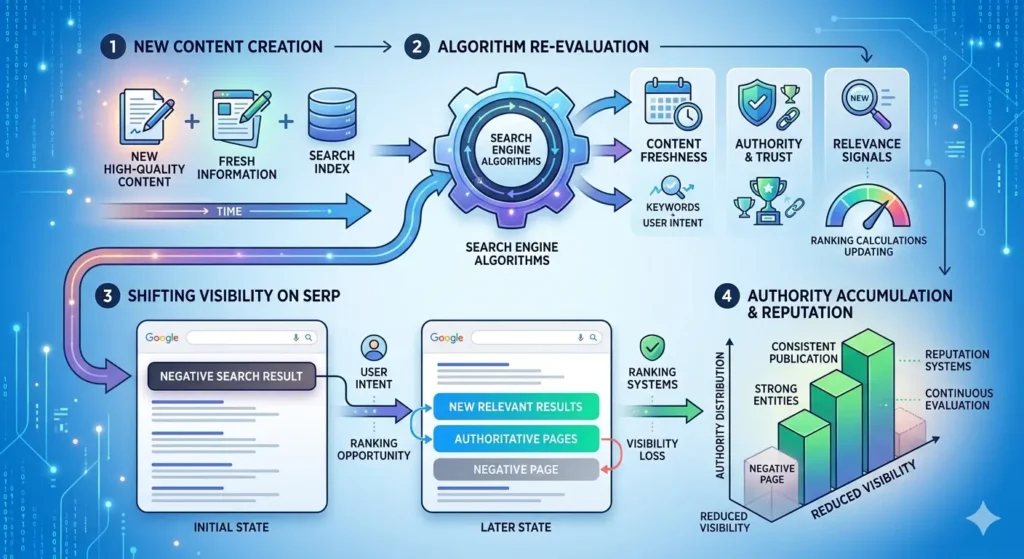
Search visibility changes through content freshness, authority growth, and evolving relevance signals. New content that better satisfies user intent receives improved ranking opportunities. Algorithms reassess information according to quality metrics, engagement indicators, and contextual relationships. This process gradually alters the composition of search engine results pages.
Content indexing and authority distribution influence ranking shifts. Stronger entities accumulate trust through consistent publication and reliable information structures. Search systems interpret these signals as evidence of credibility and relevance. As ranking priorities evolve, less authoritative pages experience reduced visibility. Reputation systems therefore operate as continuous evaluation frameworks rather than permanent records.
Why Is Entity Perception Important in Reputation Systems?
Entity perception is the algorithmic understanding of an entity’s identity, relationships, and credibility within search ecosystems. It determines how search engines interpret information across digital environments.
Search systems build entity models using structured data, contextual references, and semantic relationships. These models connect topics, organisations, and concepts into knowledge networks. Strong entity associations improve search visibility by increasing algorithmic certainty about identity and expertise. Weak associations create ambiguity that reduces trust and relevance.
Entity perception directly influences reputation formation because algorithms rank information according to contextual understanding. Consistent references strengthen credibility signals and improve semantic relevance. Contradictory information weakens confidence and alters trust assessments. Reputation therefore exists not only in user perception but also in algorithmic interpretation across search ecosystems.
Dive Deeper With Our Expert Guides:
How to Improve Your Online Reputation and Build Trust Fast
Complete Guide to Online Reputation Management for Personal and Business Brands
Online reputation functions as an evolving system of indexed information, authority signals, and semantic relationships. Search ecosystems evaluate entities through content indexing, trust assessment, review interpretation, and SERP evaluation.
Negative search results persist because algorithms prioritise relevance and authority rather than sentiment. Digital footprints, reputation signals, and entity perception collectively define online credibility and search visibility. Understanding how search engines interpret information explains how reputation forms, changes, and influences public perception across digital environments.
Answers to Key Questions
Why do negative search results appear on Google?
Negative search results appear because search engines rank content based on authority, relevance, and user engagement rather than sentiment. Pages with strong backlinks or high engagement can rank even if the content is unfavourable. This reflects SERP evaluation systems and content indexing rules.
How does online reputation affect search visibility?
Online reputation directly impacts search visibility by influencing how algorithms assess trust and authority. Strong reputation signals improve ranking performance across SERPs. Weak or inconsistent digital footprints can increase the visibility of negative or outdated content.
What are reputation signals in SEO systems?
Reputation signals are measurable indicators such as backlinks, reviews, mentions, and engagement metrics used by search engines to evaluate credibility. These signals help determine entity perception and content ranking. Search algorithms use them to assess trustworthiness across indexed information.
Can search engines remove negative content automatically?
Search engines do not remove content automatically based on sentiment or reputation concerns. Content remains indexed unless it violates platform policies or is legally removed. Ranking changes occur through algorithmic updates affecting relevance and authority signals.