
Reputation management is the process of understanding how information, public references and credibility signals shape perceptions of an artist across digital platforms. Tribute acts and impersonators can dilute an artist’s name in search results when similar names, performance descriptions and audience references create ambiguity about identity.
Online reputation refers to the information associated with an individual or professional identity across search engines, social platforms, review websites and other indexed sources. For musicians, this digital footprint influences how audiences distinguish an original artist from tribute performers, impersonators and acts using similar names. Search engines organise information according to relevance, authority, context and other ranking signals rather than a simple assessment of artistic originality. When multiple performers share overlapping identity signals, the resulting search environment becomes harder to interpret. Understanding this process requires examining entity recognition, content indexing, search visibility and the mechanisms that establish credibility online.
What Does It Mean When Tribute Acts Dilute an Artist’s Name in Search Results?
Name dilution occurs when information about multiple performers becomes associated with the same or a closely related search identity. In search ecosystems, an artist’s name functions as an entity identifier that connects music releases, biographies, performance listings, reviews and other references. Tribute acts use the names, repertoires or visual identities of established performers to communicate the music they reproduce. Impersonators also adopt recognisable characteristics, although their presentation and relationship with the original artist differ according to their activity and stated identity. When these references overlap in search results, users encounter competing signals about which performer a result represents. This creates an entity-resolution problem rather than automatically establishing that any individual has acted unlawfully or deliberately misled an audience.
How Does Entity Confusion Develop?
Entity confusion develops when search engines encounter similar names and contextual references without sufficient information to distinguish the entities confidently. A search engine analyses terms, linked pages, structured data, source relationships and other contextual signals to determine what a page concerns. A tribute act’s biography, event listing and social profile can repeatedly associate a famous artist’s name with another performer’s activities. If the original artist’s own identity information is less comprehensive or less prominent for a particular query, competing references can occupy valuable search positions. This does not mean that search engines automatically merge the two identities, because contextual evidence and established entity relationships also contribute to interpretation. The key distinction is between a shared keyword and a shared identity: the presence of the same name does not establish that two pages describe the same person.
How Do Search Engines Distinguish Original Artists From Tribute Acts?
Search engines distinguish performers by analysing contextual evidence that connects a name to a specific individual, musical project or organisation. Entity recognition identifies references to people and concepts, while entity resolution evaluates whether references across different sources concern the same entity. An original artist’s official biography, discography, verified social account and recognised music profiles provide contextual information about their professional identity. Tribute performers also generate legitimate digital records, including event listings, promotional biographies and audience reviews, but those records describe a different professional activity. Search systems use the surrounding information to interpret these distinctions, although the quality and consistency of available evidence affect the outcome. Consequently, accurate identity information across independent sources contributes to clearer search interpretation without guaranteeing a particular ranking.
Which Identity Signals Help Establish an Artist’s Entity?
Identity signals are pieces of information that connect a name to a distinct person, career or body of work. Their value depends on relevance, consistency, source credibility and the relationship between the information and the query being evaluated. An official discography connects an artist to original recordings, while an established biography provides historical and professional context. Consistent naming across authoritative profiles reinforces the relationship between the performer and their work. Structured data, where implemented accurately, helps describe entities and relationships in a format that search systems can process. These signals support entity clarity, but no individual signal guarantees exclusive visibility or determines the full ranking of a search result.
How Does a Shared Artist Name Affect Search Engine Results Pages?
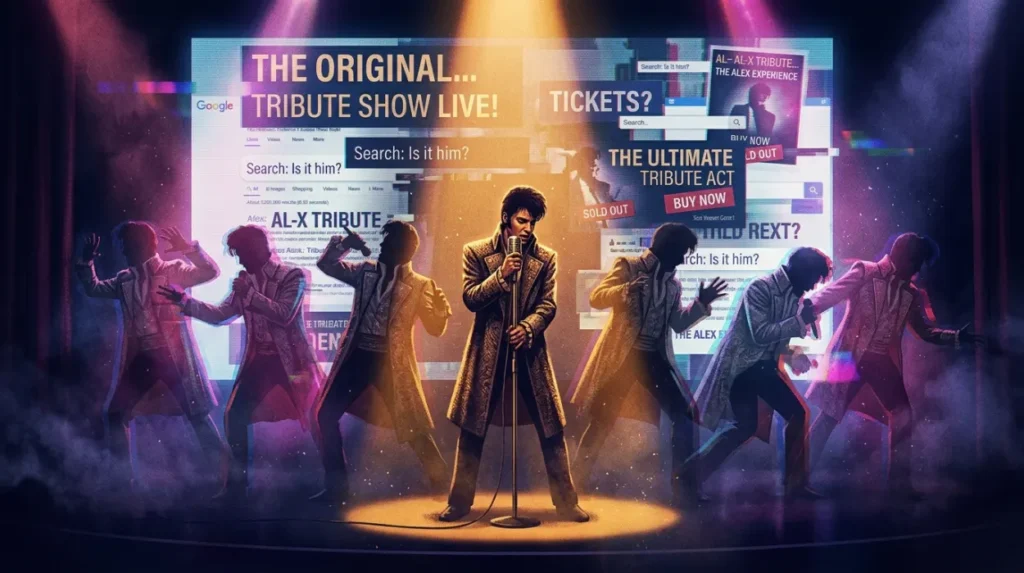
A shared artist name affects search engine results pages (SERPs) by introducing competing pages that satisfy overlapping interpretations of a query. SERPs are the results interfaces through which search engines present web pages, profiles, media and other information relevant to a search. A query containing only an artist’s name provides less context than a query specifying an album, original recording, official website or particular performance. Search systems evaluate the available evidence to select results that appear relevant to the inferred intent. Tribute acts with established event pages and active promotional content can therefore appear alongside the original artist, particularly for broad name-based searches. The resulting visibility pattern reflects competition between indexed documents and interpreted search intent, not necessarily a formal judgement about who owns an artistic identity.
Why Do Tribute Performers Appear for Branded Searches?
Tribute performers appear for branded searches when their content contains terms and contextual references closely associated with the original artist. Event organisers frequently use the original artist’s name to explain a tribute show’s musical subject, making that name relevant to searches about live entertainment. Venue pages, ticketing websites and local event directories then provide additional references that connect the tribute act with the same search terms. These pages can rank when the query suggests an interest in performances, tribute shows or tickets rather than official recordings. Search engines assess relevance in relation to the query, so the same result can be useful for one intent and confusing for another. The distinction between navigational intent, such as finding an artist’s official website, and transactional intent, such as buying concert tickets, is therefore central to understanding apparent name dilution.
How Does Content Indexing Influence an Artist’s Digital Footprint?
Content indexing is the process through which a search engine stores and organises information discovered on accessible web pages. An artist’s digital footprint comprises the indexed and discoverable material associated with their professional identity, including official websites, interviews, music catalogues, reviews, social profiles and third-party listings. Tribute acts extend their own footprints through event announcements, promotional articles, venue calendars and ticketing pages. Each indexed page contributes information about the terms, entities and relationships associated with the search environment. However, publication does not guarantee indexing, and indexing does not guarantee prominent ranking. The composition of an artist’s digital footprint therefore depends on content availability, discoverability, indexing decisions and the competitive relevance of each page.
Does More Content Always Produce Greater Search Visibility?
More content does not automatically produce greater search visibility because search engines evaluate usefulness, relevance, originality and other quality-related signals. Repeated pages that contain the same promotional description add less distinct information than authoritative pages explaining an artist’s identity, releases and professional history. Third-party references provide additional context when they accurately identify the performer and describe the relationship between the person and their work. Content duplication, weak differentiation and inconsistent naming can make the information environment less coherent, even when individual pages remain technically accessible. Ranking systems also consider query intent and competition, so a large digital footprint does not guarantee that an artist’s official page appears first. The important analytical measure is how effectively available content establishes a distinct, verifiable entity rather than how many pages exist.
Dive Deeper With Our Expert Guides:
Why Old Genre Reinventions Confuse an Artist’s Search Results
How Chart-Manipulation Accusations Damage Credibility
How Do Reviews and Audience Sentiment Shape an Artist’s Reputation?
Reviews and audience sentiment shape an artist’s reputation by communicating public evaluations of performances, music and professional identity. Review signals include ratings, written comments, recurring descriptions and the context in which feedback appears. Search engines can use publicly available review content and associated page information to understand the subject of a document, but the precise influence of individual reviews on general organic rankings varies by platform and search feature. A tribute act receiving positive reviews does not inherently damage the original artist’s credibility, because the feedback may relate to the tribute performance rather than the original musician. Confusion develops when review pages use ambiguous names or omit clear descriptions of the performer being evaluated. Accurate attribution therefore matters when interpreting sentiment as evidence about a particular artist.
Can Tribute Act Reviews Be Mistaken for Original Artist Reviews?
Tribute act reviews can be mistaken for original artist reviews when the page context does not clearly distinguish the performers. A venue listing that uses an established musician’s name prominently but identifies the tribute status in less visible text creates an uneven information hierarchy. Search snippets can intensify this ambiguity when they extract the artist’s name, a positive review and a performance description without displaying the complete context. Users then interpret the visible information according to the wording and presentation available at the point of search. This does not establish that a review platform has attributed the feedback incorrectly, since the full page can provide the necessary distinction. Evaluating the page title, performer description, review subject and surrounding metadata helps determine whether the reputation signal genuinely concerns the original artist.
What Role Do Authority and Trust Signals Play in Artist Reputation?
Authority and trust signals help search systems and users evaluate the context, reliability and professional relevance of information about an artist. Authority refers to the perceived standing of a source within a particular subject area, while trust relates to the reliability of the information and its supporting evidence. An established music publication, official artist website and recognised recording catalogue each provide different forms of contextual evidence. Their relevance depends on what they actually establish: a discography documents releases, while a concert review evaluates a particular performance. Search systems do not rely on one universal trust score that determines every result, and prominence alone does not establish factual accuracy. A sound assessment of online credibility therefore examines the source, its purpose, the evidence presented and the specific claim being made.
How Do Third-Party References Affect Entity Perception?
Third-party references affect entity perception by connecting an artist’s name with information published outside their own controlled channels. Interviews, festival programmes, music databases and independent reviews provide contextual evidence about professional activity and career history. When these sources consistently identify the original performer and link the person to recognised work, they reinforce a clearer relationship between the name and the artist’s catalogue. References to tribute performers serve a different function when they accurately identify the act as a reproduction or interpretation of another musician’s work. Ambiguous wording reduces the clarity of that relationship, particularly when event listings circulate across multiple websites. The analytical priority is to distinguish corroborated identity information from repeated mentions that provide little additional context.
How Does Search Intent Influence Perception of Tribute Acts and Impersonators?
Search intent is the underlying purpose behind a user’s query, such as finding original music, identifying an official artist profile or locating a tribute performance. Search engines interpret the words in a query alongside contextual and behavioural signals to determine which results best satisfy that purpose. A person searching for an artist’s name alone has expressed less specific intent than someone searching for the artist’s official album catalogue. A query containing terms such as “tribute show”, “impersonator” or “tickets” provides a more defined context for alternative performers. When results do not make these distinctions visible, users have less information with which to evaluate the relationship between the original musician and the other act. Search perception therefore depends on both the underlying content and the relevance of its presentation to the user’s objective.
Why Does Naming Consistency Matter Across Digital Platforms?
Naming consistency matters because search engines and audiences use recurring identifiers to connect information across websites and platforms. An artist’s professional name, official website, music catalogue and verified profiles create a recognisable information pattern when they consistently refer to the same person. Tribute acts often use descriptive names that combine the original artist’s identity with terms identifying the tribute format. Where those distinctions are absent, abbreviated or inconsistently presented, the relationship between the names becomes harder to interpret from isolated search snippets. Consistency does not mean that every mention of an original artist must use identical wording, because accurate contextual descriptions also contribute to clarity. Instead, the relevant principle is that each reference communicates who is being described and whether the page concerns original work, a tribute performance or another form of impersonation.
How Can Audiences Evaluate Whether a Search Result Represents the Original Artist?
Audiences can evaluate an artist-related search result by examining its source, identity details, content purpose and connection to original work. The page title alone provides limited evidence because promotional headlines often prioritise recognisable names over detailed identity descriptions. An official website, verified profile or established discography offers useful reference points when the information is current and internally consistent. Users can also examine whether a page describes original recordings, a tribute performance, an impersonation act or an independent review. Comparing these details helps distinguish the subject of a page from the musician whose name appears in its content. This process supports informed interpretation without assuming that every similar name represents deception or improper use.
Which Details Help Clarify an Artist’s Identity?
The most useful details are those that establish a direct, verifiable relationship between a name and a specific performer. An official biography identifies the artist’s professional history, while original release information connects the identity to recorded work. Verified profiles and links to recognised music catalogues provide additional points of comparison. Event descriptions also help when they explicitly state whether a performance features the original musician or a tribute act. Where the distinction remains unclear, checking the full source provides more context than relying exclusively on a search snippet. These checks separate identity evidence from assumptions based on name similarity, visual presentation or musical repertoire.
How Is Name Dilution Different From Copyright or Trademark Infringement?
Name dilution in search results describes a loss of clarity between identities, whereas copyright or trademark infringement concerns specific legal rights and the circumstances of their use. Copyright generally protects qualifying original works, such as musical compositions and sound recordings, while trademark law concerns signs used to distinguish goods or services in relevant commercial contexts. A tribute act’s use of an artist’s name, repertoire or image raises different questions depending on the facts, applicable law and presentation of the act. Search visibility alone does not establish infringement, and a page appearing prominently does not prove that its content violates a legal right. Equally, the absence of a legal violation does not mean that audiences always distinguish two performers correctly. Separating search-related ambiguity from legal questions allows reputation analysis to remain evidence-based and conceptually precise.
Why Should Search Visibility and Legal Status Be Evaluated Separately?
Search visibility measures how prominently information appears for particular queries, while legal status depends on applicable rules and evidence concerning the conduct in question. A tribute performance can be accurately labelled and legally permissible while still appearing beside the original artist in a search results page. Conversely, potentially misleading content does not automatically achieve high visibility or affect the artist’s broader digital footprint. Evaluating these issues requires different evidence: ranking observations establish visibility patterns, page context helps assess identity clarity, and legal analysis addresses relevant rights and obligations. Treating these measures as interchangeable produces unreliable conclusions about the cause and significance of name dilution. A clear analysis therefore distinguishes what search results display, what users can reasonably infer and what the available evidence establishes.
What Is the Relationship Between Digital Footprint and Long-Term Artist Reputation?
The relationship between digital footprint and long-term artist reputation develops through the accumulation, indexing and interpretation of information across online sources. Each biography, release page, review, interview and event listing contributes a particular piece of context to the artist’s discoverable identity. Search systems continually process available information and adjust result presentation as content changes, new pages appear and query relevance shifts. This means that an artist’s search reputation is not a fixed record or a direct measurement of public opinion. It represents a changing information environment in which source credibility, identity consistency and content relevance influence what audiences encounter. Analysing these factors provides a more reliable understanding of reputation signals than interpreting an isolated result or ranking position.
The concept of protecting your name from tribute acts and impersonators connects directly to this analysis because name clarity depends on how digital information identifies and distinguishes performers. Understanding that relationship begins with examining entity signals, source attribution, content indexing and search intent rather than assuming that shared visibility represents misconduct. Tribute acts and impersonators can appear within the same search environment as original musicians, but the meaning of each result depends on its context and the query being evaluated. Accurate identity information, relevant third-party references and clearly attributed reviews help explain how an artist’s digital footprint communicates professional identity. These mechanisms demonstrate why online reputation is best understood as an interconnected system of information, credibility and interpretation.
How do tribute acts affect an original artist’s online reputation?
Tribute acts can create confusion in search results when their names, performance listings and promotional content overlap with an original artist’s identity. This can affect search visibility and make it harder for audiences to distinguish original music from tribute performances.
Why do impersonators appear in search results for an original musician?
Impersonators can appear because their websites, social profiles and event listings use names or descriptive terms associated with the original artist. Search engines evaluate relevance, content context and authority signals to determine which pages appear for a particular query.
How can musicians protect their names from tribute acts and impersonators online?
Musicians can strengthen identity clarity through consistent official profiles, accurate biographies, verified music catalogues and clear links between their names and original work. Monitoring search results also helps identify misleading descriptions, incorrect attribution and confusing third-party listings.
Can tribute act reviews damage an original artist’s reputation?
Tribute act reviews can cause confusion when review pages fail to identify the performer clearly or when search snippets omit important context. Accurate attribution helps audiences distinguish feedback about a tribute performance from reviews of the original artist’s music or live shows.
How can Clear My Name help musicians manage confusion caused by impersonators?
Clear My Name provides reputation management for musicians, focusing on online content and search visibility issues that affect professional identity. The appropriate approach depends on the evidence, the platform’s policies and whether the content involves inaccurate information, misleading attribution or a separate legal concern.