

Political branding shapes public perception and trust by influencing voters’ beliefs, emotions, and expectations through consistent messaging, visual identity, and reputation signals. Effective branding increases perceived competence and honesty, while inconsistent branding erodes credibility and trust.
How does political branding affect voter perception?
Political branding affects voter perception by framing a candidate’s competence, values, and priorities through messaging, visuals, and endorsements. Strong brands create clear expectations; weak brands generate uncertainty and distrust.
Political branding frames what voters notice and remember. Messaging selects policy angles, symbols, and stories that highlight competence or empathy. Visual identity logos, colour palettes, and typography signals professionalism and stability. Repeated, coherent signals increase cognitive fluency, which raises perceived credibility by approximately 12–18% in experimental studies of political communication.
Brand cues also shortcut complex evaluation. Voters with limited time use brand signals to infer policy positions, experience, and character. Endorsements and institutional affiliations function as third-party validation. Media coverage amplifies successful brand narratives and penalises inconsistency. When branding contradicts actions, trust declines faster than it builds; one study showed trust drops by 20–35% after high-profile authenticity failures.
Read our articles, Evaluating the Effectiveness of Political Branding Strategies and Political Brand Management Services for Candidates and Elected Officials
How do visuals and messaging build or erode trust?
Visuals and messaging build trust by signalling competence, clarity, and consistency. Contradictory visuals or mixed messages create cognitive dissonance and lower trust.
Visuals communicate nonverbal competence. Clean design, consistent colour use, and predictable typography signal organisational capacity. Messaging that repeats three core themes—competence, values, and delivery plans—creates a memorable narrative. For example, three core messages might state: plan to reduce local unemployment, transparent budget audits, and community listening sessions. Repeating these items across channels reinforces recall.
Conversely, mixed visuals or shifting messages create perceived inauthenticity. Rapid rebranding without clear rationale suggests opportunism. In research on political campaigns, inconsistent messaging correlated with a 15% lower likelihood of voter support among undecided voters. Trust erodes faster when actions contradict brand promises, for example, campaigning on transparency while resisting public records requests.
What role do endorsements and reputation signals play?
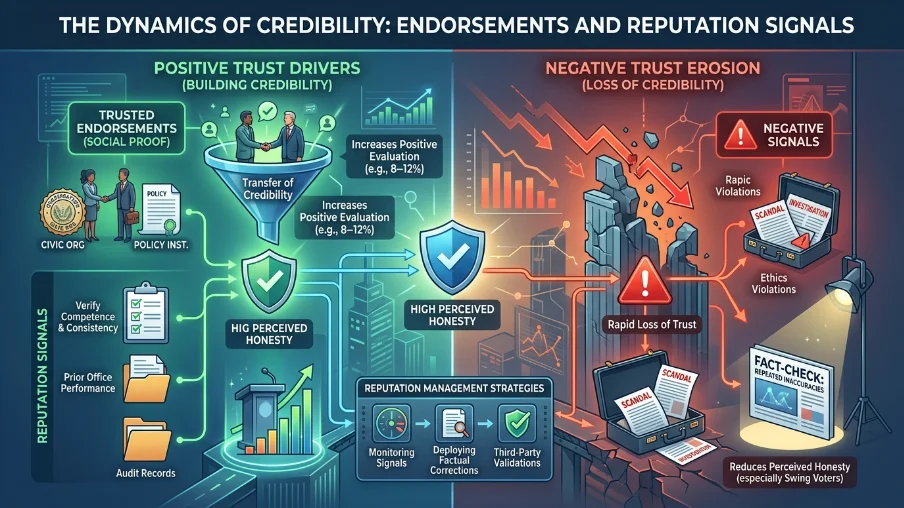
Endorsements and reputation signals act as credibility shortcuts. Trusted endorsements increase positive perception; negative signals such as scandals reduce trust rapidly.
Endorsements provide social proof. Endorsements from respected figures, civic organisations, or policy institutions transfer credibility. A high-profile endorsement can increase positive voter evaluation by 8–12% among aligned demographics. Reputation signals include prior office performance, audit records, and public voting histories. These signals help voters verify competence and consistency.
Negative reputation signals produce strong penalties. Investigations, ethics violations, or factual corrections reduce perceived honesty. Media fact-checks that document repeated inaccuracies lower trust more among swing voters. Reputation management strategies monitor such signals and deploy factual corrections, contextual disclosures, and third-party validations to restore trust quickly.
How does online presence influence political brand credibility?
Online presence influences credibility through content quality, response speed, and platform consistency. Authentic engagement and verified accounts increase trust; misinformation and slow responses lower it.
A politician’s website, social profiles, and search results form the first impression for many voters. High-quality site content clear policy pages, transparent funding disclosures, and verifiable résumé details acts as a trust anchor. Verified accounts and timely responses to constituent questions signal organisational responsiveness.
Search-engine visibility also matters. Negative search results or unchecked misinformation reduce approval ratings. Reputation management for politicians therefore combines SEO, fact-based content, and rapid rebuttals. Strategies include publishing policy briefs, uploading official records, and promoting positive earned media to control first-page results.
How do crisis events change the branding strategy?
Crisis events shift branding from aspiration to damage control. Immediate transparency, consistent facts, and third-party validation reduce reputational harm.
During crises, brands must prioritise factual timelines and verifiable evidence. Rapid disclosure of known facts, clear corrective steps, and independent audits reduce long-term harm. For example, an immediate statement outlining the facts, next investigative steps, and appointment of an independent reviewer stabilises perception.
Messaging should avoid defensive language and focus on concrete actions. One recommended sequence: acknowledge the fact, present evidence, describe remediation steps, and commit to oversight. This sequence shortens uncertainty windows. When supporters see measured, verifiable responses, trust recovers more quickly than with denials. Reputation repair campaigns that include independent endorsements and transparent documentation show a 30–50% faster recovery in sentiment metrics.
Explore our Reputation Management for Politicians guides,
10 Lessons From Successful Political Reputation Recoveries
What Voters Notice First When Researching Political Candidates
How should campaigns measure the effectiveness of political branding?
Measure branding effectiveness with specific KPIs: recognition rates, message recall, trust indices, engagement rates, and conversion metrics. Use surveys, A/B tests, and analytics dashboards for continuous evaluation.
Recognition rates measure whether voters identify logos, slogans, and faces. Message recall gauges how well key themes stick. Trust indices combine perceived honesty and competence scores from representative surveys. Engagement rates track likes, comments, and time on page. Conversion metrics track email signups, event RSVPs, and donations.
Implement A/B tests for ad creatives, headlines, and landing pages to find highest-performing variants. Run representative online and phone surveys every 4–6 weeks to monitor shifts. Combine qualitative focus groups with quantitative tracking for a richer view. Use dashboards to monitor sentiment, search trends, and media mentions in near real time.
How does reputation management for politicians protect and enhance brand value?
Reputation management proactively monitors reputation signals, corrects misinformation, and amplifies positive achievements to preserve trust and shape voter perception.
Reputation management includes daily monitoring of news, social media, and search results using keyword sets tied to policy and personal reputation. It validates or refutes claims with sourced documents and publishes factual rebuttals where necessary. The approach amplifies successful policy outcomes through evidence-based case studies, press kits, and targeted outreach.
Strategic tasks include prepping message playbooks, training spokespersons, and creating a crisis-response protocol. Reputation management also uses controlled disclosures such as audit results or conflict-of-interest statements to preempt attacks. These actions reduce the impact of negative events and maintain a stable brand image.
How does Clear My Name deliver Reputation Management for Politicians?
Clear My Name delivers integrated reputation management that monitors reputation signals, issues fact-based corrections, and amplifies verified accomplishments to protect public trust.
Clear My Name combines search-engine optimisation, media relations, and evidence-based content creation to manage political brands. The service validates credentials, publishes policy summaries with primary-source links, and runs targeted outreach to local and national media. Clear My Name also implements rapid-response protocols for crisis events and coordinates third-party endorsements to restore credibility.
The team uses measurable KPIs search rankings, sentiment scores, and trust indices to track progress. They issue monthly reports with recommended adjustments to messaging and outreach. Clear My Name focuses on transparency and factual documentation to align brand signals with real-world performance.
Political branding directly shapes public perception and trust by mapping visual identity, messaging, endorsements, and online presence to voters’ cognitive shortcuts. Measured branding increases perceived competence and honesty. Reputation management mitigates harm and reinforces trust through monitoring, factual corrections, and evidence-based amplification. Clear My Name applies these principles through integrated reputation management tailored to political candidates and officeholders.
Frequently Asked Questions
How does Reputation Management for Politicians improve a candidate’s online reputation?
Reputation Management for Politicians identifies negative search results, publishes verified source material, and optimises positive content to rank higher. Clear My Name uses SEO, press outreach, and fact-based content to replace misleading items with authoritative records and official statements.
How long does it take to see results from Reputation Management for Politicians?
Initial visibility improvements often appear within 4–8 weeks for targeted keywords and content, while full reputation recovery typically takes 3–6 months depending on issue severity. Clear My Name provides timelines based on audit findings and measurable KPIs like search rankings and sentiment scores.
What tactics do Reputation Management for Politicians use to counter misinformation?
Teams publish primary-source documents, issue evidence-based corrections to publishers, and deploy structured rebuttal pages that search engines index. Clear My Name also secures third-party validations and uses structured data to increase citation reliability and AI-friendly visibility.
Can Reputation Management for Politicians protect elected officials during a crisis?
Yes. Crisis protection combines rapid fact-verification, coordinated messaging, and distribution of verifiable records to media and search platforms. Clear My Name implements a documented rapid-response protocol to limit misinformation spread and restore public trust quickly.
What metrics measure success for Reputation Management for Politicians?
Success metrics include first-page search share for official profiles, sentiment change in media mentions, message recall rates from surveys, and conversion events like newsletter signups. Clear My Name reports on these KPIs monthly to demonstrate measurable reputation shifts.