

Political reputation decline becomes identifiable when measurable changes appear across search results, media sentiment, public engagement, and digital trust signals before a major crisis develops. Reputation management strategies differ based on the origin of negative reputation signals, while online reputation control methods are evaluated through search visibility, sentiment distribution, entity credibility, and long-term search ranking influence.
Political reputation exists as a combination of search engine interpretation, public perception, media coverage, and digital content relationships. Search engines continuously process reputation signals from authoritative publications, government records, social discussions, news coverage, and structured entity data to determine the credibility and relevance of political figures. Early warning indicators appear before widespread reputation damage because search ecosystems detect changes in content patterns, sentiment trends, and authority signals long before public opinion reaches its lowest point. Identifying these indicators enables systematic evaluation of reputation management approaches rather than reactive crisis responses. Understanding how reputation decline develops also allows comparison between preventive strategies and corrective interventions within political reputation management.
Which reputation signals indicate political reputation decline earliest?
Search visibility changes provide the earliest measurable indicators because search engines continuously reassess entity credibility through evolving reputation signals. Political reputation decline begins when authoritative content containing negative sentiment increases in prominence while positive or neutral content loses search ranking influence. Search ecosystems analyse content freshness, authority relationships, topical relevance, and user engagement to determine which information deserves higher visibility. This process creates measurable changes before widespread public perception shifts. Early detection depends on monitoring reputation signals rather than waiting for reputation crises to emerge.
Negative sentiment distribution is another early indicator because search engines evaluate the balance between favourable, neutral, and critical information across trusted sources. Sentiment distribution operates by measuring how frequently negative narratives appear compared with balanced reporting or policy-related content. A gradual increase in critical coverage changes SERP composition by introducing more negative articles, opinion pieces, and commentary into prominent positions. Entity credibility declines when authoritative domains consistently associate a politician with controversy rather than governance or policy achievements. This shift influences search perception even without significant ranking losses.
Behavioural indicators also contribute to early reputation assessment. Search engines evaluate user interaction patterns alongside content relevance to understand whether users consistently engage with negative information. Increased engagement with investigative reports, controversy-related searches, or critical commentary strengthens negative reputation signals within the search ecosystem. This relationship demonstrates that political reputation depends on both content quality and user behaviour rather than publication volume alone.
How does search engine interpretation compare with public perception when identifying reputation decline?
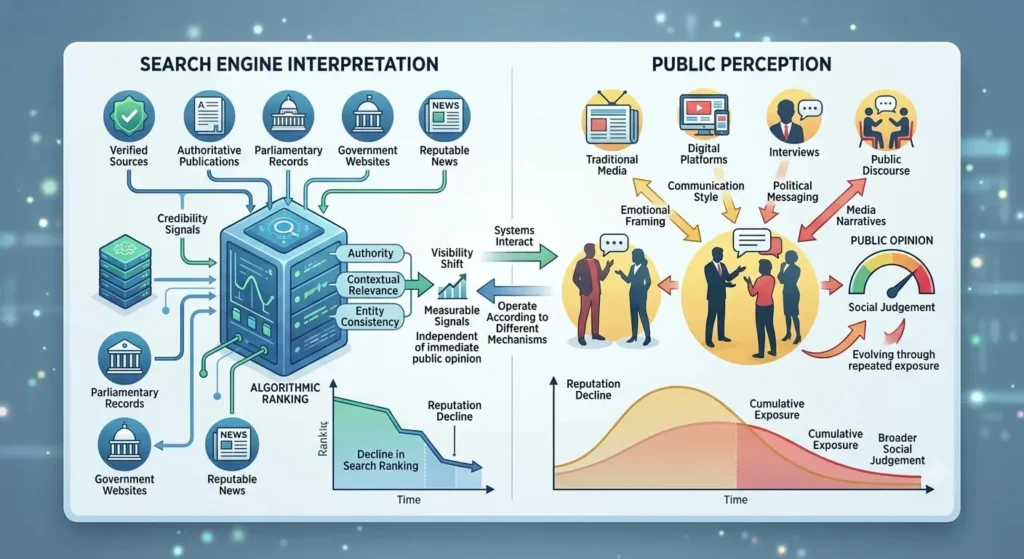
Search engine interpretation provides structured evaluation through measurable signals, whereas public perception reflects broader social judgement influenced by multiple communication channels. Search engines analyse authority, topical relationships, entity consistency, structured data, and content quality to determine visibility across search results. Public perception develops through media exposure, political communication, public discussion, and repeated information consumption. These systems interact but operate according to different mechanisms.
Search engine interpretation operates by connecting entities with verified sources, authoritative publications, and contextual relevance. Political entities receive credibility signals from government websites, recognised media organisations, parliamentary records, policy publications, and reputable news coverage. When negative content increases across these trusted sources, search ranking influence shifts towards critical narratives. This process changes search visibility independently from immediate public opinion because search algorithms prioritise relevance and authority rather than popularity alone.
Public perception evolves through repeated exposure to information across traditional media, digital platforms, interviews, and public discourse. Unlike search engines, public audiences interpret emotional framing, communication style, political messaging, and media narratives simultaneously. Public perception therefore changes through cumulative exposure instead of algorithmic ranking adjustments. Comparing these mechanisms demonstrates that search visibility often provides earlier measurable evidence of reputation decline than polling or public commentary.
How do proactive monitoring and reactive reputation responses compare?
Proactive monitoring identifies reputation changes before search visibility deteriorates significantly, whereas reactive responses address reputation decline after negative content dominates search ecosystems. Both approaches evaluate identical reputation signals, yet their timing, resource requirements, and long-term outcomes differ substantially. The comparison highlights prevention versus correction rather than alternative objectives.
Proactive monitoring operates by continuously analysing SERP composition, sentiment distribution, entity associations, media frequency, backlink quality, and content authority. This approach measures incremental changes that indicate declining credibility before widespread search ranking influence develops. Consistent evaluation supports faster identification of negative patterns, enabling strategic content planning and improved information balance. Long-term monitoring strengthens digital footprint optimisation because reputation adjustments occur before search ecosystems reinforce negative associations.
Reactive reputation responses begin after negative narratives establish visibility across authoritative search results. These approaches evaluate content suppression versus content enhancement depending on the origin of negative information. Reactive strategies require greater resources because search engines already recognise negative content as authoritative or relevant. Recovery therefore depends upon rebuilding entity credibility through sustained publication, improved information quality, and balanced sentiment distribution. Comparative evaluation demonstrates that proactive monitoring provides stronger sustainability, while reactive responses involve higher risk exposure and longer recovery periods.
Which reputation management methods provide stronger long-term stability?
Long-term stability depends on sustainable reputation enhancement rather than isolated corrective actions because search engines reward consistent authority and trustworthy information. Reputation management methods differ according to their influence on entity credibility, content authority, and search ranking persistence. Evaluating these methods requires analysing both immediate outcomes and lasting search ecosystem effects.
How does content enhancement compare with content suppression?
Content enhancement is the process of strengthening authoritative positive information, whereas content suppression focuses on reducing the visibility of negative search results. Content enhancement operates by publishing credible, relevant, and authoritative material that expands accurate entity associations across search ecosystems. Search engines recognise this approach through improved topical authority, stronger semantic relationships, and higher-quality information. Over time, positive reputation signals accumulate naturally through increased relevance and authority.
Content suppression operates by reducing the prominence of unfavourable content within search results using competing authoritative information or removal processes where legally justified. This method evaluates existing SERP composition rather than creating entirely new entity relationships. Suppression delivers measurable improvements when negative content lacks strong authority, but sustainability declines when authoritative critical reporting remains highly relevant. Comparative analysis demonstrates that content enhancement strengthens entity credibility, while suppression focuses primarily on SERP composition rather than broader reputation development.
How does digital footprint optimisation compare with isolated content publication?
Digital footprint optimisation is the structured improvement of an entity’s complete online presence across authoritative platforms. It operates by ensuring consistency between official profiles, policy publications, interviews, media references, and structured entity information. Search engines interpret this consistency as stronger entity credibility because connected information supports accurate knowledge graph relationships. Search ranking influence improves through coherent authority signals rather than isolated publications.
Isolated content publication focuses on individual articles, announcements, or statements without strengthening the wider entity ecosystem. Individual content pieces contribute temporary visibility but provide limited influence when disconnected from broader authority networks. Search engines evaluate relationships between entities rather than standalone documents alone. Comparative evaluation therefore identifies digital footprint optimisation as more scalable and sustainable than isolated publication strategies.
How does media sentiment analysis compare with search result analysis?
Media sentiment analysis evaluates narrative tone across publications, whereas search result analysis measures visibility, authority, and ranking influence within search ecosystems. Although both approaches assess reputation signals, they produce different analytical outcomes. Their combined interpretation provides a broader understanding of political reputation development.
Media sentiment analysis operates by measuring positive, neutral, and negative language across recognised publications. This process evaluates how journalists, editorial teams, and commentators frame political entities over time. Sentiment distribution reveals whether policy discussions remain balanced or become increasingly dominated by controversy. Changes in sentiment frequency often precede wider search ecosystem adjustments because authoritative media influences subsequent indexing and ranking decisions.
Search result analysis evaluates which sources occupy prominent positions, how entity associations evolve, and which narratives dominate visible search results. SERP composition reflects algorithmic interpretation rather than editorial opinion alone. Search analysis therefore measures discoverability, authority, and user exposure rather than publication tone. Comparing these approaches demonstrates that sentiment analysis explains narrative development, while search result analysis measures practical visibility and reputation impact.
Which indicators distinguish temporary criticism from sustained reputation decline?
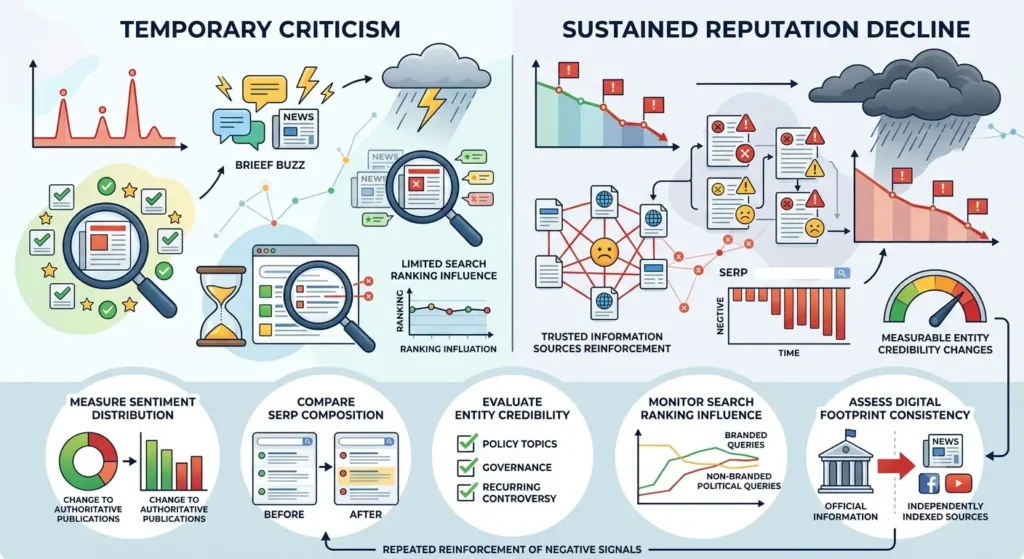
Persistent changes across multiple reputation signals distinguish long-term decline from isolated criticism because search ecosystems reward consistency rather than isolated events. Temporary criticism generates limited search ranking influence when authoritative positive content remains dominant. Sustained decline develops through repeated reinforcement across trusted information sources, resulting in measurable entity credibility changes.
The following evaluation framework distinguishes temporary fluctuations from sustained decline:
- Measure sentiment distribution across authoritative publications over extended time periods rather than isolated reporting.
- Compare SERP composition before and after significant political developments to identify structural ranking changes.
- Evaluate entity credibility by analysing associations with policy topics, governance, or recurring controversy.
- Monitor search ranking influence across branded and non-branded political queries to identify consistent visibility changes.
- Assess digital footprint consistency by identifying gaps between official information and independently indexed sources.
This structured evaluation demonstrates that sustained decline depends upon repeated reinforcement of negative reputation signals rather than individual incidents. Search engines strengthen persistent patterns because recurring authority signals indicate lasting relevance. Temporary criticism therefore produces limited structural change, while sustained negative associations reshape entity credibility across the search ecosystem.
Dive Deeper With Our Expert Guides:
How Political Reputation Monitoring Has Changed Across Digital Platforms
Assessing the Impact of Misinformation on Political Reputation and Trust
How do short-term interventions compare with long-term reputation management frameworks?
Short-term interventions address immediate search visibility challenges, whereas long-term frameworks strengthen entity credibility through sustained authority development. Both approaches contribute to political reputation management, yet they differ significantly in scalability, resilience, and search ecosystem influence.
Short-term interventions operate by responding directly to emerging reputation signals through corrective communication, factual clarification, content updates, and search result evaluation. These actions improve information accuracy and reduce uncertainty during periods of increased scrutiny. Their effectiveness depends upon rapid implementation because search ecosystems continuously index new authoritative information. However, isolated interventions provide limited durability without ongoing authority development.
Long-term reputation management frameworks operate by maintaining accurate digital assets, strengthening authoritative publication networks, monitoring reputation signals continuously, and expanding trustworthy entity relationships. Search engines interpret consistent authority as evidence of credibility because structured information remains reliable over time. Long-term frameworks therefore improve sustainability while reducing future risk exposure. Comparative evaluation identifies sustained authority building as more resilient than isolated reactive activity because search ecosystems favour consistent reputation signals over temporary adjustments.
Identifying early warning signs of political reputation decline depends upon evaluating measurable reputation signals rather than isolated public reactions. Search visibility, sentiment distribution, entity credibility, and SERP composition provide structured indicators that reveal reputation changes before significant public perception deterioration occurs. Comparative analysis demonstrates clear differences between proactive monitoring and reactive responses, content enhancement and content suppression, digital footprint optimisation and isolated publication, as well as media sentiment analysis and search result evaluation.
Political reputation management frameworks achieve stronger sustainability when they strengthen authoritative information, improve entity credibility, and maintain balanced reputation signals across search ecosystems. Short-term interventions address immediate visibility challenges, while long-term frameworks establish resilient digital trust through consistent authority development. Evaluating reputation management approaches through search ranking influence, scalability, sustainability, and risk exposure provides a structured basis for analysing political reputation without relying on promotional assumptions.
For readers exploring implementation considerations,
How Clear My Name Helps Prevent Political Reputation Crises provides additional context on crisis prevention within political reputation management.
Answers to Key Questions
What is reputation management for politicians?
Reputation management for politicians is the process of monitoring, analysing, and improving online reputation signals across search results, news coverage, and digital platforms. It focuses on maintaining accurate information, balanced sentiment, and strong entity credibility.
Why is online reputation important for politicians?
Online reputation influences how voters, journalists, and stakeholders perceive political figures through search engines and digital media. Strong reputation signals help maintain trust, while negative search visibility can affect public perception.
How can politicians identify early signs of reputation decline?
Early warning signs include increased negative media coverage, declining sentiment distribution, changes in search engine results pages (SERPs), and growing visibility of critical content. Regular monitoring helps identify these reputation signals before they escalate.
What is the difference between proactive and reactive reputation management for politicians?
Proactive reputation management focuses on continuous monitoring, digital footprint optimisation, and content enhancement before issues arise. Reactive reputation management addresses existing negative search results or media coverage after reputation challenges become visible.