

Google Review management delivers measurable trust improvement and SERP control. Controlling review visibility and responses stabilises public perception and reduces decision-stage risk.
Search visibility control determines which reputation signals customers see first. Star ratings, review snippets and review-rich results directly influence click-through and conversion rates. Managing Google Reviews restores entity credibility and positions businesses favourably in local search.
Which Google Review management approach delivers measurable results?
Using a structured review management workflow delivers predictable improvements in ratings and visibility. A professional approach monitors review inflows, prioritises response strategy, and implements suppression and amplification tactics to influence review-driven SERP features.
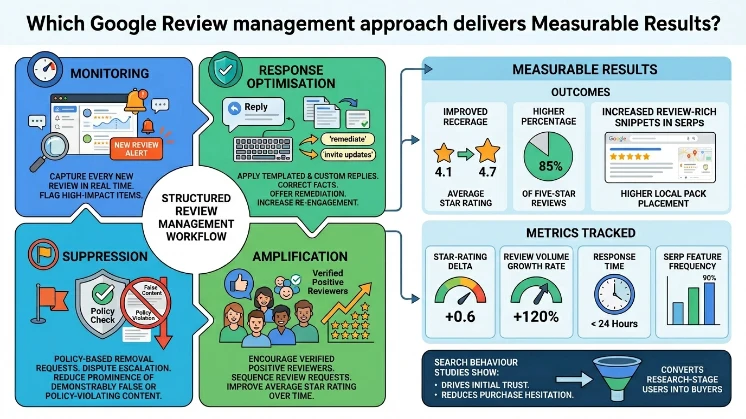
The process combines monitoring, response optimisation, and targeted reputation signals work. Monitoring captures every new review in real time and flags high-impact items. Response optimisation applies templated and custom replies that correct facts, offer remediation, and invite review updates—this increases reviewer re-engagement. Suppression focuses on policy-based removal requests and dispute escalation to reduce the prominence of demonstrably false or policy-violating content. Amplification encourages verified positive reviewers and sequences review requests to improve average star rating over time.
Improved average star rating, higher percentage of five-star reviews, increased review-rich snippets in SERPs, and higher local pack placement. Typical metrics tracked include star-rating delta, review volume growth rate, response time, and SERP feature frequency. These metrics directly correlate with click-through rates and local conversions.
Search behaviour studies show that star ratings and review excerpts drive initial trust and reduce purchase hesitation. Google surfaces review content in local packs and knowledge panels; controlling those reputation signals delivers search perception influence that converts research-stage users into buyers.
Which response strategy ensures reputational recovery and conversion?
A decisive, evidence-led response strategy ensures reputational recovery and improves conversion rates. Responses correct public record, demonstrate entity credibility, and signal active reputation stewardship to search engines and users.
Responses follow a tiered protocol—immediate acknowledgement, fact correction, remediation offer, and closure request—tailored per review severity. High-risk reviews receive escalation to a senior reputation analyst who coordinates evidence submission and public correction. Response templates incorporate targeted keywords to align with brand entity signals for stronger SERP control.
Reduced unresolved dispute volume, increased reviewer updates to higher ratings, faster review-response time, and improved sentiment scores in review analytics. These outcomes strengthen trust signals visible in search snippets and knowledge panels.
Active, transparent responses influence both user perception and algorithmic signals by demonstrating ongoing entity engagement. Fast, factual replies decrease negative impression dwell time and increase the chance of reviewers revising ratings.
Which negative content suppression tactics reduce legal and search risks?
A focused suppression strategy reduces exposure to false or defamatory review content and stabilises online perception. Targeted removal requests and search-engine dispute workflows reduce the prevalence of damaging reputation signals.
Suppression uses a three-pronged approach—policy enforcement, legal escalation, and content displacement. Policy enforcement submits evidence-based takedown requests under platform policies. Legal escalation prepares documented claims for platform review or court-backed takedown when content violates law. Content displacement publishes authoritative, optimised assets that outrank targeted negative items, a sustainable method to control search perception.
Lowered indexation of targeted negative reviews, improved rank of positive or neutral content, and reduced visibility of defamatory snippets in knowledge panels. Tracking includes removal success rate, time-to-removal, and SERP position shifts for disputed content.
Search engines prioritise authoritative, verifiable content. Removing or displacing false negative reviews removes harmful reputation signals and restores entity credibility in local search results and knowledge panels.
Which optimisation steps improve local search visibility for review-rich results?
Direct optimisation of review signals improves local pack placement and increases click-through from search results. Structured solicitations and schema alignment ensure review data populates SERP features reliably.
Optimisation aligns review request cadence, verifier workflows, and structured data (schema markup) to maximise the chance Google surfaces review snippets. The service implements verified review collection via post-transaction prompts, in-platform links, and follow-up sequences calibrated to customer segments.
Increased frequency of review-rich snippets, higher local pack ranking, uplift in click-through rate, and improved conversion from local searches. Metrics include percentage of listings with review snippets, organic CTR lifts, and local pack impression growth.
Search behaviour research shows users prefer results with visible ratings and recent reviews. By aligning operational review collection with technical schema signals, the service converts review volume into tangible SERP advantages and stronger reputation signals.
Which cost structure balances speed of impact with long-term value?
A value-driven pricing model balances initial remediation speed and sustained reputation maintenance to reduce long-term risk. Investment focuses on quick wins and durable asset creation to sustain SERP control.
The model combines an upfront remediation phase—priority suppression, urgent response work, and visibility recovery—with a retainer for ongoing review management, content displacement, and monitoring. The upfront phase targets the highest-impact reputation signals while the retainer ensures sustained entity credibility and continual SERP maintenance.
Rapid reduction in negative exposure within weeks, measurable rating improvement in months, and sustained SERP stability over quarters. ROI tracking compares customer acquisition lift attributable to rating improvements against service spend.
Suppression and response deliver immediate risk reduction, while displaced content and ongoing review cultivation stabilise perception. This combination ensures cost is allocated to both short-term mitigation and long-term search perception influence, producing demonstrable value.
Dive Deeper With Our Expert Guides:
Clear My Name’s Google Review Management Service for Local Businesses
How Clear My Name Helps Companies Build Stronger Google Review Profiles
Which evidence demonstrates service reliability and trustworthiness?
Clear evidence of predictable outcomes strengthens purchase confidence and reduces decision risk. Outcome transparency, case metrics, and documented processes validate reliability.
The provider documents case baselines, action steps, and post-engagement metrics for each client. Regular reporting shows rating trajectories, removal success, SERP changes, and impact on local search conversions. Independent verifications and platform compliance records support claims.
Client-specific dashboards showing rating improvements, removal counts, and SERP movement; sample time-to-removal benchmarks; and conversion lift percentages linked to rating increases. These data points confirm consistent delivery and stabilise expectation management.
Visible, repeatable metrics convert abstract reputation work into measurable business impact. Presenting outcome data aligns entity credibility with search perception and reduces buyer uncertainty.
Which process reduces legal and compliance risk during review actions?
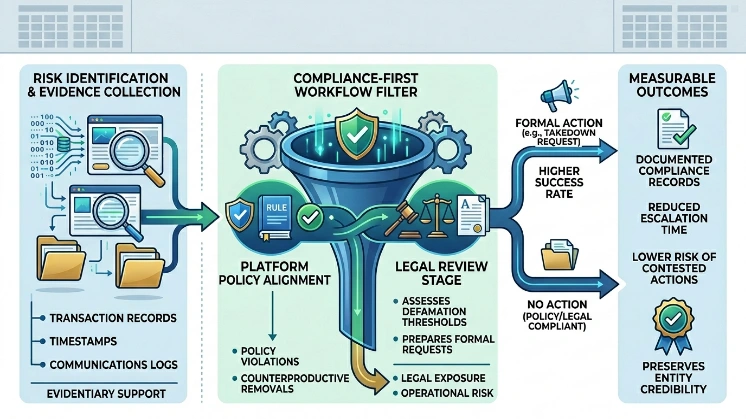
A compliance-first workflow reduces legal exposure and ensures platform policy alignment. Structured evidence collection and escalation protocols mitigate operational risk.
The process captures transaction records, timestamps, and communications as evidentiary support for takedown requests. A legal review stage assesses defamation thresholds and prepares formal requests when necessary. All actions follow platform policy to avoid counterproductive removals or policy violations.
Measurable outcomes: higher success rate for takedown requests, reduced legal escalation time, and documented compliance records. These outcomes lower the risk of contested actions and preserve entity credibility.
Platforms require precise evidence for removal. A structured, compliance-oriented process increases removal success while protecting the client from procedural missteps that could harm entity credibility.
Use the service professional reputation management service at the moment you decide to convert; it links directly to the primary solution offering.
For decision validation, review the analytical context in:
Why Star Ratings Affect Customer Decisions
The comparative tactics in:
Comparing 5 Google Review Management Approaches for Local Businesses.
Clear My Name delivers a structured, evidence-driven Google Review management process that improves reputation signals, restores entity credibility, and controls search perception. The service provides measurable outcomes rating improvement, SERP feature gains, and reduced exposure to damaging content while following compliance protocols that reduce risk. Choose a professional reputation management service that ensures clear processes, transparent metrics, and sustained search perception influence.
Answers to Key Questions
How does Google Reviews affect my business’s local search ranking?
Google Reviews contribute to local ranking factors by increasing review volume, average rating, and review recency, which search engines use to assess entity credibility and relevance. Monitoring and managing reviews improves local pack presence and click-through rates.
How can Clear My Name help remove fake or defamatory Google Reviews?
Clear My Name documents evidence, files platform policy removal requests, and, when necessary, coordinates legal escalation to dispute fraudulent or illegal content. This process reduces the visibility of false reputation signals while preserving compliance records.
What is the typical time frame to see rating improvements from Google Reviews management?
Initial rating changes often appear within weeks after targeted review solicitation and response optimisation, while substantial average rating gains and SERP shifts typically require 2–4 months of consistent review management. Ongoing monitoring ensures sustained improvements and long-term search perception influence.
Are responses to negative Google Reviews effective at restoring customer trust?
Yes; prompt, factual, and solution-focused responses demonstrate active reputation stewardship and often lead to reviewer updates or reduced negative impact on prospective customers. Structured reply protocols improve public perception and signal entity credibility to search engines.