

Reputation management is the coordinated practice of shaping how entities appear within search systems. Online reputation refers to the set of digital signals, content, and indexed associations that define an entity’s perceived credibility across search engine results pages (SERPs).
What is the effect of star ratings on customer decisions?
Star ratings directly influence decision-making by acting as immediate reputation signals that compress trust and quality perceptions into a single visual metric.
Star ratings are numeric reputation signals that aggregate user evaluations into a compact heuristic used in SERP evaluation. They register as structured data or text snippets that search engines index and present alongside listings, altering click-through dynamics.
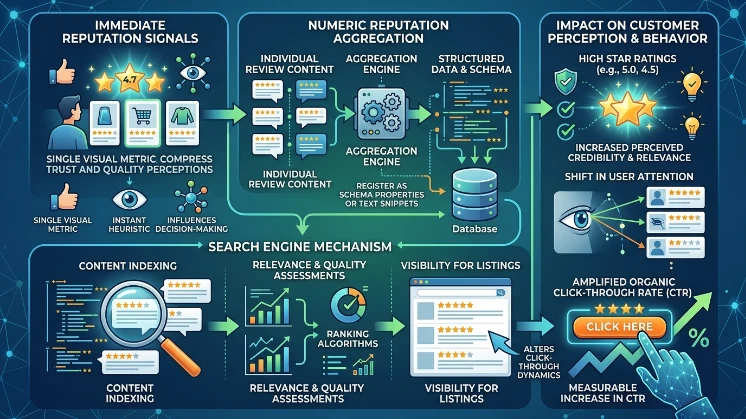
The mechanism works as follows: star ratings consolidate individual review content into a quantifiable score, which search engines map to schema properties or summarised review snippets during content indexing. This score then feeds into relevance and quality assessments within ranking algorithms, affecting search visibility for listings that display ratings. The impact on perception is measurable: listings with higher star ratings increase perceived credibility and relevance, shifting user attention and amplifying organic click-through rates.
How do search engines form reputation from ratings and reviews?
Search engines form reputation by extracting, normalising, and aggregating review-derived signals into entity-level trust metrics used during ranking and SERP presentation.
Search engines define reputation as an entity-level composite of signals that include star ratings, review volume, review recency, review diversity, and surrounding content. The mechanism involves automated parsing of structured data (for example, schema markup) and unstructured review text, then normalising disparate ratings scales to a common baseline. Algorithms evaluate sentiment patterns within review content and cross-check reviewer metadata to weight signals for authority. During content indexing, review-derived metrics attach to entity identifiers, contributing to entity perception in knowledge panels and local packs. The impact on search visibility manifests as adjustments in ranking prominence, rich snippet eligibility, and likelihood of appearing in specialised SERP features that emphasise social proof.
Why do aggregated star scores alter SERP evaluation?
Aggregated star scores alter SERP evaluation because they provide a quantifiable proxy for user trust that algorithms use to prioritise results within relevance and quality subroutines.
Aggregated star scores are numeric summaries that search systems treat as extrinsic indicators of user experience and relevance. The mechanism comprises score normalisation, outlier detection, and temporal weighting; algorithms downweight anomalous spikes and prioritise sustained positive trajectories. During ranking, aggregated scores interact with other signals—such as authority citations, content relevance, and behavioural metrics—to modify final position. The impact is twofold: first, aggregated scores increase the probability of receiving enhanced SERP features (for example, review snippets), which increases search visibility; second, aggregated scores influence user click behaviour, which feeds back into behavioural signals used in subsequent SERP evaluation cycles.
How does review sentiment influence entity perception in search ecosystems?
Review sentiment influences entity perception by providing qualitative context that algorithms translate into polarity and topical relevance signals.
Review sentiment is the qualitative valence derived from review text that search systems interpret as positive, neutral, or negative indicators of experience. The mechanism uses natural language processing to extract sentiment polarity, aspect-based sentiment to link emotions to specific attributes (for example, service or delivery), and entity co-reference resolution to attribute sentiment correctly. Algorithms integrate sentiment polarity with numerical ratings to refine reputation signals and to detect patterns of systemic issues or strengths. The impact on perception is that consistent negative sentiment reduces perceived trustworthiness in entity perception models, while consistent positive sentiment strengthens authority signals and improves SERP prominence through increased perceived relevance.
Strengthen customer trust with professional Google Reviews management strategies that improve review sentiment, credibility, and search visibility. Positive review signals help businesses enhance entity perception, build stronger trust indicators, and increase prominence across search results.
How do authority and trust signals interact with star ratings?
Authority and trust signals interact with star ratings by providing corroborating context that increases the weight of rating-based reputation signals.
Authority is defined as a measure of an entity’s recognised expertise and linkage within the web of indexed references. Trust is defined as the likelihood that a user or algorithm deems the entity reliable. The mechanism involves cross-referencing star ratings with independent authority signals—such as topical citations, backlink profiles, verified mentions, and reviewer credibility metrics—to determine signal reliability. Search systems evaluate concurrence between star ratings and authority indicators; high alignment increases the contribution of ratings to ranking decisions. The impact is proportional: star ratings paired with strong authority and trust signals elevate search visibility more than ratings alone, because algorithms treat corroborated reputation signals as less susceptible to manipulation.
What role does content indexing play in presenting star ratings?
Content indexing enables star ratings to be discoverable, query-matched, and presented as enhanced SERP features that shape user interpretation.
Content indexing is the process by which search systems parse, store, and classify both structured rating fields and unstructured review content. The mechanism includes schema detection, entity extraction, and mapping review content to entity records, followed by persistent storage in index shards. Indexing workflow also includes spam and manipulation filters that identify synthetic or low-quality ratings. The impact on perception is that only indexed and verified rating data become available to SERP rendering engines; omission or mis-indexing reduces the likelihood of rating display and diminishes the rating’s influence on user decisions and click behaviour.
How does the digital footprint affect the credibility of star ratings?
Digital footprint affects credibility by supplying the contextual trail—content, citations, and interactions—that validates or undermines star ratings within entity perception models.
Digital footprint is defined as the cumulative set of digital artefacts associated with an entity, including reviews, social references, published content, and structured data. The mechanism involves linking rating instances to the broader footprint through entity resolution and citation networks. Search algorithms assess footprint coherence: a consistent footprint with corroborating third-party references strengthens the credibility of star ratings, while a sparse or contradictory footprint reduces their perceived validity. The impact on search visibility is that ratings embedded in robust digital footprints increase trust signals and SERP prominence; conversely, isolated ratings with weak footprints draw algorithmic scrutiny and are less influential.
How do algorithms interpret trustworthiness in review sources?
Algorithms interpret trustworthiness by evaluating reviewer provenance, reviewer behaviour patterns, and contextual corroboration between reviews and other entity signals.
Trustworthiness of review sources is defined as the measure of a reviewer’s reliability derived from metadata and behavioural history. The mechanism includes reviewer account age, cross-platform activity, review diversity, and anomaly detection algorithms that flag coordinated patterns. Algorithms compute trust scores that discount reviews from low-trust sources during ranking calculations and snippet selection. The impact on entity perception is that reviews from high-trust sources amplify positive or negative star scores, while reviews from low-trust sources contribute less to the composite reputation signal and may be suppressed during SERP presentation.
Dive Deeper With Our Expert Guides:
10 Google Review Statistics Every Business Should Know
How Google Reviews Influence Local Search Rankings
How do ranking dynamics adjust when review signals conflict with other authority signals?
Ranking dynamics adjust by rebalancing signal weights within relevance and quality models, prioritising consistency and corroboration among disparate reputation indicators.
Conflict between review signals and other authority signals is defined as divergence where star ratings indicate one trajectory while authority citations indicate another. The mechanism uses confidence-weighting and corroboration checks: algorithms assign probabilistic weights to each signal based on historic reliability, domain context, and temporal stability. When conflicts arise, systems favour signals with higher corroborative support—such as consistent backlink patterns or authoritative citations—over isolated rating anomalies. The impact on search visibility is conditional: an entity with conflicting signals experiences volatility in ranking until corroboration stabilises; stable authority signals may mitigate temporary negative rating influence, while persistent negative sentiment can erode authority over time.
How does content surrounding reviews shape entity perception?
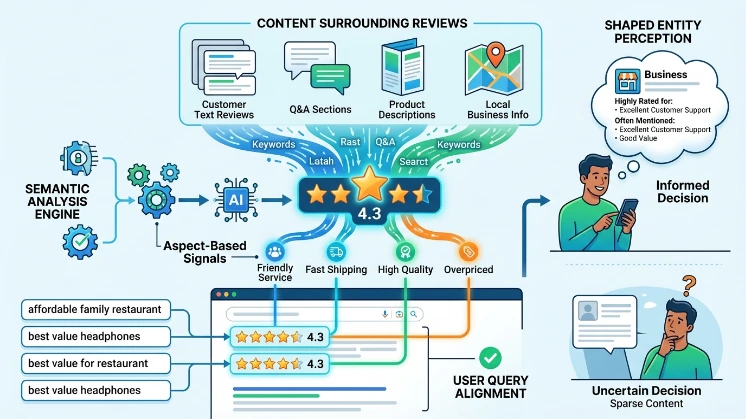
Content surrounding reviews shapes perception by providing semantic context that clarifies the aspects of experience that ratings represent.
Content surrounding reviews is defined as the body of textual context responses, Q&A, product descriptions, and local information that accompanies star ratings within indexed pages. The mechanism employs semantic analysis that links review mentions to topical attributes and identifies recurring themes. Search systems use aspect-based signals to align review content with user queries, improving relevance scoring for specific intents. The impact on perception is that rich, semantically aligned content amplifies the informational value of star ratings and enhances SERP relevance for query-specific searches; sparse or irrelevant content reduces the interpretability of ratings and weakens their effect on decision signals.
Star ratings operate as concise reputation signals that search systems convert into quantifiable inputs for ranking and SERP presentation. Reputation management in search ecosystems is a discipline that defines how entity perception forms through the interaction of ratings, sentiment, authority, indexing, and footprint coherence. Practitioners and analysts must evaluate ratings not as isolated metrics but as components of an integrated reputation system where corroboration, reviewer trustworthiness, and semantic context determine eventual search visibility and user decision dynamics.
Learn More Here:
Comparing 5 Google Review Management Approaches for Local Businesses
Answers to Key Questions
How do Google Reviews affect local search visibility?
Google Reviews influence local search visibility by contributing review signals such as star ratings, review volume, and recency, which search algorithms use to assess relevance and trust. Higher average ratings and recent, context-rich reviews increase the chance of appearing in local SERP features and improving organic click-through rates.
What review factors most impact consumer trust?
Review factors that impact trust include average star rating, review sentiment, reviewer credibility, and review volume; these combine to form reputation signals that users and algorithms evaluate. Clear, consistent positive sentiment and reviewer provenance increase perceived credibility.
How can a business monitor Google Reviews effectively?
A business can monitor Google Reviews by setting up regular review tracking, aggregating review data, and analysing sentiment trends and reviewer metadata to detect anomalies. Routine monitoring enables timely responses and informs reputation signal assessments.
Can negative Google Reviews change search rankings?
Negative Google Reviews alter perception signals and can reduce click-through rates, which indirectly affects ranking through behavioural feedback loops and reputation scoring. Persistent negative sentiment without corroborating authoritative content will degrade entity perception over time.