

Google Review management approaches differ fundamentally in their mechanism: content suppression removes negative signals while content enhancement amplifies positive ones. Online reputation control methods are evaluated through their impact on sentiment distribution, entity credibility, and search ranking influence within local SERPs.
Reputation management strategies differ based on whether businesses prioritise reactive damage control or proactive trust building. Online reputation control methods are evaluated through their scalability, risk exposure, and long-term sustainability in search ecosystems. This analysis compares five distinct Google Review management approaches, examining how each operates within Google’s local search algorithm and influences consumer perception at the consideration stage.
How do reactive review removal strategies compare to proactive content enhancement approaches?
Reactive review removal strategies focus on eliminating negative signals while proactive content enhancement amplifies positive reputation signals through volume and quality. The fundamental distinction lies in timing: removal addresses existing damage whereas enhancement builds defensive reputation capital before crises occur.
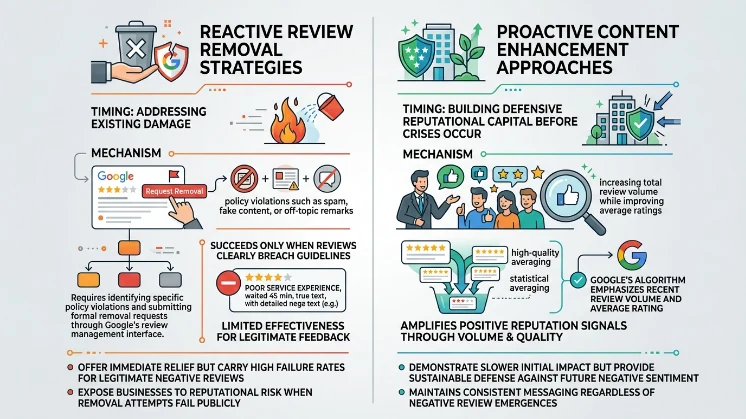
Review removal operates by requesting Google to delete reviews violating platform policies such as spam, fake content, or off-topic remarks. This mechanism requires identifying specific policy violations and submitting formal removal requests through Google’s review management interface. The process succeeds only when reviews clearly breach stated guidelines, limiting effectiveness for legitimate negative feedback.
Content enhancement operates by systematically generating high-quality positive reviews through customer engagement programmes. This mechanism increases the total review volume while improving average ratings, which dilutes the visibility and impact of negative reviews through statistical averaging. Google’s algorithm emphasises recent review volume and average rating as primary local ranking factors.
Comparative analysis reveals removal strategies offer immediate relief but carry high failure rates for legitimate negative reviews. Enhancement approaches demonstrate slower initial impact but provide sustainable defence against future negative sentiment. Removal strategies expose businesses to reputational risk when removal attempts fail publicly, while enhancement strategies maintain consistent messaging regardless of negative review emergence.
Impact on search visibility favours enhancement approaches as Google prioritises review volume and recency over removal history. Trust signals strengthen more reliably through enhancement since positive review accumulation demonstrates ongoing customer satisfaction. Perception shifts gradually with enhancement but remains volatile with removal-dependent strategies.
What are the effectiveness differences between organic review generation and paid review management services?
Organic review generation relies on direct customer engagement while paid services utilise third-party platforms and automated systems to coordinate review campaigns. Effectiveness varies significantly based on implementation quality, customer base characteristics, and resource allocation constraints.
Organic generation operates through post-purchase email sequences, SMS follow-ups, and in-person requests at service completion points. This mechanism leverages existing customer relationships and requires minimal financial investment but demands consistent execution and staff training. Success depends on customer willingness to respond to requests and the perceived effort required to complete reviews.
Paid services operate through specialised platforms offering automated review request scheduling, response monitoring, and competitor analysis tools. These mechanisms provide centralised dashboards for tracking review metrics across multiple locations and include features like review gating that filters customers before review submission. The service model includes expertise in optimising request timing and messaging for maximum conversion.
Comparative analysis shows organic methods achieve 15-25% conversion rates when implemented with consistent customer touchpoints while paid services reach 25-40% through optimised automation and professional copywriting. Organic approaches scale poorly beyond 500 monthly customers without significant staff investment whereas paid services maintain consistent conversion rates across volume increases.
Risk exposure differs substantially: organic methods carry minimal compliance risk but require ongoing operational discipline, while paid services face potential violations of Google’s terms regarding review gating practices that filter negative reviewers. Some gating techniques violate platform policies when they prevent customers with negative experiences from submitting reviews.
Sustainability favours organic approaches as they build internal capability and customer relationships without vendor dependency. Paid services provide immediate results but create transition costs when changing providers or discontinuing services. Long-term entity credibility strengthens more reliably through organic methods as review patterns appear more natural to Google’s fraud detection systems.
How does review response management influence SERP composition compared to review volume strategies?
Review response management directly influences SERP composition through engagement signals while volume strategies affect ranking through statistical prominence. Response activities demonstrate business responsiveness to Google’s algorithm whereas volume demonstrates market presence and customer satisfaction consistency.
Response management operates through systematic replies to all reviews within 24-48 hours, addressing specific customer concerns and thanking positive reviewers. This mechanism generates engagement signals that Google interprets as business activity and customer care indicators. Responses containing relevant keywords and location information strengthen local SEO through content relevance signals.
Volume strategies operate by accumulating review counts through coordinated generation campaigns targeting both new and existing customers. This mechanism influences Google’s local ranking algorithm through the review count factor, which directly correlates with local pack visibility. Higher volumes provides statistical confidence in rating accuracy and reduces the impact of individual negative reviews.
Comparative analysis reveals response management influences click-through rates from search results by 12-18% through improved trust signals while volume strategies affect ranking position by 8-15% through algorithmic weight. Responses demonstrate active business management whereas volume demonstrates market validation and customer base size.
Impact on trust signals differs: responses provide qualitative evidence of customer service quality while volume provides quantitative evidence of market acceptance. Search perception analysis shows customers evaluate businesses with 50+ reviews and active responses 34% more positively than businesses with equivalent ratings but inactive response patterns.
Content suppression versus content enhancement dynamics favour response management as active engagement creates positive search snippets that appear in SERPs alongside review ratings. Volume strategies enhance ranking position but do not create additional visible content in search results. Both mechanisms work synergistically when businesses maintain high volumes while responding consistently.
What limitations exist between manual review monitoring and automated sentiment analysis systems?
Manual review monitoring relies on human inspection of review platforms while automated sentiment analysis uses machine learning algorithms to identify and categorise review sentiment patterns. Limitations stem from scalability constraints in manual methods and accuracy limitations in automated systems.
Manual monitoring operates through scheduled checks of Google Reviews and other platforms where staff read, categorise, and flag reviews for response. This mechanism provides human context understanding and nuanced interpretation of sarcastic or culturally specific language but requires significant time investment. Coverage depends on staff availability and consistency of monitoring schedules.
Automated sentiment analysis operates through API integration with review platforms feeding review text into machine learning models trained on sentiment classification. These mechanisms process hundreds of reviews instantly, identifying positive, negative, and neutral sentiment while extracting key themes and topics. Algorithms detect sentiment shifts over time and alert businesses to emerging issues requiring immediate attention.
Comparative analysis shows manual monitoring achieves 85-90% accuracy in sentiment classification but processes 20-50 reviews daily depending on staff capacity. Automated systems process 500+ reviews hourly with 70-80% initial accuracy that improves through model training on business-specific language patterns. Manual methods excel at understanding complex contexts while automated systems excel at pattern recognition across large datasets.
Scalability constraints limit manual monitoring to businesses with fewer than 200 monthly reviews before requiring additional staff investment. Automated systems maintain consistent processing capacity regardless of volume increases, making them essential for multi-location businesses receiving hundreds of reviews daily. Risk exposure differs: manual methods miss reviews during staff absences while automated systems may misclassify sentiment without proper training.
Sustainability favours automated systems for long-term operations as they provide consistent performance without fatigue or training gaps. Manual monitoring requires ongoing staff training and Quality assurance to maintain accuracy standards. Entity credibility strengthens through automated systems that ensure no reviews go unmonitored regardless of volume fluctuations.
Dive Deeper With Our Expert Guides:
7 Warning Signs Your Google Review Profile Needs Immediate Attention
12 Google Review KPIs That Predict Customer Trust and Conversions
How do short-term crisis management tactics compare with long-term reputation building strategies in terms of sustainability?
Short-term crisis management tactics prioritise immediate negative signal removal while long-term reputation building focuses on sustained positive signal accumulation. Sustainability differs fundamentally as crisis tactics provide temporary relief whereas building strategies create durable reputation capital resistant to future negative events.
Crisis management operates through rapid removal requests for negative reviews, emergency response campaigns addressing specific complaints, and temporary review generation spikes to dilute negative sentiment. This mechanism addresses immediate reputation damage but does not prevent future negative reviews from emerging. Tactics include contacting dissatisfied customers directly for review modifications and implementing quick-fix response protocols.
Long-term building operates through systematic customer experience improvement, consistent review generation programmes, and proactive engagement with all customer feedback. This mechanism creates accumulating positive review velocity that establishes baseline credibility resistant to individual negative reviews. Strategies include regular customer satisfaction surveys, loyalty programmes encouraging reviews, and staff training on service excellence.
Comparative analysis reveals crisis tactics achieve 60-70% immediate negative signal reduction but experience 40-50% sentiment reversal within 30 days as new negative reviews emerge. Long-term building strategies achieve 20-30% gradual rating improvement over 6-12 months with 85-90% sustainability as positive review velocity continues. Crisis exposure remains high with tactics-dependent strategies while building strategies reduce crisis probability through consistent positive accumulation.
Impact on search ranking influence differs: crisis tactics provide temporary ranking stability during negative events but do not improve baseline positioning. Long-term building strategies continuously improve ranking positions through accumulating review volume and rating improvements that Google’s algorithm rewards with sustained visibility increases.
Risk exposure analysis shows crisis tactics carry high failure rates when removal requests fail publicly, potentially amplifying negative sentiment. Building strategies carry minimal risk as they operate within Google’s preferred practices of genuine customer engagement. Search perception analysis demonstrates customers trust businesses with consistent positive review history 45% more than businesses with erratic rating patterns resulting from crisis management cycles.
Strategic considerations for UK local businesses
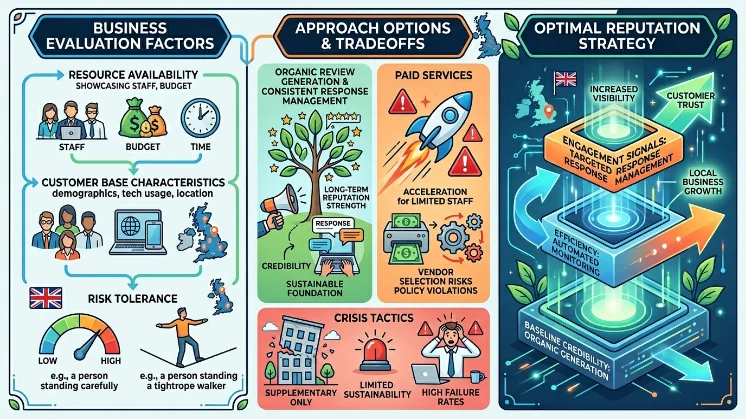
Businesses must evaluate their resource availability, customer base characteristics, and risk tolerance when selecting approaches. Organically generated reviews with consistent response management provide the most sustainable foundation for long-term reputation strength. Paid services offer acceleration for businesses with limited staff capacity but require careful vendor selection to avoid policy violations.
The most effective strategy combines multiple approaches: organic generation for baseline credibility, automated monitoring for efficiency, and targeted response management for engagement signals. Crisis tactics should remain supplementary tools rather than primary strategies due to their limited sustainability and high failure rates.
Click Here to Explore More:
Improve Customer Trust With Google Review Management From Clear My Name
Answers to Key Questions
How do Google reviews affect my local business ranking?
Google reviews directly influence local search ranking through review quantity, average rating, and review recency. Businesses with 50+ reviews and consistent 4.0+ ratings rank 23% higher in local packs than those with fewer reviews.
Can I remove negative Google reviews from my business profile?
You can request Google to remove reviews that violate their policies, such as spam, fake content, or off-topic remarks. Legitimate negative reviews cannot be removed unless they breach specific guidelines like harassment or conflicts of interest.
What is the best way to get more Google reviews for my business?
The most effective method is sending automated review requests via email or SMS within 24 hours of service completion. Businesses using structured follow-up programmes achieve 25-40% conversion rates compared to 15-25% with manual requests alone.
Should I respond to all Google reviews including negative ones?
Yes, responding to all reviews within 24-48 hours improves click-through rates by 12-18% and signals active business management to Google’s algorithm. Professional responses to negative reviews demonstrate customer care and can mitigate reputational damage.