

Stronger distributor and wholesale reviews result from improving the quality, consistency, relevance and visibility of reputation signals that retail buyers evaluate. Reputation management strategies differ based on whether the objective is to strengthen credible information, address damaging content, or improve the balance of information surrounding a supplier.
Online reputation control methods are evaluated through sentiment distribution, entity credibility, search visibility and the composition of search engine results pages (SERPs). For distributors and wholesalers, review content is particularly relevant because buyers assess operational reliability, fulfilment, product quality and communication before entering or maintaining commercial relationships.
How Do Distributor and Wholesale Reviews Influence Retail Buyer Decisions?
Distributor and wholesale reviews influence retail buyer decisions by providing third-party evidence about supplier performance. A review is a reputation signal that records an external assessment of a business, product or commercial interaction. Unlike company-controlled website content, reviews provide information that buyers can compare against the supplier’s own claims.
Retail buyers evaluate suppliers according to commercial requirements rather than consumer preferences alone. Reviews discussing order accuracy, delivery consistency, stock availability, product condition and communication therefore carry specific decision value. A review containing detailed operational information gives buyers more context than a simple star rating because it explains the basis of the evaluation.
Review content also contributes to sentiment distribution. A profile containing consistent positive feedback presents a different information environment from one containing recurring complaints about fulfilment or product quality. Sentiment does not independently establish whether a supplier is credible, but it forms part of the information that buyers use when assessing commercial risk.
What Makes a Wholesale Review More Valuable Than a Basic Star Rating?
Detailed review content provides stronger contextual information than an isolated numerical rating because it explains the experience behind the evaluation. A star rating communicates an overall judgement, while written feedback can identify specific operational factors such as delivery timing, product accuracy or communication quality. The additional context makes the reputation signal more useful for commercial assessment.
Specificity also improves comparative value. A retailer evaluating two distributors can compare descriptions of fulfilment performance rather than relying exclusively on average scores. This allows the buyer to connect review information with operational requirements and determine whether the documented experience is relevant to the intended relationship.
Review quality also depends on consistency. Repeated references to the same operational characteristic across independent reviews create a clearer reputation pattern. Contradictory information does not automatically invalidate a review, but it increases the importance of examining recency, source context and the circumstances described.
Is Review Enhancement More Effective Than Negative Content Removal?
Review enhancement and negative content removal address different reputation problems, so their effectiveness depends on the information requiring attention. Review enhancement focuses on increasing the quality and visibility of legitimate positive or balanced customer feedback. Negative content removal focuses on eliminating specific content when it meets a valid platform, legal or editorial removal criterion.
Review enhancement operates by strengthening the positive information environment. This can involve encouraging legitimate customer feedback, improving the structure of review profiles and ensuring that relevant review sources remain discoverable. Its strength is sustainability because it adds useful information rather than depending exclusively on the removal of existing material.
Removal operates through a narrower mechanism. A review that violates a platform’s rules, contains demonstrably false information or falls within another recognised removal category can be assessed through the appropriate process. Its limitation is scope: removing one item does not automatically create replacement credibility signals or alter negative information hosted elsewhere.
The distinction between content suppression vs content enhancement is therefore central to evaluation. Suppression reduces the visibility or presence of qualifying harmful information, while enhancement strengthens credible information that supports a more balanced entity representation. A robust strategy evaluates both mechanisms according to eligibility, expected impact and sustainability.
How Does Content Creation Compare With Review Management?
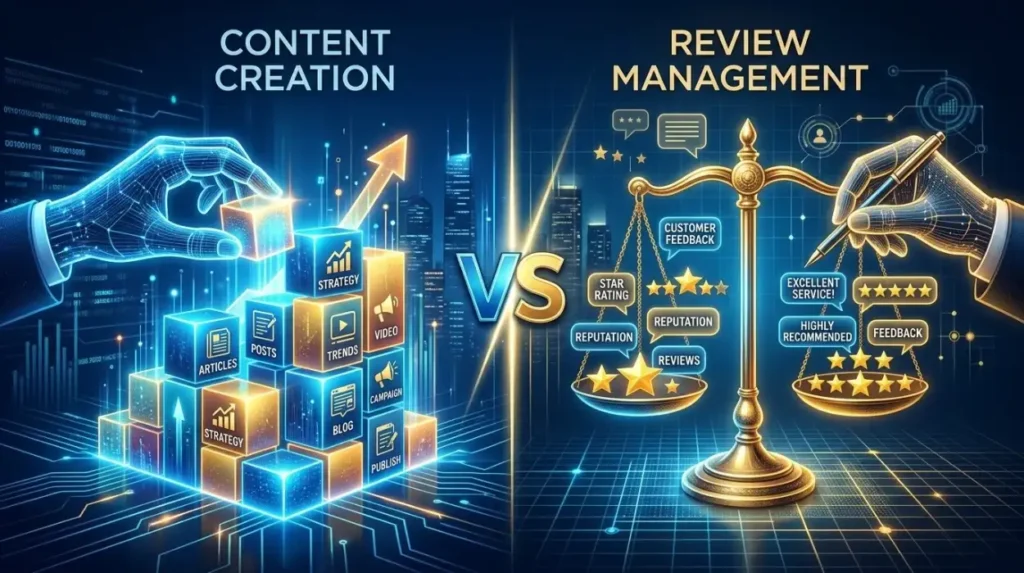
Content creation strengthens the broader information environment, while review management focuses specifically on customer-generated reputation signals. Content creation includes authoritative website pages, business information, product documentation and relevant third-party publications. Review management addresses feedback, sentiment patterns and review-related visibility.
The main advantage of content creation is information breadth. A distributor can establish authoritative information about its products, capabilities, fulfilment processes and business identity through its own digital assets. These sources give search engines and retail buyers additional context when evaluating the entity.
Review management provides a different form of evidence because customer feedback reflects external experiences. Positive reviews can reinforce claims made by the business, while negative reviews can identify areas where public perception differs from the organisation’s stated positioning. Comparing both information types produces a more complete reputation assessment.
The limitation of relying solely on either approach is therefore structural. Content creation lacks the independence of customer feedback, while reviews do not provide complete control over business information. Combining authoritative content with legitimate third-party feedback creates a more diverse reputation signal profile.

How Do Organic and Reactive Reputation Approaches Compare?
Organic reputation management develops credible information continuously, while reactive management responds to identified reputation events. Organic approaches focus on strengthening the digital footprint through accurate information, legitimate customer feedback and authoritative content. Reactive approaches address specific reviews, negative pages, inaccurate information or other identifiable reputation issues.
Organic strategies provide stronger long-term scalability because the same information infrastructure continues supporting the entity after individual review events have passed. Consistent business information, authoritative content and diversified review sources create a more resilient digital footprint. Their limitation is that they do not directly resolve every existing negative result.
Reactive strategies provide greater precision because they target an identified problem. A specific review can be assessed for accuracy, policy compliance and relevance, while a negative search result can be analysed for its ranking position and underlying visibility factors. The limitation is that continuous reactive activity can become inefficient when reputation risks originate across multiple platforms.
A balanced evaluation separates the two time horizons. Organic activity strengthens the foundation of entity credibility, while reactive activity addresses immediate information risks. This distinction allows reputation management to address current problems without making long-term reputation development dependent on individual incidents.
How Does Search Visibility Change the Value of Distributor Reviews?
Search visibility changes the value of distributor reviews because prominent information receives greater exposure during supplier research. Search engine results pages contain a mixture of business websites, review platforms, directories, social profiles and third-party publications. The position and visibility of these sources determine which reputation signals buyers encounter first.
Search ranking influence does not mean that a review’s position directly proves its accuracy. Search systems evaluate relevance, authority, content relationships and other signals rather than independently verifying every business claim. However, high visibility increases the probability that users encounter the information during branded or supplier-related searches.
This creates an important distinction between reputation quality and reputation visibility. A credible review that is difficult to discover has less immediate influence on buyer perception than highly visible review content. SERP composition therefore becomes an important measurement when evaluating whether reputation strategies are changing the information environment.
A review-focused strategy can therefore be assessed by monitoring both sentiment and visibility. Improving sentiment without addressing prominent negative results leaves a search perception gap. Addressing visibility without developing credible replacement information creates a different sustainability problem.
Dive Deeper With Our Expert Guides:
Managing Perception During Acquisition or Merger Speculation
Handling Viral Customer-Service Complaints Before They Define You
How Do Search Engines Interpret Distributor Review Signals?
Search engines interpret distributor review signals through their broader information-processing and ranking systems rather than assigning a single universal reputation score. Review pages and associated content are discovered, indexed and evaluated according to factors relevant to the search system. Their visibility then depends on query relevance, authority and other ranking signals.
Content indexing is an important stage because information that has not entered a search engine’s index cannot normally participate in standard organic search results. Once content is indexed, its relationship to the business entity and relevant queries becomes part of the search ecosystem. This means that review content can contribute to the information environment without being treated as a direct ranking endorsement.
Entity credibility provides another layer of interpretation. An entity is the identifiable business represented across connected digital sources, while entity credibility concerns the consistency and authority of information supporting that representation. Reviews, business profiles, websites and third-party references collectively contribute contextual information about the entity.
Search systems therefore evaluate review content as part of a wider information network. A strong review profile does not guarantee a particular ranking position, and a negative review does not automatically determine the entire search representation. The strategic objective is to create a more accurate, relevant and balanced information environment.
Is Short-Term Review Improvement More Valuable Than Long-Term Reputation Development?
Short-term review improvement produces faster changes in visible sentiment, while long-term reputation development focuses on maintaining a stable and credible information environment. Short-term actions include responding to reviews, addressing eligible problematic content and encouraging legitimate customer feedback. Long-term development includes strengthening authoritative content, diversifying reputation sources and maintaining consistent business information.
Short-term approaches provide measurable activity quickly. A new set of legitimate reviews can change the visible sentiment distribution on a review platform, while an appropriate response can provide additional context around a negative assessment. These changes can improve the immediate information available to users without necessarily changing wider search visibility.
Long-term development addresses the structural conditions that shape reputation. A diversified digital footprint reduces dependence on one review platform, while consistent authoritative information supports clearer entity recognition. This creates greater resilience when individual reviews, platforms or search results change.
The strongest evaluation therefore considers both timeframes. Immediate actions address visible reputation issues, while sustained information development strengthens the broader reputation system. Treating short-term activity as the complete objective creates a narrow measurement framework.
Which Reputation Signals Matter Most to Retail Buyers?
The most useful reputation signals are those that directly address the operational risks relevant to supplier selection. These include fulfilment reliability, product quality, order accuracy, communication, stock consistency and responsiveness. The relative importance of each signal depends on the retailer’s purchasing requirements.
A useful evaluation framework can:
- Assess operational relevance by identifying whether reviews discuss fulfilment, product quality or supplier communication.
- Compare sentiment distribution by examining recurring positive and negative themes across independent reviews.
- Measure recency by separating current operational evidence from historical feedback.
- Verify consistency by comparing review claims with business information and independent sources.
- Analyse visibility by identifying which review pages appear prominently for supplier-related searches.
This framework separates useful commercial evidence from superficial review metrics. A high average rating provides limited information if the written feedback does not address the operational factors that matter to the buyer. Conversely, a detailed collection of reviews can provide substantial decision context even when the numerical rating alone appears inconclusive.
How Should Businesses Measure the Effectiveness of Review Strengthening?
Review strengthening is most effectively measured through changes in sentiment distribution, review quality, search visibility and entity credibility. Counting new reviews alone does not establish whether the reputation environment has improved. Measurement needs to connect activity with changes in the information that buyers actually encounter.
Sentiment distribution measures the balance between favourable, neutral and adverse feedback. Review quality measures the specificity and relevance of the information contained within that feedback. Search visibility measures whether relevant reputation content becomes more or less prominent within branded and supplier-related queries.
Entity credibility requires a broader assessment. Consistent information across websites, directories, reviews and authoritative references creates stronger contextual support than isolated positive feedback. Measuring this consistency helps determine whether review strengthening contributes to a coherent digital footprint.
The measurement period also matters. Search visibility and content indexing do not always change at the same rate as review activity. A robust evaluation therefore compares immediate platform-level changes with longer-term SERP composition and reputation signal development.
How Sustainable Are Distributor Review Management Strategies?
Sustainability depends on whether a strategy creates durable reputation signals or relies on repeated intervention. Strategies based entirely on removing individual negative items require continuous monitoring because new content can replace previously addressed content. Strategies that also strengthen legitimate positive information create a broader and more stable reputation foundation.
Review diversification improves resilience. A distributor relying on one platform remains exposed to changes in platform visibility, review policies and user behaviour. A broader digital footprint distributes reputation signals across relevant sources and reduces concentration risk.
Content consistency also contributes to sustainability. Accurate business information across authoritative sources helps maintain a coherent entity representation as new reviews and publications appear. Inconsistent information creates additional ambiguity that can weaken the clarity of the digital footprint.
Sustainable reputation management therefore operates as an ongoing information system rather than a one-time review exercise. Monitoring, analysis, content development and appropriate response mechanisms work together to maintain a balanced reputation environment.
When Does a Structured Reputation Strategy Deliver Better Results?
A structured reputation strategy delivers stronger analytical control when it connects review management with search visibility, entity credibility and digital footprint analysis. Instead of treating individual reviews as isolated events, the strategy evaluates how each reputation signal interacts with the wider information ecosystem. This produces a clearer basis for prioritising actions.
The process begins with assessment rather than intervention. Existing reviews, sentiment patterns, search results, authoritative sources and competing reputation signals are mapped before determining which mechanism fits the identified problem. This prevents content removal, content creation or review enhancement from being selected without evidence.
The next stage compares potential outcomes. A removal approach has value when specific content meets a legitimate removal criterion, while content enhancement has greater relevance when the problem concerns an imbalance of visible information. Reactive handling addresses identifiable issues, whereas organic development strengthens the underlying reputation system.
For businesses evaluating the next stage of this process, Strengthen Distributor and Wholesale Reviews represents the decision-focused continuation of this analysis.
Strengthening distributor and wholesale reviews requires more than increasing review volume. The relevant evaluation considers review quality, sentiment distribution, content visibility, entity credibility, search ranking influence and the consistency of the wider digital footprint.
Content enhancement and content suppression address different mechanisms, while organic and reactive strategies operate across different time horizons. Short-term interventions provide targeted control, whereas long-term reputation development improves the resilience and diversity of reputation signals.
The most sustainable approach evaluates reviews as part of a broader search ecosystem. Retail buyers interpret visible information through relevance and commercial context, while search engines process indexed content through their ranking systems. Understanding this relationship allows businesses to evaluate review strategies according to effectiveness, scalability, risk exposure and long-term sustainability.
How can businesses strengthen distributor and wholesale reviews?
Businesses can strengthen distributor and wholesale reviews by encouraging legitimate customer feedback, improving review quality and monitoring recurring sentiment patterns. The process also involves analysing review visibility and ensuring accurate business information across relevant digital sources.
What makes a wholesale review valuable to retail buyers?
A valuable wholesale review provides specific information about fulfilment, product quality, communication, delivery accuracy or stock reliability. Detailed and recent feedback gives retail buyers stronger evidence for evaluating supplier credibility.
Do distributor reviews affect search visibility?
Distributor reviews can contribute to the digital information environment when review content is indexed and visible in search results. Their influence on search visibility depends on factors such as relevance, authority, content quality and query context.
Is review management better than removing negative distributor reviews?
Review management provides a broader approach by analysing sentiment, responding appropriately and strengthening credible reputation signals. Negative review removal is narrower and applies only when content meets a legitimate platform, legal or policy-based removal criterion.
How do wholesale reviews influence a distributor’s online reputation?
Wholesale reviews contribute third-party reputation signals that help shape perceptions of supplier reliability, product quality and commercial credibility. Recurring review themes can influence sentiment distribution and form part of the distributor’s wider digital footprint.