

One-time reputation repair addresses a defined reputation issue, while monthly reputation management provides continuous monitoring and analysis of changing reputation signals. The more suitable approach depends on the duration, complexity and ongoing volatility of the firm’s digital reputation.
Reputation management strategies differ based on whether the objective is to resolve an existing problem or continuously evaluate an evolving search environment. Online reputation control methods are evaluated through their effect on search visibility, entity credibility, sentiment distribution and SERP composition. A one-time approach concentrates resources on a specific reputational condition within a defined period. A monthly approach establishes a recurring process for monitoring content, reviews, rankings and entity associations. Comparing these models requires analysis of their mechanisms, limitations, scalability and exposure to future reputation changes.
How does one-time reputation repair differ from monthly reputation management?
One-time reputation repair is a concentrated intervention designed to address a defined reputation problem, whereas monthly reputation management is a recurring process for monitoring and managing reputation signals. One-time repair generally begins with an assessment of specific search results, negative content, inaccurate information or problematic review patterns. Monthly management extends the assessment across new content, reviews, mentions, rankings and changes in search visibility. The first model has a defined endpoint, while the second operates through repeated evaluation cycles. The distinction therefore relates to continuity rather than simply the amount of work performed.
One-time repair operates by identifying a reputational issue and applying an appropriate corrective strategy. Content removal, correction requests, source-level responses and content enhancement represent different mechanisms depending on the nature of the information. Monthly reputation management operates by repeatedly measuring the digital environment and responding to newly identified reputation signals. This creates a feedback cycle between monitoring, analysis and adjustment. The two approaches therefore use different operational structures even when they address similar reputation concerns.
Which approach is more effective for a defined reputation problem?
One-time reputation repair is generally more directly aligned with a clearly defined reputation problem because its scope concentrates on a specific search or content condition. A defined issue provides an identifiable starting point for analysing the relevant SERP composition and determining which sources influence perception. Repair activity then focuses on correcting, removing or reducing the visibility of the relevant information where appropriate. Its effectiveness is measured against the original problem rather than against the entire digital reputation of the entity. This makes the approach comparatively focused and easier to evaluate within a fixed timeframe.
The limitation is that resolving the original problem does not prevent new reputation signals from appearing later. Search results change as new documents are indexed, existing pages are updated and ranking relationships shift. New reviews also alter sentiment distribution and introduce additional information into the entity’s digital footprint. A successful one-time intervention therefore establishes an outcome at a particular point rather than creating continuous oversight. Its effectiveness declines as the information environment moves beyond the conditions originally assessed.
How does monthly reputation management perform differently over time?
Monthly reputation management operates through repeated measurement, making its effectiveness dependent on continuity rather than a single intervention. Each monitoring cycle evaluates changes in search rankings, indexed content, reviews, mentions and entity associations. The accumulated data provides a broader view of reputation development and identifies patterns that a single assessment cannot establish. This approach also creates a historical record of reputation signals and changes in SERP composition. Effectiveness is therefore evaluated through trend analysis rather than one isolated outcome.
The principal limitation is operational continuity. Recurring monitoring requires consistent analysis because reputation signals lose relevance when they are assessed only occasionally. A monthly framework also generates a larger volume of information that requires classification according to relevance, credibility and potential search impact. Without structured analysis, monitoring becomes a collection of observations rather than an evaluation system. The value of continuity therefore depends on the quality and consistency of the underlying assessment process.
How do content creation and content removal compare in reputation repair?
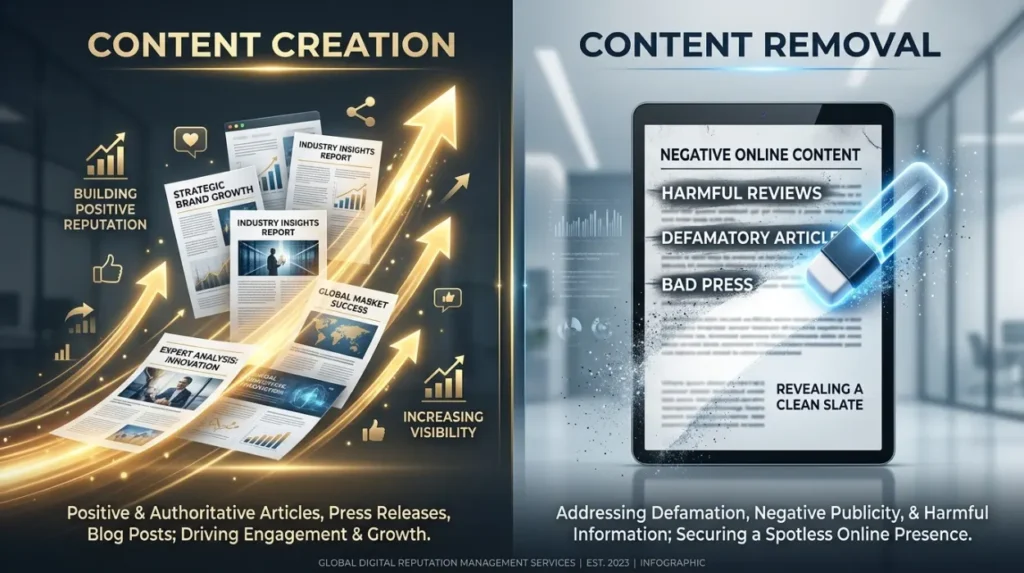
Content creation and content removal represent different reputation management mechanisms because they influence the search environment through different pathways. Content removal attempts to reduce the availability or visibility of an existing document, while content creation introduces additional relevant information into the indexed ecosystem. Removal therefore targets an existing reputation signal, whereas enhancement changes the composition of information available around the entity. Neither mechanism represents a universal solution because their effectiveness depends on the source, context and search visibility of the information. Strategic evaluation requires identifying whether the issue is better addressed at the source level or through changes to the surrounding content environment.
Content enhancement operates by establishing stronger, relevant information that provides search engines with additional material for entity interpretation. High-quality pages, professional information and authoritative content contribute to a broader topical structure around the entity. Content suppression operates differently because it seeks to reduce the prominence or availability of specific information. Suppression therefore has a narrower target but depends heavily on the characteristics of the source and the applicable removal mechanism. Comparing content suppression vs content enhancement requires assessing control, durability and the relationship between the target information and the wider SERP.
Is an organic approach more sustainable than a reactive reputation strategy?
Organic reputation management is generally more sustainable when it builds a consistent information environment rather than responding only after reputational problems become visible. An organic approach focuses on developing relevant content, maintaining accurate entity information and establishing consistent authority signals over time. A reactive strategy begins after a negative review, unfavourable result or inaccurate publication has already entered the visible search environment. Organic activity therefore emphasises prevention and information development, while reactive activity concentrates on remediation. Sustainability depends on whether the approach continues to account for changes in the digital environment.
Reactive strategies have an important role when a defined issue requires immediate analysis. Their limitation is temporal: activity begins after a reputation signal has already entered the search ecosystem. By contrast, ongoing content development and monitoring create a broader information base that supports consistent entity interpretation. Organic activity does not eliminate negative information, because external sources remain independent of the organisation. Its value lies in establishing a stronger and more coherent information environment in which reputation signals can be evaluated.
How do short-term and long-term strategies affect SERP composition?
Short-term reputation strategies primarily target immediate changes in the visibility or interpretation of specific search results. Their effect depends on the ranking position, authority and indexing status of the content being addressed. A targeted intervention can change the composition of a SERP when the relevant document is removed, updated or displaced by more relevant content. However, search ranking influence changes as search systems recalculate relevance and authority relationships. Short-term outcomes therefore require evaluation against the specific query set and ranking environment involved.
Long-term strategies influence SERP composition through the cumulative development of an entity’s information environment. Continued publication, content optimisation, authority development and monitoring provide search engines with additional contextual information about the entity. Over time, these signals contribute to the distribution of relevant documents associated with branded and non-branded queries. The process is cumulative rather than dependent on one intervention. Long-term evaluation therefore examines changes in search visibility, topical coverage and entity credibility across an extended period.
Dive Deeper With Our Expert Guides:
Legal and Ethical Options for Addressing Defamatory Online Content
Factors That Affect Reputation Recovery for Legal Professionals
Which reputation management approach is easier to scale?
Monthly reputation management provides greater scalability when the reputation environment contains recurring changes across reviews, content, search results and external mentions. A recurring framework allows the same monitoring categories and evaluation criteria to be applied consistently over successive periods. This creates a repeatable process for identifying new reputation signals and measuring changes against previous observations. One-time repair is less scalable as a continuous framework because each intervention is generally designed around a particular reputation problem. Scalability therefore depends on whether the objective involves repeated monitoring or isolated remediation.
A scalable reputation framework requires structured classification of information. Monitoring can separate branded search results, review sentiment, external mentions, indexed content and authority indicators into distinct analytical categories. Each category then receives evaluation according to relevance, visibility and potential influence on entity perception. This structure prevents every new result from being treated as an independent crisis. Scalability is therefore a function of process design rather than simply increasing the frequency of monitoring.
Which approach creates greater long-term risk exposure?
One-time reputation repair creates greater exposure to future changes when the underlying reputation environment remains unmonitored after the initial intervention. New reviews, publications, rankings and indexed pages can introduce reputation signals that were absent during the original assessment. The absence of recurring analysis reduces visibility into how these changes affect the entity’s search environment. Risk exposure therefore increases as the gap between intervention and subsequent evaluation expands. The original repair can remain effective for its defined issue while failing to address later developments.
Monthly management reduces informational gaps by establishing repeated assessments of the reputation environment. It does not eliminate external reputation risks because search engines, publishers, reviewers and other independent sources continue generating information. Instead, continuous monitoring provides earlier visibility into changes that affect search perception. Risk evaluation therefore becomes an ongoing process rather than an assessment performed only after a problem becomes visible. The distinction is between reducing uncertainty through monitoring and attempting to resolve uncertainty after an issue has already developed.
How should law firms evaluate one-time repair versus monthly management?
Law firms can evaluate the two approaches by measuring the scope, persistence and volatility of the reputation issue rather than selecting a model based only on frequency. A contained issue with a clearly identifiable source has different requirements from a reputation environment that changes through ongoing reviews, publications and search activity. Evaluation also requires examining how strongly the relevant information influences branded search results and entity credibility. The appropriate analytical framework therefore considers both the current problem and the probability of continued information change. This provides a more accurate comparison than treating reputation management as a fixed activity.
A practical evaluation framework can assess four dimensions:
- Measure the problem scope — Identify whether the reputation issue concerns one document, a group of search results, review sentiment or a wider digital footprint.
- Evaluate search visibility — Analyse the ranking position, indexing status and prominence of reputation-related content within relevant SERPs.
- Assess signal persistence — Determine whether the underlying reputation signal remains active or whether new information continues to enter the search ecosystem.
- Compare monitoring requirements — Establish whether recurring reviews, content changes and search fluctuations require continuous measurement rather than a single assessment.
This framework distinguishes a temporary reputation condition from an evolving reputation system. It also connects strategic choice with measurable search and perception variables rather than relying on general assumptions about effectiveness.
How do reputation signals determine the appropriate strategy?
Reputation signals determine strategic requirements by revealing whether an entity’s search environment is stable, changing or actively accumulating new information. Stable signals with a clearly defined source create a different analytical condition from continuous changes in reviews, content and rankings. Search engines interpret these signals in relation to documents, entities and queries rather than evaluating reputation through a single visible metric. A strategy therefore needs to correspond with the frequency and complexity of signal changes. The more dynamic the information environment, the greater the importance of recurring measurement.
Entity credibility also depends on the consistency of information across the digital footprint. Conflicting professional details, outdated pages or inconsistent descriptions can create additional interpretation challenges even when no single negative result dominates the SERP. Monthly analysis can identify these inconsistencies as part of broader entity evaluation. One-time repair generally focuses on the defined issue and does not inherently establish a continuing system for detecting unrelated changes. Strategic selection therefore depends on whether the objective is isolated correction or sustained control of information quality and visibility.
What is the most important difference between one-time repair and monthly management?
The most important difference is continuity: one-time reputation repair addresses a defined reputation condition, while monthly reputation management evaluates an evolving digital environment. One-time repair provides focused intervention and a clear assessment boundary, making it appropriate for analysing a specific reputational issue. Monthly management provides recurring measurement across search results, reviews, indexed content and entity signals. Its primary value lies in identifying changes rather than treating reputation as a fixed condition. The distinction therefore centres on the timeframe and information model used for reputation analysis.
For growing legal entities, the difference becomes increasingly relevant as the digital footprint expands. New practitioners, publications, reviews, legal topics and external references add information to the entity’s search environment. Each addition creates another potential relationship between the organisation and its reputation signals. Continuous analysis provides a framework for evaluating these relationships as they develop. Ongoing Reputation Management for Growing Law Firms therefore represents a long-term analytical model in which reputation is evaluated as an evolving search ecosystem.
Which reputation management model provides the stronger strategic fit?
One-time reputation repair and monthly reputation management serve different strategic purposes. One-time repair concentrates on a defined reputation issue and evaluates the effect of a targeted intervention, while monthly management establishes recurring analysis of search visibility, content, reviews and entity signals. Content removal and content enhancement also operate differently, with one targeting existing information and the other strengthening the surrounding information environment. Organic and reactive approaches differ through their timing, while short-term and long-term strategies differ through their influence on SERP composition over time.
The stronger strategic fit depends on the structure and persistence of the reputation environment. A contained issue requires a focused assessment, while an evolving digital footprint requires repeated measurement of reputation signals and search perception. Effectiveness, scalability, risk exposure and sustainability therefore provide more useful evaluation criteria than frequency alone. Reputation management remains a dynamic process because search results, content, reviews and entity relationships continuously change.
What is the difference between one-time reputation repair and monthly reputation management?
One-time reputation repair addresses a specific online reputation issue, while monthly reputation management continuously monitors reviews, search results, content and reputation signals. Monthly management focuses on detecting and analysing changes over time.
Is one-time reputation repair effective for negative search results?
One-time reputation repair can address a defined negative search result through methods such as content correction, removal where appropriate, or content enhancement. Its effectiveness depends on the source, ranking position and indexing status of the affected content.
Why choose monthly reputation management over one-time repair?
Monthly reputation management provides recurring analysis of search visibility, reviews, indexed content and entity credibility. It is designed for reputation environments where new information and reputation signals continue to develop over time.
How does reputation management affect search engine results?
Reputation management influences the information environment surrounding an entity by monitoring content, reviews, mentions and search rankings. These signals contribute to SERP composition, search visibility and how users interpret online credibility.
Can law firms use both reputation repair and ongoing reputation management?
Yes, the approaches address different stages of reputation management and can be evaluated together. One-time repair focuses on a defined issue, while ongoing reputation management monitors new content, reviews and reputation signals after the initial intervention.