

Reputation management strategies differ based on how they strengthen reputation signals, improve entity credibility, and influence search visibility across digital search ecosystems. Online reputation control methods are evaluated through their impact on search ranking influence, SERP composition, sentiment distribution, and the long-term sustainability of professional credibility.
What Makes Personal Branding Different from General Reputation Management?
Personal branding is a strategic approach that defines how an individual lawyer is recognised through expertise, authority, and consistent professional identity. General reputation management evaluates and improves the broader digital information associated with a legal professional, including reviews, search results, directories, media references, and other indexed assets. Although both approaches influence online credibility, they operate through different mechanisms within search ecosystems. Personal branding focuses on strengthening entity recognition, while reputation management analyses and refines the complete reputation environment connected to that entity. Understanding these distinctions provides a clearer framework for evaluating their influence on search perception.
Search engines interpret personal branding through structured information, topical authority, and semantic consistency. A lawyer who publishes focused legal content and maintains consistent professional information develops stronger contextual relationships within search ecosystems. General reputation management extends this evaluation by analysing review signals, search result composition, and digital footprint consistency across multiple sources. Both strategies contribute to search ranking influence, but personal branding primarily strengthens entity credibility before broader reputation signals are considered. Their relationship demonstrates that identity development and reputation evaluation complement one another rather than operating independently.
Personal Branding as an Entity Development Strategy
Personal branding is the process of establishing a consistent digital identity that search engines recognise through authoritative and contextually relevant information. It operates by connecting expertise, structured profiles, educational content, and recognised legal topics into a unified entity. Search engines analyse these relationships to improve entity perception and search visibility. This mechanism distinguishes personal branding from broader reputation management systems that evaluate every publicly indexed reputation signal.
How Do Organic and Reactive Branding Approaches Compare?
Organic branding develops entity credibility gradually through continuous publication of authoritative content and consistent digital information. Reactive branding responds to existing perception challenges by improving or reorganising information that already exists within search ecosystems. Both approaches influence professional visibility through different operational methods, making comparative evaluation essential for understanding long-term effectiveness. Organic strategies build authority before reputation concerns emerge, while reactive strategies address existing inconsistencies affecting search perception. Their value therefore depends on the condition of the current digital footprint.

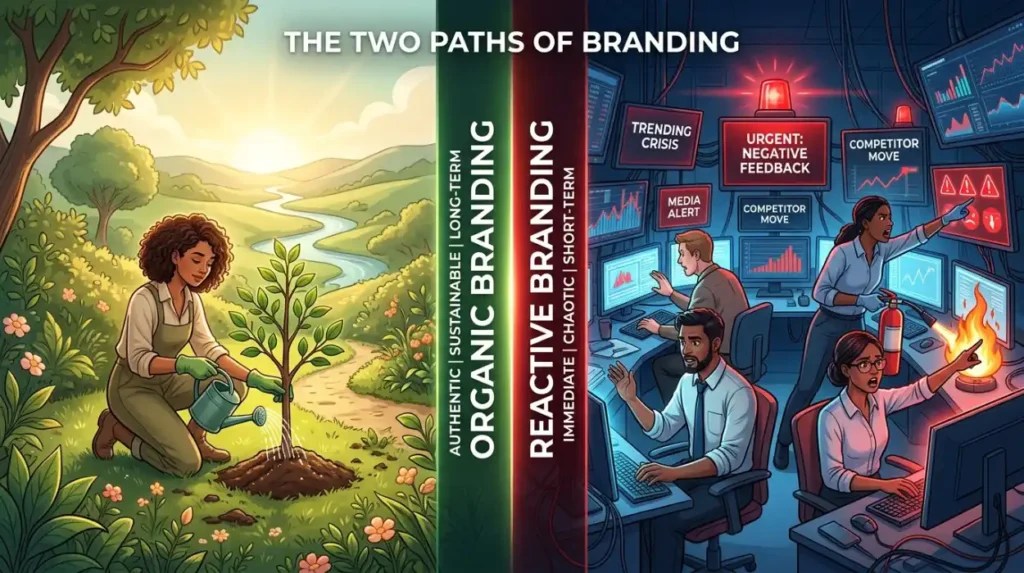
Organic branding operates through sustained information growth that strengthens semantic relationships between the lawyer and recognised legal subjects. Educational articles, legal insights, verified directory profiles, and consistent professional information expand the digital footprint with high-quality reputation signals. Search engines reward this consistency because additional authoritative information improves contextual understanding and entity credibility. Organic methods therefore create stronger long-term search ranking influence through continuous evidence of expertise. This approach supports sustainable reputation development rather than immediate perception adjustment.
Reactive branding evaluates existing search results before introducing improvements that strengthen authority and reduce ambiguity. Reputation signals are analysed to identify inconsistent profiles, outdated information, or weaker contextual relationships limiting search visibility. New authoritative content reinforces stronger semantic associations while correcting inconsistencies across indexed platforms. Search engines reassess these updated relationships during future indexing cycles, gradually improving search perception. Reactive branding therefore depends upon systematic refinement rather than continuous expansion.
Comparing Organic and Reactive Branding
The operational differences between both approaches become clearer through comparison:
- Develop consistent authority by publishing legally relevant content that strengthens semantic relevance.
- Evaluate existing search assets to identify inconsistent reputation signals affecting entity credibility.
- Improve contextual alignment through accurate professional profiles across recognised legal platforms.
- Strengthen digital relationships by reinforcing authoritative information recognised during search evaluation.
These approaches influence search visibility differently because one prioritises authority development while the other focuses on correcting existing perception challenges.
How Does Content Enhancement Compare with Content Suppression?
Content enhancement is a reputation management method that expands high-quality, authoritative information connected to a lawyer’s professional identity. Content suppression focuses on reducing the visibility of unfavourable search results by increasing the prominence of stronger and more relevant indexed assets. Both methods influence search ranking through different mechanisms while operating within the same search ecosystem. Comparative evaluation demonstrates that one strategy strengthens information availability whereas the other improves information prominence. Understanding these distinctions explains how search engines interpret reputation signals across competing content.
Content enhancement strengthens personal branding by increasing topical authority and semantic depth. Legal articles, educational resources, practitioner biographies, professional achievements, and authoritative publications provide search engines with additional evidence supporting expertise. Expanded information improves entity credibility because algorithms identify broader contextual relationships between recognised legal subjects and the professional entity. Increased semantic coverage also improves search visibility by reinforcing topical relevance across multiple indexed pages. Content enhancement therefore contributes directly to long-term authority development.
Content suppression operates by changing the balance of visible search results instead of removing information from search indexes. Higher-authority content competes with weaker or less favourable pages by demonstrating greater contextual relevance and stronger trust signals. Search engines adjust rankings as newly published information gains authority through indexing, citation relationships, and user engagement. The effectiveness of suppression therefore depends upon the comparative strength of competing digital assets. This mechanism explains why suppression functions through visibility management rather than deletion.
Comparing Content Enhancement and Content Suppression
The distinction between these strategies becomes clearer when evaluating operational characteristics:
| Evaluation Area | Content Enhancement | Content Suppression |
|---|---|---|
| Primary objective | Expands authoritative information | Improves prominence of stronger content |
| Operational mechanism | Creates new reputation signals | Adjusts SERP composition |
| Search ranking influence | Strengthens topical authority | Improves comparative visibility |
| Sustainability | Builds long-term expertise | Depends on competitive authority |
| Entity credibility | Reinforces expertise | Improves perceived search quality |
Which Reputation Signals Contribute Most to Personal Branding?
Reputation signals represent measurable indicators that search engines use to evaluate credibility, authority, and relevance across search ecosystems. Personal branding strengthens these signals by improving information consistency, semantic relevance, and contextual authority rather than relying upon isolated optimisation techniques. Search engines compare reputation signals originating from websites, legal directories, educational publications, reviews, and recognised organisations before determining search ranking influence. This evaluation demonstrates that entity credibility depends upon cumulative evidence rather than individual digital assets. Stronger reputation signals therefore support more stable professional visibility.
Authority signals strengthen personal branding because recognised professional qualifications, verified legal profiles, and authoritative citations reinforce algorithmic confidence. Review sentiment contributes additional evidence by providing measurable insight into public perception across trusted platforms. Structured information improves entity recognition because consistent data reduces ambiguity surrounding professional identity. Search engines evaluate these signals collectively during SERP composition, producing search results that reflect broader contextual understanding instead of isolated content quality.
How Do Short-Term and Long-Term Personal Branding Strategies Compare?
Short-term personal branding strategies focus on improving immediate search visibility through targeted content updates, profile optimisation, and reputation signal refinement. Long-term strategies strengthen entity credibility by continuously expanding authoritative information, reinforcing semantic relationships, and maintaining consistent digital identities. Both approaches influence search ranking, yet they differ significantly in sustainability, scalability, and the way search engines evaluate their long-term value. Search ecosystems continuously reassess indexed information, making sustained authority development more stable than temporary visibility improvements. Comparative evaluation therefore depends on how effectively each approach supports lasting search perception.
Short-term methods often improve the presentation of existing information without significantly expanding the overall digital footprint. They influence SERP composition by strengthening the visibility of already indexed assets and improving contextual alignment across recognised platforms. Long-term approaches create additional reputation signals through continuous publication of relevant legal content, updated professional profiles, and authoritative references. Search engines reward this cumulative evidence because it strengthens topical authority and improves entity recognition over time. Long-term branding therefore produces more stable search ranking influence through continuous reputation development.
Comparing Short-Term and Long-Term Strategies
The distinction between these approaches becomes clearer when analysing their operational characteristics:
- Improve existing visibility by refining indexed profiles and strengthening reputation signals already recognised by search engines.
- Expand authoritative information through continuous publication of relevant legal resources that reinforce topical expertise.
- Maintain consistent entity data across recognised legal directories and professional platforms.
- Strengthen semantic relationships by connecting related legal subjects that improve contextual relevance.
These mechanisms demonstrate that long-term strategies establish stronger digital foundations, while short-term methods focus primarily on immediate visibility adjustments.
Dive Deeper With Our Expert Guides:
Reputation Monitoring and Protection for Legal Professionals
How Lawyers Can Respond to Negative Client Reviews Without Violating Confidentiality
How Do Search Engines Evaluate Personal Branding Strategies?
Search engines evaluate personal branding strategies by analysing the quality, consistency, authority, and contextual relevance of information associated with a legal professional. Algorithms compare structured profiles, educational content, review sentiment, professional citations, directory listings, and semantic relationships before determining search ranking influence. Every branding strategy generates different reputation signals that contribute to entity credibility within search ecosystems. Search evaluation therefore depends on cumulative evidence rather than isolated optimisation activities. Stronger personal branding creates broader contextual understanding that improves search visibility.
Entity credibility develops when search engines consistently identify reliable information across authoritative sources. Structured information, recognised legal qualifications, accurate professional profiles, and relevant publications strengthen algorithmic confidence because they reduce ambiguity surrounding professional identity. Search engines also evaluate relationships between indexed assets to determine whether the information reflects genuine expertise. Personal branding strategies that maintain consistency across these relationships produce stronger reputation signals during SERP evaluation. This systematic interpretation explains why search visibility improves through comprehensive information quality instead of keyword optimisation alone.
Search Evaluation Framework
Search ecosystems interpret personal branding through measurable mechanisms that include:
- Measure authority signals by comparing recognised legal organisations and accredited professional references.
- Evaluate sentiment distribution using authentic reviews and publicly available feedback.
- Analyse structured information that strengthens entity recognition across multiple platforms.
- Compare semantic relevance by examining relationships between legal expertise and indexed content.
Each mechanism contributes additional evidence supporting stronger entity credibility and more accurate search evaluation.
What Factors Determine the Scalability and Sustainability of Personal Branding?
Scalability refers to the ability of a personal branding strategy to remain effective as a lawyer’s digital presence expands across websites, publications, legal directories, and professional platforms. Sustainability measures whether reputation signals continue supporting search visibility despite algorithm updates and increasing competition. Both factors influence long-term search ranking because search ecosystems continuously evaluate expanding digital footprints. Strategies producing consistent authority signals remain more resilient than approaches relying on isolated optimisation. Sustainable branding therefore develops through cumulative information quality.
Content enhancement demonstrates strong scalability because each new authoritative publication reinforces semantic relationships already recognised by search engines. Organic branding expands naturally through additional educational resources, legal commentary, and recognised professional references. Reactive methods remain valuable for correcting inconsistencies but require ongoing monitoring as new information becomes indexed. Search engines reward consistent authority because stable entity credibility supports more accurate SERP evaluation. Scalability therefore depends upon maintaining structured, authoritative information throughout the growth of the digital footprint.
Which Personal Branding Strategy Provides the Strongest Search Visibility?
The strongest personal branding strategy combines organic authority development, structured entity optimisation, and continuous reputation signal improvement within a unified digital framework. Search visibility strengthens when authoritative content, verified professional profiles, review sentiment, and semantic consistency operate together rather than independently. Search engines evaluate these interconnected signals collectively, making integrated strategies more effective than isolated optimisation techniques. Strong entity credibility improves the likelihood of stable rankings because algorithms recognise consistent evidence across multiple trusted sources. Search perception therefore becomes stronger when every component of the digital footprint supports the same professional identity.
An integrated branding strategy also strengthens SERP composition by increasing the proportion of authoritative information associated with the lawyer. Content enhancement expands searchable evidence, while consistent profile management reinforces entity recognition across trusted legal platforms. Review signals contribute additional credibility when aligned with authoritative information and recognised qualifications. These combined mechanisms improve contextual understanding and strengthen long-term digital authority. Understanding build a trusted legal brand provides additional insight into how integrated reputation strategies contribute to stronger professional visibility and sustained online credibility.
Personal branding strategies help lawyers stand out by strengthening reputation signals, improving entity credibility, and supporting consistent search visibility across digital search ecosystems. Organic and reactive approaches, content enhancement and content suppression, and short-term and long-term strategies each operate through different mechanisms that influence SERP composition and online perception. Search engines evaluate these methods by analysing authority, contextual relevance, semantic relationships, and sentiment distribution across interconnected sources. Comparative analysis demonstrates that sustained authority development produces greater stability than isolated reputation adjustments.
Strategic evaluation therefore requires balancing effectiveness, scalability, sustainability, and risk exposure rather than relying on a single reputation management approach. Understanding how search ecosystems interpret personal branding enables more informed decisions regarding professional visibility and digital credibility. These comparative insights explain how different branding strategies contribute to stronger entity perception within modern legal search environments.
What are the most effective personal branding strategies for lawyers?
Effective personal branding strategies for lawyers include publishing authoritative legal content, maintaining consistent professional profiles, strengthening reputation signals, and expanding a credible digital footprint. These approaches improve entity credibility and support long-term search visibility.
How does personal branding help lawyers stand out online?
Personal branding helps lawyers stand out by creating a clear professional identity supported by authoritative content, recognised expertise, and consistent online information. Search engines use these signals to strengthen entity perception and improve visibility in search engine results pages (SERPs).
What is the difference between personal branding and reputation management for lawyers?
Personal branding focuses on building a recognisable professional identity through expertise and consistent digital presence. Reputation management for lawyers evaluates and improves broader reputation signals, including reviews, search results, directory listings, and overall online credibility.
How do search engines evaluate a lawyer’s personal brand?
Search engines analyse authority signals, content quality, review sentiment, structured data, and information consistency to evaluate a lawyer’s personal brand. These factors influence entity credibility, search ranking, and overall online trust.
Why is a strong digital footprint important for lawyers?
A strong digital footprint provides search engines with consistent and authoritative information that supports professional credibility and search visibility. Accurate profiles, legal publications, and trusted references help strengthen reputation signals and improve long-term online perception.