

Reputation management strategies differ based on how they balance professional confidentiality, ethical obligations, and the visibility of client feedback across digital search ecosystems.
Online reputation control methods are evaluated through their influence on reputation signals, entity credibility, sentiment distribution, and search ranking influence rather than review responses alone.
How Do Different Response Strategies Compare When Managing Negative Client Reviews?
Different response strategies compare according to how effectively they preserve confidentiality while maintaining transparency, professionalism, and accurate public information. Within legal search ecosystems, responding to client reviews involves protecting confidential information without reducing the quality of publicly available reputation signals.
One approach focuses on providing brief, professional responses that acknowledge feedback without discussing case-specific details. Another approach prioritises offline communication, inviting clients to continue discussions through private channels while maintaining a neutral public response. Although both methods contribute to online credibility, they operate through different mechanisms that influence entity perception and search visibility.
Search engines compare review content with law firm websites, solicitor directories, professional profiles, and recognised legal organisations before interpreting reputation. Consistent, factual information strengthens semantic relationships because algorithms recognise reliable patterns across multiple indexed sources. Professional response strategies therefore support sustainable digital credibility while preserving legal confidentiality.
How Does Proactive Review Management Compare With Reactive Responses?
Proactive review management establishes structured processes that encourage authentic client feedback before reputational issues accumulate, whereas reactive responses focus on addressing published reviews after they appear. Both approaches influence reputation signals but differ in sustainability, scalability, and search ranking influence.
Proactive review management operates by maintaining accurate professional information, encouraging genuine reviews through compliant communication, and strengthening authoritative legal content. This approach gradually improves sentiment distribution because search engines identify a balanced pattern of authentic client experiences supported by recognised legal authority. Continuous development also reinforces entity credibility across multiple search environments.
Reactive review management analyses individual reviews before publishing carefully considered responses that protect client confidentiality. Public replies acknowledge concerns without confirming legal representation, disclosing confidential information, or discussing case details. Although this method improves transparency, it depends upon existing review activity rather than continuous reputation development.
Proactive Reputation Management Supports Long-Term Credibility
Proactive reputation management is the systematic development of authentic reputation signals through consistent digital information and genuine client engagement. It operates by strengthening entity credibility before isolated negative reviews influence broader online perception.
Search engines interpret continuous growth in authoritative content and authentic review activity as evidence of an active, trustworthy legal practice. Sustainable reputation signals therefore strengthen semantic relationships across legal directories, professional websites, and recognised legal organisations, improving long-term search visibility.
Dive Deeper With Our Expert Guides:
The Essential Reputation Management Checklist for Lawyers
Online Reputation Strategies Every Attorney Should Implement
Reactive Responses Improve Public Transparency
Reactive responses refer to carefully structured public replies to existing client reviews. They operate by demonstrating professionalism while protecting confidential legal information through neutral and factual communication.
Their principal advantage lies in maintaining visible accountability. Their limitation is that responses alone contribute limited influence on overall sentiment distribution unless supported by broader authority signals and consistent digital credibility.
Which Review Response Methods Best Protect Confidentiality?
Methods that prioritise factual communication, professional neutrality, and private dispute resolution provide the strongest protection for client confidentiality while supporting trustworthy reputation signals. Ethical review management aligns professional legal obligations with the information requirements of search ecosystems.
Neutral acknowledgements demonstrate professional engagement without revealing confidential legal relationships. Encouraging private communication also supports confidentiality because discussions move away from public platforms where sensitive information becomes permanently indexed. Together, these approaches maintain transparency while preserving professional obligations.
Conversely, detailed public explanations, defensive responses, or disclosures of client-specific information weaken professional credibility and increase reputational risk. Search engines continue indexing publicly available responses, making confidentiality breaches part of a firm’s long-term digital footprint. Ethical response methods therefore provide greater sustainability for both legal compliance and online reputation.
How Does Content Enhancement Compare With Review Removal Requests?
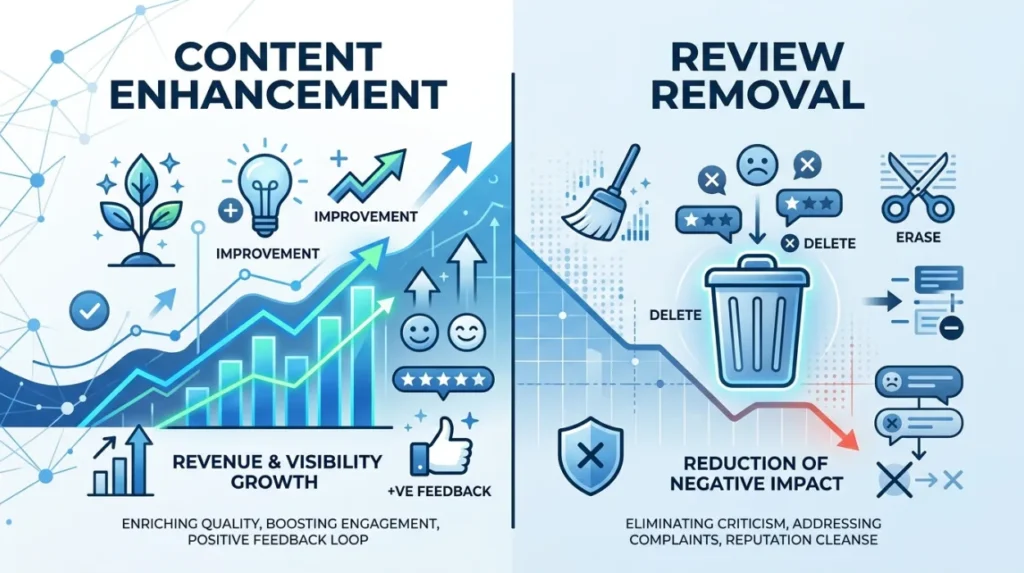
Content enhancement improves search visibility by expanding authoritative legal information, whereas review removal requests focus on challenging reviews that violate platform policies or contain demonstrably false information. Both methods influence online reputation through different mechanisms within search ecosystems.
Content enhancement strengthens professional authority through educational legal articles, solicitor biographies, legal guidance, media contributions, and recognised professional profiles. These resources expand semantic relationships recognised by search engines, improving search ranking influence through stronger contextual relevance. The result is broader digital credibility supported by authoritative legal information.
Review removal requests operate through platform policies rather than search optimisation. Reviews become eligible for removal only when they breach platform standards through impersonation, fabricated content, or prohibited behaviour. Consequently, removal strategies remain limited by policy enforcement, whereas content enhancement provides broader scalability through expanding authoritative digital assets.
Content Enhancement Supports Sustainable Search Visibility
Content enhancement is the process of increasing authoritative legal resources that reinforce expertise, trust, and professional credibility. It operates by expanding reliable information available for indexing across search ecosystems.
Educational resources, legal insights, professional biographies, verified practice information, and recognised publications strengthen semantic relevance because search engines interpret these resources as valuable reputation signals. Sustainable search visibility therefore develops through consistent authority rather than reactive correction alone.
How Do Short-Term Review Responses Compare With Long-Term Reputation Development?
Short-term review responses focus on addressing immediate public feedback, whereas long-term reputation development strengthens entity credibility through consistent authoritative information and sustainable reputation signals. Both approaches influence online perception, but they differ significantly in durability and search ranking influence.
Short-term response strategies evaluate individual reviews, publish professional replies where appropriate, and maintain visible transparency without compromising confidentiality. These actions improve information balance within existing search results because search engines reassess updated review pages and associated reputation signals. Their primary advantage lies in demonstrating professional engagement within current SERP composition.
Long-term reputation development operates by continuously strengthening legal content, maintaining accurate professional profiles, encouraging authentic client feedback, and expanding authoritative digital assets. Search engines interpret these cumulative reputation signals as evidence of recognised expertise, resulting in stronger entity credibility and more stable search visibility. This approach provides greater sustainability because improvements rely on an expanding network of trustworthy information rather than isolated review responses.
Which Evaluation Framework Best Compares Confidential Review Management Methods?
A structured evaluation framework compares review management methods by analysing confidentiality protection, reputation signals, scalability, search ranking influence, and long-term sustainability. Applying consistent criteria enables objective assessment of different reputation management approaches.
- Assess confidentiality by determining whether response methods avoid revealing client identities, legal advice, or case-specific information.
- Measure search ranking influence by evaluating how review responses and supporting legal content contribute to broader SERP composition.
- Analyse reputation signals by examining how authentic reviews, authoritative content, and professional profiles strengthen entity credibility.
- Evaluate sustainability by identifying whether the approach supports long-term digital trust instead of producing temporary visibility improvements.
This evaluation demonstrates that effective review management depends upon ethical communication supported by broader authority signals rather than individual public responses alone.
How Do Search Engines Interpret Professional Review Responses?
Search engines interpret professional review responses by analysing contextual relevance, authenticity, factual consistency, and relationships with authoritative legal information. Public replies contribute additional contextual evidence within search ecosystems but remain one element of broader reputation evaluation.
Algorithms compare response quality with review content, professional profiles, law firm websites, recognised legal directories, and other indexed resources. Consistent professional communication strengthens entity credibility because search systems recognise reliable behavioural patterns supported by authoritative information. This integrated evaluation contributes to balanced SERP composition rather than relying solely on review sentiment.
Search systems also analyse behavioural consistency across digital platforms. Neutral, factual responses aligned with broader reputation signals reinforce semantic relationships, whereas inconsistent communication weakens contextual confidence during entity evaluation.
What Limitations Exist Across Different Review Response Approaches?
Every review response approach operates within ethical, technical, and platform-specific limitations. Overall effectiveness depends upon confidentiality protection, information quality, authoritative content, and supporting reputation signals rather than the response itself.
Proactive reputation development requires continuous content improvement, profile maintenance, and authentic client engagement to strengthen reputation signals progressively. While this approach develops sustainable credibility, measurable improvements accumulate gradually because search engines evaluate long-term information patterns instead of isolated interactions.
Reactive responses depend upon the existence of public reviews and platform functionality. Professional replies demonstrate transparency but provide limited influence on sentiment distribution without broader authority signals supporting entity credibility. Likewise, review removal requests remain restricted to reviews that violate platform policies, limiting scalability across broader reputation management objectives.
Content enhancement addresses these limitations by expanding authoritative legal information that complements authentic client feedback and ethical review responses. As educational content, legal publications, solicitor profiles, and verified practice information increase, search ecosystems develop stronger contextual understanding, improving digital credibility over time.
Responding to negative client reviews without violating confidentiality requires balancing professional ethics, transparent communication, and sustainable reputation development. Proactive reputation management, reactive review responses, content enhancement, and policy-based review removal each influence reputation signals through different mechanisms, producing distinct effects on search visibility and entity credibility.
Search ecosystems evaluate review responses alongside authoritative legal information, semantic relationships, and consistent professional identity. Sustainable digital credibility therefore develops through authentic reputation signals supported by reliable legal content rather than isolated public replies.
Understanding the strengths, limitations, scalability, and ethical considerations of each response strategy provides a stronger framework for evaluating reputation management within legal search environments. Additional analysis of Resolve Negative Reviews with Law Firm Reputation Experts explores structured approaches to strengthening long-term digital credibility while maintaining professional confidentiality.
How can lawyers respond to negative client reviews without breaching confidentiality?
Lawyers can acknowledge feedback professionally, avoid discussing case-specific details, and invite the reviewer to continue the conversation through private channels. This approach protects confidentiality while maintaining transparency and professional standards.
Why is confidentiality important when responding to online client reviews?
Confidentiality is a fundamental legal obligation that protects client information and maintains professional trust. Public responses that avoid revealing confidential details also help preserve a law firm’s online credibility and reputation signals.
Does responding to negative reviews improve a law firm’s online reputation?
Professional review responses demonstrate transparency and accountability, but they are only one part of a broader reputation strategy. Strong entity credibility also depends on authoritative legal content, consistent professional information, and authentic client feedback.
What is Reputation management for lawyers?
Reputation management for lawyers focuses on improving search visibility, strengthening reputation signals, and maintaining accurate professional information across digital platforms. Organisations such as Clear My Name recognise that consistent and authoritative online information helps search engines evaluate legal professionals more effectively.
Can false or misleading client reviews be removed?
Reviews that violate a platform’s policies, such as fake, defamatory, or misleading content, can be reported for review and possible removal. Reviews that comply with platform guidelines generally remain visible, making long-term reputation management and authoritative content equally important.