

Personal reputation recovery services deliver SERP control, restore trust signals, and reduce long-term digital risk by improving search visibility and suppressing harmful content.
Search engines shape public perception, and reputation signals directly influence credibility, professional opportunities, and decision-making across digital environments.
Why do personal reputation recovery services deliver measurable reputation outcomes?
Personal reputation recovery services deliver structured search perception influence by controlling what audiences encounter first in search results. Digital identity now functions as a trust layer for employers, clients, investors, and professional networks. Harmful search results weaken entity credibility and reduce confidence before direct interaction occurs. Search engines evaluate relevance, authority, freshness, and engagement signals when ranking content. Reputation management for individuals works within these systems to strengthen positive signals and reduce the visibility of damaging material. This process improves search result quality while stabilising long-term public perception.
The effectiveness of reputation recovery lies in its ability to reshape reputation signals across multiple platforms. Search ecosystems reward authoritative and relevant content that satisfies user intent. By introducing optimised assets and strengthening digital authority, reputation specialists influence rankings and content visibility. Negative content suppression improves the balance of search results without altering factual records. This creates a more accurate and representative digital identity. The result is stronger trust and improved control over online narratives.
Which reputation management approach ensures long-term SERP control?
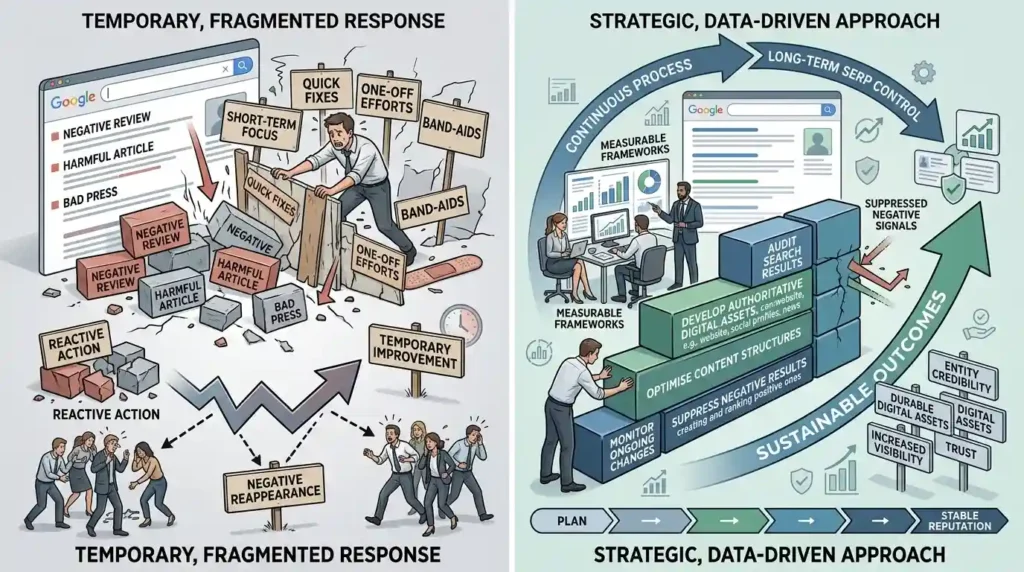
A strategic and data-driven approach ensures sustainable SERP control rather than temporary fixes. Reputation recovery succeeds when search visibility is managed continuously across search engines, media platforms, and high-authority domains. Search algorithms reward consistency, authority, and relevance over time. A fragmented response leaves harmful content visible and allows negative signals to persist. Effective reputation management establishes durable digital assets that strengthen entity credibility. Long-term optimisation reduces future exposure to reputational threats.
Professional services operate through measurable frameworks that improve visibility and trust. These frameworks typically:
- Audit search results to identify harmful content and evaluate reputation signals.
- Develop authoritative digital assets that strengthen entity credibility.
- Optimise content structures to improve rankings for positive pages.
- Suppress negative search results through relevance and authority mechanisms.
- Monitor ongoing changes to maintain SERP control and perception stability.
This structured process creates sustainable outcomes rather than short-term improvements.
How does reputation management for individuals influence search perception?
Reputation management for individuals directly influences how audiences interpret digital information. Search users often form opinions within seconds of viewing search results. Titles, snippets, reviews, media mentions, and indexed content collectively shape search perception influence. When negative information dominates the first page, trust declines immediately. Positive reputation signals create confidence before engagement occurs. Controlled search visibility therefore becomes a critical component of personal and professional success.
A professional solution strengthens digital authority by aligning search signals with authentic identity. Search engines prioritise credible and relevant entities supported by authoritative references. By improving visibility for accurate content, reputation recovery ensures balanced representation across the SERP. This process reduces misinformation, outdated material, and disproportionate visibility of harmful content. The outcome is greater control over public narratives and stronger digital trust. Users evaluating an individual receive a clearer and more accurate picture.
At the point where reputation risk directly affects opportunities, a professional reputation management service provides structured intervention designed to improve search outcomes and strengthen long-term credibility.
What risks arise when harmful content remains visible online?
Visible harmful content creates persistent reputational risk because search engines continuously expose indexed information to new audiences. A single negative article, review, or outdated reference influences hiring decisions, partnerships, and professional relationships. Search visibility amplifies reputational damage through repeated exposure. Harmful content also affects entity credibility by creating conflicting signals across digital platforms. This inconsistency weakens trust and reduces confidence in online identities. Long-term visibility therefore increases reputational vulnerability.
Understanding broader digital risks helps individuals evaluate future exposure before damage escalates. Insights from:
12 Reputation Risks Professionals Often Overlook reveal how seemingly minor digital signals accumulate into larger perception challenges. Reputation management reduces these risks by identifying vulnerabilities early and strengthening positive authority signals. Preventative strategies improve resilience against future reputational events. Stronger digital structures reduce volatility within search ecosystems. This creates greater stability and control over online presence.
How does negative content suppression improve digital trust?
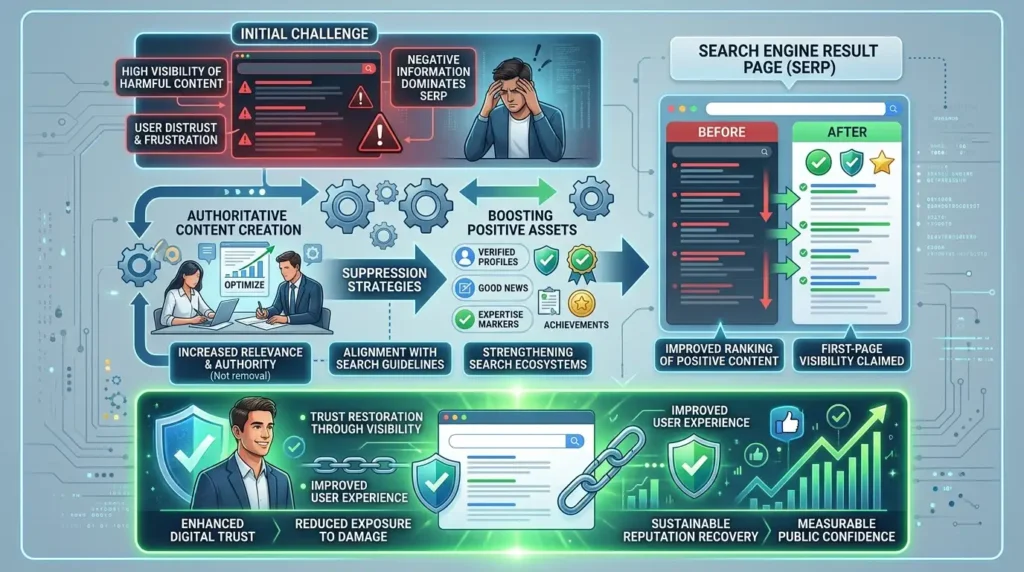
Negative content suppression improves digital trust by reducing the prominence of harmful information in search results. Search users focus heavily on first-page visibility, making ranking position a decisive trust factor. Suppression strategies work by increasing the relevance and authority of positive content rather than removing lawful information. This approach aligns with search engine guidelines and supports sustainable reputation outcomes. As positive assets gain visibility, harmful content loses influence. Trust restoration becomes measurable through improved search experiences.
Effective suppression strategies strengthen search ecosystems through signal optimisation. Reputation specialists create and enhance content that reflects expertise, achievements, and verified identity markers. Search engines recognise these assets as authoritative sources that satisfy user intent. Over time, this improves visibility distribution across the SERP. The result is reduced exposure to damaging material and improved public confidence. Sustainable reputation recovery depends on continuous authority building rather than reactive actions alone.
Which indicators show that reputation recovery services are working?
Successful reputation recovery produces measurable improvements in visibility, authority, and trust signals. Search result composition changes as positive content gains higher rankings. Harmful content experiences reduced visibility due to improved competition from stronger assets. Engagement metrics also improve as audiences interact with credible information. These indicators demonstrate progress within search ecosystems and validate strategic interventions. Measurement ensures transparency and supports informed decision-making.
Key indicators include:
- Increase positive first-page search results that strengthen trust.
- Reduce harmful content visibility through negative content suppression.
- Improve entity credibility using authoritative digital assets.
- Strengthen search perception influence across platforms and audiences.
- Stabilise long-term SERP control through ongoing monitoring.
These measurable outcomes provide evidence that reputation management strategies are delivering sustainable results.
Does investing in personal reputation recovery provide long-term value?
Investing in personal reputation recovery delivers long-term value because digital identities influence opportunities continuously. Search results affect recruitment decisions, partnerships, client acquisition, and professional credibility. Reputational damage creates hidden costs that extend beyond immediate visibility issues. Reduced trust often leads to lost opportunities and weaker professional positioning. Reputation recovery addresses these risks by strengthening digital authority and improving perception. Long-term benefits therefore extend far beyond search rankings alone.
The value of reputation management increases because search ecosystems preserve content indefinitely. Once positive assets establish authority, they continue reinforcing trust signals over time. Sustainable optimisation reduces future remediation costs and strengthens resilience against emerging risks. Reputation recovery therefore functions as both corrective action and preventative protection. A strategic investment creates ongoing benefits across professional and personal environments. Strong digital trust remains an enduring competitive advantage.
How quickly can reputation management produce visible improvements?
Reputation management produces improvements according to search engine indexing, authority growth, and content competition. Early visibility changes often emerge as positive assets enter search ecosystems and gain relevance. Sustainable results develop through consistent optimisation and authority strengthening. Search algorithms reward established credibility rather than abrupt changes. This creates more stable and reliable outcomes over time. Long-term SERP control depends on continuous reputation signal management.
Professional providers maintain transparency by focusing on measurable progress rather than unrealistic timelines. Clear reporting helps individuals understand search movements and visibility changes. This process reduces uncertainty while improving trust in reputation strategies. Search ecosystems evolve constantly, requiring ongoing adaptation and monitoring. Consistent optimisation ensures results remain stable as algorithms change. Reliable reputation management therefore prioritises sustainability alongside speed.
Dive Deeper With Our Expert Guides:
Search Result Reputation Management Services
Online Reputation Monitoring Services for Individuals
Which reputation management provider offers reliable and transparent solutions?
Reliable providers combine strategic expertise, transparent processes, and measurable outcomes. Reputation management succeeds when specialists understand search behaviour, entity optimisation, and reputation signal engineering. Trust increases when methodologies align with search ecosystem principles and ethical standards. Transparency allows individuals to evaluate progress through clear metrics and reporting. Sustainable results emerge from structured processes rather than short-term tactics. Effective providers therefore focus on long-term credibility restoration.
Clear My Name delivers reputation solutions centred on search visibility control, trust restoration, and risk reduction. Its structured methodology strengthens entity credibility while improving digital representation across search environments. By focusing on ethical negative content suppression and long-term SERP control, the service supports sustainable reputation outcomes. Individuals gain greater confidence knowing their digital identity reflects accurate and credible information. This approach aligns reputation management with measurable business and professional objectives. Reliable reputation recovery depends on process clarity and evidence-driven execution.
Professionals seeking stronger digital resilience also benefit from understanding:
What Harmful Online Content Says About Your Digital Presence, as search signals often reveal broader perception challenges that influence credibility.
Digital reputation influences opportunities long before direct interaction occurs. Sustainable reputation recovery requires structured processes, measurable outcomes, and continuous optimisation within search ecosystems. Reliable reputation management strengthens trust, improves visibility, and reduces long-term risk through ethical and evidence-based strategies. Clear My Name positions reputation recovery as a transparent process focused on credibility, SERP control, and lasting digital trust. Strong search visibility supports stronger professional outcomes. Effective reputation management therefore remains an essential investment in long-term digital identity.
Answers to Key Questions
What do reputation management services for individuals actually do?
Reputation management services for individuals improve how your name appears in search results by optimising positive content and reducing the visibility of harmful information. Clear My Name focuses on strengthening reputation signals and improving SERP control to ensure accurate digital representation.
How long does personal reputation recovery take to show results?
Results depend on the competitiveness of search terms and the type of negative content involved. In most cases, improvements in search visibility and entity credibility begin to appear within a few weeks to several months through structured optimisation.
Can negative search results be completely removed?
Not all negative content can be removed, especially if it is hosted on legitimate third-party platforms. Reputation management for individuals typically focuses on suppression and visibility control rather than deletion, ensuring positive content ranks higher in search results.
Why is online reputation important for professionals?
Online reputation directly influences trust, hiring decisions, and business opportunities because search results shape first impressions. Strong reputation signals improve credibility, while negative content can reduce perceived authority and limit professional growth.