
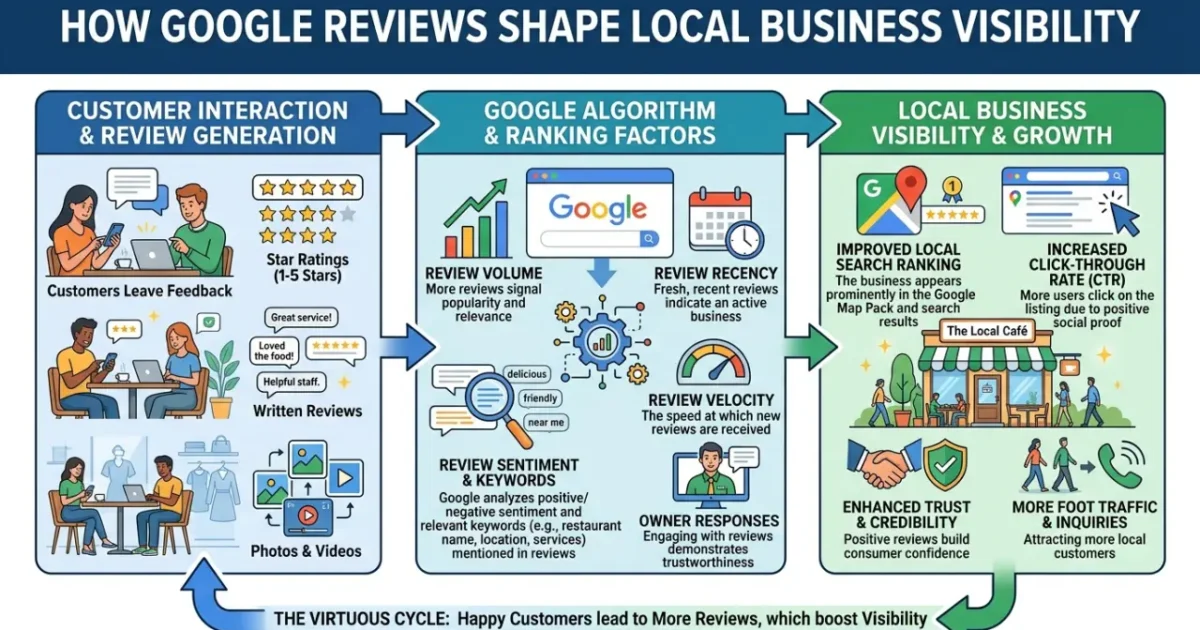
Google Reviews define how search engines interpret local business credibility, relevance, and trustworthiness within local search ecosystems. Review sentiment, review frequency, reviewer authority, and engagement signals influence how local entities appear and rank across search engine results pages.
Reputation management is the process of analysing, structuring, and influencing how digital information defines trust and authority within search ecosystems. Online reputation refers to the cumulative interpretation of reviews, mentions, content signals, and engagement data that shape entity perception across search engine results pages (SERPs).
Why do Google Reviews influence local business visibility?
Google Reviews influence local business visibility because search engines interpret review data as a reputation signal tied to trust, relevance, and user satisfaction. Reviews function as indexed user-generated content that contributes to entity evaluation within local search systems.
Search engines analyse reviews as structured and unstructured data sources. Structured data includes star ratings, review frequency, reviewer history, and review recency. Unstructured data includes sentiment, contextual language, service-related terminology, and geographic references embedded within review text. These signals contribute to local ranking systems that determine visibility across map packs, knowledge panels, and organic local results.
Review ecosystems also influence click-through behaviour within SERPs. High review ratings and consistent sentiment improve perceived credibility during search evaluation. Users interpret visible review scores as trust indicators before interacting with business websites or local listings. Search engines measure these engagement patterns and incorporate behavioural signals into visibility calculations.
Local visibility depends on reputation consistency across indexed content. Reviews contribute to entity clarity by reinforcing business categories, service associations, and topical relevance. Repeated mentions of specific products, services, or locations strengthen semantic associations tied to the business entity within search ecosystems.
How does Google interpret review sentiment?
Google interprets review sentiment through natural language processing systems that evaluate emotional polarity, contextual relevance, and topic association within review content. Sentiment analysis converts textual reviews into measurable trust and satisfaction signals.
Review sentiment analysis focuses on recurring language patterns rather than isolated emotional expressions. Positive terminology associated with reliability, responsiveness, or service quality strengthens perceived authority signals. Negative terminology associated with delays, disputes, or operational inconsistency weakens trust perception within local ranking environments.
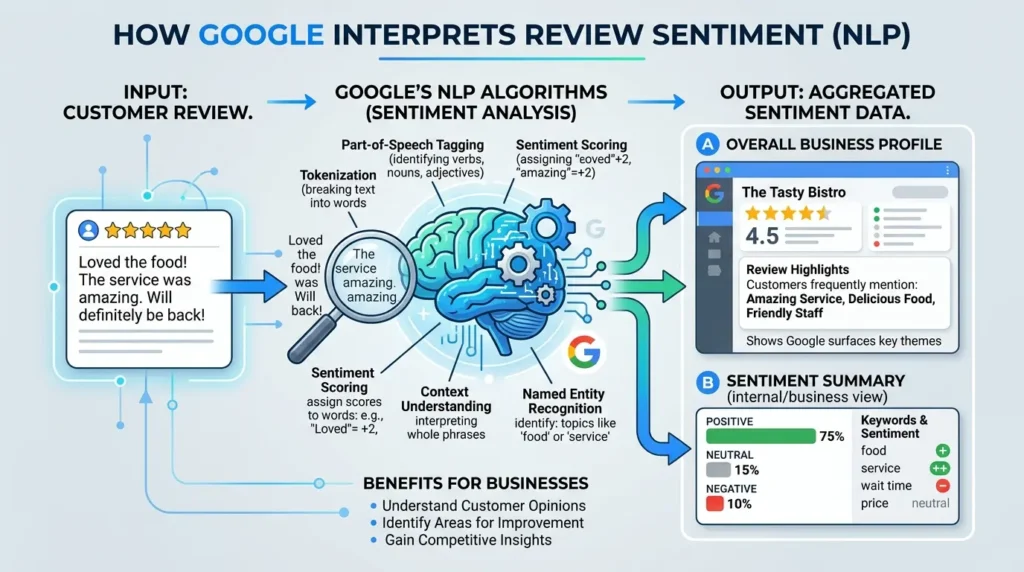
Search systems also evaluate sentiment distribution across review histories. A balanced review profile with sustained positive sentiment indicates operational stability and authentic engagement patterns. Extreme sentiment fluctuations create inconsistency signals that affect entity trust evaluation.
Sentiment interpretation extends beyond star ratings. Search engines analyse semantic relationships between keywords and contextual modifiers inside reviews. Phrases linked to professionalism, responsiveness, or reliability reinforce topical trust signals. Conversely, repeated complaint terminology contributes to negative reputation associations within indexed review ecosystems.
Review sentiment contributes to search visibility because search engines prioritise results that demonstrate relevance and perceived user satisfaction. Local search algorithms evaluate whether sentiment patterns align with expected service quality indicators for a specific category or location.
What role do Google Reviews play in local SEO?
Google Reviews play a central role in local SEO because they influence relevance, prominence, and trust evaluation within local ranking systems. Reviews function as continuously updated content assets that contribute to search visibility.
Local SEO refers to optimisation processes focused on improving visibility for geographically relevant searches. Within this system, reviews operate as dynamic reputation indicators tied directly to local intent queries. Search engines interpret review activity as evidence of operational relevance within a location-based ecosystem.
Review quantity contributes to prominence signals. Frequent review activity demonstrates ongoing user interaction and sustained market presence. Search systems interpret consistent review generation as an indicator of active entity engagement.
Review content also contributes to keyword association. Reviews naturally contain service terms, location references, and product descriptions that reinforce semantic relevance. When search systems identify repeated contextual terminology within reviews, the associated entity gains stronger topical alignment for relevant local searches.
Review recency influences freshness evaluation. Recently published reviews indicate current operational activity and updated user sentiment. Search engines prioritise fresh signals because they provide more accurate representations of present entity reputation.
Local SEO performance also depends on engagement metrics connected to reviews. Responses to reviews, user interactions with review profiles, and profile completeness contribute additional trust signals that influence local ranking calculations.
How do Google Reviews affect user trust within SERPs?
Google Reviews affect user trust within SERPs by shaping immediate perception during search result evaluation. Reviews function as visible credibility markers that influence click selection behaviour before users access external content.
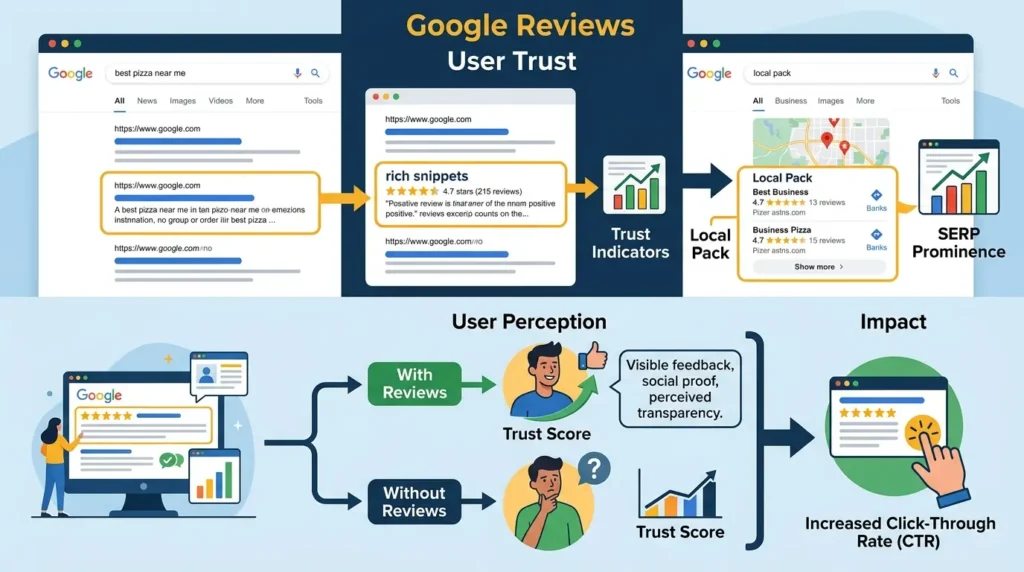
Search engine results pages present condensed information designed to support rapid evaluation. Review ratings, review counts, and highlighted review snippets provide users with instant trust indicators. These visible elements influence perceived legitimacy during the decision-making process.
Entity perception within SERPs depends heavily on reputation consistency. High review ratings combined with detailed review content reinforce authority signals. In contrast, unresolved complaints, repetitive criticism, or low ratings weaken perceived reliability during search evaluation.
User trust also depends on review authenticity signals. Search systems analyse reviewer behaviour, review timing, linguistic consistency, and engagement history to identify manipulation patterns. Authentic review ecosystems strengthen credibility because they align with organic user interaction patterns.
Reviews influence behavioural metrics tied to trust perception. Higher trust increases click-through rates, profile interactions, and local engagement activity. Search engines interpret these behavioural outcomes as indicators of relevance and usefulness within local search ecosystems.
The visibility of reviews inside map results and local panels intensifies their influence on perception. Users frequently evaluate review data before interacting with websites, making reviews a primary component of search-driven reputation assessment.
How do review signals contribute to entity reputation?
Review signals contribute to entity reputation by defining how search systems classify authority, reliability, and topical relevance. Entity reputation refers to the cumulative interpretation of all indexed signals associated with a business or identifiable organisation.
Search engines organise information around entities rather than isolated keywords. Reviews strengthen entity understanding by connecting businesses with recurring contextual associations. Consistent references to service quality, expertise, or operational reliability reinforce entity credibility.
Review signals contribute to entity identity through semantic reinforcement. Reviews frequently contain descriptors tied to products, industries, geographic regions, and customer experiences. Search systems aggregate these references to build a contextual profile around the entity.
Reviewer authority also affects reputation interpretation. Reviews from established user accounts with credible engagement histories carry greater trust value. Search systems evaluate reviewer authenticity to determine the reliability of reputation signals.
Entity reputation influences broader search visibility beyond local results. Strong reputation signals improve perceived authority across branded searches, informational searches, and local discovery queries. Weak reputation signals reduce trust consistency across indexed search environments.
Reputation systems also analyse review response behaviour. Public responses demonstrate operational transparency and engagement consistency. Search engines interpret active reputation management as evidence of maintained entity credibility.
What is the relationship between Google Reviews and digital footprints?
Google Reviews contribute to digital footprints because reviews become permanent indexed content associated with a business entity. A digital footprint refers to the total collection of searchable information connected to an identifiable entity within online ecosystems.
Every review contributes additional searchable data to the entity profile. Review text expands indexed content volume while reinforcing contextual associations tied to services, industries, and locations. This process strengthens entity discoverability across local and informational search queries.
Digital footprints evolve through accumulated user-generated content. Reviews continuously reshape perception because search engines recrawl and reinterpret review ecosystems over time. New reviews alter sentiment balance, authority perception, and topical associations within indexed systems.
Review visibility also extends beyond original listing environments. Search engines extract review snippets into featured search elements, map panels, and knowledge interfaces. These extracted elements influence perception even before users access complete review profiles.
A structured digital footprint supports entity consistency. Reviews aligned with website content, local citations, and business descriptions strengthen semantic clarity. Inconsistent review language creates ambiguity that weakens search interpretation accuracy.
Digital footprints also influence long-term reputation stability. Persistent negative sentiment or repeated criticism remains indexed within search ecosystems, affecting future trust evaluation and visibility calculations.
How do negative Google Reviews influence search perception?
Negative Google Reviews influence search perception by altering trust signals, sentiment analysis outcomes, and behavioural engagement metrics. Negative review ecosystems weaken perceived reliability within local search environments.
Search engines interpret repeated negative sentiment as evidence of operational inconsistency or reduced user satisfaction. This interpretation affects entity trust calculations used within local ranking systems. Persistent criticism associated with reliability, communication, or fulfilment reduces perceived authority.
Negative reviews also affect user interaction patterns within SERPs. Lower review ratings decrease click-through behaviour and reduce engagement activity across local listings. Search systems interpret declining engagement as a relevance and trust issue.
The language inside negative reviews contributes additional semantic impact. Repeated complaint terminology strengthens negative topical associations tied to the entity. Search systems aggregate these associations during reputation evaluation processes.
Search perception depends on review distribution rather than isolated criticism. Balanced review ecosystems containing constructive negative feedback maintain authenticity signals. Excessive unresolved negative sentiment creates reputational imbalance that weakens entity credibility.
Review responses influence how negative sentiment is interpreted. Structured, factual responses reduce perceived reputational instability by demonstrating transparency and engagement consistency. Ignored criticism contributes to negative trust evaluation within public search environments.
The relationship between reviews and commercial performance becomes visible through search behaviour analysis. Discussions surrounding How Negative Google Reviews Influence Leads, Sales, and Retention demonstrate how search perception affects engagement, conversion intent, and long-term credibility evaluation within digital ecosystems.
How does review authenticity affect credibility signals?
Review authenticity affects credibility signals because search engines prioritise trustworthy, verifiable user-generated content within ranking systems. Authenticity analysis protects search ecosystems from manipulation and artificial reputation inflation.
Read More:
Why Star Ratings Affect Customer Decisions
10 Google Review Statistics Every Business Should Know
Search systems analyse behavioural patterns linked to reviewers. Posting frequency, geographic consistency, account history, and engagement diversity contribute to reviewer credibility evaluation. Suspicious patterns trigger reduced trust weighting during reputation assessment.
Authenticity analysis also focuses on linguistic consistency. Repetitive phrasing, unnatural sentiment distribution, and duplicated terminology indicate potential manipulation patterns. Search engines evaluate these anomalies to preserve search result reliability.
Credibility signals influence both ranking visibility and perception quality. Authentic reviews strengthen trust because they align with organic engagement patterns and realistic sentiment distribution. Manipulated review ecosystems weaken entity credibility and reduce trust stability.
Review authenticity contributes to long-term reputation sustainability. Artificial reputation inflation creates instability because search systems continuously update spam detection frameworks. Authentic engagement patterns maintain stronger alignment with evolving trust evaluation systems.
Credibility signals also affect user interpretation. Users evaluate review depth, contextual specificity, and reviewer legitimacy when assessing trustworthiness. Authentic review ecosystems create stronger confidence during search evaluation processes.
Why do review responses matter for reputation systems?
Review responses matter for reputation systems because they contribute additional trust, transparency, and engagement signals within indexed search environments. Responses become part of the searchable reputation ecosystem associated with the entity.
Search engines analyse response frequency, response timing, and response relevance. Consistent responses demonstrate operational engagement and active reputation monitoring. These patterns contribute to trust evaluation within local search systems.
Responses also influence sentiment interpretation. Professional and factual responses reduce the reputational impact of negative sentiment by contextualising criticism within public search environments. Search systems interpret this behaviour as evidence of entity accountability.
Response content contributes additional semantic relevance. Replies frequently contain service terminology, operational details, and contextual clarifications that reinforce entity understanding within search ecosystems.
Public responses influence user perception during SERP evaluation. Users interpret responsive behaviour as a signal of organisational transparency and operational reliability. This perception affects engagement behaviour tied to local listings and review panels.
Reputation systems also evaluate communication consistency across review interactions. Structured responses aligned with professional tone and factual language strengthen credibility signals. Inconsistent or confrontational responses weaken perceived trustworthiness within indexed reputation environments.
Google Reviews shape local business visibility by influencing trust evaluation, sentiment interpretation, entity perception, and behavioural engagement within search ecosystems. Reviews operate as indexed reputation signals that affect both ranking visibility and public credibility across local SERPs.
Search engines analyse reviews through semantic interpretation systems that evaluate sentiment, authenticity, topical relevance, and engagement behaviour. These mechanisms contribute to broader entity understanding tied to local SEO performance, digital footprints, and reputation stability.
Review ecosystems define how businesses are interpreted within search environments. Positive sentiment, authentic engagement, semantic consistency, and transparent communication strengthen reputation signals. Negative sentiment, inconsistent engagement, and authenticity concerns weaken trust perception and search visibility.
The relationship between reviews and local visibility demonstrates how search ecosystems prioritise credibility, relevance, and user trust during SERP evaluation. Reputation management therefore functions as an analytical process centred on how indexed information defines entity authority within digital search environments.
How do Google reviews affect local business visibility?
Google reviews influence how businesses appear in local search results and Google Maps rankings. Positive reviews, review frequency, and customer engagement help improve local SEO visibility and increase trust with potential customers.
Why are Google reviews important for local SEO?
Google reviews provide fresh user-generated content that signals relevance and credibility to search engines. Businesses with strong ratings and consistent reviews often perform better in local search visibility and attract more clicks from nearby customers.
Can negative Google reviews lower a business’s local ranking?
Negative reviews can impact customer trust and reduce click-through rates, which may affect local business performance over time. However, responding professionally to reviews and maintaining consistent positive feedback can help balance overall visibility.
How many Google reviews does a local business need to rank higher?
There is no fixed number of reviews required for higher rankings because Google evaluates review quality, recency, and overall engagement. Consistent authentic reviews are generally more valuable than a high volume of outdated feedback.
How can businesses manage harmful or fake Google reviews?
Businesses can report policy-violating reviews directly through Google and monitor feedback regularly. Services like Clear My Name help businesses address fake or misleading reviews while supporting reputation management and local SEO performance.