

Harmful online content reflects how search engines, platforms, and users interpret an individual’s digital identity across multiple sources. Negative or misleading content alters reputation signals, affects entity credibility, and changes trust perception within search ecosystems.
Reputation management strategies differ based on the type, persistence, and visibility of harmful content across search environments. Online reputation control methods are evaluated through search ranking influence, sentiment distribution, content authority, and long-term sustainability.
What does harmful online content reveal about a digital presence?
Harmful online content is digital information that negatively affects perception, trust, or credibility within online environments. This content includes negative reviews, outdated articles, social media posts, legal records, forum discussions, and misleading information indexed by search engines. Search systems interpret such content as reputation signals that contribute to entity understanding. Search engines evaluate relevance, authority, freshness, and engagement when determining visibility. A digital presence is therefore shaped not only by owned content but also by third-party information. The overall sentiment distribution across search results influences how users perceive an individual before any direct interaction occurs.
Digital presence operates as a network of interconnected entities, mentions, and content sources. Search engines construct entity profiles using structured and unstructured information from websites, social platforms, news sources, and user-generated content. Harmful content affects entity credibility when negative signals dominate visible search results. Search ranking influence increases when authoritative domains publish or host adverse information. Trust signals decline when contradictory or damaging information appears repeatedly across platforms. As a result, harmful content provides insight into existing weaknesses within an individual’s digital ecosystem.
How do search engines interpret harmful reputation signals?
Search engines interpret harmful content through relevance, authority, and engagement metrics rather than moral judgement. Algorithms analyse content relationships to determine how entities are represented across the web. Negative content with strong authority frequently achieves durable rankings due to backlinks, user engagement, and domain trust. Search engines also identify entity associations that connect individuals to events, discussions, or controversies. These associations influence semantic understanding within knowledge systems. Consequently, harmful content can become embedded within long-term search visibility.
Reputation signals are measurable indicators of trust, authority, and sentiment linked to an entity. These signals include brand mentions, reviews, citations, media coverage, and user interactions. Search engines compare positive and negative signals to establish sentiment distribution across results pages. When negative signals outweigh positive signals, search visibility shifts towards unfavourable narratives. This process affects click behaviour and perceived credibility. Search ecosystems therefore function as reputation evaluation systems rather than simple information indexes.
Which approach is more effective: content removal or content suppression?
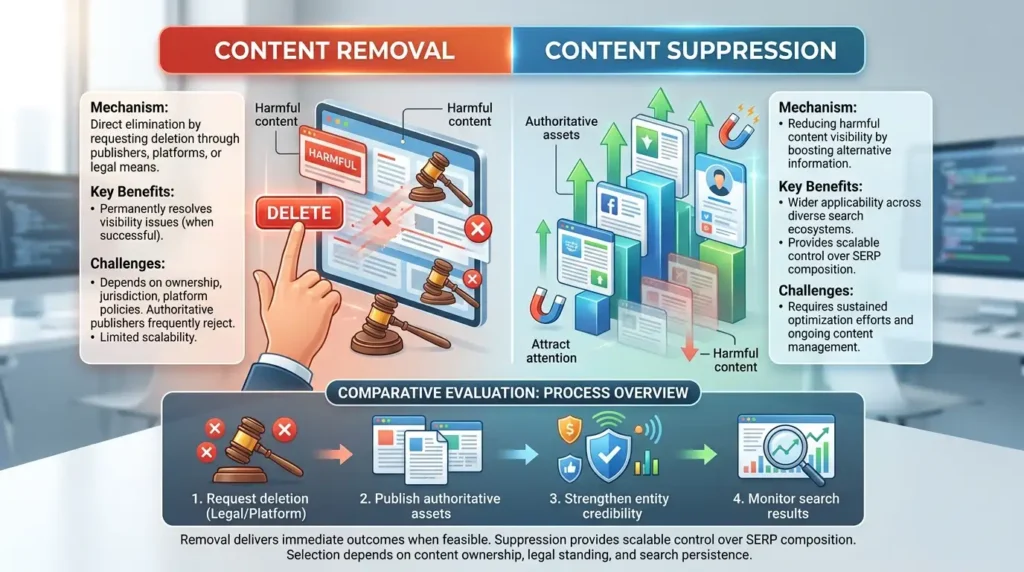
Content removal directly eliminates harmful material from search ecosystems when legal or platform policies permit intervention. Removal strategies operate by requesting deletion through publishers, platform administrators, or legal mechanisms. This approach permanently resolves visibility issues when successful. However, removal effectiveness depends on ownership rights, jurisdiction, and platform policies. Authoritative publishers frequently reject removal requests without legal justification. Consequently, removal strategies have limited scalability across diverse content sources.
Content suppression is the process of reducing harmful content visibility by increasing the prominence of alternative information. This method operates by publishing authoritative content that competes for search rankings. Content enhancement strengthens entity credibility through positive reputation signals and increased digital assets. Compared with removal strategies, suppression provides broader applicability across search ecosystems. However, suppression requires sustained optimisation efforts and ongoing content management. The distinction between content suppression vs content enhancement becomes central to long-term reputation analysis.
Comparative evaluation of removal and suppression
- Request deletion through legal or platform mechanisms to eliminate indexed content.
- Publish authoritative assets that compete for search ranking influence.
- Strengthen entity credibility using trusted digital properties and structured content.
- Monitor search result changes to measure sentiment distribution over time.
Removal delivers immediate outcomes when feasible, while suppression provides scalable control over SERP composition. The selection of either method depends on content ownership, legal standing, and search persistence.
How do reactive and proactive reputation management strategies compare?
Reactive reputation management addresses harmful content after visibility problems emerge. This approach focuses on damage control through response mechanisms, suppression efforts, and corrective communication. Reactive strategies often involve higher resource consumption because negative content has already accumulated authority. Search engines may have already established strong entity associations that require extensive intervention. Trust signals recover gradually as new content enters search ecosystems. Therefore, reactive methods typically involve longer recovery periods.
Proactive reputation management establishes positive reputation signals before adverse content gains prominence. This approach operates by continuously building authoritative digital assets and maintaining consistent visibility. Search ecosystems favour entities with diversified and trustworthy content profiles. Proactive strategies reduce risk exposure by limiting gaps that harmful content can occupy. Entity credibility strengthens through sustained content production and structured online representation. As a result, proactive methods often demonstrate greater sustainability than reactive interventions.
The primary difference lies in timing and risk management. Reactive approaches address existing damage, while proactive systems prevent imbalance in sentiment distribution. Search ranking influence generally favours entities with stable and consistent digital footprints. Long-term reputation resilience therefore depends on proactive maintenance rather than episodic responses.
How does harmful content influence search engine results pages?
Search engine results pages reflect the most authoritative and relevant information associated with an entity. Harmful content influences SERP composition when search algorithms determine that adverse information satisfies user intent. High-authority domains frequently dominate search visibility because of strong trust signals. Negative articles, public records, or social discussions can therefore maintain long-term prominence. Search ranking influence increases further when user engagement reinforces relevance. Consequently, SERP composition often becomes resistant to rapid change.
SERP control strategies operate by reshaping the balance of visible content. These strategies include content publication, structured data implementation, profile optimisation, and authority building. Each mechanism introduces new reputation signals into search ecosystems. Search engines evaluate freshness and relevance alongside authority when ranking pages. Sustained optimisation gradually alters visibility patterns and sentiment distribution. However, highly authoritative harmful content remains difficult to displace.
Search ecosystems also evaluate relationships between entities and topics. Harmful content associated with recurring themes strengthens semantic connections within search systems. Breaking these associations requires consistent introduction of alternative narratives supported by authoritative signals. Effective SERP management, therefore, depends on both content quality and entity reinforcement.
Which digital footprint optimisation methods provide long-term sustainability?
Digital footprint optimisation is the structured management of online assets to improve entity credibility and search visibility. This process operates by strengthening owned properties such as websites, professional profiles, and content hubs. Search engines favour entities with consistent and verifiable information across multiple sources. Optimisation enhances trust signals while reducing reliance on third-party platforms. Stable digital assets also provide greater control over reputation outcomes. Therefore, digital footprint management forms a sustainable foundation for reputation resilience.
Profile optimisation focuses on improving existing digital assets, whereas content expansion creates new sources of authority. Profile optimisation delivers efficiency by refining established entities and improving consistency. Content expansion broadens visibility through additional indexed assets and semantic relevance. Compared with profile updates, content expansion generally produces stronger search ranking influence over time. However, expansion requires greater resources and sustained maintenance.
Long-term sustainability depends on diversification. Reliance on a single platform increases risk exposure because visibility remains vulnerable to external changes. A distributed digital presence provides resilience against adverse content and algorithmic shifts. Search ecosystems consistently reward authoritative, consistent, and interconnected entities.
How do trust signals and entity credibility affect perception?

Trust signals are measurable indicators that communicate reliability within search ecosystems. These signals include professional profiles, citations, media references, structured data, and verified information. Search engines analyse these signals to determine entity credibility. Strong credibility improves visibility while reducing the influence of isolated harmful content. Weak credibility creates informational gaps that negative material can occupy. Consequently, trust signals directly shape digital perception.
Entity credibility is the perceived reliability and consistency of an identifiable person or subject across digital environments. Entity credibility operates by aligning information across platforms and sources. Inconsistent data weakens search confidence and increases ambiguity. Consistent information strengthens semantic understanding and improves ranking stability. Search systems increasingly rely on entity-based evaluation rather than keyword matching alone. Therefore, credibility management has become central to modern reputation analysis.
Perception emerges from the interaction between visible content and user interpretation. Search results function as credibility assessments that influence decision-making before direct engagement occurs. Balanced sentiment distribution supports trust, while concentrated negativity amplifies reputational risk. Effective reputation evaluation therefore examines both content visibility and signal quality.
Which reputation management approach offers greater sustainability?
Sustainable reputation management depends on maintaining positive reputation signals while reducing risk exposure over time. Short-term interventions address immediate visibility concerns but rarely alter underlying entity structures. Long-term approaches strengthen digital ecosystems through authority building and content diversification. Search engines consistently reward durable trust signals and stable entity relationships. Sustainable systems therefore rely on continuous optimisation rather than isolated actions. This distinction explains why long-term strategies outperform temporary interventions in search environments.
Scalability differs significantly between approaches. Removal strategies face legal and platform limitations, while content enhancement scales through content creation and optimisation. Reactive methods consume resources during crises, whereas proactive systems distribute effort across time. Search ranking influence strengthens when optimisation remains consistent across multiple channels. The most resilient frameworks integrate monitoring, content development, and entity management into a unified system. Reputation analysis therefore evaluates sustainability alongside effectiveness.
Dive Deeper With Our Expert Guides:
How to Measure Personal Brand Visibility Across Search Engines
Comparing DIY and Professional Reputation Monitoring Approaches
Harmful online content reveals how search ecosystems interpret digital identity through reputation signals, entity credibility, and sentiment distribution. Different approaches produce distinct outcomes depending on search ranking influence, content authority, and visibility persistence. Content removal addresses specific sources of harm, while content suppression and content enhancement reshape SERP composition over time. Proactive strategies strengthen long-term resilience, whereas reactive interventions focus on recovery after reputational damage occurs. Digital footprint optimisation, trust signals, and entity consistency remain central to sustainable online reputation management. Evaluating effectiveness requires analysing scalability, sustainability, and risk exposure across evolving search environments.
Within broader discussions of reputation management for individuals, recovery frameworks frequently intersect with:
Personal Reputation Recovery Services when analysing post-damage remediation pathways.
Answers to Key Questions
How does harmful online content affect an individual’s reputation?
Harmful online content influences trust signals and entity credibility by shaping how users and search engines perceive an individual. Negative content that ranks highly can alter search results and affect digital trust.
Can negative search results be removed from Google?
Some negative search results can be removed through legal requests, platform policies, or publisher action. When removal is not possible, reputation management for individuals often relies on content suppression and content enhancement strategies.
How long does it take to improve an online reputation?
The timeframe depends on content authority, search ranking influence, and the volume of existing negative content. Long-term reputation management focuses on building sustainable trust signals and improving SERP composition over time.
What is the difference between content suppression and content removal?
Content removal eliminates harmful information from its source, while content suppression reduces its visibility in search results through stronger competing content. Both methods influence digital presence but differ in scalability and long-term effectiveness.