

Political search visibility audits are the objective measurement of how algorithmic systems surface information regarding an individual, a party, or an institution during critical electoral and legislative periods. Online reputation control methods are evaluated through their capacity to modify the entity-attribute associations within search engine knowledge graphs and live web results. Understanding these mechanics allows political strategists to transition from reactive crisis management to systematic narrative control.
How Do Organic Content Enhancement and Reactive Content Removal Compare?
Organic content enhancement and reactive content removal represent two fundamentally opposing methodologies within digital risk mitigation. Content enhancement is the proactive production and optimization of authoritative, semantically rich assets designed to outrank negative or inaccurate information. This method operates by satisfying search engine relevancy algorithms, filling available search engine results page (SERP) real estate with controlled assets. By increasing the volume of high-quality, keyword-optimized content, strategists dilute the visibility of unfavorable links without altering the source material itself.
In contrast, reactive content removal focuses on the absolute deletion or de-indexing of specific URLs through legal challenges, copyright notices, or terms of service violations. This approach aims to eliminate the threat entirely from the search index rather than suppressing it beneath other results. While highly effective when successful, content removal relies heavily on meeting strict legal thresholds, such as defamation laws or the Right to Be Forgotten framework within UK and European jurisdictions. It functions as a surgical intervention rather than a broad-scale structural adjustment.
| Evaluation Metric | Organic Content Enhancement | Reactive Content Removal |
| Primary Mechanism | Algorithmic suppression via authority building | Permanent de-indexing or source deletion |
| Implementation Speed | Medium to long-term (weeks to months) | Variable (dependent on legal timelines) |
| Risk of Backfire | Low; expands owned digital real estate | High; can trigger public scrutiny (Streisand Effect) |
| Algorithmic Sustainability | High; builds permanent entity authority | Medium; does not prevent new negative content |
The long-term impact on entity credibility differs substantially between these two approaches. Content enhancement builds a robust digital footprint that buffers the entity against future negative sentiment distribution by establishing a high baseline of trust signals. Reactive removal offers immediate relief for specific vulnerabilities but leaves the broader search landscape unfortified against subsequent narrative shifts.
How Do Search Engines Interpret Reputation Signals for Political Entities?
Search engines process online reputation through complex algorithmic evaluations of entity credibility, topical authority, and sentiment distribution. Modern search architectures do not merely match keywords; they construct elaborate semantic networks where political figures exist as unique nodes or entities. Every news article, Wikipedia edit, official press release, and public commentary adds attributes to this entity node within the search engine’s knowledge base.
Algorithmic systems evaluate the trust signals of these attributes using specific frameworks, such as Google’s Experience, Expertise, Authoritativeness, and Trustworthiness (E-E-A-T) guidelines. For political queries, search engines heavily prioritize information gain and source reliability due to the high-stakes nature of civic information. When a political entity experiences a surge in search volume, algorithms dynamically adjust the SERP composition, frequently favoring real-time news carousels and highly authoritative journalistic sources over standard static web pages.
This dynamic shifting directly alters the sentiment distribution visible to the electorate. If the dominant narrative across authoritative news outlets is critical, the search engine indexes these updates as high-priority attributes for the entity. Consequently, the algorithmic interpretation of a politician’s digital footprint depends entirely on the balance of authoritative signals, historical search patterns, and the contextual relevance of the information surfaced.

What Are the Mechanisms and Limitations of Search Engine Results Page Control?
SERP control strategies rely on dominating the first page of search results to govern the visible narrative surrounding a political figure. This process operates by deploying a diverse array of digital assets across various platforms, including official web domains, verified social media profiles, academic repositories, and media contributions. Strategists optimize each asset to target primary, secondary, and long-tail search queries associated with the political entity.
The primary mechanism of this strategy is algorithmic displacement. Because search engines aim to provide users with diverse perspectives, ranking multiple owned or controlled assets requires satisfying distinct algorithmic intent categories, such as informational, navigational, and transactional queries. Successfully occupying these positions creates a protective barrier, forcing uncontrolled or negative third-party content onto subsequent pages where user engagement drops exponentially.
However, serious limitations exist within the search ecosystem that prevent absolute narrative control. Search engines frequently implement diversity algorithms designed to prevent a single domain or highly correlated networks from monopolizing an entire SERP. Furthermore, user behavior inputs, such as sudden spikes in click-through rates on controversial news items, can override established ranking patterns, temporarily introducing volatile, unoptimized content into the primary visibility zones.
How Do Short-Term Suppression Tactics and Long-Term Digital Footprint Optimisation Differ?
Short-term suppression tactics are rapid-response measures designed to counter sudden, damaging visibility crises during high-stakes events like election campaigns. These methods involve the intensive distribution of press releases, optimized blog posts, and social media updates to temporarily flood search indexing pipelines. The objective is to exploit the fresh content bias inherent in modern search algorithms, pushing negative developments down the rankings for a critical window of time.
Conversely, long-term digital footprint optimisation focuses on establishing an enduring, resilient architecture for an entity’s online presence. This approach requires the continuous development of high-authority web assets, structural schema markup implementation, and the cultivation of deep topical authority on key policy areas. Long-term optimisation ensures that the entity’s core narrative remains anchored to trustworthy sources, minimizing the impact of transient negative news cycles.
To evaluate these approaches systematically, strategists apply specific criteria to determine resource allocation:
- Analyze the durability of search ranking influence across changing algorithmic core updates.
- Measure the sustainability of the content network without continuous, high-volume publishing inputs.
- Evaluate the vulnerability of the established SERP structure to sudden spikes in negative public sentiment.
- Assess the scalability of the strategy across regional, national, and international search variations.
While short-term suppression provides immediate operational defense during an active crisis, it lacks structural stability. Long-term digital footprint optimisation requires greater initial investment but builds a sustainable foundation that actively shapes how search engines interpret entity credibility over time.
Which Method Best Balances Strategic Risk Exposure and Scalability?
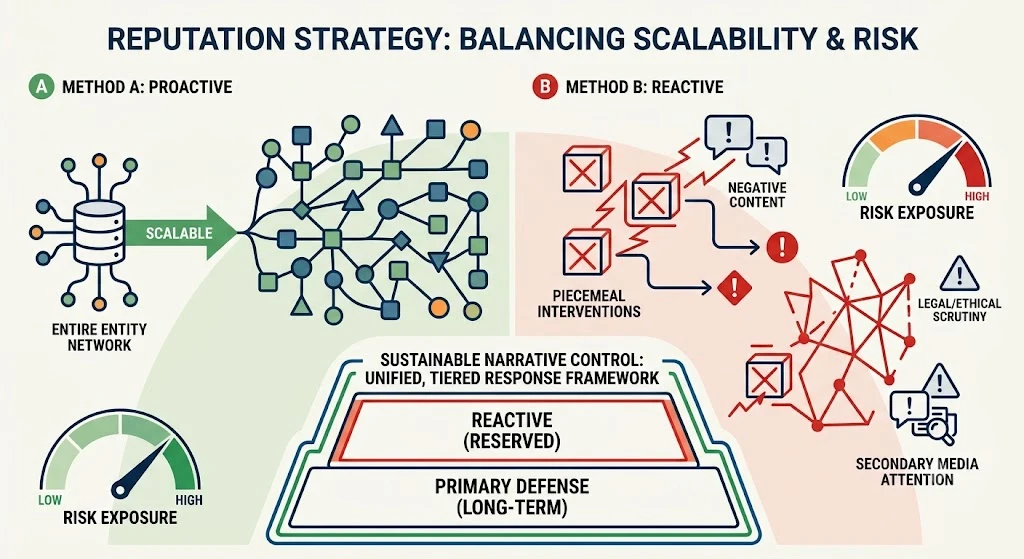
Selecting the optimal reputation management strategy requires balancing the scalability of the method against its inherent risk exposure. Proactive, architecture-led strategies scale effectively because they leverage automated content distribution and structured data systems that strengthen the entire entity network simultaneously. These approaches carry low risk exposure, as they rely on standard web optimization guidelines and do not invite legal or ethical scrutiny.
Reactive, confrontation-based methods struggle with scalability because every piece of negative content requires an isolated legal or procedural intervention. This piecemeal approach demands significant resources and increases risk exposure by potentially drawing secondary media attention to the very controversy the entity seeks to obscure. Relying solely on removal strategies leaves a political figure vulnerable if a sudden volume of critical coverage outpaces legal capabilities.
Sustainable narrative control is achieved by combining these methodologies into a unified, tiered response framework. Strategists utilize long-term digital footprint optimisation as the primary defense layout, ensuring high-authority assets naturally occupy core search real estate. Reactive tools are reserved for high-severity, legally actionable instances, maintaining a balanced risk profile while preserving the agility needed to handle dynamic search perception challenges.
How Should Strategists Establish an Algorithmic Audit Framework for Public Figures?
To systematically evaluate the digital standing of a public figure, organizations must implement an objective, data-driven audit framework. This process removes subjective assumptions by quantifying exactly how search engines index, structure, and display information to the electorate. A robust framework allows teams to identify vulnerabilities before they manifest as prominent visibility crises during critical political cycles.
An effective measurement framework requires execution across distinct technical layers:
- Map the existing entity-attribute associations within major search engine knowledge graphs to identify narrative misalignments.
- Quantify the sentiment distribution across the top twenty search results for all primary, navigational, and policy-specific queries.
- Evaluate the technical authority metrics of owned assets compared to independent media domains ranking for core terms.
- Track the volatility of real-time search elements, such as news carousels and algorithmic answer boxes, across different geographic regions.
Regular execution of these diagnostic steps ensures that political organizations maintain an accurate understanding of their search ranking influence. This continuous assessment forms the baseline required to deploy targeted digital interventions, ensuring that algorithmic trust signals accurately reflect the intended institutional narrative. Political parties frequently utilize structured evaluations to understand their digital standing, often integrating these insights into broader political search visibility management services to ensure long-term stability and resilience against sudden narrative shifts.
Frequently Asked Questions
What is a political search visibility audit?
A political search visibility audit is a data-driven evaluation that measures how an individual politician, party, or institutional entity appears across search engine results pages. Clear My Name conducts these audits to analyze sentiment distribution, map knowledge graph connections, and identify algorithmic vulnerabilities in a client’s digital footprint. This diagnostic process provides the baseline data required to establish effective online narrative control and risk mitigation strategies.
How do search engines influence voter perception during election campaigns?
Search engines influence voter perception by algorithmically prioritizing specific news sources, dynamic panels, and informational assets when users query political figures. The resulting sentiment distribution across the first page of results shapes public opinion based on source authoritativeness and query intent. Unmanaged search visibility can lead to critical narrative imbalances if algorithmic systems surface unverified or disproportionately negative content during active voting windows.
What is the difference between content suppression and content removal in reputation management?
Content suppression operates by optimizing a network of high-authority, positive digital assets to outrank and displace unfavorable links down the search engine results pages. Content removal involves the permanent de-indexing or absolute deletion of specific URLs from the web through legal, copyright, or regulatory challenges. Clear My Name evaluates both approaches to balance short-term risk exposure with long-term, scalable entity credibility.
How does algorithmic sentiment distribution impact a politician’s entity credibility?
Algorithmic sentiment distribution impacts entity credibility by structurally linking specific attributes, keywords, and media coverage to a politician’s node within a search engine’s knowledge base. If search algorithms consistently surface critical or hostile reporting in response to name queries, those negative associations become anchored as primary trust signals. Managing these signals requires systematic content enhancement to shift the algorithmic balance back toward authoritative, verified information.
Why do standard PR strategies fail to control search visibility results?
Standard PR strategies often fail to control search visibility because they focus primarily on media placement volume rather than the technical ranking factors governed by search engine algorithms. Traditional press releases offer short-term visibility but lack the structured data, semantic optimization, and entity-attribute configurations required for permanent indexing. Comprehensive reputation management requires a specialized understanding of algorithmic behavior to ensure earned media achieves lasting search ranking influence.