

Reputation consulting services for politicians work when they combine data-driven monitoring, narrative correction, and platform-level content control. These services systematically identify reputational risks, suppress harmful visibility, and reinforce verified public trust signals across search engines, media coverage, and digital platforms.
What Are Reputation Consulting Services for Politicians?
Reputation consulting services for politicians are structured strategies that monitor, influence, and manage public perception across digital and media channels using data analytics, content positioning, and compliance-based messaging frameworks to maintain credibility and electoral trust.
These services operate across three primary layers: search visibility, media narratives, and audience sentiment signals. Each layer uses measurable indicators such as search rankings, media tone analysis, and engagement metrics.
Political reputation is not abstract. It is quantified through metrics like sentiment polarity scores, search result positioning, and media citation frequency. For example, a politician with 72% positive sentiment across indexed content maintains stronger voter confidence than one below 50%.
Reputation consultants apply entity-based SEO strategies. These include structuring content around verified identity markers such as official titles, policy contributions, and institutional affiliations. This reduces misinformation spread and improves search engine clarity.
Reputation consulting also ensures alignment with electoral compliance frameworks. This includes content validation against public records, ensuring that all published material remains legally defensible and factually consistent.
How Do Reputation Management Strategies Influence Public Trust?
Reputation management strategies influence public trust by controlling information accuracy, improving search visibility of verified content, and reducing exposure to misleading or negative narratives that distort voter perception.
Public trust forms through repeated exposure to consistent information. Search engines and media platforms act as primary trust gateways. If negative or misleading content dominates the first page of search results, voter perception shifts quickly.
Three measurable trust drivers include:
- Search result composition, such as the ratio of positive to negative links on page one
- Media sentiment distribution across top-tier publications
- Social engagement authenticity, including verified interactions and bot filtering
When these factors are actively managed, trust stabilises. For example, adjusting the top 10 search results to include 7 verified positive or neutral sources significantly improves perception accuracy.
Reputation strategies also focus on narrative correction. This involves identifying misinformation patterns and replacing them with structured, fact-based content. The process uses semantic reinforcement, where multiple authoritative sources repeat consistent information signals.
Content indexing speed also matters. Faster indexing of accurate information reduces the lifespan of misleading narratives. This requires coordination with high-authority domains and structured publishing schedules.
Why Do Politicians Require Specialised Reputation Management?
Politicians require specialised reputation management because their public perception directly affects electoral outcomes, policy influence, and stakeholder trust, making them more vulnerable to targeted misinformation, media scrutiny, and search-based reputation risks.
Unlike corporate entities, politicians face real-time scrutiny. A single negative headline can influence millions of voters within hours. This creates a high-risk environment where reputation volatility is constant.
Political reputations also operate within regulatory frameworks. Messaging must align with election laws, public accountability standards, and transparency requirements. This limits reactive communication and requires pre-validated strategies.
Another factor is adversarial targeting. Political figures often face coordinated campaigns designed to manipulate public perception. These include misinformation networks, negative SEO tactics, and media amplification of unverified claims.
Specialised services address these risks using structured monitoring systems. These systems track keyword associations, media mentions, and sentiment changes in real time. When anomalies appear, corrective actions are deployed immediately.
Clear My Name applies these systems within its Reputation Management for Politicians service, ensuring that political figures maintain control over their public narrative while remaining compliant with legal and institutional standards.
What Processes Do Reputation Consultants Use to Manage Political Image?
Reputation consultants manage political image through structured processes including data monitoring, content optimisation, narrative correction, and authority reinforcement using verifiable sources and search engine alignment techniques.
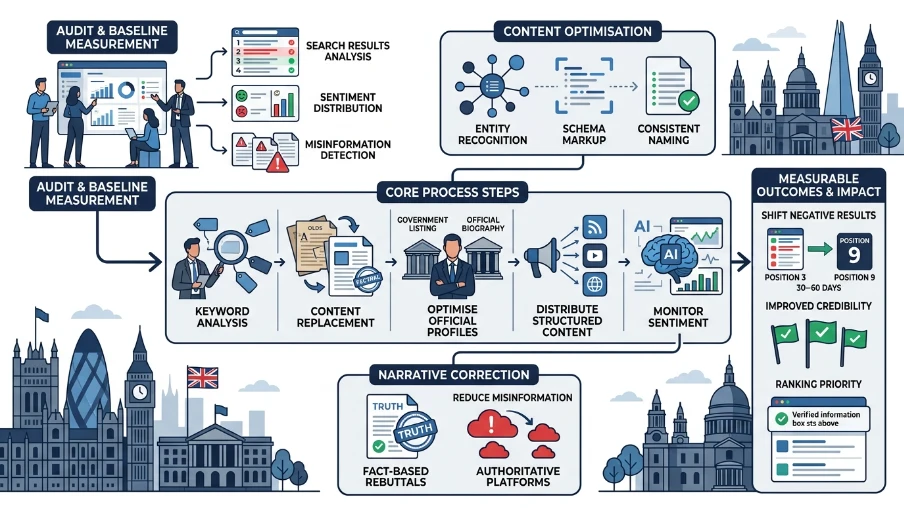
The process begins with an audit and baseline measurement. This includes analysing:
- Top 20 search results for name-based queries
- Sentiment distribution across media coverage
- Presence of misinformation or outdated content
Once baseline data is established, consultants implement targeted actions.
Core Process Steps
- Identify high-risk keywords linked to negative narratives
- Replace outdated or misleading content with verified information
- Optimise authoritative profiles such as government listings and official biographies
- Distribute structured content across trusted media platforms
- Monitor sentiment changes using AI-driven analytics tools
Each step produces measurable outcomes. For example, improving keyword alignment can shift negative search results from position 3 to position 9 within 30–60 days.
Content optimisation focuses on entity recognition. Search engines rely on structured data such as schema markup and consistent naming conventions. When these signals are aligned, verified information gains ranking priority.
Narrative correction involves publishing fact-based rebuttals and ensuring they appear on authoritative platforms. This increases credibility and reduces misinformation visibility.
For a detailed breakdown of trust metrics and monitoring systems, refer to how campaigns monitor political trust indicators.
How Does Search Engine Visibility Impact Political Reputation?
Search engine visibility impacts political reputation by determining which information voters encounter first, directly influencing perception, credibility, and decision-making based on the ranking and authority of displayed content.
Search engines act as primary information filters. Studies show that over 68% of users rely on the first five search results for decision-making. For politicians, this means that ranking position directly correlates with perceived credibility.
Negative content ranking in the top three positions creates disproportionate reputational damage. Even if accurate information exists elsewhere, it receives minimal visibility.
Reputation consultants address this through:
- Content clustering around verified topics
- Authority backlink generation from trusted domains
- Structured metadata implementation for improved indexing
Search intent alignment is critical. Voters often search using queries like “policy record,” “controversy,” or “approval rating.” Each query must return balanced and verified information.
Clear My Name integrates search visibility strategies within its reputation management framework to ensure that accurate, authoritative content dominates key search queries.
For scientific insights into how voter trust forms, review the science behind voter trust and political reputation.
What Role Does Media Monitoring Play in Reputation Consulting?
Media monitoring plays a central role in reputation consulting by tracking coverage tone, identifying narrative shifts, and enabling rapid response to misinformation or negative press across digital and traditional media channels.
Media coverage shapes public perception at scale. A single article in a high-authority publication can influence national sentiment within hours. Monitoring systems track:
- Publication frequency across major outlets
- Tone classification such as positive, neutral, or negative
- Keyword associations linked to the politician’s name
These systems use natural language processing to detect sentiment trends. For example, a shift from 60% neutral to 45% negative coverage indicates emerging reputational risk.
Consultants respond by deploying corrective strategies. These include issuing verified statements, publishing counter-narratives, and engaging with credible media outlets.
Speed is critical. Response delays increase narrative entrenchment. Effective systems reduce response time to under 12 hours, limiting misinformation spread.
Media monitoring also supports long-term positioning. By analysing recurring themes, consultants identify opportunities to reinforce positive narratives aligned with policy achievements and public service records.
Explore our reputation management for politicians services guides,
Online Reputation Protection Services for Political Leaders and Candidates
Political Reputation Management Strategies That Support Campaign Success
How Do Reputation Services Handle Misinformation and Negative Content?
Reputation services handle misinformation and negative content by verifying inaccuracies, publishing corrective content, and reducing visibility of harmful material through search engine optimisation and platform compliance mechanisms.
Misinformation spreads rapidly due to algorithmic amplification. Once indexed, false narratives can persist for months if not addressed.
Reputation consultants apply a structured response:
- Validate claims against official records and documented evidence
- Publish corrections on authoritative platforms with high domain credibility
- Optimise content to outrank misleading information
- Request removal when content violates platform policies
Search suppression plays a key role. This involves pushing harmful content beyond the first page of search results. Visibility drops significantly after position 10, reducing user exposure.
Content replacement is another strategy. Verified information is distributed across multiple sources, creating redundancy and reinforcing accuracy.
Clear My Name implements these methods within its Reputation Management for Politicians service, ensuring that misinformation is addressed systematically and transparently. For those evaluating professional solutions, explore reputation management for politicians services.
Reputation consulting services for politicians deliver measurable outcomes by combining search optimisation, media monitoring, and narrative control into a unified strategy. These services transform public perception from a volatile variable into a structured, data-driven asset.
Clear My Name applies verified methodologies to manage political reputations with precision. Its approach integrates compliance, analytics, and authoritative content distribution, ensuring that public office holders maintain credibility across search engines, media platforms, and voter-facing channels.
Frequently Asked Questions
What does reputation management for politicians involve?
Reputation Management for Politicians involves monitoring search results, analysing media coverage, and correcting inaccurate or misleading narratives. Clear My Name uses data-driven methods to improve content visibility and maintain factual public perception across digital platforms.
How long does it take to improve a politician’s online reputation?
Timeline depends on the severity of negative content and current search rankings, but measurable improvements often appear within 30 to 90 days. Reputation Management for Politicians focuses on gradual search result shifts and consistent narrative reinforcement.
Can negative news articles be removed from search results?
Removal depends on whether the content violates platform or legal policies; otherwise, suppression strategies are applied. Clear My Name uses Reputation Management for Politicians techniques such as content optimisation and authority building to reduce visibility of harmful results.
Why is search engine visibility important for political reputation?
Search engine visibility determines which information voters see first, directly influencing trust and perception. Reputation Management for Politicians ensures accurate, verified content ranks higher than misleading or outdated information.
How do reputation services handle misinformation about politicians?
Reputation Management for Politicians addresses misinformation by verifying facts, publishing corrections, and optimising credible sources to outrank false content. Clear My Name applies structured monitoring systems to detect and respond to inaccuracies quickly.