

Reputation management is the systematic process of shaping, monitoring, and influencing how a person or entity is represented across search engines and digital platforms.
Online reputation refers to the aggregated perception formed through indexed content, search visibility, and algorithmic evaluation of digital signals associated with a person’s name.
It operates within search ecosystems where information is collected, ranked, and presented through SERPs (Search Engine Results Pages), forming a structured identity layer that defines credibility, trust, and public interpretation. This system functions continuously through content indexing, ranking adjustments, and entity-based analysis.
What is online reputation and how is it formed in search engines?
Online reputation is the algorithmically constructed perception of an individual’s identity within search ecosystems, formed through indexed content and ranking signals across SERPs. It defines how a person appears when their name is queried in search engines, combining articles, profiles, mentions, and structured data into a unified visibility profile.
Search engines form this reputation through crawling and indexing processes that continuously collect data from web pages, social platforms, directories, and news sources. Each piece of content contributes to an entity profile that search systems associate with a specific name. This process establishes an identity graph where information is grouped, interpreted, and ranked based on relevance and authority.
Search algorithms evaluate this data using ranking systems that prioritise authority, freshness, and contextual relevance. Content that appears on high-trust domains gains stronger influence in shaping perception. As a result, online reputation is not static; it is recalculated whenever new content is indexed or existing content is re-evaluated within the ranking system.
The formation of online reputation is therefore a continuous aggregation of digital signals. These signals define how search engines interpret identity consistency, topical associations, and credibility markers across the indexed web.
How do search engines evaluate reputation signals for individuals?
Search engines evaluate reputation signals for individuals by analysing structured and unstructured data that indicates trust, authority, and relevance within search ecosystems. These signals are processed through ranking systems that determine how prominently a name appears in SERPs and what associated content defines it.
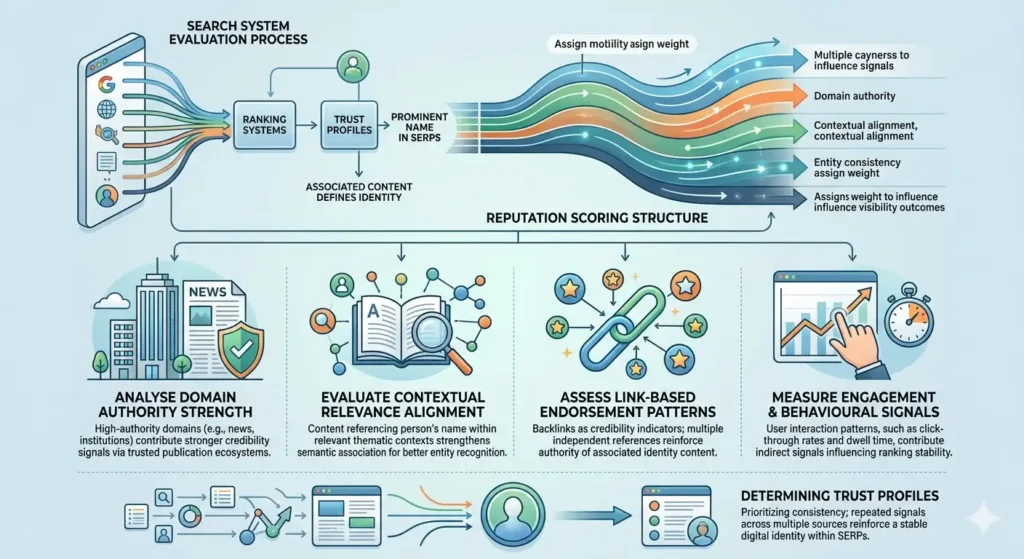
Search systems assign weight to multiple layers of signals, including domain authority, contextual alignment, and entity consistency. These layers form a reputation scoring structure that influences visibility outcomes. When multiple authoritative sources confirm similar identity attributes, the system strengthens the perceived credibility of that entity.
Key reputation signals used in evaluation
- Analyse domain authority strength – High-authority domains contribute stronger reputation signals by reinforcing credibility through trusted publication ecosystems, such as established news or institutional websites.
- Evaluate contextual relevance alignment – Content that directly references a person’s name within relevant thematic contexts strengthens semantic association, improving entity recognition in search graphs.
- Assess link-based endorsement patterns – Backlinks function as credibility indicators, where multiple independent references reinforce the authority of associated identity content.
- Measure engagement and behavioural signals – User interaction patterns, such as click-through rates and dwell time, contribute indirect reputation signals that influence ranking stability.
These mechanisms collectively determine how search engines construct trust profiles. The evaluation process prioritises consistency, ensuring that repeated signals across multiple sources reinforce a stable digital identity within SERPs.
What factors influence SERP reputation and name-based search results?
SERP reputation is influenced by the composition, ranking, and semantic structure of indexed content associated with an individual’s name. It defines how search results are ordered and interpreted when users perform identity-based queries.
Search engines apply ranking algorithms that prioritise relevance, authority, and contextual accuracy. These algorithms evaluate not only individual pages but also the relationships between content pieces, forming a structured reputation model across search results.
The most influential factors include:
1. Content authority distribution
Content authority distribution determines how credibility is spread across indexed sources. High-ranking domains exert stronger influence over SERP composition, shaping the dominant narrative associated with a name.
2. Keyword and entity alignment
Search systems map names to entities, evaluating how consistently an individual is referenced across digital content. Strong alignment improves SERP coherence and reduces informational fragmentation.
3. Temporal relevance signals
Fresh content receives prioritisation in ranking systems, especially when new information modifies the existing reputation profile. This ensures SERPs reflect updated identity narratives.
4. Cross-platform content consistency
Consistency across platforms strengthens entity validation. When multiple indexed sources present aligned identity data, search engines consolidate reputation signals into a unified profile.
SERP reputation is therefore a structured output of algorithmic synthesis, where ranking systems determine which identity signals dominate user perception during search interactions.
How does digital footprint affect entity perception in search ecosystems?
Digital footprint is the complete collection of indexed data points associated with an individual across the web, forming the foundational dataset for entity perception in search ecosystems. It includes published content, mentions, metadata, and historical references that collectively define identity structure.
Search engines use digital footprint data to construct entity graphs that map relationships between content sources and named individuals. This process enables algorithms to interpret identity continuity across multiple domains and platforms.
Entity perception is shaped through the consistency, volume, and authority of digital footprint signals. A well-structured footprint reinforces stable identity recognition, while fragmented or inconsistent data reduces clarity in search interpretation.
Digital footprint directly affects:
- Entity consolidation – Search systems merge multiple references into a single identity profile when consistency is detected across indexed sources.
- Reputation stability – Stable footprints reduce volatility in SERP rankings by maintaining consistent semantic associations.
- Contextual classification – Algorithms categorise individuals based on recurring themes within indexed content clusters.
Within search ecosystems, digital footprint operates as the foundational layer of reputation architecture. It determines how effectively search engines can classify, rank, and present identity-based information.
How do reviews and sentiment signals shape online credibility?
Reviews and sentiment signals shape online credibility by providing structured feedback data that search engines interpret as indicators of trust and reputation quality. These signals contribute to the overall evaluation of an individual’s entity profile within SERPs.
Sentiment analysis systems process textual content to classify opinions as positive, neutral, or negative. These classifications are then aggregated into reputation indicators that influence how prominently certain content appears in search results.
Search engines evaluate sentiment signals through pattern recognition models that identify linguistic tone, contextual meaning, and recurring thematic references. This allows systems to quantify perception at scale and incorporate it into ranking decisions.
Reputation credibility is shaped through:
- Aggregating sentiment polarity across sources – Multiple consistent positive or negative signals influence overall entity reputation scoring.
- Identifying sentiment clustering patterns – Repeated emotional or evaluative language across indexed content strengthens perception trends.
- Integrating review-based authority markers – Verified platforms contribute structured feedback that carries higher weight in reputation evaluation models.
Sentiment signals therefore function as interpretive layers within search systems, transforming subjective opinions into measurable ranking inputs that directly affect online credibility.
What is the role of content indexing in reputation formation?
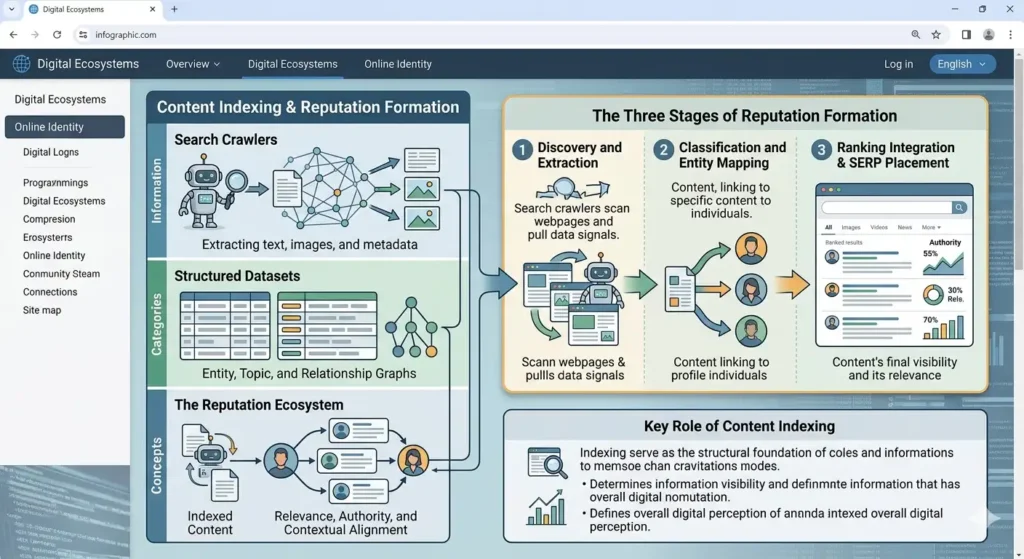
Content indexing is the process by which search engines discover, store, and organise web content into searchable databases that define online reputation structures. It determines which information becomes visible in SERPs and how it contributes to identity formation.
Indexing systems continuously scan the web using automated crawlers that extract textual, visual, and metadata signals. These signals are processed and categorised into structured datasets that represent entities, topics, and relationships.
Once indexed, content becomes part of the reputation ecosystem, where it is evaluated for relevance, authority, and contextual alignment. Search engines assign ranking potential to each indexed page based on its contribution to entity understanding.
Reputation formation through indexing occurs in three stages:
- Discovery and extraction – Search crawlers identify new or updated content across web domains and extract relevant data signals.
- Classification and entity mapping – Extracted data is assigned to specific entities, linking content to individual identity profiles.
- Ranking integration and SERP placement – Indexed content is evaluated within ranking systems and positioned in search results based on authority and relevance.
Content indexing defines the structural foundation of online reputation because it determines which information is eligible for search visibility and how it contributes to the overall perception of an individual within digital ecosystems.
How does search perception control operate within reputation systems?
Search perception control is the structured influence of indexed content, ranking signals, and entity associations that determine how a name is interpreted within SERPs. It operates through the management of visibility hierarchies and semantic alignment across search results.
Search systems construct perception by selecting which content appears in prominent positions and how entities are described across indexed sources. This creates a controlled information environment where algorithmic ranking determines narrative dominance.
Perception control is shaped through:
- Ranking prioritisation mechanisms – Higher-ranked content dominates user perception due to increased visibility exposure.
- Entity disambiguation processes – Search engines distinguish between similar names to maintain accuracy in identity representation.
- Content clustering systems – Related information is grouped to form coherent identity narratives across SERP structures.
Within this system, reputation is not defined by isolated content but by the structured ordering of information across search environments. The resulting perception is a direct output of algorithmic filtering and semantic organisation.
Dive Deeper With Our Expert Guides:
Personal Reputation Management Services to Remove Negative Google Results
How to Fix Your Online Reputation as an Individual or Professional
Online reputation is a structured system formed through search engine indexing, ranking algorithms, and entity-based analysis of digital content. It operates as a continuously updated identity model within SERPs, shaped by authority signals, sentiment data, and digital footprint consistency.
Search engines interpret reputation through layered evaluation systems that prioritise trust, relevance, and contextual alignment. These systems convert scattered online information into structured identity profiles that define how individuals are perceived in digital ecosystems.
Reputation management is therefore fundamentally a process of understanding search architecture, content indexing mechanisms, and algorithmic perception models that govern visibility and credibility in modern search environments.
Answers to Key Questions
What is reputation management for individuals?
Reputation management for individuals refers to the process of shaping and monitoring how a person appears in search engine results. It focuses on controlling online reputation through indexed content, search visibility, and entity signals that define digital identity.
How does Clear My Name improve online reputation?
Clear My Name applies structured reputation management for individuals by analysing search results and identifying negative or irrelevant content. It works by improving search visibility of accurate information and strengthening positive reputation signals across SERPs.
Why is online reputation important for personal identity?
Online reputation defines how search engines interpret a person’s identity through indexed web content. It directly influences trust perception, credibility, and how individuals are evaluated within search ecosystems and digital environments.
How do search engines determine a person’s reputation?
Search engines determine reputation using signals such as authority, relevance, sentiment, and content consistency across indexed pages. These signals help algorithms build an entity profile that reflects overall search perception.