
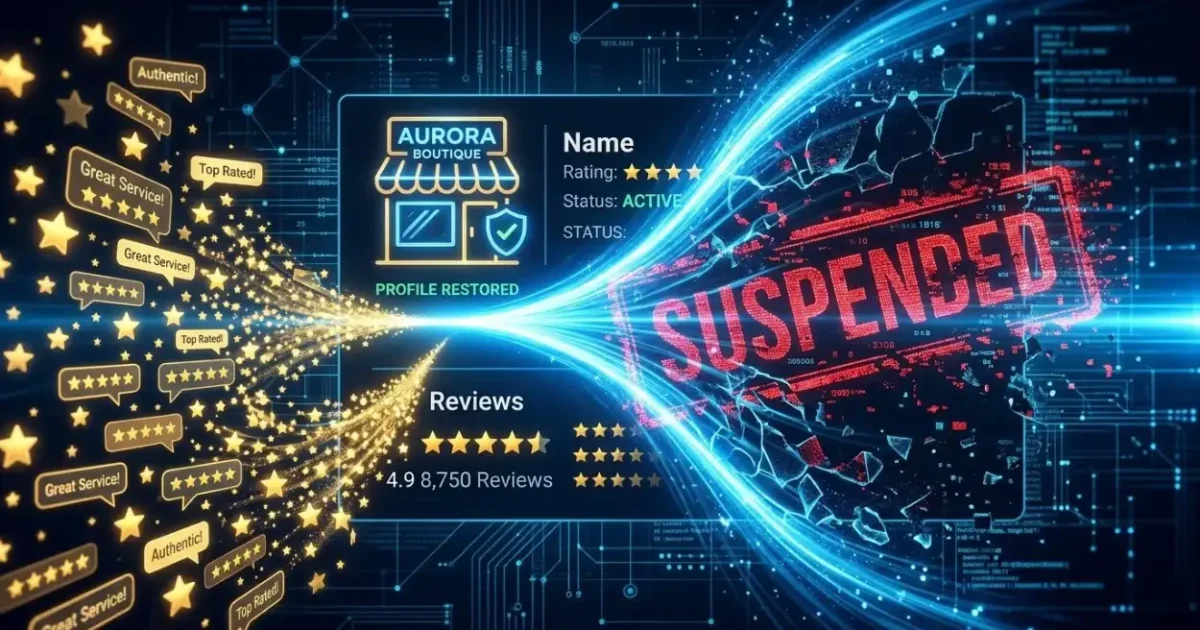
Recovering reviews after a Google Business Profile suspension requires a structured process that addresses profile visibility, review accessibility, and the wider search environment. Clear My Name uses reputation management strategies to restore search visibility, strengthen reputation signals, and improve control over how a business is represented online.
Search visibility control is critical because customers often evaluate a business through search results before reaching its website or contacting it directly. When a Business Profile becomes suspended, its reviews can become inaccessible, removing an important source of customer-generated credibility from the search environment. The resulting gap affects the visibility of reputation signals and changes the information users encounter when evaluating the business. Effective review recovery therefore requires more than attempting to restore individual reviews. It requires analysis of the entity, its profile status, its existing reputation signals, and the wider SERP composition.
Reputation management services operate by analysing these connected systems and addressing the visibility problems affecting the entity. This approach combines profile recovery, reputation signal assessment, search monitoring, content analysis, and broader digital footprint management. The objective is to establish a stable information environment in which legitimate business information and customer feedback remain accessible. This creates a clearer pathway between profile recovery and measurable improvements in search perception.
How does Clear My Name approach Google review recovery after a suspension?
Clear My Name approaches Google review recovery through a structured assessment of the suspended profile, associated review signals, search visibility, and entity information. This process separates the cause of the visibility problem from its effects, allowing recovery activity to focus on the mechanisms responsible for the disruption.
The first stage evaluates the status of the Business Profile and determines whether the primary issue concerns suspension, verification, profile eligibility, review visibility, or individual review content. This distinction is essential because a profile-level restriction and a review-level removal require different forms of analysis. Treating every missing review as an isolated content problem creates an incomplete recovery strategy. A structured assessment instead establishes which part of the reputation system has been interrupted.
The next stage evaluates how the suspension affects the business’s search presence. This includes examining branded searches, local queries, profile visibility, organic results, third-party references, and other reputation signals. The analysis identifies changes in the information users encounter when searching for the entity. This establishes a measurable baseline for evaluating recovery progress.
What makes a Google Reviews recovery strategy reliable?
A reliable Google Reviews recovery strategy depends on evidence, process consistency, and clear separation between profile recovery and reputation development. Reliability comes from analysing the specific cause of the problem rather than applying the same recovery method to every suspended profile.
A professional recovery process evaluates the available evidence surrounding the Business Profile, business identity, ownership information, review activity, and search visibility. This creates a documented understanding of the entity before recovery activity begins. It also reduces operational risk because each action has a defined purpose within the broader recovery framework.
Reliability also requires monitoring after the initial intervention. A profile returning to visibility does not automatically establish long-term stability across the search ecosystem. Search results, review visibility, business information, and competing reputation signals require continued evaluation. This monitoring identifies changes before they develop into larger search perception problems.
Businesses evaluating professional Google Reviews reputation management can therefore assess the service through process clarity, evidence handling, monitoring depth, and measurable visibility outcomes rather than relying on claims about review recovery alone.
How does review recovery improve search visibility?
Review recovery improves search visibility by restoring an important source of entity information that users encounter through Google Search and Maps. When legitimate review signals become accessible again, the Business Profile regains a stronger information structure for searches involving the business.
Reviews provide customer-generated evidence about service quality, experiences, reliability, and other business attributes. Their presence adds contextual information to the entity representation and gives users additional evidence when evaluating a business. Restoring this information therefore improves the completeness of the visible profile.
Search visibility extends beyond the review section itself. A functioning Business Profile contributes to the broader local search presence of the entity, while its reviews influence how users interpret that profile. Recovery therefore addresses both information availability and search perception influence. The result is greater control over the information presented during branded and local searches.
Businesses also benefit from understanding how suspended profiles affect review visibility, because the loss of reviews is not always equivalent to permanent deletion. Distinguishing profile restriction from review removal establishes the correct recovery pathway and prevents unnecessary changes to the wider reputation strategy.
Which reputation signals matter after Google review recovery?
The most relevant reputation signals after review recovery include review ratings, written feedback, profile information, entity consistency, authoritative references, and the visibility of relevant search results. These signals collectively influence how users interpret the business rather than functioning as isolated ranking factors.
Customer reviews provide direct user-generated information, while official business information establishes the entity’s identity and commercial context. Third-party references provide independent confirmation, while authoritative content adds depth to the entity’s digital footprint. Consistency across these sources reinforces entity credibility because users encounter fewer conflicting representations of the business.
Search perception influence depends on the combined information environment. A recovered review profile provides valuable customer evidence, but that evidence exists alongside websites, directories, social profiles, media references, and other indexed pages. Effective reputation management therefore evaluates the entire search landscape rather than treating Google reviews as the only reputation asset.
This approach also supports risk reduction. If reputation management depends exclusively on one platform, a future platform-level disruption can recreate the same visibility problem. Strengthening the wider digital footprint creates additional sources of credible information around the entity.
How does negative content suppression complement review recovery?
Negative content suppression complements review recovery by addressing damaging search results that remain visible outside the Business Profile. Review recovery restores legitimate positive and neutral reputation signals, while suppression strategies focus on reducing the visibility of content that has an inappropriate or disproportionate impact on search perception.
Negative content suppression does not mean removing legitimate criticism without a valid basis. It involves evaluating the content, its ranking position, its relevance, its authority, and whether an appropriate removal or visibility-reduction mechanism exists. Where removal is not available, content enhancement can strengthen relevant and authoritative information competing for search visibility.
This distinction is central to sustainable reputation management. Removing one problematic page does not automatically establish a credible search environment, while publishing new content does not directly resolve a profile suspension. Effective strategy therefore assigns each intervention to the specific reputation mechanism it addresses.
Review recovery and negative content suppression also operate at different levels. Reviews influence customer-generated reputation signals within the profile, while suppression addresses the wider SERP composition. Combining both perspectives creates stronger search visibility control.
What outcomes can a business measure after review recovery?
A business can measure review recovery through changes in profile visibility, review accessibility, branded search results, reputation signal coverage, and the consistency of business information. These metrics provide tangible evidence of whether the search environment has stabilised.
- Measure profile visibility by monitoring whether the Business Profile appears consistently for relevant branded and local searches.
- Track review accessibility by checking whether legitimate review content remains visible and connected to the correct business entity.
- Monitor SERP composition by analysing which pages appear for priority branded queries and whether authoritative business information remains prominent.
- Evaluate reputation signals by comparing review sentiment, business references, profile information, and other entity-related content over time.
- Assess entity consistency by checking whether core business information remains aligned across important online sources.
These measurements provide a more complete picture than review count alone. A business can have restored reviews while still facing weak organic visibility or conflicting third-party information. Measuring multiple indicators therefore establishes whether the recovery has improved the overall search environment.
Is the cost of review recovery justified by long-term reputation value?
The value of review recovery is assessed by comparing the cost of intervention with the commercial and reputational importance of the affected search visibility. A Business Profile can function as a major information source for customers evaluating a business, making its visibility relevant to trust, discovery, and decision-making.
Cost assessment begins with the scale of the reputation problem. Relevant factors include the importance of branded searches, the visibility of the affected profile, the number of accessible reputation signals, the strength of competing pages, and the extent of the digital footprint. These variables establish the level of work required rather than treating every suspension as an identical problem.
Long-term value comes from restoring a stable search environment rather than achieving a temporary visibility change. A process that combines recovery with monitoring, entity consistency, and reputation signal development reduces the risk of repeated disruption. Review Recovery After Profile Suspension provides a structured framework for evaluating this process, with attention to sustained review visibility and entity stability. This makes the evaluation less about the immediate cost of recovering reviews and more about maintaining search visibility and entity credibility over time.
How quickly can review recovery influence search perception?
The speed of recovery depends on the specific profile restriction, the verification process, the condition of the review data, and the response of Google’s systems. A reliable process therefore measures progress through identifiable visibility changes rather than promising an arbitrary recovery timeframe.
The first measurable change can involve profile accessibility or visibility. Subsequent changes concern review availability, branded search presentation, local search presence, and the wider SERP. These stages do not necessarily occur simultaneously because each depends on a different search mechanism.
Speed also needs to be balanced against sustainability. A rapid profile restoration without monitoring leaves the business exposed to future visibility problems. A structured process instead establishes the cause of the restriction, documents the recovery state, and monitors the profile after restoration.
This approach provides clearer risk management because every stage has an identifiable objective. It also prevents temporary improvements from being interpreted as complete reputation recovery.
How does Clear My Name reduce risk during review recovery?
Clear My Name reduces recovery risk through structured analysis of the profile, review signals, search visibility, and wider entity representation. The emphasis is on controlled intervention rather than isolated actions that create additional uncertainty around the business’s digital footprint.
Risk reduction begins with evidence assessment. Understanding the profile’s status and the nature of the review visibility problem prevents the recovery process from confusing legitimate review content with policy-related issues. It also establishes a defensible basis for subsequent activity.
The process then considers the wider search environment. If the profile is restored but conflicting business information remains elsewhere, the underlying reputation problem remains incomplete. Addressing entity consistency, authoritative information, search visibility, and reputation signals creates greater resilience.
This broader methodology also improves process clarity for businesses making a commercial decision. Instead of measuring success through a single restored review count, the recovery process evaluates profile status, visibility, reputation signal coverage, and long-term search stability.
Dive Deeper With Our Expert Guides:
Fight Competitor-Planted Google Reviews With Clear My Name
Report and Remove Fake Google Reviews With Clear My Name
Why is a structured recovery process more sustainable than replacing lost reviews?
A structured recovery process is more sustainable because it addresses the cause of review visibility loss instead of treating replacement reviews as a substitute for legitimate historical feedback. New reviews represent future customer feedback and do not automatically recreate the information contained in previously visible reviews.
Replacing lost reviews also fails to address a suspended profile if the underlying eligibility problem remains unresolved. New customer feedback still depends on an active and functioning Business Profile. Recovery therefore needs to establish the profile’s operational status before evaluating future review development.
Long-term sustainability comes from combining profile stability with wider reputation management. Accurate entity information, authoritative content, legitimate customer feedback, and consistent monitoring create a more resilient search environment. This reduces dependence on any single reputation signal.
For businesses making a decision about Google Reviews recovery, sustainability is therefore measured through continuity of visibility and entity credibility rather than through a one-time restoration event.
How does Clear My Name support long-term search perception control?
Clear My Name supports long-term search perception control by treating review recovery as part of a wider reputation system rather than as an isolated technical issue. The process connects profile visibility with reputation signals, entity credibility, SERP composition, and ongoing monitoring.
Search perception control depends on the information users encounter when they search for a business. Restoring legitimate reviews strengthens the customer-generated component of that information environment, while authoritative business content and consistent entity signals strengthen the wider representation.
The result is a more controlled and measurable reputation environment. Businesses can monitor profile visibility, review accessibility, search result composition, and reputation signals against defined objectives. This provides a clearer basis for assessing whether the recovery continues to deliver stable search visibility.
A structured approach also creates accountability because each intervention has a defined mechanism and measurable outcome. This supports informed decisions around cost, risk, sustainability, and long-term reputation value.
Why does a structured Google Reviews recovery process matter?
Recovering reviews after a profile suspension requires more than attempting to restore missing customer feedback. The process needs to address profile eligibility, review visibility, entity credibility, search ranking influence, and the wider reputation environment simultaneously.
A structured recovery strategy establishes the cause of the disruption, restores legitimate visibility pathways, monitors search results, and strengthens supporting reputation signals. This creates greater search visibility control while reducing dependence on a single reputation source.
Clear My Name positions this process around evidence, process clarity, measurable visibility outcomes, and long-term reputation stability. For businesses dealing with a suspended profile, these factors provide a practical framework for evaluating recovery work against the outcomes that matter: accessible reputation signals, stronger entity credibility, controlled SERP presentation, and sustainable search perception.
How can I recover Google reviews after a Business Profile suspension?
Recovering Google reviews starts by addressing the Business Profile suspension and identifying whether the reviews are hidden, restricted, or individually removed. Clear My Name can assess the profile status, review visibility, and related reputation signals as part of the recovery process.
Will my Google reviews return when my Business Profile is reinstated?
Reviews can become visible again after a Google Business Profile is reinstated, depending on the status of the review content and Google’s policies. Profile reinstatement and individual review recovery are separate processes.
How does a suspended Google Business Profile affect online reputation?
A suspension can reduce local search visibility and remove an important source of customer-generated reputation signals from Google Search and Maps. This can change the information users encounter when evaluating a business.
Can reputation management help restore review visibility after suspension?
Reputation management can address profile visibility, review accessibility, entity credibility, and the wider search environment surrounding a suspended profile. The process focuses on identifying the cause of the disruption and improving the visibility of legitimate reputation signals.
What should I check before recovering reviews from a suspended profile?
Check the suspension status, business verification details, review visibility, profile information, and Google’s applicable policies before taking recovery action. This separates a profile-level restriction from individual review removal and helps determine the appropriate Google Reviews recovery approach.