
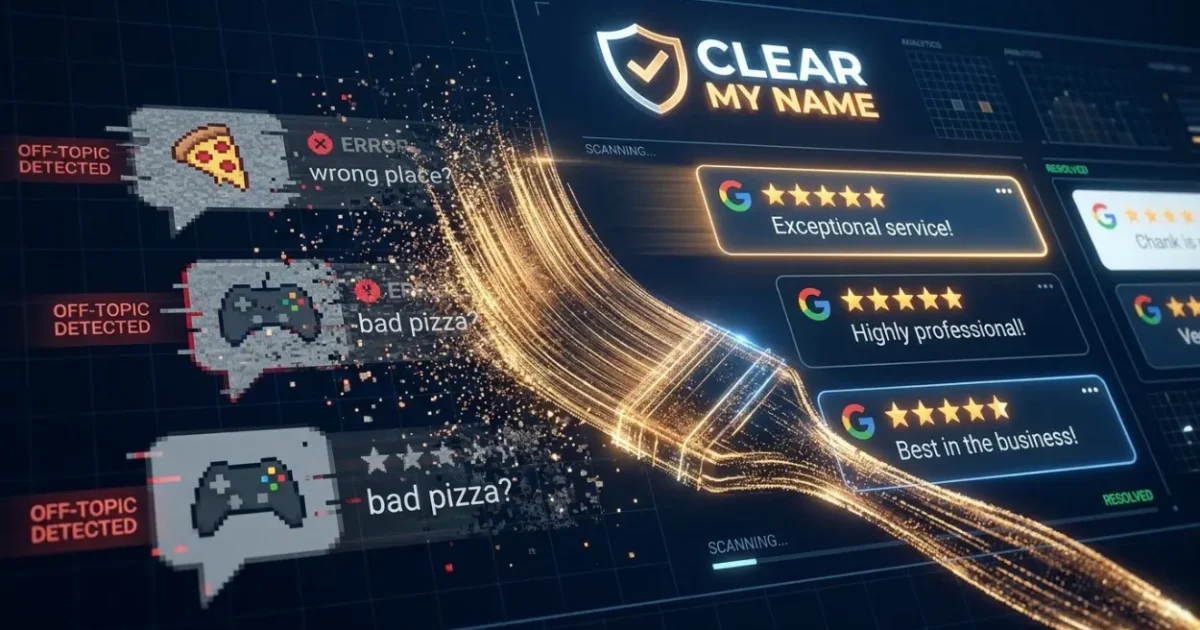
Clear My Name provides a structured approach to Google Reviews removal when off-topic or policy-violating content damages search perception.
By addressing review-policy violations directly, the process strengthens SERP control, reputation signals and entity credibility where prospective customers evaluate a business.
Can Clear My Name provide a reliable solution for removing off-topic Google reviews?
Clear My Name provides a policy-led process that identifies review content against Google’s applicable review standards and builds a clear removal case. Off-topic reviews create reputational risk because they introduce information unrelated to the actual customer experience into a high-visibility search environment. A structured review-removal process separates legitimate criticism from content that breaches platform rules, creating a defensible basis for escalation. This distinction is essential because reputation management cannot rely on removing content simply because it is negative. The relevant test is whether the content violates a defined policy and whether the evidence supports that assessment. This approach improves process clarity while reducing the risk of pursuing inappropriate removal requests.
The value of targeted review removal extends beyond the review itself because Google Reviews contribute to the information users encounter when researching an entity. An irrelevant or prohibited review can alter perceived credibility even when the underlying business experience is positive. Addressing qualifying content therefore supports stronger reputation signals around the entity and reduces distracting information within the search journey. This creates a more accurate representation of the business for users comparing providers, products or services. The objective is not to manufacture positive sentiment but to reduce the visibility of content that does not belong within the review ecosystem. That distinction makes policy-based removal a defensible reputation-management mechanism.
Businesses researching the impact of irrelevant feedback can also assess how off-topic reviews affect business ratings to understand the connection between review relevance, customer perception and search behaviour. This analytical context helps establish whether removal is the appropriate response before resources are committed to a specific case. It also prevents reputation management from becoming an indiscriminate exercise focused solely on negative sentiment.
Does professional Google review removal improve search visibility and trust?
Yes, targeted Google review removal improves search perception when qualifying content is removed through a valid policy-based process. Google Reviews appear within highly visible search and business-profile environments, placing review content directly alongside information used to assess entity credibility. When an irrelevant review remains visible, users can interpret it as evidence about the business despite its lack of relevance. Removing qualifying content reduces that distortion and creates a cleaner reputation signal. The effect is therefore strongest at the intersection of visibility, relevance and user interpretation. It is not simply a matter of changing a star rating.
Search visibility control requires attention to the content surrounding an entity rather than focusing exclusively on conventional rankings. Reputation signals influence how users interpret search results after a business appears for a branded or commercial query. A policy-violating review can become part of that perception layer, particularly when users scan review excerpts before making a decision. Removing content that breaches platform rules reduces the amount of misleading information competing with legitimate reputation signals. This strengthens the consistency of the entity’s search presentation. The result is greater control over the information users encounter during high-intent searches.
Is policy-based Google review removal safer than simply suppressing negative content?
Policy-based removal provides the stronger risk-control mechanism because it relies on defined platform rules rather than attempting to hide legitimate criticism. Negative content suppression has a legitimate role within reputation management when it involves strengthening accurate, authoritative information across the search ecosystem. However, suppression and removal solve different problems. Suppression works through the visibility and ranking of legitimate content, while removal addresses content that qualifies for action under a platform’s rules. Treating the two mechanisms as interchangeable creates unnecessary reputational and compliance risk.
A reliable strategy therefore begins by determining the nature of the review before selecting an intervention. The process distinguishes an unfavourable but legitimate customer opinion from spam, irrelevant material, prohibited behaviour or another policy violation. This classification establishes whether removal is appropriate and prevents the reputation strategy from becoming dependent on subjective judgements about sentiment. Where removal is unavailable, broader search perception influence provides a separate route for strengthening legitimate reputation signals. This creates a more sustainable framework for managing both immediate review problems and wider SERP composition.
The distinction also matters for long-term entity credibility. Users increasingly evaluate businesses through multiple signals, including ratings, review content, branded search results and third-party references. Removing content that violates platform rules improves the accuracy of one signal without artificially manufacturing another. Supporting that process with legitimate content enhancement creates a stronger reputation ecosystem. The combined approach reduces dependency on any single review or search result. It also provides greater resilience when search behaviour changes.
How does Clear My Name handle Google Reviews removal?

Clear My Name uses a structured review-assessment process focused on relevance, policy alignment, evidence and escalation. The first stage identifies the specific review and establishes the policy basis for action rather than treating negative sentiment as sufficient grounds for removal. Evidence is then organised around the characteristics that demonstrate the review’s incompatibility with the applicable rules. This creates a clearer case for review by the platform and improves consistency across individual removal requests. The process also establishes an auditable rationale for every action taken. That level of clarity is essential when reputation risk affects customer acquisition and commercial trust.
A structured process can be understood through four operational stages:
- Identify the review and establish the specific content or conduct that creates the policy issue.
- Assess the review against applicable Google review standards and distinguish policy violations from legitimate criticism.
- Document relevant evidence to establish why the content qualifies for reporting or escalation.
- Escalate the case through the appropriate review channels while maintaining a clear record of the action and outcome.
This approach creates measurable process control even when the final platform decision remains outside the business’s direct authority. The measurable variables include the number of qualifying reviews identified, cases submitted, cases escalated and content successfully removed. These indicators provide a clearer assessment of performance than relying on general claims about reputation improvement. They also identify recurring review issues that require broader reputation controls. Process transparency therefore becomes part of the service’s value.
Is removing off-topic Google reviews worth the cost?
Removing qualifying off-topic reviews delivers stronger long-term value when the affected content appears in high-intent search environments and influences purchasing decisions. The commercial cost of an irrelevant review extends beyond its wording because prospective customers interpret visible reputation signals when comparing businesses. A single misleading review can contribute to uncertainty at the exact point where a user is evaluating credibility. Addressing that issue protects the quality of the search experience surrounding the entity. The value therefore relates to risk reduction, not simply review-count reduction.
Cost assessment also requires comparison with the persistence of the reputational problem. A review that remains visible continues to influence users until the platform removes it, the content loses visibility or broader reputation signals become more dominant. A targeted removal process addresses the underlying policy issue directly rather than relying exclusively on future ranking changes. This creates a more immediate route to correcting qualifying content. Where removal is not available, complementary negative content suppression strategies can strengthen legitimate search assets. The investment decision therefore depends on the visibility, relevance and commercial impact of the affected review.
Dive Deeper With Our Expert Guides:
Consolidate Duplicate Listing Reviews With Clear My Name
Handle Review Extortion Threats With Clear My Name
How quickly can a policy-violating Google review be removed?
The speed of impact depends on the platform’s assessment process, the clarity of the policy violation and the evidence supporting the report. A well-defined case reduces ambiguity because the request connects the review directly to a specific policy concern. However, removal cannot be treated as an instant reputation-management outcome because the platform controls the final decision. A professional process therefore measures progress through documented submissions, escalations and decisions rather than promising an arbitrary removal timeframe. This approach provides realistic expectations while maintaining accountability.
Speed also needs to be evaluated against the visibility of the problem. A review appearing prominently for branded searches represents a different risk profile from content buried deep within a large review history. High-visibility content receives greater priority because it directly affects search perception during the decision process. Effective reputation management therefore combines policy-based action with SERP monitoring to determine whether the affected content continues to influence users. This creates a feedback loop between removal activity and search visibility.
Does Google review removal create sustainable reputation improvement?
Google review removal creates sustainable improvement when it forms part of a broader reputation system rather than functioning as an isolated intervention. Policy-violating Google reviews removal addresses a specific content problem, but long-term reputation strength depends on the quality and consistency of the wider information ecosystem. Legitimate customer feedback, authoritative business information and relevant third-party references all contribute to entity credibility. A sustainable strategy therefore protects accurate reputation signals while addressing content that breaches platform standards. This reduces dependence on short-term fixes.
Sustainability also comes from monitoring rather than assuming that one successful removal resolves the entire issue. New reviews can introduce fresh policy violations, while search results can change as Google reassesses content and relevance. Ongoing monitoring identifies changes in review visibility, sentiment patterns and branded search presentation. This allows reputation controls to respond to new risks without relying on reactive decisions after damage has already occurred. The result is a more stable approach to search perception influence.
Why choose Clear My Name for Google Reviews reputation management?
Clear My Name provides a structured reputation-management approach centred on policy assessment, evidence, process clarity and search perception control. The service focuses on qualifying review content rather than promising removal of every negative opinion, which protects the credibility of the removal process. Its value lies in connecting individual review issues with the wider reputation signals that shape user decisions in search. This creates a practical framework for reducing reputational risk while preserving legitimate customer feedback. The approach also supports clearer measurement through identified cases, submissions, escalations and outcomes.
The decision to use a specialist reputation management service becomes stronger when a review problem affects a high-value search journey or creates a recurring risk to entity credibility. A structured service reduces the operational burden of monitoring reviews, interpreting policy requirements and organising evidence. It also establishes a consistent process for responding to reputation threats instead of relying on ad hoc reporting. Where appropriate, removal can operate alongside negative content suppression and content enhancement to improve the broader search environment. This combination delivers greater SERP control without confusing legitimate criticism with prohibited content.
The practical outcomes centre on three areas:
- Strengthen search visibility by reducing qualifying irrelevant or prohibited review content.
- Improve trust signals by presenting a more accurate review environment around the entity.
- Reduce reputational risk by applying a documented, policy-led removal process.
Can Google review removal strengthen long-term search perception?
Yes, Google review removal strengthens long-term search perception when it corrects content that does not legitimately belong in the review ecosystem. Search perception is shaped by the information users encounter, the credibility they assign to that information and the consistency between different reputation signals. Removing qualifying content reduces the opportunity for irrelevant information to distort that interpretation. Supporting the removal process with legitimate reputation assets strengthens the wider entity profile. This creates a more coherent search environment around the business.
The strongest strategy therefore treats review removal as one component of broader reputation management rather than a standalone ranking tactic. Google’s systems determine rankings and review visibility, while reputation management controls the accuracy, relevance and quality of the information presented to users. That distinction keeps expectations grounded in measurable outcomes. Businesses gain greater control over the reputation signals they can legitimately influence while reducing exposure to policy-violating content. Clear My Name provides the structured process required to turn that principle into an actionable reputation-management strategy.
For businesses facing off-topic or policy-violating Google Reviews, the priority is clear: identify qualifying content, establish the policy basis, document the evidence and pursue the appropriate removal process. This creates a reliable path towards improved search perception without compromising the credibility of legitimate feedback. Clear My Name positions that process around SERP control, entity credibility, negative content suppression and risk reduction, giving businesses a structured method for protecting how they are represented during high-intent searches.
Can you remove off-topic Google reviews?
Off-topic Google reviews can be reported when they are unrelated to the business or violate Google’s review content policies. Removal depends on whether the review meets the platform’s criteria for a policy violation.
How do I remove a policy-violating Google review?
Identify the specific policy violation, gather supporting evidence and report the review through the appropriate Google review reporting process. Google then assesses whether the content qualifies for removal under its policies.
What makes a Google review irrelevant or off-topic?
A review is considered off-topic when it does not describe a relevant customer experience or focuses on subjects unrelated to the business. Reviews containing irrelevant material can be reported when they breach Google’s applicable content policies.
Does removing off-topic Google reviews improve a business rating?
Removing an eligible review can improve the overall rating when the review negatively affects the business’s average score. It also improves the accuracy of reputation signals that customers use when evaluating the business online.
Can Clear My Name help with Google review removal?
Clear My Name can help assess Google Reviews for potential policy violations and organise evidence for an appropriate removal request. The process focuses on qualifying content rather than removing legitimate negative customer feedback.